Why Spain Belongs on Your Caving List
Spain’s underground diversity at a glance
Spain’s karst landscapes make underground exploration unusually varied. From Mallorca’s coastal caves to Cantabria’s mountain systems, you get scale and contrast. The best caves for caving in Spain formed in soluble rocks like limestone and dolomite, where water carved galleries, shafts, and subterranean rivers over millions of years. Regions such as the Cantabrian Mountains, the Central System, Andalusia, and the Balearic Islands host iconic caverns recognized by regional authorities and scientific bodies.
You’ll move from sea-level caves with living lakes to high-altitude massifs drilled by vertical shafts. A constant 12–18°C underground climate lets you plan almost year-round, with winter closures mainly to protect bat colonies. Spain’s speleological heritage is well documented by local councils and foundations like Diputación de León (Valporquero), Fundación Cueva de Nerja, and El Soplao’s official organization. For families, these sites demystify geology; for trained teams, deep systems in Picos de Europa read like wild topographic puzzles.
How we selected these underground standouts
We prioritized places where you can safely plan a day out and learn something real. We ranked sites by accessibility and safety measures, geological or scenic interest, technical difficulty, permit requirements, availability of accredited guides, and environmental impact. “Technical difficulty” means the skills and gear you need, from simple walking tours to SRT (Single Rope Technique) with ropes and ascenders.
We leaned on official operators and protected-area rules for up-to-date access, including Diputación de León (Valporquero), Coves del Drach, Fundación Cueva de Nerja, El Soplao (Cantabria), Ojo Guareña (Junta de Castilla y León), and the Picos de Europa National Park. The goal is to help you spot where to go caving in Spain without guesswork. Picture your headlamp catching a crystal edge, then choose the right level and season.
Picuco te puede ayudar
Does something here catch your eye?
Tell us.
Write to us on WhatsApp or email: we answer questions, find the best options and help you sort out the booking.
Seven Places That Define Caving in Spain
1.Cueva de Valporquero (león) — initiation and adventure
Start here if you want a gentle tour or a true underground adventure in the same system. Valporquero sits near Vegacervera, about 47 km north of León, and offers both easy circuits and the famed internal canyoning route. A paved access, trained guides, and multiple route options make it ideal for mixed groups.
The river’s echo, somewhere below, slips through the dark like a quiet drum.
- Location: Vegacervera, León (Castile and León)
- Level: Initiation to advanced (touristic route vs. adventure “curso de aguas”)
- Guide/permit: Tourist route guided by the operator; adventure route requires accredited guide and reservation
- Typical duration: 60–90 minutes (tour); 3–5 hours (adventure, depending on flow and group)
- Geological highlight: Subterranean river canyons, large chambers, speleothems (stalactites, stalagmites)
- Best season: Spring to autumn; adventure route often from late spring (water temperature and flow dependent)
- Safety/gear: Tour requires sturdy footwear and warm layer (12–13°C). Adventure requires wetsuit, neoprene socks, harness, descender, and helmet with light; local guides supply technical gear.
- Useful fact: Operated by Diputación de León; seasonal calendar and flow conditions determine availability.
2.Cuevas del Drach and Hams (mallorca) — families and underground scenery
If you’re traveling with kids or want a polished experience, Drach and Hams deliver Mediterranean underground charm. Drach’s Lago Martel hosts a brief live classical concert during visits; Hams pairs formations with tasteful lighting in its “Blue Cave.”
The air feels cool and still, and the lake mirrors the rock like glass.
- Location: Porto Cristo, Mallorca (Balearic Islands)
- Level: Initiation/family-friendly (no technical sections)
- Guide/permit: Guided visits; booking recommended in high season (Easter, June–September)
- Typical duration: 60–70 minutes (Drach); 45–60 minutes (Hams)
- Geological highlight: Large underground lakes, flowing curtains, columns; coastal karst development
- Best season: Year-round; aim for first or last slots to avoid crowding
- Safety/gear: Closed, non-slip footwear; carry a light layer (temperatures ~17–20°C). Photography rules vary; flash may be restricted.
- Useful fact: Schedules and pricing published by each operator (Coves del Drach and Coves dels Hams); public buses connect Palma with Porto Cristo.
3.Cueva de Nerja (málaga) — organized visits with real geology
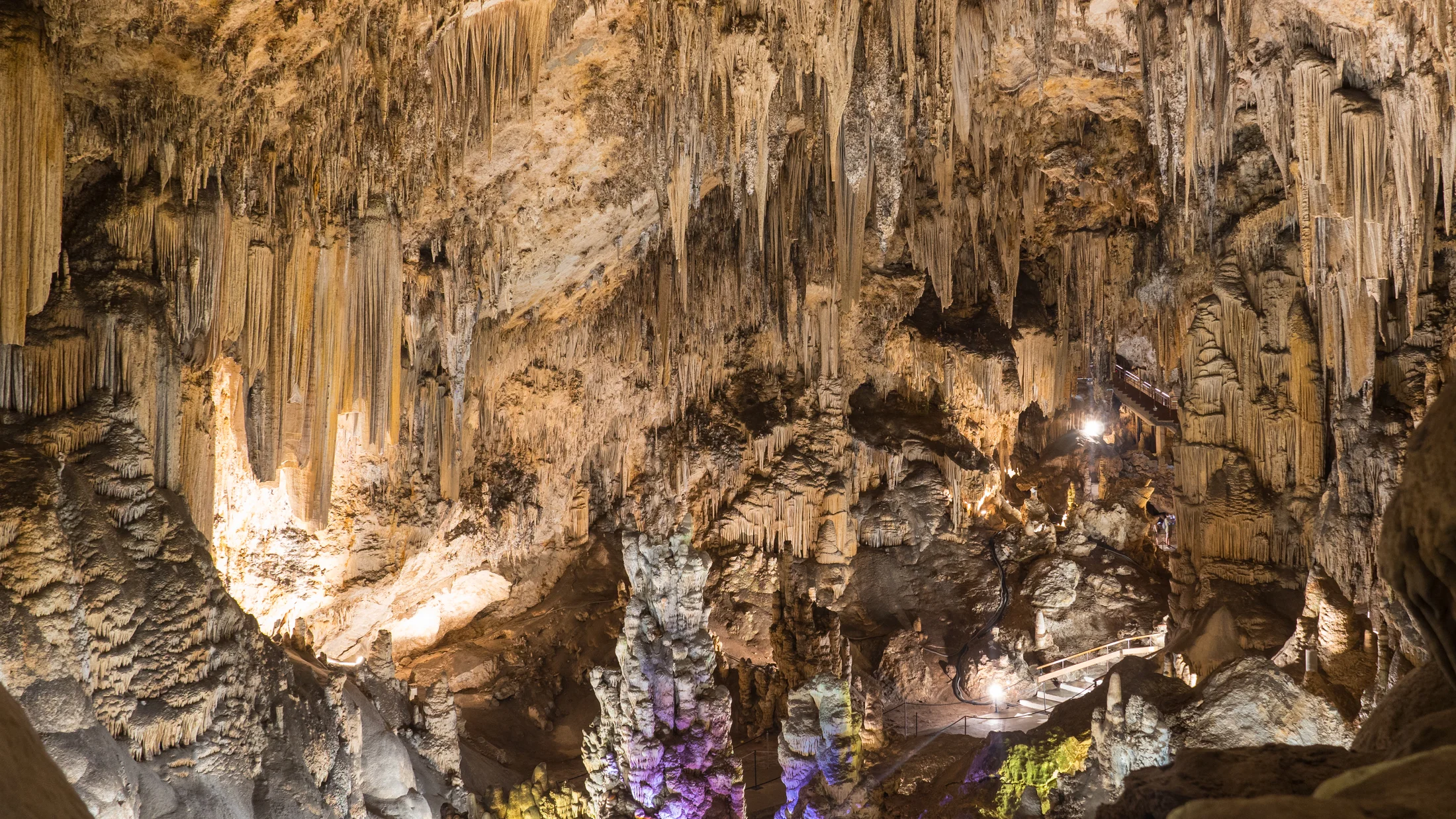
Nerja combines a well-run tour with serious formations and archaeology. Its colossal chambers include one of Europe’s largest cave columns, around 32 m high, documented by the Fundación Cueva de Nerja.
Your footsteps tick softly on the walkway as the ceiling lifts into shadow.
- Location: Maro–Nerja, Málaga (Andalusia)
- Level: Initiation/family-friendly; occasional special visits
- Guide/permit: Guided or self-guided with audio; advance booking recommended, especially summer and weekends
- Typical duration: 45–60 minutes
- Geological highlight: Vast chambers, columns, draperies; archaeological interest and occasional cultural events
- Best season: October–May for fewer crowds; summer concerts on limited dates
- Safety/gear: Comfortable shoes with good grip; light layer (constant cool temperature). Respect photo policies.
- Useful fact: Ticketing, events, and capacity limits vary; check Fundación Cueva de Nerja’s official information before travel.
4.El Soplao (cantabria) — helictites and advanced speleotourism
El Soplao is famous for forests of helictites—delicate, gravity-defying crystals—and for mine galleries tied to Cantabria’s industrial past. Beyond the standard tour, the “Visita Aventura” suits fit travelers ready for crawling, mud, and a real sense of exploration.
A thin crystal twists like a frozen flame when your beam finds it.
- Location: Between Valdáliga, Rionansa, and Herrerías, Cantabria (Green Spain)
- Level: Initiation (standard tour) to intermediate/advanced (adventure visit)
- Guide/permit: Guided by the official operator; adventure visits require reservation and health declaration
- Typical duration: 60 minutes (tour); 2–3 hours (adventure)
- Geological highlight: Helictites (aragonite), gours, crystal pockets, ancient mining galleries
- Best season: Year-round; fewer visitors outside July–August
- Safety/gear: Standard tour needs warm layer and good footwear. Adventure includes overalls, boots, helmet, and lighting from the operator; bring thin gloves and moisture-wicking base layers.
- Useful fact: Cantabria concentrates many caves in Spain; El Soplao’s rules protect fragile speleothems, so no touching and limited group sizes.
5.Ojo Guareña (burgos) — grand galleries and regulated routes
Ojo Guareña is one of the largest karst complexes in Spain, exceeding 110 km of mapped passages according to the Junta de Castilla y León. Public access focuses on heritage spots like the San Bernabé cave-hermitage, while sport caving requires permits.
The rock smells faintly of damp earth as the valley wind fades at the entrance.
- Location: Merindad de Sotoscueva, Burgos (Castile and León)
- Level: Initiation (heritage routes) to advanced (sport caving with permits)
- Guide/permit: Guided visits offered for heritage sections; permits essential for speleology beyond the tourist areas
- Typical duration: 45–75 minutes (guided heritage); multi-hour to full-day for sport routes
- Geological highlight: Multi-level galleries, subterranean streams, archaeology, and the unique cliffside hermitage
- Best season: Spring and autumn; some closures protect bat colonies in winter
- Safety/gear: Tourist routes require normal walking gear; sport caving demands full kit (helmet, lighting redundancy, thermal layers, ropes where applicable) and experienced leadership.
- Useful fact: Capacity is capped; local regulations and natural-monument protections are strictly enforced.
6.Cañón y Cueva de los Enebralejos (segovia) — initiation and families
Near the village of Prádena, Enebralejos pairs a compact show cave with prehistoric remains and hands-on workshops. Its proximity to the Cega River’s canyon and Sierra de Guadarrama makes it a simple plan for families from Madrid.
Cool air brushes your face as calcite curtains catch a soft sheen.
- Location: Prádena, Segovia (Castile and León); ~110 km from Madrid by A-1/N-110
- Level: Initiation/family-friendly
- Guide/permit: Guided visits only; on-site booking or advance reservation on busy weekends
- Typical duration: 45–60 minutes; extra time for archaeology workshops and short trails nearby
- Geological highlight: Flowstone, columns, prehistoric context; easy walking with steps
- Best season: Year-round; spring and autumn offer mild weather for pairing with nearby forests
- Safety/gear: Closed shoes, light jacket (around 10–12°C). For kids, bring a small torch to engage them, respecting guide instructions.
- Useful fact: Combine with short walks in beech and holly woods maintained by the local community.
7.Picos de Europa (asturias/cantabria/león) — advanced with a certified guide
Picos de Europa hosts some of Europe’s great vertical and through-caves, set in steep limestone massifs. It’s the realm of SRT, complex route-finding, and serious logistics—best done with accredited guide services based in Arenas de Cabrales, Potes, or Cangas de Onís.
Outside, cowbells scatter across the slopes; inside, rope creaks softly against descenders.
- Location: Picos de Europa National Park (Asturias, Cantabria, León)
- Level: Advanced only (some intermediates exist, but conditions are alpine)
- Guide/permit: National Park rules apply; many systems require permits and certified guides; group sizes limited
- Typical duration: Half-day to multi-day objectives; weather, snowmelt, and hydrology dictate timing
- Geological highlight: Deep shafts, active and fossil galleries, alpine karst at altitude
- Best season: Late summer to early autumn (more stable hydrology and daylight)
- Safety/gear: Full SRT kit (harness, chest ascender, handled ascender, cowstails, descender), two independent light sources, thermal layering, emergency bivvy, and navigation; avalanche and snow knowledge for winter approaches.
- Useful fact: Caves in Cantabria, Spain, extend into this massif; always plan conservative objectives and work with local federations and guides.
Where They Are and How to Stitch a Trip Together
You can group caves by region and cover 2–4 sites in a 3–7 day escape. The Cantabrian Coast (Cantabria, Asturias) bundles El Soplao with guided options in Picos de Europa; base yourself in San Vicente de la Barquera or Potes and allow 45–90 minutes’ drives between sites. The Central System (León–Burgos–Segovia) links Valporquero, Ojo Guareña, and Enebralejos using the AP-66, N-623, and A-1 corridors.
Andalusia’s Cueva de Nerja pairs with nearby Sierras Tejeda and Almijara for hiking days; Málaga city sits 55 km away by the A-7. In the Balearics, Drach and Hams sit minutes apart in Porto Cristo, so pick off both in half a day and leave time for the coast.
- Transport tips:
- Fly to Santander or Bilbao for Cantabria; León or Burgos for the Central System; Málaga for Nerja; Palma for Mallorca.
- Distances: León–Vegacervera ~47 km; Santander–El Soplao ~70–90 km depending on route; Málaga–Nerja ~55 km; Palma–Porto Cristo ~64 km.
- Public transport works for Drach/Hams and Nerja; rural caves typically need a car.
A cool draft at each entrance hints at space ahead; plot short hops to keep travel light.
Adventure activities in Spain
Discover active tourism and nature activities on Picuco. Explore →
Choosing a Route and Level That Match Your Experience
First, be honest about your fitness and comfort in enclosed, dark spaces. For caving for beginners Spain offers guided show caves with steady paths and railings; these are perfect to test how you feel underground before you add ropes or water. Move to intermediate options once you’re relaxed with darkness, cool temperatures, and uneven footing.
-
Initiation (no technical gear):
- Who it suits: Families, first-timers, mixed groups.
- What it feels like: Walking on steps or paths, handrails, constant temperature.
- Where to try: Drach, Hams, Nerja, Enebralejos, Valporquero tourist route.
-
Intermediate (adventure visits, short crawls, possible water):
- Who it suits: Fit visitors who like scrambling and getting muddy.
- What it requires: Helmet and lighting, overalls or wetsuit provided by operator, basic agility.
- Where to try: Valporquero “curso de aguas,” El Soplao “Visita Aventura.”
-
Advanced (SRT, verticality, route-finding):
- Who it suits: Experienced cavers or novices with a certified guide service.
- What it requires: Full rope systems, training, strong navigation and risk management.
- Where to try: Selected systems in Picos de Europa with guides and permits.
When to hire a guide: Any time ropes, flowing water, or complex route choices appear, or when regulations require it. When to seek permits: Always check protected-area rules, seasonal closures, and quotas; park or regional websites list current procedures. Assess risk by asking operators about water levels, exit options, and exposure time, and by choosing conservative caving routes Spain is known for offering at multiple levels.
Imagine the smell of damp limestone and the steady patter of drops, then choose the level that lets you enjoy it.
Safety and Essential Gear for Spelunking in Spain
Caves are controlled environments until water, cold, or confusion make them serious. Think redundancy, communication, and warmth, then add local knowledge from guide services and park staff. Even for caving tourism Spain’s operators expect you to show up prepared.
-
Core equipment:
- Helmet with mounted light (and one spare headlamp); fresh batteries
- Footwear with grip (approach shoes or sturdy boots)
- Thermal base layers (synthetic/merino) and a windproof outer
- Thin gloves; buff or light beanie; small dry bag
- For water routes: 3–5 mm wetsuit, neoprene socks, and gloves
-
Personal safety:
- Never go alone; ideal group size is 3–6 with a capable leader
- Tell someone your plan, entry/exit, and cut-off time
- Carry a compact first-aid kit, emergency bivvy, and whistle
- Two light sources per person, minimum; three for advanced routes
-
Insurance and paperwork:
- Sports insurance that covers caving and rescue costs
- Permits where required (National Parks, natural monuments)
- ID and emergency contact info sealed in a plastic bag
-
What not to forget:
- Check weather and hydrology; recent rain can flood active systems
- Respect formations: no touching, no collecting, stay on marked lines
- Decontaminate gear if moving between caves to protect bats (WNS protocols where applicable)
A faint breeze at the mouth often signals changing pressure—treat such cues as part of your safety checklist.
Frequently Asked Questions
A single droplet can take decades to form a calcite tip—slow down and tread lightly.
Do I need a permit to go caving?
Tourist routes don’t, but sport caving often does in protected areas like Picos de Europa and Ojo Guareña. Always check the official site for current quotas and seasonal closures.
What’s the minimum age for cave visits?
Show caves typically allow children (sometimes from 3–5 years); adventure visits set age and height limits. Operators publish exact thresholds and may require adult ratios.
Can I go on my own?
Only on marked tourist circuits where it’s allowed and safe to self-guide. For anything beyond, hire a certified guide or join a local club; regulations and complexity demand it.
How do I book a guide?
Book directly with official cave operators or accredited local providers near each site. Look for federated guides and ask about group size, equipment, and insurance coverage.
Can I take photos?
Policies vary: some ban flash or tripods, others restrict photography during concerts or sensitive sections. Respect staff directions to protect fauna and formations.
What are typical hours and seasons?
Most show caves run daily schedules in high season and reduced hours in winter. Adventure routes depend on water levels, staffing, and conservation needs; reservations are essential.
How do I reduce my impact?
Stick to paths, avoid touching calcite, and pack out all waste. Clean and dry gear between caves to prevent spreading pathogens to bat colonies.
What to Do Next
Spain’s underground offers a spectrum: lakes under Mallorca, canyoning in León, crystal forests in Cantabria, and deep systems in Picos. Choose according to your experience, season, and appetite for mud, water, and rope, then confirm access with official operators.
Book early for weekends and holidays, and prioritize accredited local guides who protect both you and the cave. If you want a simple starting point, pick a family-friendly tour, then step up to a guided adventure day. When you’re ready, plan a long weekend linking nearby caves to keep driving short and learning high.
If you want curated options and trusted contacts, explore stays and local guide recommendations on Picuco and reserve in advance for peak dates.