The essentials of Cabo Peñas

  • • 1852 lighthouse with marine interpretation centre and 300-degree Cantabrian Sea views
  • • Podes blowholes: marine geysers shooting columns of water and spray through the rock
  • • Post-breeding migration with over 10,000 seabirds on northwesterly wind days
  • • 8 km circular trail linking the lighthouse, Xagó beach and Civil War coastal batteries
  • • Intertidal pools with dense limpet, anemone and sea urchin communities visible at low tide

Description

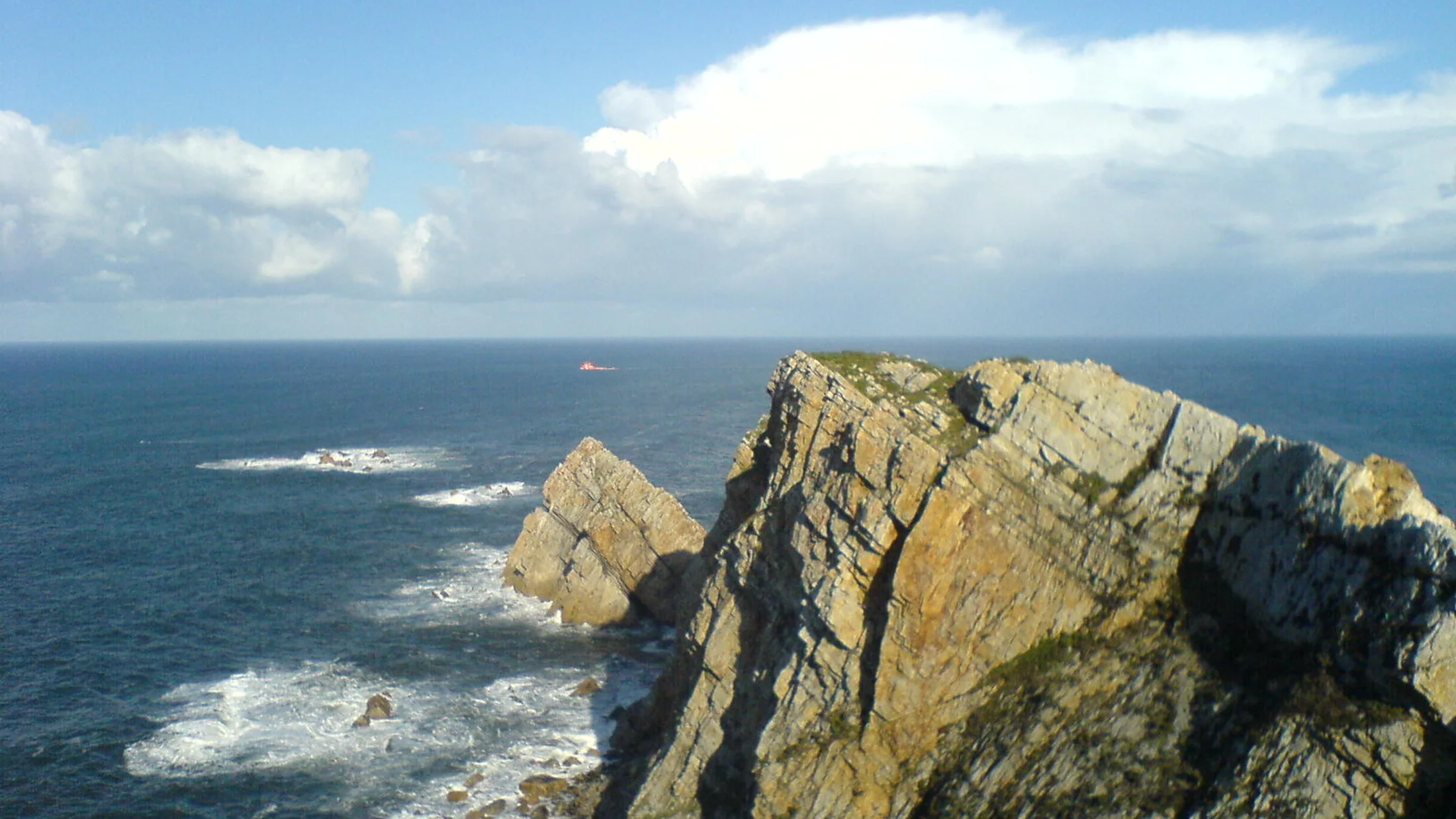
Cabo Peñas is the northernmost point of Asturias, a tongue of quartzite rock jutting into the Cantabrian Sea at 100 metres above the water. Its lighthouse, operational since 1852, serves as the navigation reference for the central Asturian coast and now houses a marine interpretation centre. From the lighthouse esplanade, the horizon opens in a nearly 300-degree arc over the sea, and on clear days the coastline stretches from Cabo Vidio to the west to Cabo Lastres to the east, a panorama spanning over 100 km of shoreline.

The cape's geology is written in Ordovician quartzites and slates, rocks over 450 million years old that rank among the oldest surface materials in Asturias. Marine erosion has carved a stepped cliff relief, wave-cut platforms, blowholes and small rocky coves from these layers. The Podes blowholes, a few kilometres to the east, function as marine geysers when northwesterly swells force water through karst fissures: columns of water and spray can reach several metres in height with a deep sound audible from a distance. At low tide, the rock platforms reveal intertidal pools where limpets, anemones and sea urchins form dense communities visible to the naked eye.

The cape's forward position makes it one of the finest seabird observation points on the Cantabrian coast. During the post-breeding migration, between September and November, thousands of northern gannets, Balearic shearwaters, skuas and lesser black-backed gulls pass the cape heading south. Ornithological counts have recorded days with over 10,000 birds in movement when northwesterly winds push migratory currents close to the coast. In spring and summer, the cliffs host European shag colonies, a species with small Cantabrian populations that uses inaccessible rocky ledges for nesting. Peregrine falcons breed on the steepest faces, and their stooping silhouettes above starling flocks are a regular sight at dusk.

The cape's immediate surroundings blend rocky coast with littoral meadows where Asturiana de los Valles cattle graze. Green pastures reaching the very edge of the cliff create a landscape of contrasts between vivid grass, dark quartzite and the shifting blue of the Cantabrian Sea. The perimeter trail, an 8 km circular route signposted as PR-AS, links the lighthouse with Xagó beach to the south and the Ferrero coves to the east, passing the remains of Civil War coastal defence batteries. Xagó beach, a 1 km strand facing northwest, is a reference point for surfing and bodyboarding in central Asturias.

The coastal towns of Luanco and Candás, 5 and 8 km away respectively, are the natural base for visiting the cape. Luanco retains its working fishing harbour and a historic quarter of Indiano mansions. Candás, adopted home of the sculptor Antón, houses a museum devoted to his work and a canning tradition that lives on in local shops. The cuisine revolves around fresh fish and shellfish: monkfish, spider crab and goose barnacles in the cider houses and harbour restaurants. Gijón is 15 km away via the N-632, making it easy to combine a day at the cape with a city visit.

Practical information

Everything you need to know for your visit to Cabo Peñas

How to get there
From Gijón, take the N-632 to Luanco and follow the AS-328 to Cabo Peñas lighthouse (20 km, 25 min). From Avilés, via the AS-238 to Luanco and the AS-328 (15 km, 20 min). Large car park at the lighthouse. In summer, regulated access with a shuttle from Luanco on weekends.
Area Information
Interpretation centre at Cabo Peñas lighthouse (seasonal hours). Signposted PR-AS circular trail. Car park at the lighthouse. Accommodation and restaurants in Luanco (5 km) and Candás (8 km). Xagó beach accessible by paved track. Surf zone with schools at Xagó.
Geography
Promontory of Ordovician quartzites and slates (450 Ma) projecting into the Cantabrian Sea. Cliffs up to 100 m, wave-cut platforms and karst blowholes. Littoral meadows over rocky substrate. Xagó beach (1 km of sand) to the south.
Flora & Fauna
European shag colonies on sea cliffs. Northern gannet, Balearic shearwater, skua and lesser black-backed gull on migration. Breeding peregrine falcon. Intertidal communities: limpets, anemones, sea urchins, goose barnacles. Littoral meadows with sea clover and thrift.

Things to do

Find the best plans and things to do in Cabo Peñas

20

Accommodations

Best accommodation options in Cabo Peñas

Loading accommodation options...

Frequently Asked Questions

Get answers about Cabo Peñas

Yes, the Cabo Peñas lighthouse houses a marine interpretation centre open to visitors. Hours vary by season: it typically opens daily in summer and weekends only in winter. The exhibition covers navigation history, cape geology and marine wildlife. Entry is free or at a nominal charge, depending on the year.
The Podes blowholes activate when northwesterly swells force pressurised water through karst fissures in the rock. The best conditions occur in autumn and winter, when Atlantic storms generate strong waves. They barely function in calm seas. Keep a safe distance and avoid walking on cracked ground, as jets can shoot up without warning.
Yes, the circular trail packs a variety of landscapes into a short distance: lighthouse cliffs, littoral meadows with grazing cattle, Civil War battery ruins, rocky coves and Xagó beach. It is low difficulty with no significant elevation change, taking roughly two and a half hours at a relaxed pace. Binoculars enhance the birdwatching and intertidal wildlife experience.
Yes, Xagó is a key surf and bodyboard spot in central Asturias. Its northwest orientation picks up Atlantic swells well. Surf schools offer lessons and gear hire. The beach has strong currents, so swimmers without boards should check sea conditions first. Access is via a paved track from the AS-328 road.
Luanco, 5 km from the cape, has several fish and seafood restaurants by the harbour. Monkfish, spider crab and goose barnacles are the standout dishes. Candás, 8 km away, maintains a canning tradition and its cider houses serve set menus with catch of the day and cachopo. Both towns also have local produce shops selling artisanal preserves and Asturian cheeses.