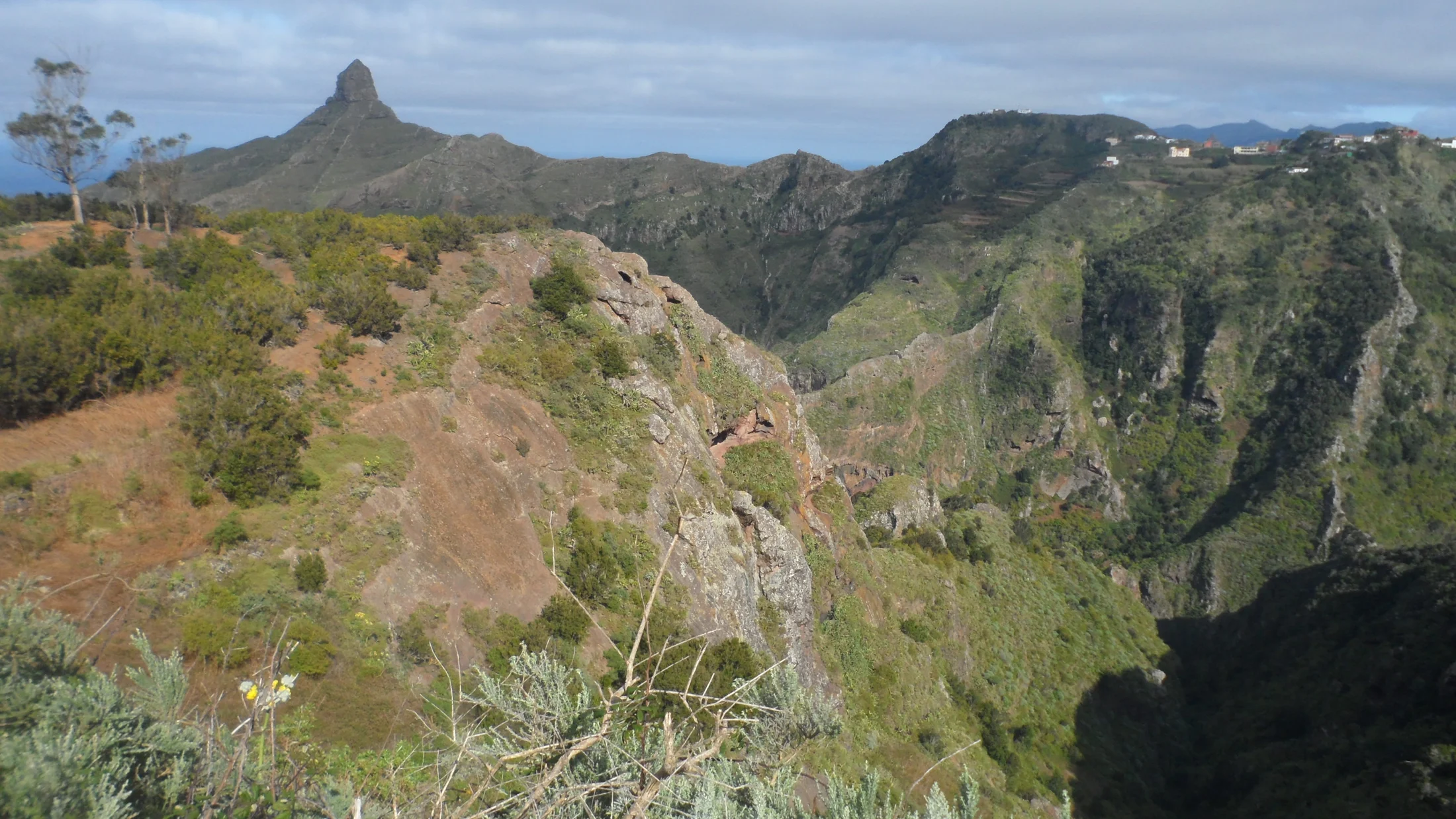
The Anaga massif rises at the northeastern tip of Tenerife like a green spine sculpted over seven million years. Declared a UNESCO Biosphere Reserve in 2015, this volcanic corner harbours the largest concentration of laurel forest in the Canary Islands — a relict woodland that once covered southern Europe twenty million years ago and now survives, wrapped in mist, only across the Macaronesian archipelagos.
Walking through Anaga means stepping into a landscape that feels older than memory. Trails plunge into deep ravines where light arrives filtered through tree ferns and moss-laden fayas, and the only sound is the drip of water that the fog itself deposits on the leaves — a phenomenon called horizontal rain that the Guanche people already harnessed for their crops. The contrast between the perpetually damp northern slope and the dry, Atlantic-facing southern side creates, in barely fifteen kilometres, a diversity of microclimates hard to match anywhere else in Europe.
The network of marked trails exceeds forty kilometres. Among the most celebrated routes is the one linking Cruz del Carmen to Punta del Hidalgo, a roughly four-hour descent through the laurel forest to the coast. Another essential walk drops into the hamlet of Taganana, a village perched between mountains where vines still grow on terraces and traditional fishing methods endure. At Benijo, at the end of the road, a beach of black volcanic sand meets the Atlantic swell in front of Los Roques — basalt stacks that rise from the sea like stone sentinels.
Anaga is also a human territory. Scattered hamlets — Taborno, Afur, Chamorga, Las Carboneras — have been continuously inhabited for centuries. Their residents maintain subsistence farming adapted to steep slopes and scarce soil: potatoes, mojo sauce, goat cheese. Visiting these villages is a way to understand how the island was settled long before mass tourism.
From a scientific standpoint, Anaga hosts more than twenty endemic species exclusive to this massif, including the Bolle's pigeon (Columba bollii) and the laurel pigeon (Columba junoniae), two birds that live only in the Canarian laurel forest. It also shelters unique invertebrates and a flora rich in mosses, lichens, and ferns that botanists study as a living laboratory of island evolution.
The Cruz del Carmen Visitor Centre provides up-to-date information on trail conditions and weather. Checking in before setting out is highly advisable, since fog can reduce visibility suddenly. Access by car is possible via the TF-12 road, though parking fills quickly in peak season; public transport from La Laguna on TITSA bus lines is an effective and more sustainable alternative.
Anaga does not offer large tourist facilities or luxury hotels. Its value lies in the opposite: the chance to walk a forest that already existed when the first hominids roamed Africa, to hear silence broken only by the song of a blue chaffinch, to sit down to a watercress stew in a guachinche in Taganana while the mist wraps the peaks. It is, in short, the Tenerife that existed before everything else.