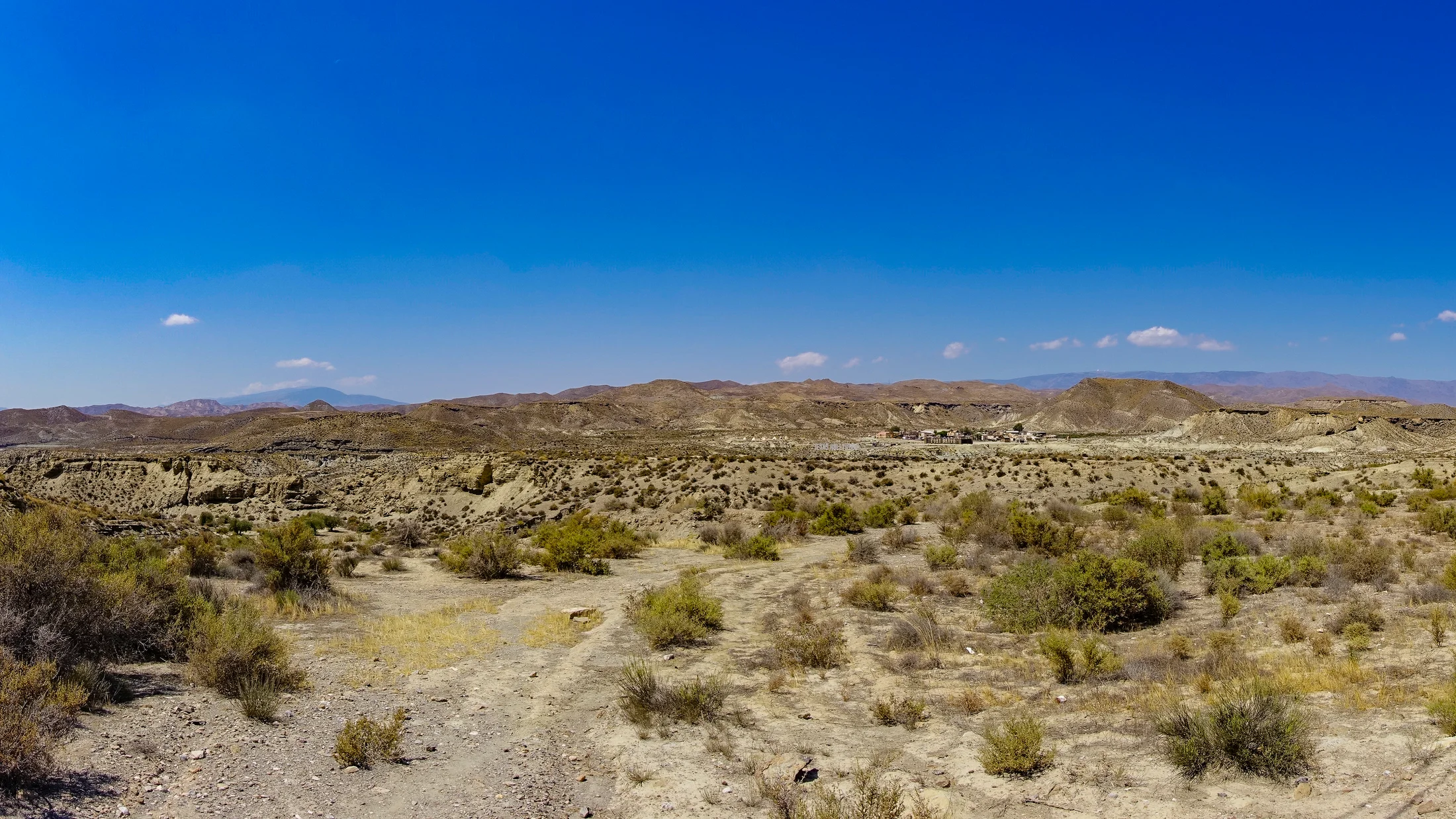
The Tabernas Desert occupies a geological depression north of Almería, wedged between the Sierra de los Filabres, the Sierra Alhamilla and the Sierra de Tabernas. It is Europe's only true desert: not merely a dry landscape or a steppe, but a genuine desert with average rainfall below 250 millimetres a year, summer temperatures exceeding 40 degrees Celsius, and erosion that has carved a labyrinth of badlands, dry riverbeds and bare hills more reminiscent of the American West than of southern Spain.
That resemblance did not go unnoticed. In the 1960s, directors such as Sergio Leone chose Tabernas as the setting for their spaghetti westerns, and films that defined an entire genre were shot here: A Fistful of Dollars, For a Few Dollars More, The Good, the Bad and the Ugly. Lawrence of Arabia, Indiana Jones and the Last Crusade and Exodus also passed through these ravines, among dozens of other productions. Three western towns — Mini Hollywood (Oasys), Fort Bravo and Western Leone — survive as visitable theme parks that stage gunfights, bank heists and equestrian shows.
But Tabernas is far more than a film set. Geologically, the depression formed about six million years ago when the sea that covered the area retreated, leaving soft marine sediments that rain, wind and thermal cycling have since eroded into today's landscape. The exposed strata display a sequence of ochre, grey and red that geologists read like an open book of the Earth's recent history.
Tabernas' extreme aridity has turned it into a first-rate scientific laboratory. The Plataforma Solar de Almería, managed by CIEMAT (the Centre for Energy, Environmental and Technological Research), harnesses more than 3,000 hours of annual sunshine to research concentrated solar power. It is Europe's largest solar research centre and can be visited by prior booking.
The desert's flora and fauna are adapted to conditions that would kill most species. The jujube tree, a thorny shrub of African origin, forms the last remaining groves of a species once abundant across the Mediterranean before the glaciations. The dry riverbeds, waterless for most of the year, shelter oleanders that burst into vivid pink after the torrential autumn rains. Notable fauna include the common chameleon, the Eurasian eagle-owl, the horseshoe whip snake and an array of reptiles and invertebrates that have developed remarkable survival strategies.
Exploring the desert on foot or by mountain bike reveals a beauty that photographs never quite capture. The most accessible routes follow the dry riverbeds that wind between walls of eroded clay, where the silence is so thick you can hear your own footsteps echo. At dawn and dusk, the raking light ignites the mineral tones of the landscape and casts long shadows across the badlands. It is a place that teaches you to look with patience: what at first glance seems empty is, in truth, full of life, history and geological beauty.
The town of Tabernas, at the desert's entrance, preserves the remains of an 11th-century Moorish castle and has restaurants where you can try Almería's traditional cuisine: migas, gurullos and choto al ajillo. From here you can reach the western film sets, the inland trails and the Solar Platform.