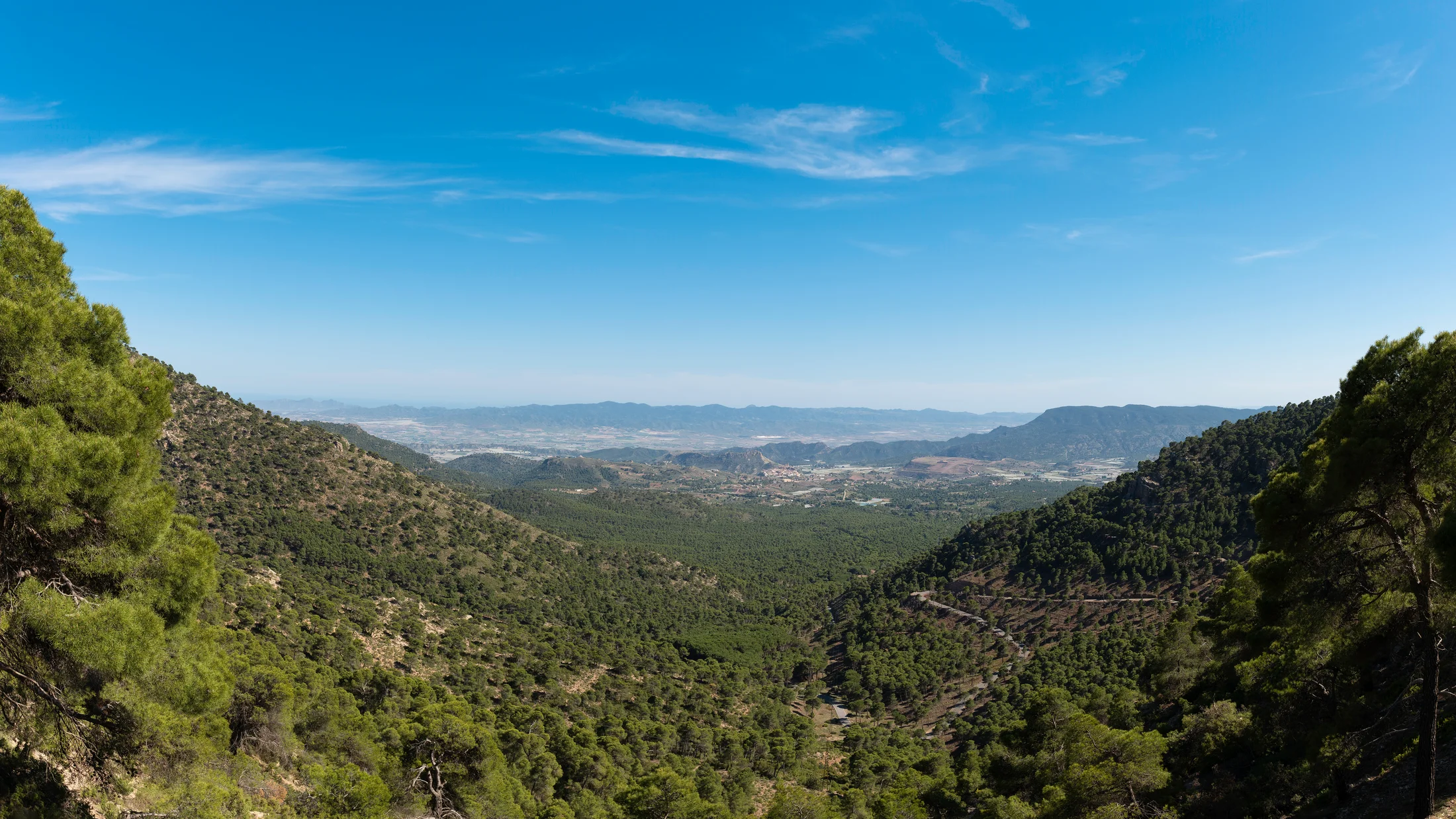
Eight destinations in the Region of Murcia await you less than two hours by car from the city, and the furthest one only takes 75 minutes. Within that range, you will find mountain ranges, a canyon, a valley next to the Segura, towns with history, and virgin sandy beaches. Here you have what to see in each one, how long it takes to get there, and what is worth booking before you head out.
Sierra de la Pila, the regional park at the foot of Fortuna
Sierra de la Pila is a Regional Park and has a colony of red-billed chough that has earned it the declaration of a Special Protection Area for Birds and a Site of Community Importance.
If you stay in the area, keep in mind that camping is only allowed in designated areas and with authorisation. Before heading out, consult the Sierra de la Pila file to see access points and the status of the park.
Picuco te puede ayudar
Does something here catch your eye?
Tell us.
Write to us on WhatsApp or email: we answer questions, find the best options and help you sort out the booking.
Sierra Espuña, regional park between Alhama, Mula and Totana
Sierra Espuña is a Regional Park, SIC, and SPA, with 17,804 hectares spread between Alhama de Murcia, Mula and Totana. Its maximum altitude is 1585 m at Morrón de Totana.
You have all the information about the area in Sierra Espuña.
You arrive by car from Murcia in 38 minutes without traffic, with 40.9 km to the Avenida de la Sierra Espuña. With that distance, the mountain range fits into a full morning or afternoon.
Valle de Ricote, the Moorish valley next to the Segura
Valle de Ricote is a fertile valley next to the Segura river, nestled between steep mountains and ravines.
The historical region of the Region of Murcia is formed by Archena, Ojós, Ricote, Ulea and Villanueva del Río Segura.
From Murcia, there are 43.3 km and 43 minutes by car without traffic to Ricote. With that margin, you have time to stroll through several municipalities in one morning.
Cañón de Almadenes, the Segura gorge between Calasparra and Cieza
The Segura river is wedged between vertical walls of up to 150 metres in the Cañón de Almadenes, a Protected Natural Space of the Region of Murcia. It is in the upper course of the Segura river, and from Murcia you arrive by car in 1 h 11 min to travel 65.1 km without traffic.
The Eurasian eagle-owl and the short-toed snake eagle fly through the canyon, and the Eurasian otter frequents the water. On the banks, poplars, ash and willow grow.
For walking, the PR MU101 trail goes from Cortijo de El Viso to Casa de La Maestra. The GR 127 section from Central de Almadenes is discouraged due to danger. If you are looking for views, the PR-MU 132 Sendero Balcón de Almadenes has panoramas of the canyon, and you can book hiking through the Cañón de Almadenes.
The canyon holds two archaeological sites: the cueva de los Monigotes (Abrigo del Pozo) and the Cueva Sima de la Serreta, with rock paintings and remains of Bronze Age utensils. The Centro de Interpretación de Almadenes is temporarily closed, so organise your visit without counting on it.
Outside of the marked trails, the terrain is technical: there are off-trail sections, smooth rocks and gradients that require good physical condition. Wear grippy footwear and calculate the daylight before heading out.
Bullas, wine and the birth of the Río Mula
Bullas lives off wine and guards the birth of the Río Mula.
Bullas brings together history, culture and viticulture tradition in a 19th-century winery belonging to the Melgares de Aguilar family. Inside, more than 1,400 m2 explain the wine-making processes step by step.
It is worth checking the calendar before going. The museum is open from Tuesday to Saturdays from 10:30 to 14:00 h. and from 17:00 to 20:00 h.; Sundays and holidays, from 10:30 to 14:00 h. From 1 November to 31 March, the afternoon session changes to 16:00 to 19:00 h.
General entry costs 3.5 €; for groups of at least 12 people, 2.5 €; and pensioners, Youth Card holders and large families pay 2 €. From Murcia, it is 63.0 km and 54 minutes by car without traffic to El Llano de Bullas.
Caravaca de la Cruz, the Holy City of the Northwest
Caravaca de la Cruz has celebrated a Jubilee Year in perpetuity since 1998, a privilege granted by the Pope. That is why it is known as the Holy City and the City of the Cross.
Religious tradition maintains that three splinters of the cross on which Jesus Christ died were deposited in the Vera Cruz. This relic explains the municipality's fame and the rhythm of pilgrims it receives.
Caravaca de la Cruz is 86.1 km and 1 h 9 min from Murcia. Plan for a full day if you want to see the basilica and stroll through the old town. It is worth checking the calendar before going: jubilee years and the May festivals fill the streets and the parking lots.
Lorca Castle, the Fortress of the Sun
The Lorca Castle is a site of cultural interest and is known as "The Fortress of the Sun" due to its elevated position, which provides it with sunlight all day long. Among its most representative elements are the Espolón tower and the Alfonsina tower.
The fortress occupies an area of 52,000 m², with 640 metres in length and 120 metres in width at its widest point, and a walled perimeter of 1,426 metres. Walking around the enclosure takes a good while: plan for at least a couple of hours if you want to see the towers calmly.
It is 75.9 km and 1 h 8 min by car without traffic from Murcia, so it fits into a morning or full-day getaway.
Calblanque, beaches and mountains in Cartagena
Calblanque combines beaches and mountains in the same natural park, 70.2 km from Murcia and 1 h 15 min by car without traffic. It is in Cartagena, so you can go from the sand to a mountain path on the same day.
In summer, the car stays in the El Sabinar outer parking lot and access to the park is made via the shuttle. From October to May, it is possible to park inside the park, next to the beaches.
You reach it via the A-7 Alicante-Cartagena motorway, exit 800 to Mar Menor, MU-312 fast road and exit to Calblanque.
You have more details in Calblanque.
Rules in regional parks: camping, fire and pets
Three basic rules are enough to ensure your visit to a regional park leaves no trace. They apply to any time of the year and to any corner of the Región de Murcia.
Making fires is prohibited except in authorised places and times. Before leaving, check if your area allows lighting anything and on which dates.
Keep your pet on a lead and pick up its excrement. And always walk on authorised paths: creating shortcuts deteriorates the ground.
Frequently asked questions
How long does it take to get from Murcia to each getaway?
The times are for one way and vary with the traffic leaving the city, so it is advisable to calculate them for an early morning.
The closest are Avenida de la Sierra Espuña, at 40,9 km and 38 minutes, and Ricote, at 43,3 km and 43 minutes. A little further away are El Llano de Bullas, at 63,0 km and 54 minutes, and Cañón de Almadenes, at 65,1 km and 1 h 11 min.
Calblanque is at 70,2 km and 1 h 15 min, the longest journey in time on the list.
If you are going to Calblanque or Cañón de Almadenes, leave with a margin: they are the ones that require the most time and the ones that are enjoyed most calmly.
What nature plans are there near Murcia?
All of them can be done in one morning or in a full day, depending on how much you want to walk.
Sierra Espuña is a Regional Park, LIC and ZEPA, so it combines the protection of habitats and birds. Cañón de Almadenes is a Protected Natural Space of the Region of Murcia and is visited with short routes.
Sierra de la Pila is a Regional Park and has marked hiking routes. Calblanque forms the Parque Regional de Calblanque, Monte de las Cenizas y Peña del Águila, with beaches and paths by the sea.
Book in advance if you go on a weekend or in summer, and bring water: for much of the year, the heat intensifies from mid-morning.