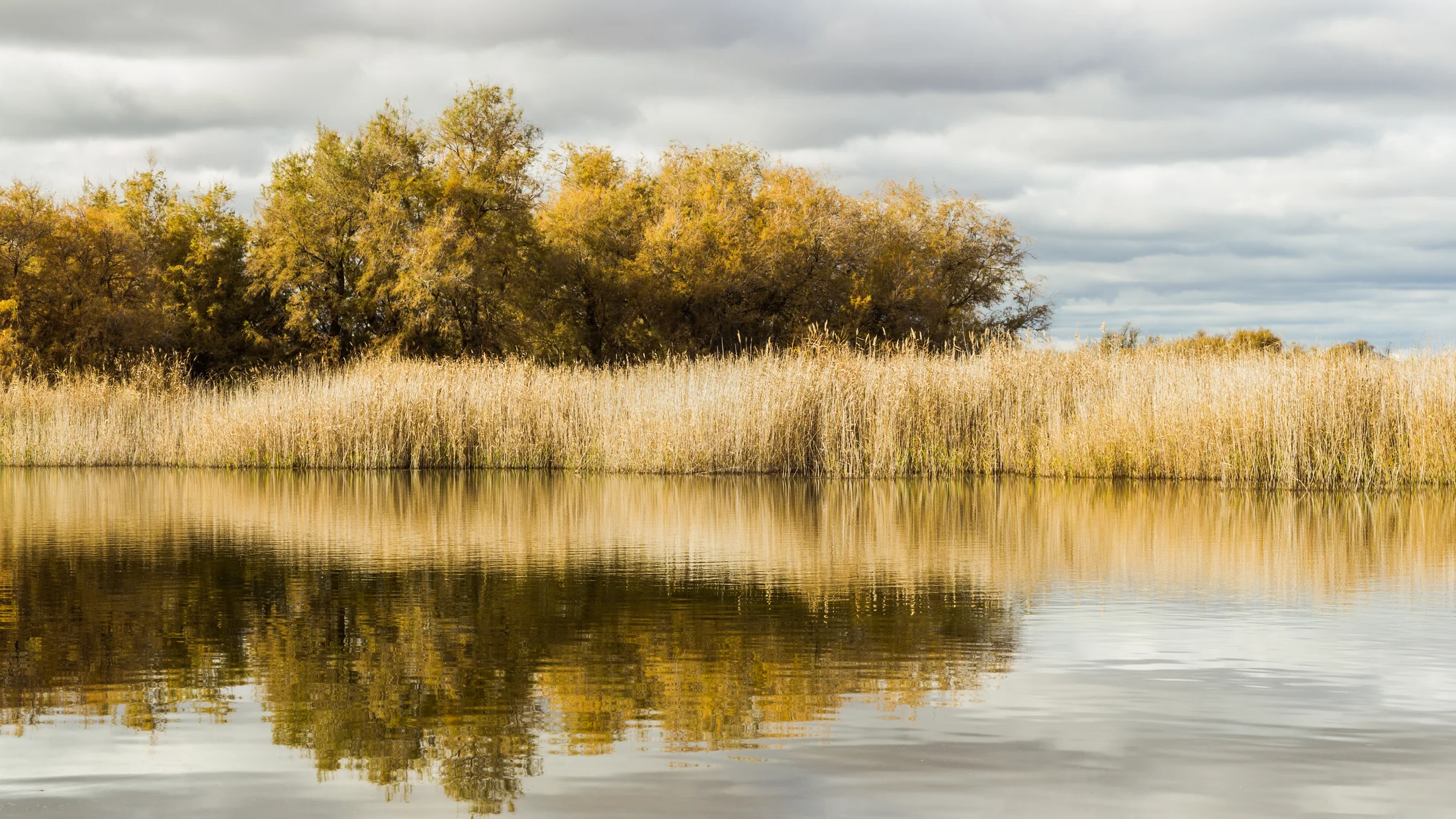
A mosaic of water and wind in La Mancha
In the centre of La Mancha, the Guadiana and the Cigüela meet and form the Tablas de Daimiel, a wetland that breaks the idea of an infinite plain. From there, the water links with the Ruidera Lagoons and with hills crowned by windmills.
The Tablas de Daimiel have been a national park since 1973 and part of the La Mancha Húmeda Biosphere Reserve since 1980. They preserve an ecosystem of fluvial "tablas" almost disappeared in Europe. In Ruidera, 16 pools or fluvial lagoons are connected by tuff barriers, with tones ranging from turquoise blue to jade green depending on the light.
The visit to the Tablas de Daimiel is free and open to the public, and the itinerary starts from the car park of the Visitor Reception Centre. It is 1.7 km round trip to two observatories, over flat terrain (altitudes between 606 and 608 m) and with 5 m of positive elevation gain.
In this guide you will find reasons to come and data to plan: distances, recommended seasons, access by car and public transport. Also activities and routes for all levels, and sustainability guidelines.
The territory is sustained by farmers, shepherds, boatmen, nature guides and park staff. The idea is to return with memories and without leaving a trace.
If you are looking for organised activities, at Picuco we group verified experiences by area so you can choose calmly and book when you are sure.
Picuco te puede ayudar
Does something here catch your eye?
Tell us.
Write to us on WhatsApp or email: we answer questions, find the best options and help you sort out the booking.
Why choose this trip: living wetlands, clear lagoons and windmills with history
Water, stone and wind: the Tablas de Daimiel wetland, the Ruidera lagoons and the windmills of La Mancha. Three La Mancha landscapes that can be covered in a weekend and that change their light with the seasons.
The Tablas de Daimiel are a Ramsar wetland and a river "table" where the waters of the Guadiana and the Cigüela form shallow sheets that feed reedbeds, sedgebeds and tamarisk. It is a key refuge for migratory waterfowl. In wet winters you will see western marsh harrier, white-headed duck (a swan endangered in Europe), purple heron and bearded reeding; on migration, waders such as redshanks and sandpipers, and in winter abundant swans.
The Navaseca Lagoon lies outside the park but within the "Mancha Húmeda", over Aquifer 23, and allows you to observe birds up close all year round. It has a car park, observation points and walking routes. You can explore it on foot, by bicycle or on horseback, with no motor vehicles and with pets kept under control.
In Ruidera, tufa explains the landscape: lime precipitates when it meets plants and rocks and forms steps over which the water falls, among holm oak and Spanish juniper. The windmills of La Mancha, in Campo de Criptana, Consuegra or Mota del Cuervo, are whitewashed towers with wooden sails on hills. Many offer guided tours about cereal milling and its adaptation to the plateau. In Almagro, the Corral de Comedias on the Plaza Mayor is the only surviving example of this type of theatre preserved in its entirety and was built in 1628 after the Mesón del Toro was extended.
The plan allows for several paces. There is easy hiking along boardwalks in the Tablas de Daimiel, ideal for families and photography, and kayaking and paddleboarding in authorised areas of Ruidera with local rental and guided routes. Cycling works on the gentle tracks of the Ruta del Quijote and on local paths, and birdwatching is done from hides and towers.
Compared with other Spanish wetlands, there are no oceanic marshes or open deltas here: it is an inland wetland of shallow sheets among tamarisk, quieter and manageable in a day, with a contrast between reedbed and cereal plain. Couples find quiet sunsets, viewpoints and short routes with picnic stops. As a family, the level paths, the safe boardwalks and the inland beaches of Ruidera make it easy. A group can fit cycling, kayaking and windmills into a weekend. For photography and nature, winter and spring bring slanting light and birds close by.
The essentials for planning your visit
Location and how to get there
The axis of the visit is the Tablas de Daimiel National Park, in the province of Ciudad Real, with the Ruidera Lagoons about 70–85 km to the east. The breeze barely moves the tamarisk while the wooden signs guide you without any rush.
From Madrid to Daimiel there are about 172 km by road, a journey of between 2 and 2.5 h by car. Once in Daimiel, follow the "Parque Nacional Tablas de Daimiel" signage via local road to the Visitor Centre, which has free and signposted parking. You reach the centre via an asphalted minor road of about 10 km, and there is also access from Villarrubia de los Ojos via another asphalted minor road of about 10 km.
By regional bus, the Daimiel–Ruidera journey costs 7.74 €, has service every day and makes stops in Manzanares, Membrilla, La Solana, Alhambra and Casas Blancas. The final stretch to the Tablas de Daimiel usually requires a taxi from Daimiel or Ciudad Real.
Park at the Tablas de Daimiel Visitor Centre and walk along the boardwalks. The wide boardwalks and adapted sections facilitate the passage of prams and wheelchairs, but it is advisable to confirm the condition after rainfall. In Ruidera, the car parks fill up in summer: arrive early and respect the signage. Mobile coverage can be irregular, so download offline maps and bring cash for occasional parking fees.
Best time and schedules
Spring, from March to May, is the best time for birdwatching in the Tablas de Daimiel, with more water following the winter rains and greater bird activity. It is the best time if your plan is to observe wildlife.
Water rules in both spaces. In the Tablas de Daimiel, levels vary due to precipitation and contributions from rivers and aquifers, and after dry years, some itineraries may be closed for conservation or safety. In Ruidera, the connections between lagoons and the small waterfalls depend on the flow: in dry periods, some falls disappear and the authorised areas for navigation may be reduced.
The National Park itineraries are visited freely and for free, without prior reservation or maximum capacity. Guided visits do require prior reservation. To organise your day, the National Park Visitor Centre is the point to obtain information about the Park.
In Ruidera, the inland beaches open during the season and non-motorised navigation is only permitted in the lagoons and during periods authorised by the Natural Park. Check the seasonal restrictions before setting off.
Accommodation and bases of operations
Sleeping next to the wetland allows you to dawn at the observatories or enter the water early. The base is chosen according to your plan: birds, swimming or routes.
Daimiel works for birdwatching, with access to the Navaseca lagoon, one of the best places in Castilla-La Mancha to observe waterfowl throughout the year, where more than 200 bird species can be seen. Pets are allowed.
Almagro mixes culture and gastronomy 37.1 km from Daimiel, with the Corral de Comedias in the Plaza Mayor, the only theatre of this type to be fully preserved, and tapas. Villahermosa serves quiet families 46 min (47.2 km) from Ruidera, with rural houses and a peaceful agricultural environment.
There are rural houses and small hotels in Daimiel, Almagro and surrounding villages. In Lagunas de Ruidera, wild camping is prohibited within the park, so you must use the existing campsites.
If your priority is routes through La Mancha and sunrises in Tablas de Daimiel, choose Daimiel to minimise early morning travel. To combine windmills and lagoons, Almagro offers a balance between culture and accessible roads.
High season arrives with spring and summer weekends: book in advance, especially in August. Ask about flexible check-in times if you want to head out to the observatories at dawn.
What to see and do: wetland, lagoons, windmills and fauna
Tablas de Daimiel wetland: a visit to the heart of the ecosystem
In the Tablas de Daimiel, you walk on wooden boardwalks that cross sheets of water between tamarisk groves, common reed and great fen-sedge. There are observatories and open banks where you can see swans and little grebe.
The Molemocho Mill is an ethnographic centre that explains the historical relationship between water and milling. It is reached via a 400 m boarded path from the designated car park.
The Interpretation Centre is open from 9:00 to 21:00 in summer and from 8:30 to 18:30 in winter.
These easy itineraries allow you to get to know the wetland:
- The Isla del Pan Itinerary is circular, flat, 2.5 km long, low difficulty, 1.5 h and partially adapted.
- The Laguna Permanente Itinerary is circular, 1.5 km long, low difficulty, 1 h and partially adapted.
- The Torre de Prado Ancho itinerary can remain almost entirely dry from the end of spring until winter.
Reserve 2–3 hours for a full tour with stops at the observatories. Bring binoculars, a cap, water and comfortable footwear; in winter, a windbreaker.
Stay on the boardwalks, avoid noise, do not feed the fauna and do not use drones. The wetland has a fluvial "table" dynamic, with spaces flooded by slow overflowing, and a mix of tamarisk, common reed and great fen-sedge that provide shelter to birds affected by the loss of European wetlands. The air smells of wood warmed by the sun.
Ruidera Lagoons: inland beaches, viewpoints and water activities
The Ruidera Lagoons are a set of sixteen pools or river lagoons connected by streams, waterfalls and water jumps. The water is divided into two branches: one part of the Blanca lagoon with the Pinilla river and another part of the San Pedro lagoon with the Alarconcillo stream.
Only swim in the designated areas, respect the signage and avoid the tuff ridges, which are fragile.
In the authorised lagoons you can go kayaking and paddleboarding. The kayak route costs €20 for those over 12 years old and €10 for those under 12 years old. The 1.5 h kayak + 1.5 h paddle surf pack costs €35 for adults and €18 for children under 12 years old, and the 1.5 h kayak + 1.5 h snorkel pack costs €40 for adults and €25 for children from 6 to 12 years old.
Official routes do not require authorisation if the group is smaller than 60 people. Vessels must be registered and present a Responsible Declaration to the Guadiana Hydrographic Confederation. Navigation with motor, electric or combustion vessels is prohibited.
Wear water shoes to enter rocky areas and avoid sudden rises in water levels after storms; check the Natural Park notices. Picnics are only allowed in the marked areas, without leaving any waste or cigarette butts.
Cyanobacteria are the main builders of the area's tuff structures. A turquoise reflection shimmers under the poplars.
La Mancha windmills and cultural heritage
The windmills of La Mancha rise on summits that dominate the cereal plain. In Campo de Criptana and Consuegra there are sets of restored windmills, with whitewashed towers and wooden sails. The windmills of La Mancha offer guided tours, and on the first Sunday of every month it is possible to visit one of the historic windmills in operation.
The sunset views are the most photographed. In Consuegra, 12 of the 13 windmills that crowned Calderico hill remain, built in the first half of the 19th century, next to the Muela castle; the complex has been declared a historic site since February 2008. At the Sancho windmill, "La molienda de la paz" is celebrated on the Saturday of the last weekend of October.
You can combine a day with the morning in the Tablas de Daimiel and the afternoon in nearby windmills, with dinner in Almagro. If you have two days, do the lagoons route and, the next day, the Consuegra windmills for open panoramas.
Birdwatching and fauna: how to make the most of your visit
In Daimiel, birds move more at sunrise and at the last hour of the day, when the light is also favourable. Choose one of those two time slots and reserve the rest of the day for walking.
What you will see changes with the season. After the rains, greater flamingos and occasional waders arrive.
The Navaseca lagoon, near Daimiel, has a high density of birds and easy access: flamingos and common coots can be seen from very close by. In the Tablas de Daimiel you will find observatories and pedestrian itineraries, such as the 1.7 km round-trip route from the Visitor Centre to two observatories.
Bring 8x or 10x binoculars, a field notebook and a bird guide. Identification apps allow you to take notes without disturbing the animals. For photography, a moderate telephoto lens, a lightweight tripod and clothing in neutral tones.
Keep your distance, do not play bird calls and respect breeding areas and temporary closures.
Recommended routes: hiking, cycling and kayaking
1. Wetland Trail: circular route through Tablas de Daimiel
The Wetland Trail is a circular itinerary of boardwalks and observatories to explore without haste. The terrain is flat and the wooden boardwalks have accessible sections for strollers, so the difficulty is easy.
The key points are the observatories over shallow sheets of water and the dense tarayal. Move slowly and stop for 10–15 min at each observatory: patience multiplies sightings.
Choose sunrise or early afternoon in winter; in summer, it is best to avoid midday. Bring water, a cap and sun protection, and dress warmly on windy days. After rainfall, confirm the condition of the boardwalks, as some sections may be closed for conservation.
2. Lagoon Circuit: route through Lagunas de Ruidera
The Lagoon Circuit links several lagoons within the Lagunas de Ruidera Natural Park, with viewpoints and shores where you can stop to eat. The clear water reflects the sky like green glass.
The route starts from the Ruidera cemetery, where there is parking, and is signposted as a Natural Park. The elevation gain is low or moderate, between small hills and access points to viewpoints. The difficulty is easy-moderate: tracks and paths, with some sections alongside a secondary road.
Along the way, you will find local viewpoints and waterfalls when there is flow. The Batana, Santo Morcillo and Salvadora lagoons have depths between 11 and 14 metres.
If you want to add water to your walk, there is kayaking in the San Pedro and Tinaja lagoon for a €15 general fee, with children under 5 free. The San Pedro, Tinaja and Chorro de las Minas option costs €18 for adults and €12 for children under 14.
On hot days, divide the route into two half-days with a swim at midday.
Bring water and sun protection, and wear a reflective vest if you walk short sections of road. Do not climb or lean on the railings or handrails to avoid falls.
3. Greenway and cycling paths: pedalling through La Mancha
The La Mancha plain is traversed by bicycle via compact tracks and wide horizons. The temperate air whistles through the spokes while the path stretches out without haste.
The route is of easy difficulty and suitable for families: compacted earth surface and secondary asphalt, with little traffic. Along the way, birdwatching, panoramas of the plain and towns with porticoed squares await you.
Before setting off, confirm availability and sizes at bike rentals in nearby cities. Bring a helmet, lights, a water bottle and a puncture kit, respect crossings and signal your manoeuvres.
In summer, avoid the middle hours of the day; in winter, dress warmly and watch out for crosswinds. At the tourist offices, they can guide you regarding sections of the Quijote and quieter paths.
4. Kayak trip through the lagoons: practical guide
Paddling in the Ruidera lagoons is like gliding through connected watercolours.
The activity is available from 1 July to 15 September. In July, departures are at 11:30 and 18:00; in August and September, at 11:30 and 17:30. It is not recommended for children under 6 years old and pets are not allowed.
Bring swimwear, a cap, sun protection and water shoes. The life jacket must always be worn, and it is advisable to add water shoes and a dry bag. Avoid going out during storms or strong winds.
Rental is done through local operators who provide life jackets and stable vessels. Confirm the conditions with Picuco or directly with the operator.
Respect restricted areas and the tuff ridges, and do not anchor over vegetation. If you want to observe birds, keep your distance, paddle gently, keep quiet and only stop at authorised shores.
To end the day, combine the trip with an evening stroll to the viewpoints.
Practical tips, rules and sustainability
Travel light and leave space for the wildlife and those who look after it.
Stay on the paths and walkways, without taking shortcuts through reedbeds or tuff formations. In Ruidera, swimming is only permitted in designated areas. Navigation is exclusively non-motorised in authorised areas, and drones are not to be used unless express permission is granted. Do not pick plants, animals or rocks, do not feed the wildlife and do not light fires: use the designated picnic areas. Dogs must always be on a lead.
The heat is intense in summer: avoid the middle hours of the day, drink water often and bring sun protection and a hat. In winter, use thermal layers and windbreakers; getting up early pays off in terms of birds and light. After heavy rain, check warnings for rising water levels or route closures. Follow the official signs and download offline maps with an external battery.
For the day, prepare a light backpack with water (minimum 1–1.5 l per person on routes), snacks and a bag for waste. Hiking boots or trainers with a gripped sole, and water shoes in Ruidera. Some 8x–10x binoculars and, if you like photography, a camera with moderate telephoto. Add a basic first aid kit and sun protection.
Walking through the wetland areas marked by itineraries is free; guided visits by nature tourism companies require payment. Kayaking, snorkelling and other organised activities require authorised companies or Natural Park permits: find out in advance. Fines for swimming outside permitted areas, unauthorised navigation or the use of drones can be high.
Zero waste: everything that goes in must come out, and pick up even micro-waste if you see it. Carpool whenever possible and group visits to reduce travel. Buy DOP Manchego cheese, saffron, oil or wine from nearby producers. In the observatories, lower your voice and do not force approaches to the wildlife. Carrying an extra bag for others' waste and choosing less crowded hours also counts.
Frequently asked questions
Can I swim in the Tablas de Daimiel?
The Tablas de Daimiel National Park is the smallest in Spain (3,030 hectares). It is explored via wooden walkways over the wetland, crossing five islands, with flat and accessible terrain.
It is open all year round; the best time for birdwatching is autumn-winter. Within the park, fire, camping, collecting natural elements, disturbing animals, cycling, loud noises, straying from the path, bringing pets, littering, hunting, and fishing are prohibited.
When is the best time to see birds in Daimiel?
Sunrise and sunset concentrate bird activity and provide the best light. In autumn-winter, the peaks of Anatidae arrive; in spring, the migration.
After the rains, water levels rise and bird diversity increases. On cold days, the mist among the common reed betrays the presence of hidden birds.
Book your visit for first thing in the morning or late in the afternoon and check the rainfall calendar before going.
Do I need a guide to go kayaking in the Lagunas de Ruidera?
Yes, you can paddle without a guide in the authorised lagoons if you respect the regulations. During the season, boat rentals are available with a life jacket included.
The gentle splashing of the paddle is enough to move through the water. If it is your first time, a guided route gives you security and explains the environment to you.
Book the kayak upon arriving at the lagoon or in advance during high season, and check beforehand which areas are permitted for navigation.
How do I get to Tablas de Daimiel by public transport?
Arriving at Tablas de Daimiel by public transport requires a bit of planning: the final stretch to the Visitor Centre usually does not have regular transport. It is advisable to arrange a taxi for that final journey.
From the window, the landscape anticipates the Manchegan plain before you get off. Check the updated schedules and plan with plenty of time, because transport connections can vary.
Is it a suitable destination to go with children?
Yes, it is a suitable destination to go with children: the walkways are safe, the routes have no elevation gain, and the observatories make the visit educational and pleasant. A dragonfly over the water always sparks curiosity.
In Ruidera, there are inland beaches and picnic areas, which add options for a family visit. It is advisable to bring a cap, water, and lightweight binoculars to share.
Which windmills in La Mancha are the most photogenic?
Campo de Criptana and Consuegra feature large groups of windmills, with panoramas at sunset. Mota del Cuervo adds alignments of windmills and an interpretation centre where you can understand how they worked.
The blades silhouetted against the sky are a classic photographic subject. For variety, combine the visit to the windmills with the Tablas de Daimiel wetland or with the Lagunas de Ruidera, about 70–85 km to the east.
Book your experience — discover active tourism activities in Spain with providers verified by Picuco.
Conclusion
The trip combines three plans: landscapes and birds in the Tablas de Daimiel, swimming and kayaking in the Lagunas de Ruidera, and history in the windmills of La Mancha. With all three in mind, the day is better organised and each stop has its moment.
It is advisable to plan calmly, respect the rules of each space, and choose mild hours to explore them. This way, the wetland, the water, and the windmills can be enjoyed without rushing and without any scares.
With a clear idea, you can explore and book the activities that suit each traveller. Check the calendar, choose the ones you fancy, and leave the rest for your next visit.