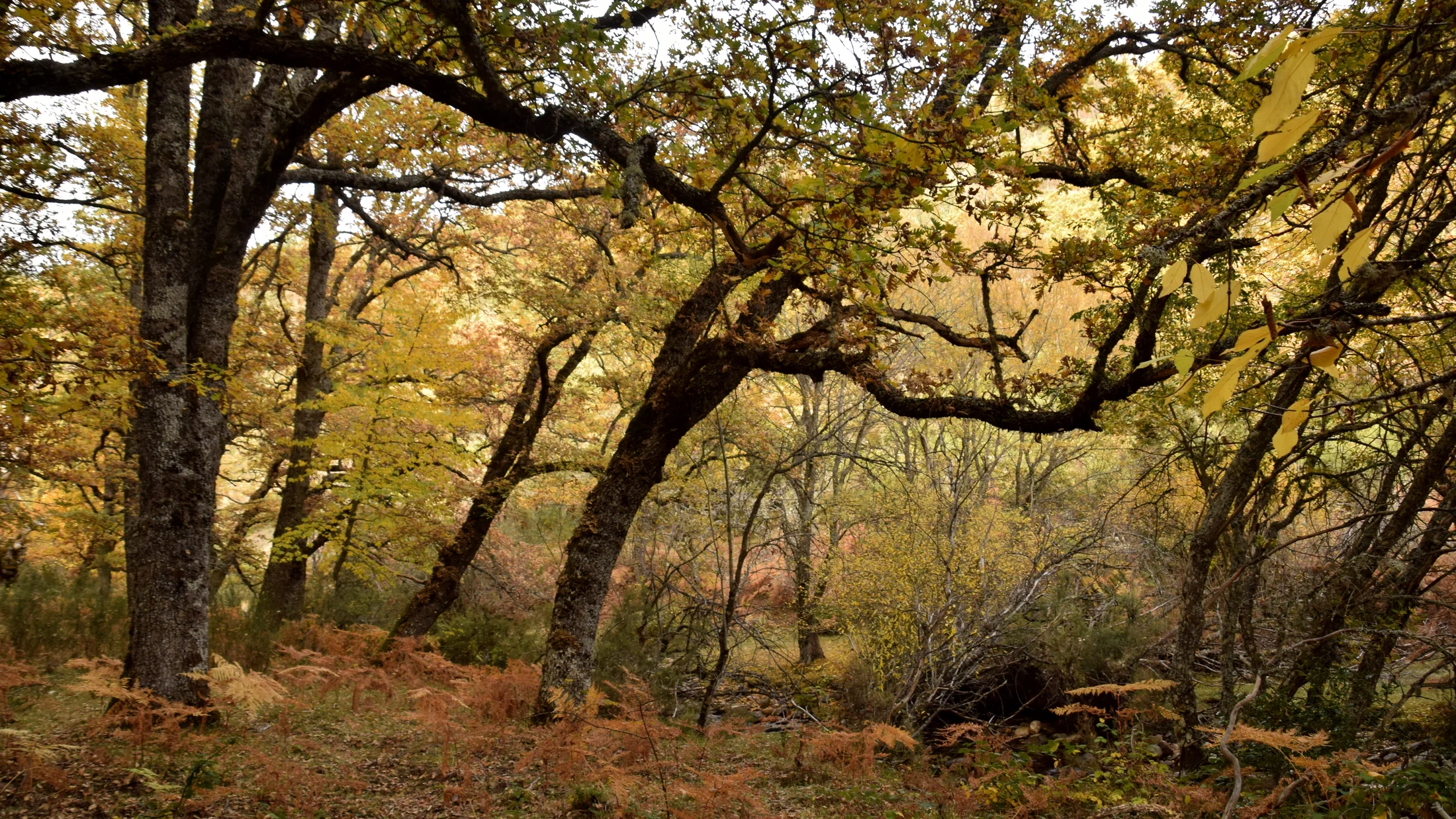
Montejo Beech Forest in autumn: why it deserves your trip
The Hayedo de Montejo is a relict beech forest: a forest of beech trees that survives outside its typical area, in the Sierra del Rincón, northeast of Madrid. In autumn, it changes colour and the ground crunches under your boots, while the river reflects liquid gold on its surface.
The forest is protected by regional regulations and is part of the Biosphere Reserve Network (UNESCO, 2005) and the UNESCO World Heritage site of European beech forests (2017). Visits are always guided and have limited capacity, so it is advisable to book in advance.
This guide brings together how to get tickets, how to choose routes, and tips for organising your visit safely. If you are coming from Madrid, check out the excursions and activities near Madrid first.
Brief history and Natural value
The Hayedo de Montejo is one of the southernmost beech forests in Europe: a survivor of colder climates that arrived after the last glaciation. It covers around 250 hectares on the banks of the Jarama river, where beeches, oaks, holly, and birches form a unique vegetal mosaic.
The Community of Madrid protected it and since 2005 it has been part of the Sierra del Rincón Biosphere Reserve (UNESCO). In 2017, it was integrated into the serial property “Ancient and Primeval Beech Forests of the Carpathians and Other Regions of Europe” recognised by UNESCO.
The forest holds climatic memory and serves as a biodiversity refuge. Its management prioritises conservation, so you have to book in advance to visit it.
What this guide includes and who it is for
Getting tickets for the Hayedo de Montejo has its own process, and here you will see it step by step. The guide brings together how to book, which route fits each profile, and how to set up the visit for a weekend.
It is designed for photographers, families with children, and hikers who travel light. You will find clear and verifiable data, without any filler.
It also includes how to get there, the basic rules of the beech forest, and seasonal tips. Keep your ID and a calendar handy: booking is easier and safer.
Picuco te puede ayudar
Does something here catch your eye?
Tell us.
Write to us on WhatsApp or email: we answer questions, find the best options and help you sort out the booking.
The essentials before going: quotas, schedules, rules and a “quick map”
All routes are conducted with authorised environmental educators.
In autumn, quotas sell out in minutes, so book in advance. Visits are guided and free, with a limited number of daily passes.
Collect your pass in person: if you do not do this, it is considered a waiver and is given to other people on the waiting list.
Open from Monday to Sunday from 09:30 to 14:45, and closes on January 1 and 6, and December 24, 25, and 31.
After the check, you travel in your vehicle to the access point of the beech forest or follow the staff's instructions to start the route.
Conservation rules: stay on the marked path and with the group, do not bring dogs (except accredited assistance dogs), do not pick plants, mushrooms, or fruit, do not light fires or fly drones, and keep silent to respect the fauna.
What to bring: mountain footwear with a good sole, waterproof layer, water, and a snack in a reusable container. Dress in layers, because in autumn it is cool and the humidity is high.
From Madrid, drive via the A-1 to exit 76 towards Gandullas/Montejo de la Sierra and continue via the M-137 to the Information Centre.
When to go and how to get tickets without being left out
The colour peak of the Hayedo de Montejo goes from mid-October to mid-November, but the calendar changes every year depending on temperatures and rainfall. The altitude and the shaded areas also advance or delay the change in each zone of the forest.
Saturdays and Sundays during that period are the most competitive days. If you can, plan your visit during the week and choose the early hours: there are fewer people.
September brings the start of the change in the early specimens and moderate influx. The light that suits you best is the last hour of the afternoon.
October moves quickly from yellow to copper and concentrates high demand, especially during long weekends. Weeks 2 to 4 offer yellows, ochres, and oranges, and the best light arrives in the first hour of the morning.
November is the climax and the leaf fall, with short days and intense colours after the rain. There are some cancellations due to weather. At the beginning and middle of the month, intense ochres and carpeted floors dominate, and the morning after light rain is a good time to go.
1. Online tickets: how to book and tips
Online booking is the main and safest way to visit the Hayedo de Montejo, and some slots sell out in minutes. Enter the booking system of the Comunidad de Madrid by searching for "Reservas Hayedo de Montejo" and check that it is the official portal of the Sierra del Rincón.
Choose the date on the calendar and select the time slot and the available route; routes are assigned for management and conservation. Fill in your details and those of your companions: places are nominative and they may ask you for your DNI or passport on the day of the visit. Confirm the booking and save the receipt on your mobile; the visit is free and usually does not require payment.
In high season, enter the system as soon as the slots for the week open, often on the morning of a specific day announced on the portal. If there is no space, activate browser alerts and check for cancellations in the 24–48 hours prior. If you cannot find a slot, check during the week and consider early schedules.
Avoid duplicating bookings, as they could be cancelled; if you cannot attend, cancel as soon as possible to release places.
2. Draws and allocation systems (High season)
During autumns of maximum demand, the manager of the Hayedo de Montejo may activate draws or pre-allocations to distribute places among more people and avoid system collapses. The process opens a request period of several days in which you sign up indicating your preferred dates and slots.
The draw or allocation is executed on a specific date and the place is notified to you by email. Afterwards, you have a period to confirm or decline: if you do not confirm, the place goes to the waiting list.
To improve your options, choose several slots and prioritise weekdays. Avoid long weekends and the central weekends of October. If you travel in a group, you can subdivide it into two nearby slots. Check your spam folder, because many confirmations end up there.
If you do not get a place, return to the system when cancellations are released: there is usually movement 2–3 days before. The rules of the draw, the deadlines, and the communication vary by season, so book in advance. When the "sold out" notice appears, you have two options left: during the week and early in the morning.
3. In-person tickets and alternatives (Last resort)
They are assigned in order of arrival and depend on availability. Arrive at opening: in autumn, those spots run out quickly.
If you cannot get a spot, the surroundings can be enjoyed just the same without entering the beech forest. In La Hiruela, there are traditional paths through oak groves and mills, with autumn colours; the route leaves the village via a path to the left of the parish and is signposted. In Horcajuelo de la Sierra and Prádena del Rincón, you have forest tracks and viewpoints with views of the Sierra del Rincón. From the Mirador del Puerto de La Hiruela, you can see the carpetanos mountains and the Peñalara peak, with 10 parking spaces; the Mirador del Valle de la Puebla has an information panel and 21 parking spaces.
Another option is Photography of the Jarama riverbank outside the protected perimeter, always respecting properties and signage. The interpretation centres in the villages of the Reserve offer alternative exhibitions and guided walks.
As a last resort, book accommodation in the area and try again during the week. Ask for precise directions at the Information Centre: they will guide you towards itineraries compatible with conservation.
How to get there without getting lost: car, bus and autumn tips
From Madrid, the main axis is the A-1 until Buitrago del Lozoya and then the regional roads M-137 and M-130 towards Montejo de la Sierra.
On rainy days, fog can cling to the valleys, so leave with plenty of time and drive calmly on the winding sections.
Calculate the entire morning: the journey from Madrid, the stop at the centre and the route.
1. By car: routes, parking and recommendations
Reaching the beech forest by car is simple if you leave with enough time. Drive along the A-1 until the Buitrago del Lozoya exit and continue on the M-137/M-130 towards Montejo de la Sierra. Afterwards, head to the starting point indicated to you.
At the entrance, there is limited and free parking. Respect the signage and do not park outside of the designated areas. Car share if you can: it reduces parking pressure.
On October weekends, spots fill up between 10:00 and 12:00, so avoid that window. Add extra time during bank holidays, when traffic increases.
In autumn, check your tyre pressure, wipers and antifreeze level before leaving. Keep a waterproof jacket in the boot. Use GPS with offline maps and save the key points: Information Centre and the beech forest access.
2. Public transport: options and combining means
No train reaches the Hayedo de Montejo: public transport is handled by bus. From Madrid, intercity buses leave for Buitrago del Lozoya (line 191) and from there you connect to Montejo de la Sierra (191B/191C). The total journey is around 2–3 hours depending on waiting times and the day.
Before booking your pass, calculate the return connection. The most comfortable option is to choose a mid-morning or early afternoon pass so that the transfers fit. If the schedule does not work, look for spots for another working day.
The base village is Montejo de la Sierra, 3 km from the beech forest. For the final stretch from the village to the access point (8 km), you can consider a local taxi or walk if you have enough time and a reflective vest.
The visit is guided and mandatory: there is no free access and you are not allowed to separate from the guide, so book in advance.
3. Practical access and safety tips
In autumn, wet leaves are slippery and in November the light falls early. It is advisable to walk with care and calculate your times well.
Arrive at the Information Centre with a 30–40 minute margin. Before leaving, check the status of the M-137 and M-130 roads and the weather warnings.
If your pass is late and the day is short, put a headtorch or a flashlight in your backpack.
Respect the rhythm and the signals of the guide: if you deviate, you lose the experience and separate from the group.
Guided routes within the beech forest: choose your route well
Inside the Hayedo de Montejo you do not choose the path: all routes are carried out in a guided manner by environmental educators. All routes are done with a guide and at a slow pace, so the walk is enjoyed without hurry.
The routes differ by water, slope and views. Before booking, think about who you are going with: families appreciate the flat sections, photographers look for light and shadow among the beeches and hikers who want panoramas choose those that gain altitude.
Book your entry in advance and confirm the meeting point the day before. Wear footwear with grip and a warm layer: in autumn the beech forest wakes up cold and humid.
1. River path: route, highlights and tips
The Senda del río is the most gentle and photogenic route in the Hayedo de Montejo, ideal for families and for those looking for reflections in the water. It runs along the banks of the Jarama through a mostly flat route, with walkways and earthy ground, and is completed in 1 h 30 min–2 h depending on the group's pace.
In autumn, the golden mirrors in the pools are a good reason for the camera. It is a linear out-and-back route of 2.1 km, of low difficulty (1/5), and free.
The pass is requested at the Centro de Recursos e Información de la Reserva de la Biosfera Sierra del Rincón, in Montejo de la Sierra, or via the official website; the centre is open every day from 9:30 to 15:00.
Arrive at the car park of the Hayedo de Montejo recreational area, on the M-139 road. Pets are not allowed, except for assistance dogs with documentation.
To take photographs, a polariser helps to control reflections; the details that stand out most are floating leaves, roots and mossy trunks. Walk on the inside of the path when passing under embankments and avoid stepping on exposed roots.
2. Slope route: panoramas and route
The Ruta de la Ladera climbs up a slope and opens views over the mass of beeches and oaks. It is the panoramic option of the beech forest: it passes near the river and then gains altitude.
The route measures 3.2 km, with 115 m of elevation gain and medium difficulty. The climb is sustained, so aim for short strides and a constant rhythm.
In autumn, backlighting marks ranges of yellow and copper on this path. The early hours are the best time, when the low sun ignites the treetops; if it is windy, add a windbreaker layer and a thin hat.
The route is not suitable for wheelchairs or baby strollers. Wear mid-cut boots and poles if you usually strain your knees, and save energy for the descent: the terrain can be slippery with leaf litter.
3. Combined viewpoint and route: the essentials for a short visit
The combined viewpoint and route condense the essence of the beech forest in a short amount of time: a mosaic of colours, landscape reading, and a natural balcony overlooking the valley. The route has small climbs and is a good fit if you are travelling from Madrid in a single day and want margin for the return journey.
If you go with a camera, position yourself at 45° to the sun to give volume to the treetops and bring a cloth to clean the lens from the humidity. It works well for families as an entry point: it is short, varied, and features interpretive storytelling.
To enter, you need an access pass and an authorised guide. Booking is mandatory and is free. You can also try to book in person on the same day at the Information Centre, subject to availability.
Smoking, eating outside of authorised areas, and bringing pets are prohibited.
Parking is free, although spaces are limited. There is no direct bus: from Plaza de Castilla (Madrid), buses 191B or 191C run to Montejo de la Sierra, and from there you will need a taxi or private vehicle.
What to see in autumn, what to do nearby and where to sleep
Autumn in the Hayedo de Montejo arrives little by little: the leaves change colour, a fine rain falls, and the ground becomes carpeted. With that light and that humidity, the forest is explored slowly, while observing.
Go with calm and quiet observation, and combine the visit with the educational activities organised in the area. This way, the walk is better understood and more rewarding.
If you want to travel without rushing, plan to spend a night in the villages of the Reserve. It gives you margin to return to the beech forest at another time and to get to know the surroundings without watching the clock.
1. Autumn colours and unique trees
Autumn in the Hayedo de Montejo starts at the top: the colour change begins with the most exposed treetops and continues through shaded areas and river plains. There, you will see beeches turning from lemon to copper, oaks of noble browns, and holly under the shadows.
The best days to see it are usually concentrated between the second half of October and the first half of November, with margin depending on each year. It is advisable to book your visit in advance for those dates.
Pay attention to three areas. The riverside sections of the Senda del río offer intense reflections and layers of colour. The elevated slopes open up panoramas that combine beeches and oak groves. In the clearings, birches appear, adding whites and cool yellows.
Avoid touching the mossy bark: it is fragile and houses microfauna.
2. Fauna and Natural observation
In the beech forest, the fauna is heard more than it is seen. On the riverside, blackbirds and robins sing, the great spotted woodpecker drums on the trunks, and the common buzzard glides over the clearings.
Mammals are discreet: roe deer or wild boar leave tracks and rooting marks, but they are rarely seen during the visit.
To observe better, bring lightweight binoculars (8x32) and keep silent. Walk behind the guide to hear their interpretations and detect traces, and choose the early morning period.
Respect the observation ethics: no playback or calls, so as not to startle the fauna. Do not leave the path to pursue a sighting.
3. Complementary activities: photography, families and environmental education
The beech forest changes light throughout the day, and that dictates how you visit it. These are the options that best fit depending on what you are looking for: photography, a plan with children or learning more about the forest.
To photograph, arrive at sunrise and stay during the early hours of the day. After a light rain, the colours are at their peak. Bring a light wide-angle lens (24–35 mm), a short telephoto (50–85 mm) and a raincoat for your backpack; add a lightweight tripod and a soft polariser to control glare. Compose with diagonals of trunks and layers of leaves.
Turn the route into an observation game with a list of non-extractive "treasures" (colours, leaf shapes, sounds of the river) and tell "layers of autumn": ground, canopy and sky.
You can complete your visit to the Hayedo de Montejo in autumn with activities in the villages of the Reserve: orchards, traditional trades and crafts.
4. Accommodation and base for the visit + practical rules
Sleeping in the Sierra del Rincón allows you to reach the beech forest calmly and with more booking options. Montejo de la Sierra, La Hiruela, Horcajuelo de la Sierra, Prádena del Rincón and Puebla de la Sierra have rural houses and small hotels.
If your pass is early, look for accommodation less than 20 minutes from the Information Centre. Arrive the previous afternoon, collect information and check the conditions of your pass. In the morning, have breakfast with plenty of time and park in the authorised areas of the village before following the instructions.
The Information Centre of the Reserve is in Montejo de la Sierra and manages the access passes to the Hayedo. It is open from Monday to Sunday from 9:30 to 14:45 and hosts a permanent exhibition with maps, models, dioramas, an ethnographic collection and audiovisuals about the heritage of the Sierra del Rincón.
Respect these rules during your visit:
- Be punctual: if you arrive late, they may reassign your spot.
- Dogs are not admitted, except assistance dogs.
- Zero waste: everything you bring must leave the beech forest with you.
- Do not leave the path: protect roots and soil.
For bookings and notices, consult the official website of the Hayedo de Montejo and the Sierra del Rincón.
Frequently asked questions
Do I need a reservation to enter the Hayedo de Montejo?
Yes. Access to the Hayedo de Montejo is exclusively via guided tour and prior nominative reservation. The reservation is in the name of each visitor, so it is not enough to register just one person from the group.
On the day of the visit, you must present your ID or passport and carry the voucher on your mobile phone.
When is the best time to see the autumn colours?
The most intense colours of the beech forest arrive, as a guide, between mid-October and early November. The exact date changes every year depending on the weather.
After a light rain, the tones intensify and the ground looks shiny. If you can, choose a day of soft rain rather than full sun: the forest gains contrast.
Can children and people with reduced mobility go?
Yes, as long as you choose the appropriate route and time.
If you are travelling with a person with reduced mobility, consult the Information Centre beforehand regarding which passes and supports are available during the visit season. This way, you can adjust the day to what is available on those dates.
Can I go with a dog?
No, you cannot access the Hayedo de Montejo with dogs. Only accredited assistance dogs are allowed.
The prohibition protects the fauna of the beech forest and the safety of the visits. If you travel with your dog, you will have to leave it at home or look for another plan for that day.
What should I carry in my backpack in autumn?
Wear boots with a marked sole to grip on the slopes. Dress in layers and add a raincoat and a thin hat: it is cool in the early hours and then you can start taking off clothes.
Don't forget water and a snack for the way. Put a cover on your camera and carry your mobile phone fully charged with offline maps, because coverage does not always follow.
If you usually slip on leaf litter, add walking poles. With all this, you can walk peacefully and stop to look at the beech forest without any rush.
What happens if it rains or the weather is bad?
The management of the Hayedo de Montejo may cancel or modify routes for safety or conservation reasons. Before leaving, check your email and the booking portal to confirm that the visit is still going ahead.
If the visit does not take place, have a plan B ready in the nearby villages.
How do I get there by public transport?
From Madrid there is an intercity bus: line 191 arrives in Buitrago del Lozoya and from there the 191B covers the Buitrago - Somosierra route. For the final stretch to the access to the beech forest, organise a taxi or a walk.
Book your experience — discover active tourism activities in Spain with providers verified by Picuco.
Conclusion
The Hayedo de Montejo holds an autumn without artifices: leaves that crunch, water that shimmers and guides who know every tree.
Book in advance, choose your route well and respect the simple rules of the beech forest. Before the visit, consult the official website for schedules and capacities.
Organise your base in the villages of the Reserve to travel without any rush.