Walking at night: why the familiar changes under the stars
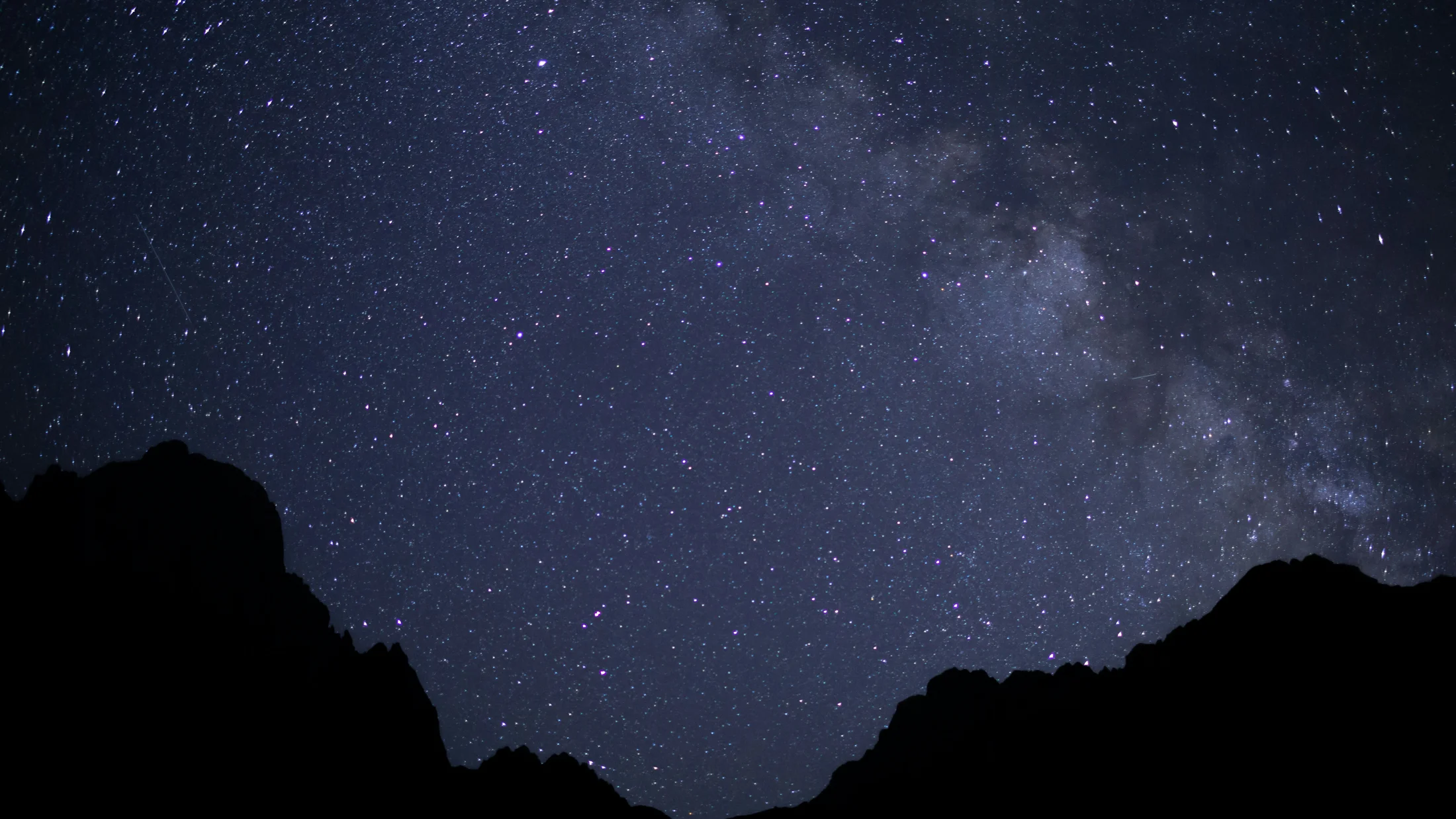
A path you walk every Sunday becomes a different place when night falls. The side lighting from the Moon, the silence among the pines and the celestial vault change the scale of time and detail.
The darkness forces you to listen more and look better. On a clear night, the Milky Way looks like fine dust falling over the valley.
Walking at night has concrete advantages: you connect with nature without extreme heat, you expand your escape schedules and you practise astrotourism with clearer skies for stargazing. It also opens up photography opportunities that do not exist during the day, such as the Milky Way, startrails and an extended blue hour.
It is advisable to know the risks before heading out: orientation, meteorology, fauna and regulations. Taking them into account prepares a safe and responsible experience.
This guide brings together 8 routes under the stars chosen for their accessibility and the quality of their sky. It includes logistics for staying and moving around, the regulations you must comply with and complementary activities such as astronomical observation and nocturnal fauna. At the end, you will find practical tips, frequently asked questions and how to book verified activities.
The rise of night hiking and the charm of astrotourism
Walking at night through Spain already has its own calendar: astrotourism has turned darkness into a reason to travel. Starlight certifications endorse quality dark skies, and night hiking is growing thanks to that seal.
With less atmospheric turbulence and reduced light pollution, stargazing improves and you can walk while avoiding the summer heat.
Night photography has popularised terms such as "galactic arc" or "extended golden hour" and has made isolated viewpoints and hermitages go viral.
The temperature can drop 6–7 ºC for every 1,000 m of altitude, something that is more noticeable at night: bring suitable clothing. Administrations are starting to regulate sensitive access, so check permits before heading out, especially in national parks and reserves.
What you are going to find here
Walking at night changes the body and the mind: here you will see what sensations appear and how to manage lights and noises. Afterwards, you will find eight night routes through Spain, with micro-fact sheets on difficulty, best time, schedules and logistics.
To organise your outing, there is a section for accommodation and transport: refuges, rural houses, campsites, car parks, starting points and safe return points. There are also complementary activities such as stargazing, nocturnal fauna and photography, with resources for planning.
At the end, we gather tips on equipment, meteorology, permits and best practices, with quick lists according to your hiker profile. The article closes with some FAQs with typical doubts and concrete steps to book outings and astrotourism experiences.
Picuco te puede ayudar
Does something here catch your eye?
Tell us.
Write to us on WhatsApp or email: we answer questions, find the best options and help you sort out the booking.
What you will feel and how to move: sensations, safety and night ethics
At night, your field of vision narrows and hearing takes over. Your night vision takes 20–30 minutes to adapt, so use the red light on your headlamp to avoid dazzling yourself.
Relief is read in greys and the texture of the path through shadows: trekking poles distinguish contrast better than colour. Shorten your steps and maintain a conversational pace; on slopes, reduce your speed by two points compared to your daytime rhythm. Drink frequently even if the coolness deceives you: at night you drink less due to thermal sensation, not real need.
Download the track on your mobile with offline maps and carry a physical map and compass as backup. Keep the zoom wide to anticipate changes in direction. To illuminate yourself, use a headlamp of 200–350 lumens with a red mode for stops and astronomical observation, spare batteries or a spare battery pack, and a secondary torch.
Look at the sky before setting off: thermal inversion can bring fog in valleys with clear summits. Check high cloud cover and wind, as more than 40 km/h on ridges reduces comfort and safety. Nighttime humidity makes rocks and walkways slippery, so step flatly, use a pole and footwear with soles in good condition.
Regarding fauna, respect breeding areas and rutting seasons, keep your distance and do not make calling sounds. On the coast, avoid direct white lights on beaches with potential nesting sites. Nighttime ethics are simple: headlamp on low mode, red light during stops and low voice. Do not leave the marked path, do not shine light directly at animals, park in designated areas without blocking agricultural access and do not mark the path with reflective strips or stones: use digital waypoints and pick up your rubbish, including organic waste.
The best conditions are stable nights, without wind, with a New Moon or Waning Crescent and low Bortle sky (class 3–4): clean contrasts and the Milky Way visible. The route can be demanding due to variable cloudiness, haze in archipelagos, old frozen snow or mud after storms. If the wind rises, the fog closes in or someone does not feel well, turning back in time is a victory.
Eight routes under the stars throughout Spain
Eight night hiking routes spread across Spain, with valuable skies and reasonable access. They swap the coast for the mountains and the forest, so there are landscapes for all tastes.
Each micro-fact sheet tells you why the route shines at night, what difficulty it has, what the best time or schedule is and the basic logistics to organise yourself. With that data you can compare and choose the one that best fits your weekend.
1. Sierra de Guadarrama: viewpoints near Madrid with clear skies at altitude
Laguna Grande de Peñalara can be reached from Cotos, and La Pedriza is a granite formation in the Sierra de Guadarrama. On serene nights, the spiraea release a soft aroma that accompanies your walk.
Two itineraries give you the measure. Cotos–Laguna Grande de Peñalara, round trip, is 6.5 km with +237 m, around 2 hours and medium-low difficulty. Collado de la Dehesilla in La Pedriza, from Canto Cochino, is 8–10 km with +426 m, 2 hours 39 minutes and medium difficulty.
Plan the final stretches to reach the summit during a new moon or last quarter between 23:00 and 01:00.
In La Pedriza, car parks have capacity limits and seasonal restrictions, and overnight parking is not permitted. In Cotos, the mountain pass car park can fill up on weekends and during high season, with possible access regulation.
Do not step off the path on the scree slopes: wet rocks are slippery. Consider a short circular return to avoid an excessive descent in the early hours of the morning.
2. Montsec Astronomical Park (Lleida): gentle paths and certified sky
Its narrow valleys separate urban lights and stabilise the air, and sky conditions are suitable more than 60% of the time at night.
Montsec Astronomical Park is located in Àger, La Noguera, and is the best place in Catalonia to observe the sky. These are simple circular routes, suitable for mixed groups, and nearby you have a planetarium and interpretive viewpoints.
If you want more kilometres, the Serra del Montsec d'Ares has tracks and paths: 18.23 km, 1,234 m of positive elevation gain and medium difficulty. Look for a new moon or quarters, with observation peaks between 22:30 and 01:30.
It is advisable to combine the route with a guided observation session before or after, so that your vision adapts to the darkness. In protected areas, stay on the path and respect the signage: some areas limit access due to the breeding of birds of prey. You can reach it via local tracks in good condition and, at night, it is advisable to avoid the edges of the cliffs.
3. Teide (Tenerife): volcanoes, altitude and a portentous island sky
Teide National Park is synonymous with clean atmosphere and astronomical quality, with peaks exceeding 3,000 m. Paths such as Trail 7 ([White Mountain](/en-es/region-types/mountain)) or the Viewpoint of the Fortaleza allow you to cross white pumice that reflects moonlight and facilitates the hike.
-
Why it stands out:
- Trade winds-thermal inversion influence that isolates you from the sea of clouds.
- Wide plains and light-coloured lavas that help in reading the terrain.
- Skies with stable seeing, ideal for star observation.
-
Difficulty and duration:
-
White Mountain (initial section of
Trail 7up to 2,600–2,700 m): +350 m ascent, 5 h, medium. -
Fortaleza Viewpoint (short): 38 m accumulated ascent, maximum elevation gain 24 m, easy.
-
Best time/schedule:
- All year round; avoid episodes of dust haze and strong winds.
- Summer and autumn offer mild nights at altitude.
-
Logistics and restrictions:
-
Final access to Teide Peak via
Trail 10 (Telesforo Bravo)requires a permit.- Bring a thermal layer: at 2,200 m the night temperature can drop below 0–5 ºC even in summer.
- Respect signage and do not step off the trails; the volcanic ecosystem is fragile.
4. Sierra Nevada: altitude and clear nights with an endless horizon
Sierra Nevada offers altitude, open horizons and a dry climate, and its skies have a transparency that you notice when walking at night. Above 2,500 m you move away from light pollution, and many high sections follow clear tracks and paths.
Cerro del Caballo from Nigüelas is the demanding option: it crowns a summit at 3,011 m and offers deep sky. The starting point is on calle del Canalón, in the plaza of Nigüelas (938 m).
Veleta is the fourth highest summit in Spain.
The ideal windows arrive at the end of summer and in autumn, when the atmosphere is more stable.
It is advisable to avoid afternoon storms and freezing snowfalls. Outside of season, occasional snow may fall and light crampons may be needed if there is ice. On the ridges, strong wind is frequent, so have a plan B at medium altitudes.
5. Cabo de Gata (Almería): volcanic coast and dark skies by the sea
In Cabo de Gata, the Milky Way arches over the Mediterranean, between Arrecife de las Sirenas, Vela Blanca and Genoveses. Coves, coastal paths and a dark sky with low relative humidity for being a coast: that is what you have here.
It stands out for the low light pollution in wide stretches of the protected coastline, for its gentle reliefs and for lighthouses that serve as safe references. Also for its settings for astrophotography with the sea in the foreground.
The Mirador de la Vela Blanca–Genoveses route has 320 m of accumulated elevation gain and takes 2.5–3.5 h, with easy-medium difficulty. You set off from the Cala de Mónsul car park and pass by the Torre de la Vela Blanca, from the 18th century, at 212 m altitude. The Arrecife de las Sirenas walk, with its rocky outcrops, is 5.14 km in 1–2 h of easy difficulty.
Go at the end of spring or in autumn, with less heat and more manageable winds, and avoid nights of strong levante, which kicks up sand and worsens visibility. In summer there are sensitive areas due to the occasional nesting of typical sea turtles on the beaches, so avoid direct white light. Park in designated areas, check the summer capacity limits and carry a headtorch with red light mode; protect your equipment from sea dew.
6. Picos de Europa: limestone, lakes and tense skies over sharp peaks
In Picos de Europa, the light-coloured rock reflects the light from your headtorch and the narrow valleys fall silent. That mixture gives night hiking here a different atmosphere.
The altitude is moderate-high and there are nearby refuges for logistics. The light-coloured rock helps if you are carrying a low-power headtorch.
The nocturnal fauna is also part of the walk: birds of prey and red deer during the rut.
You leave the Buferrera car park. The long route passes through the Palomberu beech forest and the Enol river plain: watch out for fog on that stretch.
The Sotres–Collado de Pandébano option, round trip, is 8–10 km with +400–500 m, 3–4 h and easy difficulty. The maximum altitude is 1,333 m and the minimum is 919 m.
Go at the end of summer or in autumn, for the clear skies and less night fog. Avoid the thaw and late snowfalls, which freeze at dusk. The road to Lagos regulates daytime access and the Administration may regulate it if the road becomes congested or if 90% of the parking spaces are occupied; at night it is usually open, so drive with extreme caution due to wildlife.
Orographic clouds can close off the views in minutes. The paths are stony and walking poles are useful for the descent.
7. Monfragüe (Extremadura): dark sky and birds that draw the night
In Monfragüe, the Tagus sounds deep under the stars, and above, nocturnal birds of prey fly. Monfragüe has been a Biosphere Reserve since July 2003, when UNESCO recognised it as such.
The starting point is Villarreal de San Carlos, the only inhabited settlement within the park. From there, gentle routes set out alongside pastures and riverbanks, with little slope: easy difficulty, 280 m of elevation gain and 4 h with stops. Viewpoints such as Salto del Gitano or La Tajadilla allow you to combine walking with listening to nocturnal life, always with prudence and during compatible hours. In Salto del Gitano, griffon vultures, Egyptian vultures and black storks nest.
The sky has low light pollution and Starlight certification in its surroundings. You can do twilight birdwatching and, afterwards, stargazing. There are guided tours during the season with astronomical and ornithological interpretation, and birdwatching activities are free but require prior registration.
Choose autumn-winter for the transparency and long skies; in spring, proceed with caution due to breeding. For birds, go at sunset; for the deep sky, New Moon. Some viewpoints and areas have schedules and restrictions: respect seasonal closures for nesting. Park in designated areas far from farms and do not use powerful spotlights.
8. Somiedo (Asturias): forests, lakes and intimate silence
In Somiedo, night falls completely over glacial lakes, beech forests and mountain pastures, without rush and with clear skies. The high valleys have little nocturnal tourist pressure, so you walk with a sense of seclusion.
The itineraries are short and safe, via tracks and wide paths.
You can hear wildlife in the distance if you maintain distance and respect.
Autumn is the best time due to the stability of the weather and transparent skies; in summer, the nights are mild. Watch out for typical nocturnal mists: plan clear returns.
Mountain roads are narrow: drive calmly for the wildlife and livestock, stay on the paths and respect the closures and the park regulations. Nearby rural accommodation makes short last-minute outings easier.
Where to sleep and how to move around without losing the night
Planning the before and after of a night route gives you a margin of safety and comfort. Think of the trip as part of the outing: if you resolve it in advance, the night remains for the path.
Sleeping near the starting point avoids long journeys in the early hours. Before booking, check where you are going to park and leave the car positioned for the return. Set a realistic departure and return time: this way, the night doesn't slip away in transfers.
The cold air of the early hours is better managed with a thermos and a blanket waiting at the end. Book your accommodation in advance and confirm the arrival time, especially if you are returning in the early hours.
Accommodation according to the type of route
Where you sleep decides how the night ends. Choose your accommodation thinking about the objective of the outing and how you are going to return.
Mountain refuges are the option for demanding routes in high mountains, such as Sierra Nevada or the Picos: they shorten approaches and provide shelter. Book in advance and respect the silence rules.
Rural houses and rural hotels work well for setting off from parks and for resting after returning in the early hours. Confirm late check-in if you arrive very late; they work well for couples and families.
Campsites are a good base for stargazing sessions and gentle routes, with dark skies and affordable prices. Keep nocturnal silence and dew in mind; they suit astrophotography and groups.
If you prioritise astrotourism, look for accommodation far from direct streetlights, with dark outdoor spaces and silence hours. Having them organise outings or observation talks adds points.
Times, travel and returning sensibly
Set off 60–90 minutes before the peak of darkness: your eyes need that time to adapt. Eat a light dinner 1–2 h before and hydrate as you would on any daytime route.
The good window to reach the summit or the viewpoint is from 22:30 to 01:30, depending on the season. To return, calculate 30% more time than during the day.
If you go in your own car, park in official areas and leave a visible note with the expected return time if you consider it useful. Public transport is useful for approaches like Guadarrama, but it is rare for nocturnal returns: consider a local taxi for the return.
In car parks near villages, avoid slamming doors and loud voices. Do not use high beams towards houses or livestock, and walk in a line with low light at the beginning and end of the route.
Permits, restrictions and advance bookings
In reserves and sensitive areas, such as those for birds of prey or sea turtles, seasonal closures during spring and summer are common.
Regulations can be consulted on the official websites of the park or the regional government, as well as in visitor centres and the park's nursery. If you are going to sleep in a refuge, book weeks in advance during high season: spaces are limited.
Astrotourism activities fill up on weekends and during the New Moon, so plan them with plenty of time to spare.
Save the emergency and accommodation phone numbers on your mobile and also on paper: if the battery fails, paper saves the night.
What else to do out there: stars, nightlife and photography
When night falls, the route does not end: it expands. A short hike can turn into an astroturism session, a wildlife listening session, or a stellar landscape photography outing.
For astroturism and night photography, bring a tripod and plan the outing during hours of total darkness. This way, you make the most of the dark sky and return with the photos you were looking for.
Astronomical observation: from the Pleiades to the galactic centre
Choose a night with a New Moon, or with less than 30% illumination, and the sky will do half the work. The best hours are from the first two after dusk until two before dawn, depending on what you want to see; the arc of the Milky Way is best seen from May to August.
Prepare the session with planetarium apps for the position of the arc and meteor showers, and bring a printed star chart as a backup. A pair of 7x50 or 10x50 binoculars is enough to see clusters, the Orion Nebula and Andromeda. A lightweight telescope only if it does not compromise the hike.
To combine the route and observation, walk for 45–60 min, turn off the lights, observe for 30–45 min and resume the route. In destinations with an offer, add a guided activity before or after the hike to interpret what you have observed.
Use red light and do not illuminate other groups: shared darkness is a tacit pact between enthusiasts.
Nighttime flora and fauna: observing without disturbing
In a forest at night, the first sign of a Eurasian eagle-owl is usually its voice, not its silhouette. Forests and pastures host nocturnal birds of prey such as the Eurasian eagle-owl and the tawny owl, as well as red foxes and wild boars. In high mountains, you can see Pyrenean chamois at dawn and rock-dwelling birds on the cliffs. On the coast and in wetlands, nightjars, bats and amphibians appear, and in summer, it is possible for turtles to nest in the Andalusian Mediterranean.
The basic rule is distance: if the animal stares at you insistently or changes its behaviour, you have approached too closely. Always use red light, without long sweeps, and never directed at the animals' eyes. Avoid calls, clapping or whistles except in an emergency, and do not leave food or attract wildlife to the trails.
In grazing areas, wear long trousers and check yourself for ticks upon your return. During the rut (September–October), keep your distance from red deer and do not enter the marked mating areas.
Night photography: simple tips that work
With a stable tripod and a camera in manual mode, you already have almost everything needed to photograph the night sky. The rest is a matter of starting settings and a couple of habits that make all the difference.
Bring a tripod, a camera with manual mode, a memory card, and extra batteries. Shoot using an intervalometer or a timer to avoid camera shake, and use a red torch to adjust the camera without losing your night vision.
To start, set it to manual mode, f/2.8–f/4, ISO 1600–3200, and 10–20 s exposure. Apply the 500 rule to avoid star trails. If you are looking for startrails, use ISO 800–1600 with 20–30 s exposures in sequence.
Frame with a nearby element, such as a solitary tree, a rock, or a shelter, to provide scale. Use lines like paths or fences to lead the eye towards the sky. Point the camera north for circumpolar stars or south for the galactic arc depending on the season.
Set up your equipment before dusk if you can, and control dew with a microfibre cloth or lens heaters. Do not block the path with your tripod: leave the way clear.
Essential tips: equipment, timing and permits in order
Going out prepared is what allows you to enjoy the route: the right backpack and a plan B are your best security. Before setting off, check what you are carrying, how much you are going to walk, and what permits the terrain requires.
Essential equipment and recommended extras
A headtorch of 200–350 lumens with a red mode and adjustable beam changes the night: you can see the path without dazzling the person walking with you. Also, bring a small secondary torch, batteries or a power bank, and your mobile cable so the light lasts the whole route.
Clothing should be worn in layers: thermal, fleece, and a windbreaker or waterproof jacket. Add a thin hat and gloves, even in summer if you go up to high altitude. Your footwear needs soles in good condition, and trekking poles will help you on descents.
For safety, pack a basic first aid kit, an emergency blanket, a whistle, and a small pocket knife in your backpack. Bring a map and compass, and an app with offline maps in case signal fails.
If the route is for stargazing, add a lightweight mat or a seat for observation stops. A pair of 7x50/10x50 binoculars and light filters for your headtorch complete the kit. A thermos with a hot drink and salty and sweet snacks makes the waiting more bearable.
Adjust your equipment to the season and the altitude: less weight on a temperate coast and more warmth and light reserves above 2,000 m.
Meteorology: when to go and when to postpone
Before heading out, check the AEMET forecast by municipality and by mountain areas. Based on that, you can decide if the night offers what you are looking for or if it is better to move the date.
For the sky, use models and apps that indicate high and medium cloud cover and wind on ridges, and satellite maps for dust haze or fog. High cloud cover in a thin layer ruins the deep sky and reduces contrast: if you are going stargazing, avoid it.
Wind also matters. With sustained wind exceeding 40 km/h on a ridge, there is more fatigue and heat loss, and that is enough to postpone the route. Add the nocturnal temperature drop and the wind chill factor when choosing your clothing.
There are two clear signs to cancel or postpone: active weather alerts and convective storms in the afternoon that do not subside. In archipelagos, dense dust haze prevents astronomical observation, so postpone the trip if that is the objective.
And if the group is accumulating fatigue or there are logistical doubts, it is better not to go out: deciding not to go out is also part of planning.
Permits, regulations and communication
In Teide, walking at night requires a permit and only during specific time slots: from 6:00 to 9:00 h and from 18:00 to 22:00 h. You can book it on the Tenerife ON platform, via the web or app, from the Cabildo de Tenerife.
At the start of the trail, you can arrive on foot from the base or via the cable car.
In La Pedriza and Los Lagos de Covadonga, there are access and parking regulations, so inform yourself before heading out. Permits are processed on the official website of the park or department, sometimes with online forms, or at the park's visitor and ranger centres during daylight hours.
Before starting, share the itinerary, the departure and return times, and an alternative with a trusted contact. Carry a fully charged phone and, if you are going to areas without coverage, consider a lightweight satellite communicator.
The best regulation is the one you internalise: low light, low voice, high respect.
Emergencies and best practices
An injury in the middle of the night must be handled calmly and with a clear order. Assess the ABC (airway, breathing, circulation) and avoid moving the person unnecessarily. Keep them warm, mark the location, and call emergency services with clear data: a landmark and the coordinates if you can.
If you lose your way, stop and mentally return to the last clear point. Consult the offline map and the compass, and if it is safe, backtrack to the last recognised landmark.
When the weather changes, put on your windbreaker or waterproof jacket. Reduce exposure on ridges and seek shelter on less ventilated slopes.
On the route, do not leave any waste or marks. Avoid bright lights and music, and help other groups if they need it without invading their autonomy. Serenity in the face of the unexpected is your most valuable tool at night.
Frequently asked questions
Is night hiking safe for beginners?
Yes, it is safe for beginners if you choose simple routes, plan ahead, and go with company. The key is to start with familiar terrain and leave technical terrain for later.
For your first night outings, opt for well-marked tracks or paths of less than 8 km with moderate elevation gain (<300 m), preferably ones you know from the daytime. Avoid ridges and technical terrain. Go with someone experienced or hire a guide.
Carry a headtorch with red light so you don't lose your eyes' adaptation to the dark. In your backpack, pack water, warm clothing, and an offline map: it weighs very little and reduces risks. If you have doubts due to the weather, postpone the outing.
The night magnifies small mistakes: shorten your objectives and prioritise returning with a margin. If you feel a chill on the back of your neck, keep moving and hydrate.
What age or fitness level is required?
There is no fixed age: your fitness level and the route you choose are what matter. An eight-year-old child on a flat walk will do better than a sedentary adult on a long climb.
If you are going with family, look for walks of 3–5 km on wide tracks without exposed sections, and plan observation stops to keep motivation high. With minors, explain the dynamics of light and silence and assign one reference adult for every 1–2 children.
For untrained adults, a good start is outings of 6–8 km and +200–300 m of elevation gain.
If the route aims for altitude (Sierra Nevada, Teide), prepare for acclimatisation and layers of warm clothing. Train by walking during the day 2–3 times a week and include a sunset outing to simulate the conditions.
What happens if the weather changes or there are cancellations?
The weather rules a night outing, so it is advisable to know in advance what happens if it is cancelled. In guided activities, check the cancellation policy: it is common to reschedule or refund part or all of the amount if the weather prevents the outing from being carried out safely.
If you are going on your own, check AEMET and cloud and wind apps the previous afternoon and two hours before the outing. There are clear signs to cancel: active alerts, nearby storms, strong gusts, or persistent thick fog.
Have a plan B, such as a lower altitude or a shorter route, and maintain a flexible mindset. If the objective is stargazing, high cloud cover ruins the session: it is better to postpone.
To minimise losses, book accommodation with flexible cancellation and confirm services on the same day.
Do I need a guide or can I go on my own?
Both options are valid. With a guide, you gain safety, astronomical and wildlife interpretation, and a route tailored to local regulations.
A guide is recommended if you do not know the place, if it is high mountain, if you are looking for astrotourism with interpretation, or if the group is heterogeneous. Going on your own gives you flexibility in schedules and rhythms, and you can improvise photographic stops.
If you go on your own, limit your ambition during your first outings and share your plan with someone. In both cases, the night demands respect: low light, low voice, eyes wide open.
How and where to book night routes and astrotourism activities?
Booking a night route is a matter of looking in the right place and doing it in advance. Specialist outdoor activity platforms with verified providers are the first place to look. Official park websites, which publish schedules for interpreted routes, and rural accommodation that organises trips to nearby viewpoints also work well.
In high season (June–September) and during new moons, book 2–3 weeks in advance. It is advisable to secure your spot as soon as possible on weekends; there is usually more availability during the week.
Before paying, ask about the group size, the technical level, the included equipment, the cancellation policy and the plan B. Also ask for the specific regulations for the activity, including schedules and sensitive areas. Basic guided outings move within reasonable price ranges per person depending on duration and group size, so confirm the updated conditions when booking.
The key lies in aligning expectations: a short hike plus a well-guided observation session is worth more than a long trek in a rush.
Book your experience — discover active tourism activities in Spain with providers verified by Picuco.
Conclusion
Walking at night lowers the noise of the day, allows you to see the stars better and sets a slow pace. In Spain, you have eight routes to try it out, from Sierra de Guadarrama to Cabo de Gata, passing through Montsec, Teide or Monfragüe.
The article also gives you keys to sleeping nearby, moving around in an orderly fashion, observing the sky, recognising wildlife without disturbing it and photographing with intention. To start, choose a short and well-known route, check the weather and carry a headtorch with red light. If you want to gain confidence, join a guided activity.
If you are unsure, come back. If you are sure and safe, enjoy. The next new moon is near: plan your first night route this season.