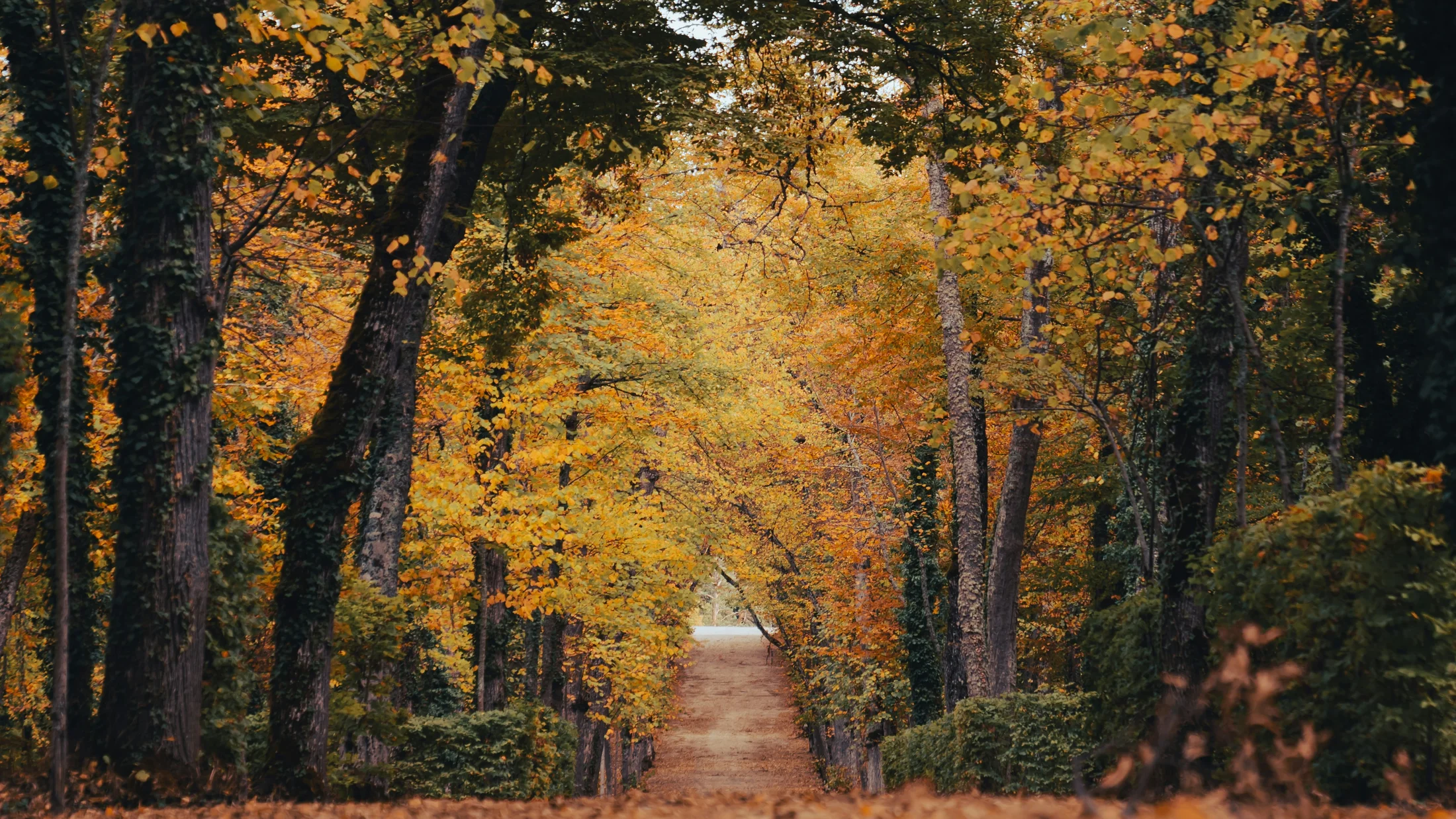
November in colour: why it is the perfect time to lose yourself in the forest
The context that makes November great
November is the hinge of the year: the light lowers, the air cools, and the countryside ignites. If you are thinking about autumn November getaways, this is the month when beech forests and deciduous woodlands reach their peak in many Spanish mountain ranges, when the yellows of the birch, the ochres of the beech, and the reds of the oaks draw maps of fire. You move during the low season, with fewer cars in the valleys and better prices on accommodation. AEMET records average daytime temperatures of 8–14 °C in inland Spain and 14–20 °C along the Mediterranean in November, with cold nights in the mountains; it is a cold that invites you to walk and then seek out a fireplace. The air smells of wet leaves and freshly lit firewood.
Furthermore, the lower influx of people frees up trails and viewpoints that in summer force you to wake up very early. The windows of colour vary by altitude and latitude: at 1,500–1,800 m the peak usually falls between the first and second week; in low valleys and vineyards, it pushes to the middle or end of the month. Everything adds up to a more serene and photogenic experience. You decide whether you are looking for the Atlantic north, with intense colour and changing weather, or the Mediterranean east, which is milder and more child-friendly. The crunch of leaves under your boots accompanies every step.
What you are going to get from this guide
Ten destinations where colours explode in November, with their reasons, key routes, and the weather you can expect. The guide helps you decide where to go and how to set up your getaway.
Inside, you will find how to get around by car, train, or bus, what type of accommodation suits you, and how to book wisely. There are also seasonal activities and two ready-made itineraries: one for a weekend and another for 3–4 days, with distances and plan Bs in case it rains.
The mist over a valley at dawn sets the tone for many of these outings. At the end, tips for adjusting dates, checking the leaf report, and organising your getaway without surprises.
Picuco te puede ayudar
Does something here catch your eye?
Tell us.
Write to us on WhatsApp or email: we answer questions, find the best options and help you sort out the booking.
Climate, colour and calm: this is how November works in practice
November is a corridor between full autumn and the first snows, and the colour shifts from north to south and from mountain to plain. Depending on where you go, the peak of colour falls on a different date, and that allows you to choose.
In the Cantábrica and the Pyrenees, above 1,500 m, the peak of colour usually occurs between late October and the first half of November. In mid-range mountains (1,000–1,400 m), it lasts until mid-month. In low valleys and vineyards, the reds and golds can hold out until 20–25 November if an early storm does not arrive.
The weather changes a lot from one coast to another. On the Atlantic coast (Galicia, Cantábrico, north of Castilla y León, Navarra), November brings frequent fronts: an average of 10–15 days of rain, daytime temperatures of 8–14 °C and nights of 0–6 °C in the mountain interior. In the eastern Mediterranean (Catalunya, Valencia) and the Ebro valley, mild days are more common, with 14–20 °C at midday, although the tramontana and cierzo winds can cool and dry the atmosphere. On the interior plateau, there is thermal inversion: cold mornings and mild afternoons if it clears up.
Light dictates the planning. After the time change, the sun sets between 17:45 and 18:10 depending on latitude, with sunrises around 7:45–8:10. Start your 3–5 hour routes no later than 11:00 and save the twilight for viewpoints close to your car. In high mountains, ice can form plates in the shade; some light crampons won't hurt if you climb to high altitudes.
Choose your date wisely. During the week, there are free parking spaces and silent forests; during long weekends (1 November, sometimes the 9th in Madrid, and the one in December if you plan ahead), the most famous destinations concentrate visitors. The service network adjusts: fewer bus and regional train frequencies, restaurants with shorter hours, and some accommodations that close on Monday and Tuesday.
Be flexible for 7–10 days: move your trip according to the weather forecast and local colour reports. Choose a microclimate according to your objective: intense colour, mists and beech forests in the Atlantic north and the Navarrese Pyrenees; mild walks with medieval towns in the interior of Girona, La Garrotxa and Besalú; vineyards and wine tourism in Rioja, Ribera del Duero and Somontano; mountains with cold days in Ordesa, Picos, Gredos and Urbión. Combine altitudes: if one altitude has passed its colour peak, go down 300–500 m and you will recover the tones.
Before heading out, consult AEMET for the 7-day forecast and meteograms by valley, and cross-reference this with warnings from the Red de Parques Nacionales and local forums.
When to go: how to choose your dates in November wisely
The week you choose decides whether you find a forest on fire or bare branches. Beech forests, oak groves and vineyards do not change colour at the same time, so cross-reference altitude and latitude with the state of each ecosystem before booking.
Beech forests (Fagus sylvatica) turn from old gold to copper, and their best days are from 1 to 15 November in the north and east of Spain depending on the altitude. Oak groves (Quercus robur/pyrenaica) undergo a broader transition and hold on well until mid-month on low slopes. Birch forests (Betula) turn quickly and drop fast, so they should be prioritised at the beginning of the month.
In the vineyards, Tempranillo tends towards red and Viura towards yellow, and tourist offices report on colour routes between villages. If you travel through vineyards, consult harvest calendars and autumn fairs: some wineries open on weekends with tastings and seasonal menus.
La Laguna Negra is near Vinuesa, in the province of Soria, and offers a contrast between forest, rock and lagoon. The terrain can change rapidly due to rain, fog or ice.
Before heading out, check the websites of natural and national parks, which publish access notices and notes on colouration. Local tourist offices update photos weekly, AEMET provides rain maps and minimum temperatures, and mycological associations indicate if mushroom season is active, a good indicator of humidity in the forest.
During the week there is maximum calm, easier last-minute bookings and better light. At the end of the month there is less crowds and more muted colours at high altitude; compensate for this with vineyards and mid-altitude mountain ranges.
To finalise dates, choose two areas with different altitudes. Confirm the forecast and local colour reports one week in advance, and book rural accommodation with flexible cancellation, heating and early breakfast. Leave one morning free to move to a nearby valley if the colour window changes.
In regulated beech forests (Montejo, with limited entries in specific areas) process permits with a few days' margin. After a strong wind storm, leaves can fall in 48 hours: if you see a powerful storm approaching, bring your trip forward or look for lower altitude.
Moving around and resting: transport and accommodation designed for autumn
How to get there: car, train and bus
In November, the key is to combine flexibility and foresight: a car lets you chase the colours from valley to valley, the train is comfortable and the bus brings you closer to the base towns at a good price.
A car allows you to stop at viewpoints and adjust to the daylight hours. In exchange, you will find wet mountain roads, morning mists and occasionally limited parking in Ordesa and Montejo. Before setting off, check your tyre pressure and wipers, and bring a scraper and a headtorch. Also check for closures and restrictions: access to the Pradera de Ordesa may be regulated during long weekends. Park in the designated car parks and arrive early to popular routes. After rain, avoid muddy tracks and park on firm ground.
The train leaves you rested, reduces your footprint and allows you to take advantage of Promo fares, although the last few miles to the trails usually require a bus or a rural taxi. Combine it with a local bus or transfers from your accommodation, and ask about schedules adapted to weekends.
The bus is economical and local networks connect valleys, but in November there are reduced frequencies and fewer services on public holidays. Check local holidays and long weekends, and whether they accept bicycles or large suitcases. Cross-check your outbound and return times so you don't get stranded; in very rural destinations, consider a shared taxi from the base town at the start of the route.
At trail entrances, carry the tracks downloaded on your mobile with offline apps in case coverage fails. Identify the route codes to orient yourself: GR-11 in Pirineos, PR-HU in Huesca, SL-GU or equivalents.
Where to sleep: rural houses, charming hotels and campsites
In November, rural accommodation is chosen for the fireplace, the early breakfast and the forest at your doorstep. Rural houses offer calm, close personal service and seasonal cuisine; small hotels add extra services, and some campsites remain open with heated bungalows.
In a rural house, look for real heating (not just a stove), thermal bedding and the possibility of dining there or having a nearby bar recommended that stays open during the week. For long weekends, book 2–4 weeks in advance; for a normal weekend, 7–10 days are enough.
Charming hotels and rural hostels have reception desks with wider hours and breakfasts starting from 7:30–8:00; some include a spa or small saunas. Check that you can walk to the bars, look for covered parking if it rains and local taxi agreements for linear routes.
Ask about sustainability measures (biomass, km 0, waste management) and support projects that care for the territory. Also ask for local information about the best viewpoint at sunset, a bar open on a cold Wednesday and the condition of the tracks.
Many campsites close in winter in forested areas, but some keep bungalows open until December. Check the heating, ensure the pitch does not get waterlogged and that services are open (hot showers, basic shop). As an alternative, you have motorhome areas with services, checking the local municipal regulations beforehand.
Always choose bookings with flexible cancellation: November is variable and it is wise to be able to change without cost. For families, look for spacious rooms, cots and 1–2 hour walks nearby. For couples, a fireplace, a bathtub and a mushroom or game dinner. For groups, entire houses with a large living room and a big table, and check the electrical power if you are going to cook.
The warm light of a lamp on old stone invites you to linger over your meal.
10 destinations where colours explode in November
1.Ordesa y Monte Perdido National Park (Huesca): gorges and golden valleys
In November, the beech forests of Ordesa turn golden under 800 m walls and alongside waterfalls that descend with force after the rains. Ordesa y Monte Perdido National Park, in Huesca, is an autumn getaway for walking among forests and gorges.
The Monte Perdido massif reaches 3,355 metres and is the highest limestone massif in Europe. In Pineta, the glacial amphitheatre shines with golden beeches and backlighting; the altitude is similar to that of Ordesa and somewhat colder.
The classic route is the Cola de Caballo Waterfall via the Gradas de Soaso: 5–6 h and a positive elevation gain of 450-500 m. Along the way, there is a small carving of the Virgen del Pilar. The Faja de Pelay is a panoramic variant of moderate difficulty, so be careful if there is ice.
In Pineta, the route to the Llanos de La Larri is 8.5 km round trip and takes 3–4 h. You access it from Bielsa via the HU-V-6402 road for 13 km. Parking costs €1.5/day in high season (free the rest of the year), with a small free car park 100 m further down.
If you want something gentle, the Beech Forest and the Ordesa Viewpoints have short circuits starting from La Pradera. Technical routes such as the Faja de las Flores are not recommended with ice or snow; it is better to reserve them for summer.
In November, morning mists and ice in the shaded areas are frequent. It is advisable to get up early and bring waterproof footwear, poles, and a headtorch. Park early on clear days: the sun sets at 17:45–18:00.
Torla-Ordesa is the usual base. In low season, access to La Pradera by car is usually permitted, and during long weekends, the bus from Torla may be reactivated. In high season (summer, Holy Week, and holidays), car access to La Pradera is restricted and you must use the shuttle bus from the Torla car park, with a 20 min journey.
To sleep, look for hotels and rural houses in Torla, Broto, or Bielsa (for Pineta), with good heating and early breakfasts. The smell of fireplaces in the stone streets accompanies your evening stroll.
2.Irati Forest and beech forests (Navarra): the splendour of the beech forests
At the beginning of November, the Irati Forest turns shades of gold and copper. It is one of the largest beech-fir forests in Europe and, during these dates, the beech forest is the benchmark for autumn in Spain.
The access points from Ochagavía (Orié, Irabia) and Orbaizeta lead to walks among beech forests.
By car, you reach it via the Mendilatz detour, passing the Information Point and the Arrazola customs, where authorisation is required for regulated passage. There is a small car park just before the dam wall, so it is advisable to get up early.
Access car parks are regulated with quotas and a conservation fee: €3 for motorcycles, €7 for cars (€4 if you stay in the valleys or spend more than €15 in their establishments), €28 for minibuses, and €45 for buses. Access is cut off when the car parks are full, and entrances close from 18:00, so arrive early on weekends and long weekends.
Bring waterproof clothing and set aside 3–4 hours to enjoy it calmly. Respect the signage, do not leave the paths, and do not collect flora. The village bells sound muffled by the mist.
To sleep, look for rural houses in Ochagavía, Ezcaroz, and Burguete/Auritz, with a fireplace and game or mushroom dinners. If you are travelling as a family, ask about triple rooms and flexible breakfast.
3. La Rioja: vineyards and harvest landscapes
It is time for tastings, walks among the vines and roasted peppers in the towns.
The mild temperatures of 12–18 °C allow you to combine the countryside with unhurried visits to wineries. At sunrise, the stillness of the vineyard is a golden whisper.
For wine tourism, check the autumn schedules of the wineries: many offer pairing menus. Book tastings weeks in advance during long weekends and, if you are going to taste, leave the car and use a rural taxi.
Nearby are Laguardia, in La Rioja Alavesa, and San Millán de la Cogolla, whose monasteries have been UNESCO World Heritage sites since 1997. Briones is situated on a hill 80 m in altitude, with a north slope on an almost vertical incline over the Ebro river.
Sleep in small hotels and rural houses among the vines or in the towns, and ask for early breakfasts. Bring a coat for the cold sunsets: the sun falls early among the vines.
4. Las Médulas (León): ochres and mining panoramas
In Las Médulas, the red of the clays blends with chestnut and yellow oak trees. The ancient Roman gold mine is a cultural landscape that changes colour in autumn.
The viewpoints and galleries tell the history and geology of this open-pit mine. The Mirador de Orellán offers a panorama of red needles and forests: it is reached via a local road and a short path.
The Galería de Orellán traverses about 100 metres of an ancient water conduit (Ruinae Montium) to a balcony on a vertical cut of the mountain. General entry costs 4 € and groups 3 €, cash only. From 27 March to 9 December it is open every day from 10:00 to 20:00, with last entry 30 min before closing and subject to weather conditions.
The visit is completed by the Carucedo Lake, formed by the exploitation of the Roman gold mines using the ruina montium method, and towns such as Villafranca del Bierzo.
Arrive by car via narrow local roads and park in designated areas. Avoid the paths after heavy rain, because the clay is slippery, and bring a torch for the authorised passages.
To sleep, look for rural houses in Carucedo, Orellán or Ponferrada, which is the base with the most services. In autumn, try chestnuts, botillo and mushrooms, and book dinner on working days. The after-dinner conversation smells of slow-cooked stew.
5. Garrotxa and Besalú Volcanic Zone (Girona): forests and medieval towns
In autumn, mild days of 12–18 °C are expected if the tramontana is not blowing. The paths are firm, over basaltic flows, with wooden benches and clear signage.
The itineraries of La Fageda range from 3–10 km, are flat and are suitable for families and photography.
In Besalú, its Romanesque bridge stands out; the town is in the region of La Garrotxa. Information centres offer maps and daily recommendations.
You reach the entrance via the Railway route, on its section between Olot and Les Preses. Respect the rules: do not leave the marked paths, do not make fires, do not camp freely and do not drive vehicles off roads and tracks.
Parking is regulated on weekends, so it is advisable to arrive early.
6. Hayedo de Montejo (Madrid) and nearby forests
A beech forest of 222 hectares, with a maximum altitude of approximately 1,600 metres, is the express autumn getaway for Madrileños. The Hayedo de Montejo has been a UNESCO Natural World Heritage site since 2017.
Access is regulated by quotas, so you must book in advance. Online bookings open on the 1st and 16th of each month at 09:30 for the following fortnight: you have 5 days to request a spot and they are assigned by lottery. Online booking only works with the Google Chrome browser.
You collect your access pass at the Centro de Información de la Reserva de la Biosfera, located 8 km before the Hayedo. Visits are free and there are guided and self-guided trails along marked itineraries; it is worth checking the current options.
If you go on a weekend or a long weekend, book 7–10 days in advance, arrive 30 minutes early, and bring your digital or physical confirmation. Wear waterproof footwear and a jacket: the valley holds moisture.
If there are no spots available, you have nearby alternatives, such as the beech forests of Tejera Negra (Guadalajara), with regulated parking access and reservations valid until 13:00 on the reserved day. To sleep, look for rural houses in Montejo de la Sierra, La Hiruela, or Rascafría, which are comfortable for a weekend with children. A thin smoke rises from the chimneys at sunset, and you will fancy a hearty soup-based dinner and a walk through the mountain villages.
7. Parque Natural de Somiedo (Asturias): fauna and autumnal lakes
In November, the silence of the low season in Somiedo allows you to hear roe deer at dawn. The park is a narrow valley of brañas, beech forests, and lakes, with slate roofs and curing cheeses.
The fauna is the other reason to come: capercaillie, roe deer, and bears in autumn dispersal, always at a distance and with respect. Early snow may appear on the summits.
The classic route is that of the Lagos de Saliencia: 8–12 km depending on variants, of moderate difficulty, and it starts at Alto de la Farrapona, at 1,700 m altitude. Lago de la Cueva is the first one and is surrounded by green meadows; Lago Cerveriz stands out for its turquoise waters and Lago Calabazosa for its dark waters and great depth.
Another option is the route from Valle del Lago to Lago del Valle: 12 km round trip, 300 m of elevation gain, and 4–5 h.
The weather is changeable, with frequent fog and rain. Bring warm, waterproof clothing, a map, and a headtorch, and respect track closures and wildlife reserve areas.
For sleeping, there are rural accommodations in Pola de Somiedo, Valle de Lago, and Saliencia. Autumn cuisine includes fabada, game, and mushrooms, and it is advisable to book dinners during the week.
8. Picos de Europa: viewpoints, lakes and paths amidst colours
In November, the Picos de Europa mix white limestone rock with reddish beech forests in the valleys. After the passage of weather fronts, days of great clarity arrive, offering long horizons from the viewpoints.
In Fuente Dé (Cantabria), the cable car operates most of the year, although there may be ice or snow in the high area.
The Cares Gorge has passable sections. The Posada de Valdeón - Poncebos route measures 21 km, with 899 m of descent and 160 m of ascent, and takes between 3 h 20 min and 5 h 30 min to complete. Watch out for humidity and polished stone.
For something gentler, the Lakes Path offers an easy circular route. The Panderrueda Viewpoint can be reached by car and allows for short walks. You cannot reach the Ordiales Viewpoint by car: you must go on foot via the PR-PNPE 5 route from the Buferrera/Lago Enol parking lot.
In November, the days are short, so plan 4–6 h routes with a margin. Wear footwear with good grip, use walking poles, and bring microspikes if there is ice.
To sleep, Potes works well as a base with services; the inland villages offer total calm. Book early breakfasts and reliable heating.
9. Sierra de Gredos (Ávila): summits and golden valleys
In Gredos, sharp granite mixes with oak groves in bronze tones. November is a good month to contrast the Laguna Grande with walks around the area.
The classic route leaves from the Plataforma de Gredos towards the Laguna Grande: 13 km round trip and 600 m of positive elevation gain. Watch out for ice on the return journey, because there can be early refreezing at the summits, so it is advisable to carry light crampons.
The valleys maintain their yellows until mid-month. To go with children, the Garganta de los Conventos, in Hoyos del Espino and Navarredonda, is a family route.
Only for those with experience and with a stable weather forecast.
Access to the Plataforma de Gredos is regulated by capacity: arrive early on weekends and holidays. Before leaving, check the AEMET forecast for the specific Gredos Sierra area.
At the table, smashed potatoes and grilled meats; book a table on weekdays. The glow from a stone fireplace accompanies your tiredness.
10. Sierra de Urbión and Laguna Negra (Soria): altitude and contrasts
In November, the Laguna Negra wakes up with mists, and the still water reflects the last yellows. Surrounded by Spanish firs and beech forests, the silence becomes denser.
The altitude dictates the colour: at 1,700–2,000 m the leaves fall earlier, so it is advisable to go early if the goal is the high altitude. The route through the forest of beeches, pines, and firs reaches the lake in about 30 min.
The source of the Duero, in Urbión, is only for those with a very stable forecast and experience: ice is frequent.
The road to the Laguna has capacity control and a possible shuttle bus on holidays; it is advisable to confirm the autumn schedules. The nearest parking is 300 m from the lake, and the one at Paso de la Serrá costs 4 € and includes a visit to the park house. The shuttle bus costs 1.20 € and operates from 10:00 to 14:30 and from 16:30 to 19:00.
At the table, pork belly, mushrooms, and hearty spoon dishes.
Activities and itineraries for your November getaway
Main activities: hiking, photography and gastronomy
In November, a 6–12 km loop with 200–500 m of elevation gain gives you plenty of colour and light margin, as long as you set off before 11:00. Choose low and medium difficulty routes and save the first weeks of the month for beech and oak forests. Leave the vineyards and riverbanks for mid-to-late month.
Respect the environment: do not step on moss or invade sensitive areas.
Light rules photography. Shoot during the golden hours, at first and last light, using a lightweight tripod and a polarising filter to saturate skies and remove glare from wet leaves. After cold nights and with temperate rivers, look for low valleys at dawn to find mist. In your framing, use vertical trunks as columns and curved paths to guide the eye.
The table matters too. Book tastings and winery visits in advance at picuco.com. If you are going after mushrooms, ask about mycological permits and go with local guides if you have no experience. Order game stews, legumes and broths, with young or ageing red wines depending on the area.
Complete your getaway with medieval towns like Besalú and Laguardia and with local museums. Visitor centres have exhibitions on forests and geology.
Suggested itineraries: weekend and 3–4 day getaway
Two closed and flexible routes, with plan Bs if rain arrives: one for a weekend and another for 3–4 days.
Weekend: Irati + Roncal (Navarra)
Access via the paved road towards the starting point is regulated to avoid overcrowding.
On Sunday, it is time for the Roncal Valley: the Esca river path (3.6 km).
Sleep in a rural house in Ochagavía or Ezcaroz and book 2 weeks in advance if it is a long weekend.
3–4 day getaway: Garrotxa + Besalú + Empordà vineyards (Girona)
On the first day, you arrive in Olot (from Girona: 56 km, 1 h). In the afternoon, you walk through the Fageda d’en Jordà, with a circular circuit of approximately 3.5 km, and visit the information centre.
On the second day, dedicate the morning to the Santa Margarida + Croscat Volcano (10–12 km) and the afternoon to Besalú, with its Romanesque bridge and historic centre. If the tramontana blows, you have a plan B: the museums of Olot and the urban volcano route.
In the Aiguamolls, some routes pass through public paths and private land with livestock: respect agricultural and livestock activities.
The fourth day is optional: the interior Costa Brava, with a short coastal path if the weather is good, or towns like Peratallada.
Sleep in sustainable masias in Olot or Besalú and in winery accommodation in the Empordà.
Practical advice, safety and logistics
November brings fewer people, more silence and a forest that changes quickly, so choose your equipment well and be flexible with the weather and light. Dress in layers: thermal, fleece and waterproof or windbreaker, with long trousers and gaiters if there is mud. Wear waterproof boots with a gripping sole and add a hat, thin gloves, a neck gaiter, a headlamp, a power bank and a basic first aid kit. The backpack, with a rain cover, a waste bag and a water bottle.
Practical advice
Save a pack of offline maps of the area and a short list of useful local phone numbers (taxi, accommodation, visitor centre) on your mobile. If coverage fails, you will be grateful to have it at hand.
Carry a physical map and an offline track: do not depend solely on coverage. Check AEMET and watch out for wind, rain and snow, and re-evaluate the conditions on the ground. Calculate 3 km/h on trails and add 30% for mud or ice; start before 11:00. Always have a plan B, let someone know your plan and your expected return time, and carry a whistle.
The low season offers flexibility, but bank holidays require advance planning: prefer rates with free changes up to 48–72 h before. For guided activities such as photography, mushrooms or interpretation, confirm the meeting point and equipment. Local buses reduce frequencies, so check holidays and last departures; rural taxis and accommodation transfers allow you to complete linear routes. At the wheel, drive calmly in fog and leaves and increase your safety distance.
Walk on the paths, do not pluck leaves or branches and do not make piles for photos. Carry your waste and minimise noise, and buy in local shops and markets by asking for producers of mushrooms, cheeses or honey. With pets, use a lead in natural parks, respect the fauna and livestock, and bring a towel for drying and extra water. With family, look for routes of 4–8 km with picnic areas and sheltered alternatives, with dry clothes for the little ones and a thermos with broth or hot chocolate.
Frequently asked questions
When is the peak colour in the beech forests in November?
The peak colour in the beech forests depends on the altitude and latitude.
Above 1,500 m the peak can occur as early as the beginning of the month. In low valleys and vineyards, the autumn colours last until 20–25 November if there is no strong storm.
Count on the wind: after a strong wind, the leaves can fall in 48 hours. If you are going to go up the mountain, aim for the first fortnight; if you prefer the valleys, you have leeway until the end of the month.
How accessible are the routes for people with reduced mobility?
Some destinations have adapted walks or compact surfaces, such as sections in the Fageda d'en Jordà or areas near lakes and viewpoints. These are the points where a wheelchair or a pram can move forward without problems.
In mountain areas, accessibility is limited by slopes and irregular surfaces. Before heading out, consult the visitor centres and park websites to obtain updated accessibility maps.
Do I need permission to visit famous beech forests like Montejo?
In the Selva de Irati, personal permission is usually not required to walk the marked trails. However, there are parking regulations and conservation fees at the entrances.
It is necessary to book in advance. It is advisable to arrive early and consult the current rules for each entrance before your visit.
Is it a good idea to travel with my dog on these routes?
Yes, you can do these routes with your dog, always on a lead and respecting the regulations of the natural parks. It is advisable not to approach the wildlife or livestock, and to pick up excrement even in the forest.
Bring water, a towel and a coat if your dog has short hair: in the beech forests, the ground can be very damp and cold.
How far in advance should I book rural accommodation in autumn?
For a standard weekend, 7–10 days are usually enough to book rural accommodation. If you are looking for a long weekend such as 1 November or early December, it is advisable to book 2–4 weeks in advance.
Choose a rate with flexible cancellation in case you change dates to better match the colour window. Before booking, check the heating, breakfast times and the possibility of dinner.
What happens if it rains all weekend?
With light rain and mist, the colour of the forests intensifies. Short paths in beech forests are a good option for those days.
Avoid aerial routes and polished stone: they become slippery with the rain and the walk becomes uncomfortable.
If it gets heavy, switch to indoor plans such as wineries or ethnographic museums. Leave another forest for the next day, when the rain stops.
Book your experience — discover active tourism activities in Spain with providers verified by Picuco.
Conclusion
November brings calm, low light and forests in full colour change: it is a good window for an autumn getaway. With the altitude and the valley well chosen, and some flexibility in the dates, you will find glowing beech forests, red vineyards and empty paths.
Before setting off, choose your destination, confirm the forecast and the availability of rural accommodation, and book your transport. This way you have room to move the trip if the weather changes.