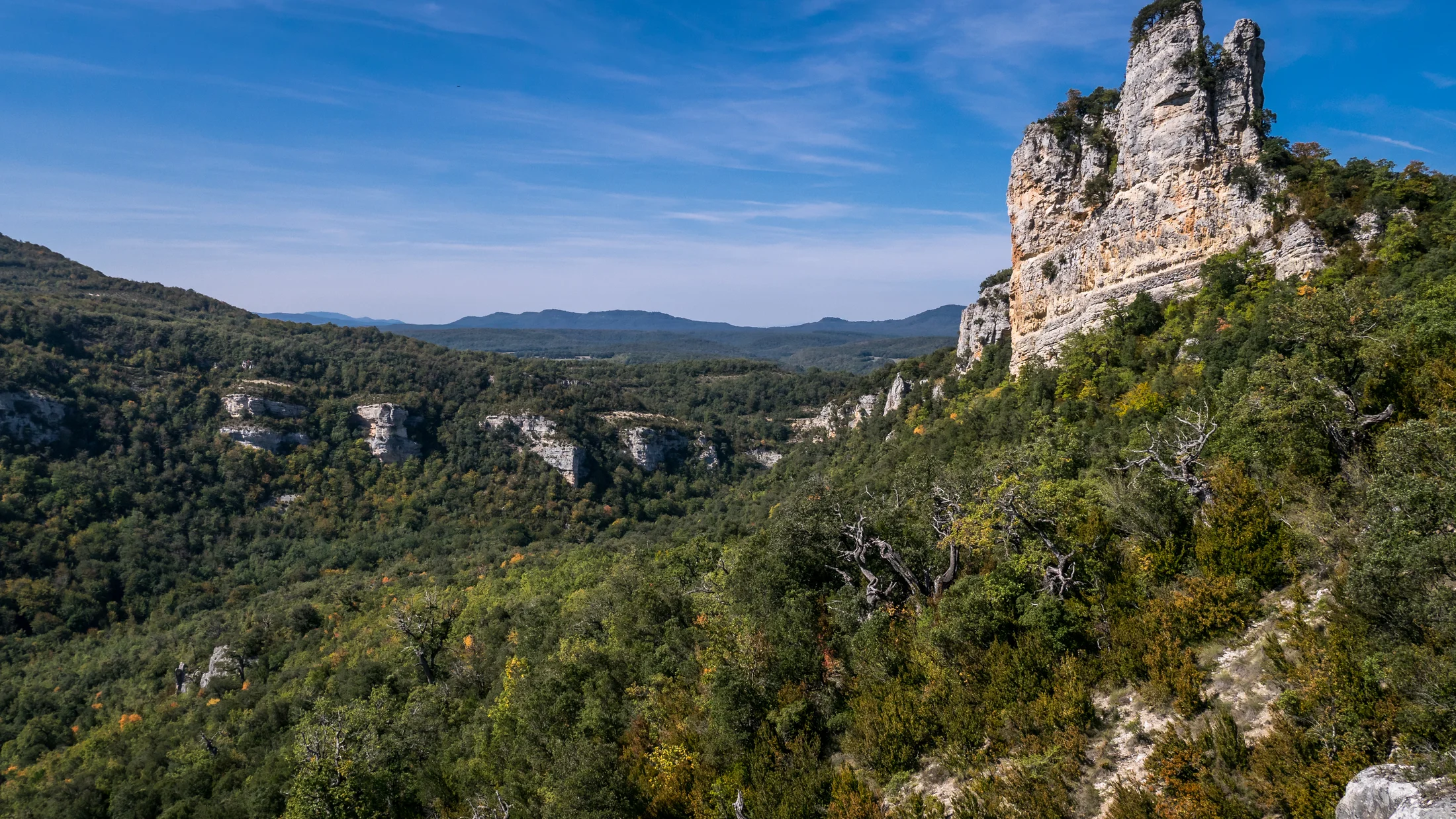
Izki Natural Park spans 9,143 hectares on the southern slopes of the Alavese Mountains in southeastern Álava province. Its botanical centrepiece is the most extensive Pyrenean-oak forest (Quercus pyrenaica) in the Basque Country and one of the largest along the entire Cantabrian rim, with over 3,500 hectares of continuous cover on hillsides between 600 and 1,000 metres. In spring, when pale, almost translucent young leaves emerge, the woodland takes on a luminous quality that contrasts with the dark, furrowed bark of centuries-old oaks.
The park's geology alternates Lower Cretaceous sandstone, marl and limestone, with conglomerate outcrops forming small cliffs and ledges at higher elevations. The Río Izki, which gives the park its name, flows along a gentle valley floor fed by a network of streams rising on the wooded slopes. Wetland areas include peat bogs and waterlogged patches where sphagnum moss blankets the ground and water seeps among rushes and ferns. The Antoñana spring at the park's foot maintains a steady flow that has supplied the medieval walled town of the same name for centuries; its defensive perimeter still retains two original 13th-century gates.
The middle spotted woodpecker (Dendrocoptos medius), a medium-sized woodpecker with a red cap and streaked breast, finds in Izki's oak forest one of its rare Iberian populations. An estimated 40 to 60 breeding pairs depend on old oaks with natural cavities in which they nest each spring. Other woodland birds include the nuthatch, short-toed treecreeper and long-tailed tit. Raptors rule the open skies above forest clearings: the European honey-buzzard hunts wasps in summer, while the goshawk dashes between trunks chasing pigeons and jays. At night, tawny owls call from the densest canopy. Mammals include roe deer, wild boar, European wildcat, pine marten and edible dormouse, and red-deer numbers have risen over the past two decades following reintroduction programmes.
The human landscape around the park is shaped by small hamlets and medieval walled towns built from golden sandstone. Corres, Urarte and Quintana are scattered along the woodland edge, each with just a handful of permanently occupied houses. Marquínez, at the park entrance, holds a cluster of artificial caves carved into the sandstone that served as dwellings, granaries and shelters from the Middle Ages through to the 19th century. These hollows, arranged on several levels linked by stairways cut into the rock, form one of the most distinctive troglodyte sites in northern Spain.
The park's trail network exceeds 40 waymarked kilometres, with routes ranging from 4 to 16 kilometres. The Izki oak-forest trail (10 km, circular) crosses the heart of the woodland along wide forestry tracks where light filters through the canopy, casting shifting patterns on the leaf-litter floor. The Marquínez caves route (6 km) combines cultural and natural heritage, descending from the caves to the Río Izki through a shaded ravine. In autumn the park becomes mushroom territory: ceps, chanterelles and thistle mushrooms sprout beneath damp leaf litter, and local foragers maintain a mycological tradition that stretches back generations.