The essentials of Montseny Natural Park

  • • Turó de l'Home (1,706 m): highest summit with views of the Mediterranean and Pyrenees
  • • Santa Fe beech forests, the southernmost beech woods on the Iberian Peninsula
  • • Spain's first UNESCO Biosphere Reserve, designated in 1978
  • • Complete altitudinal gradient: holm oak, oak, beech forest in a single walk
  • • Autumn colours in the beech forest during October and November at Santa Fe

Description

The Montseny Natural Park is the southernmost Pre-Alpine massif in Catalonia, straddling the boundary between Barcelona and Girona provinces about 50 kilometres from Barcelona. Its highest summit, Turó de l'Home, reaches 1,706 metres and shares the top of the orographic interest with Las Agudes (at the same elevation) and Matagalls (1,697 m). On clear days from any of these summits the Mediterranean is visible to the south and the Pyrenees to the north. This geographic position at the boundary between the Mediterranean and Central European climate zones is reflected directly in the vegetation: Montseny is one of the few places on the Iberian Peninsula where a walker can move in a single day from coastal holm oak woodland to a Eurosiberian beech forest.

This compressed altitudinal gradient — from around 200 metres in the foothills to 1,706 at the summit — generates a succession of plant communities that botanists have studied intensively since the nineteenth century. Holm oak (Quercus ilex) with Mediterranean maquis elements dominates the base; above 600 metres, pubescent oak (Quercus pubescens) and, in shaded gullies, Pyrenean oak (Quercus pyrenaica) take over; above 1,000 metres on north-facing slopes, beech (Fagus sylvatica) forms the southernmost beech forests on the Iberian Peninsula. In the dampest summit corners grow Central European plants that reach their southern limit here, including Soldanella montana and Gentiana pneumonanthe.

The Santa Fe del Montseny reservoir and picnic area, at around 1,100 metres on the inner slope, is the most visited single point in the park and the standard starting point for summit routes. The beech forest surrounding the reservoir changes colour dramatically between October and November, drawing visitors from across the Barcelona metropolitan area as the leaves turn from green to yellow and ochre before falling. Access roads via Santa Fe and Coll de Bordoriol can become saturated on those autumn weekends, and the park applies traffic management systems during certain periods.

Montseny was the first area declared a UNESCO Biosphere Reserve in Spain, in 1978, and served as an organisational model for subsequent Spanish biosphere reserves. Its system of concentric zones — core zone of maximum protection, buffer zone and transition zone — has been studied by protected area managers across Europe. The park combines forest areas open for public use with inhabited municipalities such as Sant Celoni, Viladrau, Arbúcies, Breda and Montseny vila, which maintain agricultural, pastoral and tourism activities integrated into the protected landscape.
Practical information

Everything you need to know for your visit to Montseny Natural Park

How to get there
From Barcelona, the C-35 reaches Sant Celoni in about 50 minutes. From there, the BV-5301 climbs to Santa Fe del Montseny (about 20 km more). For Viladrau, the C-25 and then the Gi-520 are the alternative approach from the north.
Area Information
The natural park (30,120 ha) spans municipalities in Barcelona and Girona provinces. Main access points: Sant Celoni (south), Viladrau (north), Arbúcies (east). Barcelona is 50 km away, Girona 60 km. The Can Casades Information Centre in Sant Celoni is open year-round.
Geography
Pre-Alpine massif of schist and granite on the Barcelona-Girona boundary. Main summits: Turó de l'Home and Las Agudes (1,706 m), Matagalls (1,697 m). Southern slope toward the Vallès, northern slope toward La Selva. Santa Fe reservoir as the central reference point.
Flora & Fauna
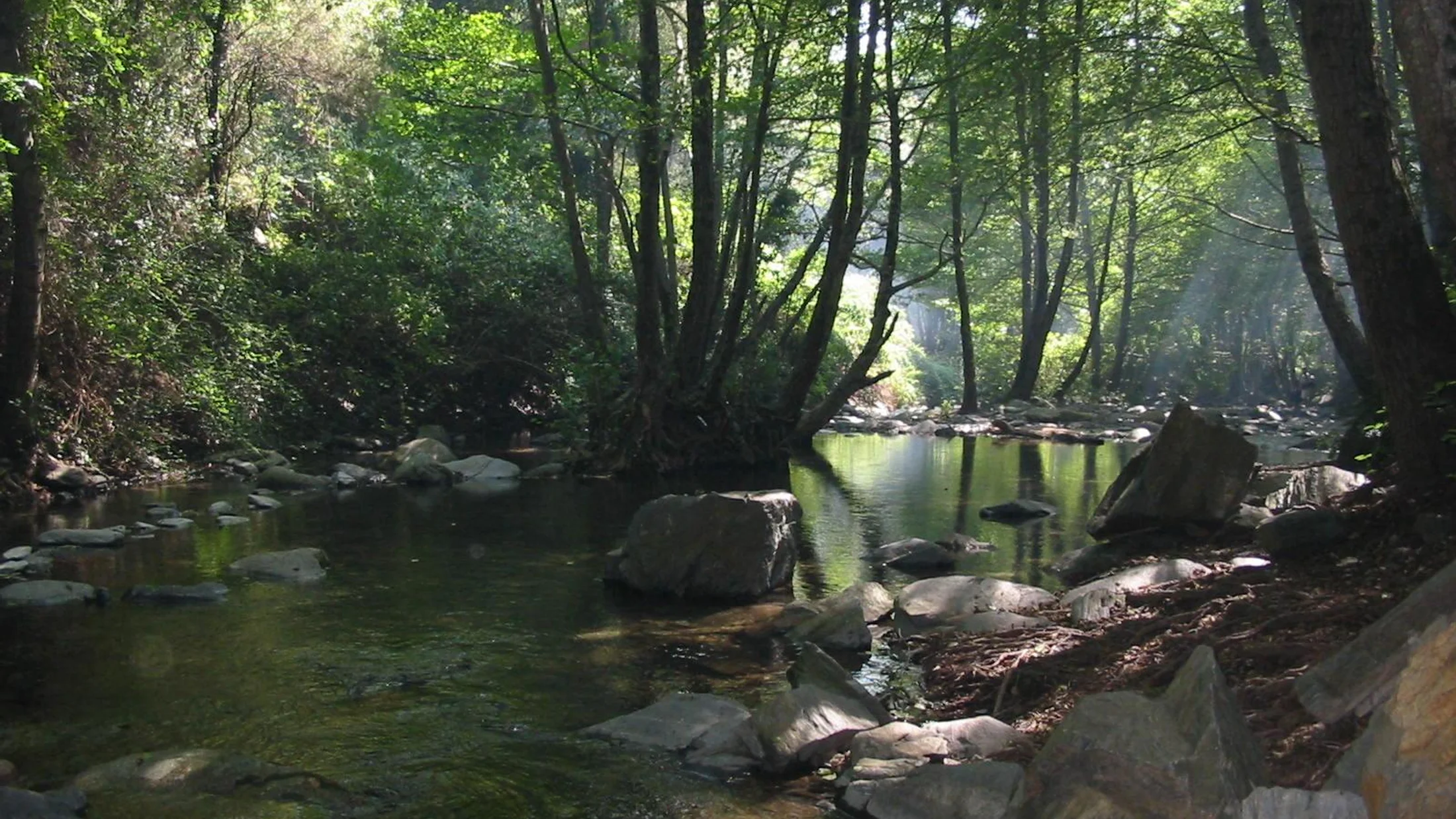
Three well-defined vegetation belts: holm oak (base), oak woodland (mid-elevation), beech forest (above 1,000 m). Relict Eurosiberian plants at summits: Soldanella, Gentiana. Wildlife: wild boar, roe deer, wildcat, bats in caves and, in rivers, white-throated dipper.

Things to do

Find the best plans and things to do in Montseny Natural Park

20

Accommodations

Best accommodation options in Montseny Natural Park

Loading accommodation options...

Frequently Asked Questions

Get answers about Montseny Natural Park

The most direct route from the Santa Fe area (1,100 m) to Turó de l'Home (1,706 m) covers about 5 km each way with 600 metres of elevation gain. Expected time is 1h 30min to 2 hours up for someone in good shape. The trail passes through the densest beech forest in the massif and offers Mediterranean views from the ridge. In winter there may be ice on the final section.
UNESCO designated Montseny a Biosphere Reserve in 1978 under the Man and the Biosphere programme (MAB). The main criteria were its biodiversity, the unique Mediterranean-to-Central European vegetation transition found nowhere else on the Peninsula, and a long tradition of scientific research in the massif — the Barcelona Botanic Garden has maintained a station at Santa Fe since the early twentieth century. The Montseny zoning model influenced the design of many later reserves.
The colour change in the Santa Fe beech forests usually happens between mid-October and early November, though it varies with September temperatures. The peak colour week is typically the second or third week of October. This period coincides with high visitor numbers; arriving before 9:00 am or using the bus service from Sant Celoni is recommended to avoid parking problems.
Yes. The park has a well-marked trail network regularly used for trail running. The three-summit circular route (Turó de l'Home, Las Agudes and Matagalls) is the best known, covering about 22 km with 1,400 metres of accumulated elevation gain, typically completed in 3-5 hours by experienced runners. The annual Cursa de Muntanya del Montseny race follows part of this course.
Yes. The park's municipalities — Viladrau, Arbúcies, Sant Celoni, Breda, Montseny vila — have rural guesthouses, hostels and mountain hotels. Hotel de Santa Fe and the Can Barrina farmhouse in Viladrau are standard references. Staying inside the park allows access to trails in the early morning hours, when the light and quietness are best.