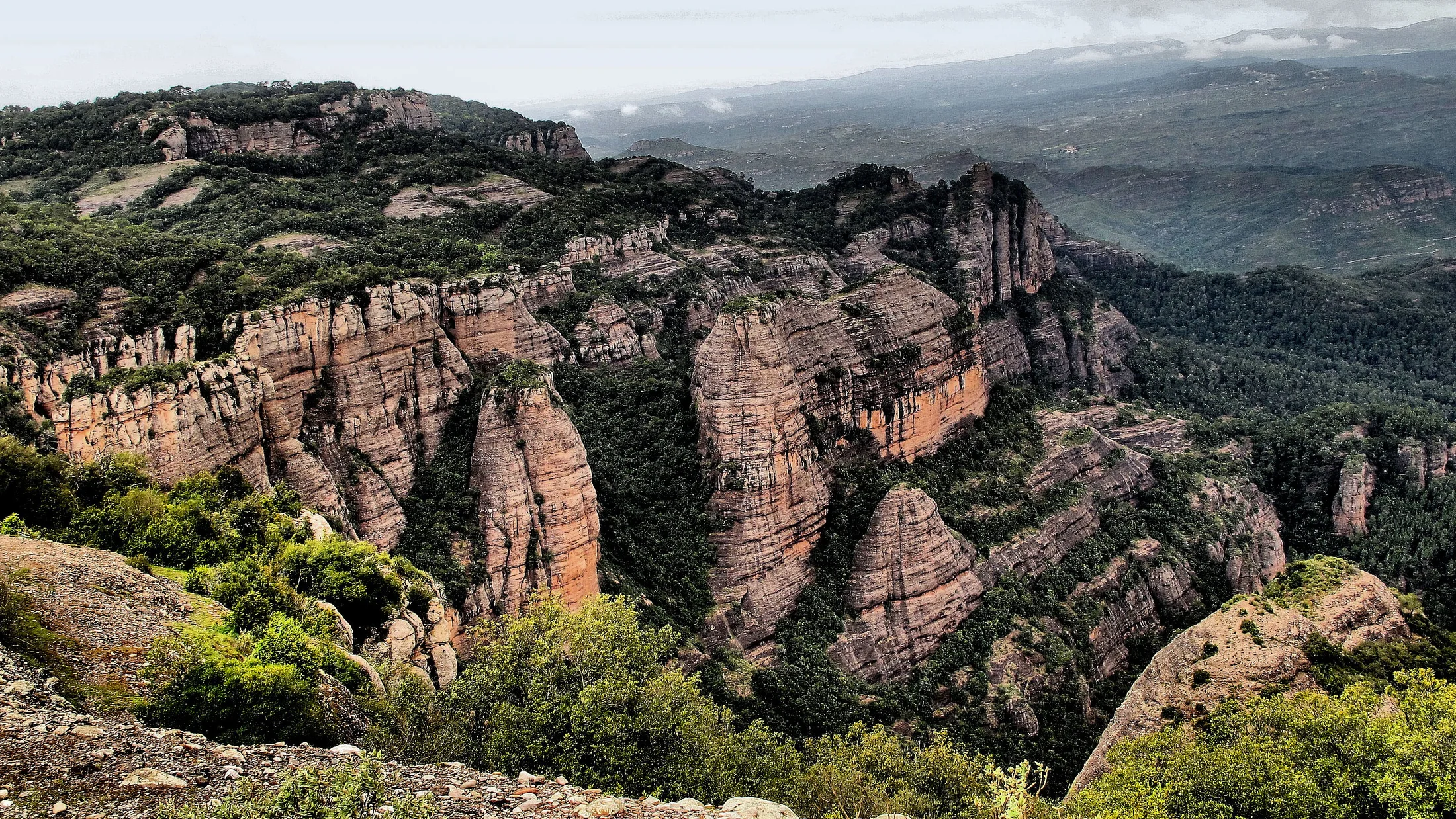
Sant Llorenç del Munt i l'Obac Natural Park
The essentials of Sant Llorenç del Munt i l'Obac Natural Park
- • Romanesque monastery of Sant Llorenç del Munt (950 AD) with views reaching the Pyrenees on clear days
- • La Mola at 1,104 m, a sandstone tabletop plateau accessible in 6 km from El Pont de Vilomara
- • Sport-climbing sectors at La Roca del Migdia and Can Sadurní, minutes from the trailheads
- • Nesting Bonelli's eagle, peregrine falcon and griffon vulture on the conglomerate walls
- • L'Obac oak forest in autumn colours: most photogenic from mid-October to early November
Description
Practical information for Sant Llorenç del Munt i l'Obac Natural Park
Everything you need to know for your visit to Sant Llorenç del Munt i l'Obac Natural Park
How to get there
How to get there
From Barcelona, take the C-16 motorway to Terrassa, then the C-58 towards Manresa. Main park entrances are at El Pont de Vilomara (B-120), Mura and Rellinars. From Terrassa by car it is under 20 minutes to Can Pobla. Without a car, take the R4 train to Manresa and a bus to El Pont de Vilomara.
Area Information
Information centre at Can Pobla (El Pont de Vilomara), open weekends and public holidays. The monastery has free access; the hermitage of Sant Pau Vell is also visitable. Car parks at Can Pobla, Mura and Rellinars. No camping inside the park; accommodation in Talamanca and Sant Llorenç Savall.
Geography
Eocene conglomerate and sandstone massif oriented E–W. Highest point: La Mola (1,104 m). The vertical walls of the northern sector exceed 200 m in height in some sections. The El Gaià and Llobregat torrents flank the massif to the north and south. Area: 13,694 ha.
Flora & Fauna
Aleppo pine, holm oak, pubescent oak and beech fragments in shaded ravines. Mediterranean scrub with mastic, kermes oak and rockrose. Wildlife: Bonelli's eagle, griffon vulture, peregrine falcon, wild boar, fox and common genet. Over 170 bird species recorded in the park.
Accommodations in Sant Llorenç del Munt i l'Obac Natural Park
Best accommodation options in Sant Llorenç del Munt i l'Obac Natural Park
Frequently asked questions about Sant Llorenç del Munt i l'Obac Natural Park
Get answers about Sant Llorenç del Munt i l'Obac Natural Park
How long does it take to hike up to the Sant Llorenç monastery?
From the Can Pobla car park, the classic ascent to the monastery covers about 5 km with 400 m of elevation gain, taking 1h30 to 2h at a normal pace. Continuing to La Mola adds another 6 km each way (with a further 300 m of gain), adding roughly two more hours to the total outing.
Are there climbing sectors accessible for beginners?
Yes. The Can Sadurní sector has routes from 4a to 7c on conglomerate rock, with several well-equipped beginner lines. La Roca del Migdia is more technical and is aimed at intermediate and advanced climbers. Both sectors are under 30 minutes' walk from the Can Pobla car park.
Can I see griffon vultures in the park?
Griffon vultures nest in the park and can be observed year-round circling above the La Mola walls. The best hours are when thermals develop, between 11:00 and 15:00. The viewpoint on the La Mola plateau offers direct views of the nesting colonies on the northern cliff faces.
Can I get to the park by public transport from Barcelona?
It is possible by combining transport. Take the R4 Rodalies train from Barcelona to Manresa (about 60 min), then the Autocars Esteve bus to El Pont de Vilomara (20 min). The bus has limited frequency; check timetables on moovit.cat before travelling, as weekend schedules differ from weekdays.
When does the L'Obac oak forest have its best autumn colour?
Peak colour usually falls between 15 and 31 October, depending on September rainfall and early October temperatures. In years with warm autumns, colour can be delayed into the first half of November. The most photogenic area is the L'Obac ravine, accessible from the village of Mura.