Why a rural house is your best option in the Ebro Delta
The Delta is a unique ecosystem, and staying here allows you to live alongside it and local life throughout your entire stay.
A rural house, on the other hand, places you right inside the landscape: you step out the door and you already have the Delta right in front of you.
From a rural house, the Delta is experienced: the sunrise over the lagoons, the flight of the greater flamingo, and the work in the rice fields form the backdrop of daily life.
Direct connection with nature
These accommodations are usually located in natural enclaves, so the barriers between the traveller and the landscape disappear.
From your doorstep, you can go out walking or cycling along hiking and cycling routes without having to take the car. You also gain silence and calm, far from the bustle of the most touristy towns: that helps you truly recharge your batteries.
Birds can be observed up close and without rushing. Early in the morning, you can listen to their songs while you have your coffee.
The trip becomes sensory: the Mediterranean breeze mixed with the smell of the earth, the whisper of the reeds, and a starry sky without light pollution.
A gateway to local culture and gastronomy
Sleeping in a rural house in the Delta places you at the table of the people who have shaped this land for generations. The owners are usually great hosts and know the area thoroughly, so their recommendations won't appear in guidebooks.
Rural tourism is growing: overnight stays in April increased by 30.1% compared to the previous year, with 50.5% more among Spanish travellers, according to non-hotel occupancy data.
A rural house also allows you to buy fresh products at the village markets and cook with zero-kilometre ingredients. Rice and seafood are the basis of the Delta's gastronomy, and tasting them cooked in your own kitchen changes the experience.
Picuco can help you
Does something here catch your eye?
Tell us.
Write to us on WhatsApp or email: we answer questions, find the best options and help you sort out the booking.
Write to us
We guide you based on the type of plan you have in mind and reply by WhatsApp or email.
Find the ideal location for your rural house
Choosing the right village is the first step of an escape to the Ebro Delta. Seeking the tranquillity of the rice fields is not the same as seeking the sea breeze of a fishing village.
Each locality has its own personality, and knowing which one fits you changes your stay completely. The locality you choose functions as a base camp: daily explorations set out from there, and that is where you return every night.
Most people look for disconnection, contact with nature, and authenticity. Think about which of the three carries more weight in your trip and choose your location accordingly.
Deltebre: the heart of the natural park
Deltebre is the largest municipality in the Ebro Delta and is located in the centre of the delta. If you want to stay in the centre of the delta, this is the option.
From here, access to key points is direct: the mouth of the river, Illa de Buda, and Fangar beach. It is also the most practical base if you travel wanting to move around, because organising a kayak route, renting bicycles, or walking along the paths that border the Ebro is easy.
Deltebre has all the services and maintains the feeling of being surrounded by nature.
Sant Jaume d'Enveja: a slower pace
Sant Jaume d'Enveja is on the opposite bank to Deltebre and maintains a more traditional and tranquil pace of life. If you are looking for a more authentic experience, far from the most crowded areas, the village gives you that breathing space.
Life here revolves around the cycles of rice and the river. That rhythm also marks the village's schedules and the tone of its streets.
As a base for exploring the southern part of the Delta, it is a very practical option: from Sant Jaume, you can easily reach lagoons such as the Tancada, famous for its greater flamingos. If you are travelling as a family or as a couple looking for peace, a rural house in the surroundings is a safe bet.
L'Ampolla and Sant Carles de la Ràpita: the taste of the sea
L'Ampolla is the gateway to the Delta. It combines coves and fine sand beaches with quick access to the landscapes of the Ebro Delta Natural Park.
Sant Carles de la Ràpita is in the Alfacs bay and is a fishing port with a great maritime tradition. Food lovers will eat well there: there are seafood restaurants. In the calm waters of the bay, water sports are practised, and the atmosphere is more lively than in L'Ampolla.
To decide, think about your plan. Choose L'Ampolla if you want the sea and nature nearby; choose Sant Carles de la Ràpita if you are looking for gastronomy, water sports and more atmosphere.
Comparison of Delta del Ebro villages for your rural house
In the Delta del Ebro, the village you choose decides how your day begins: with waterbirds or with the sound of the waves.
Deltebre is the option for active travellers and nature lovers, with a functional and central atmosphere. Nearby you have the mouth of the river, the Illa de Buda and Fangar Beach.
Sant Carles de la Ràpita is for lovers of gastronomy and water sports, with a maritime atmosphere, and nearby are the Alfacs bay and the fishing port.
Before booking, decide if you prefer to wake up with waterbirds or with the sound of the waves: that answer defines the village for you. To start exploring, check the selection of accommodation and experiences in the Ebro Delta Natural Park.
What type of rural house to choose according to your travel plan
In the Delta del Ebro, the house you choose changes the getaway: not all are the same. There are everything from buildings that mimic the traditional architecture of the rice fields to stately masias with a swimming pool.
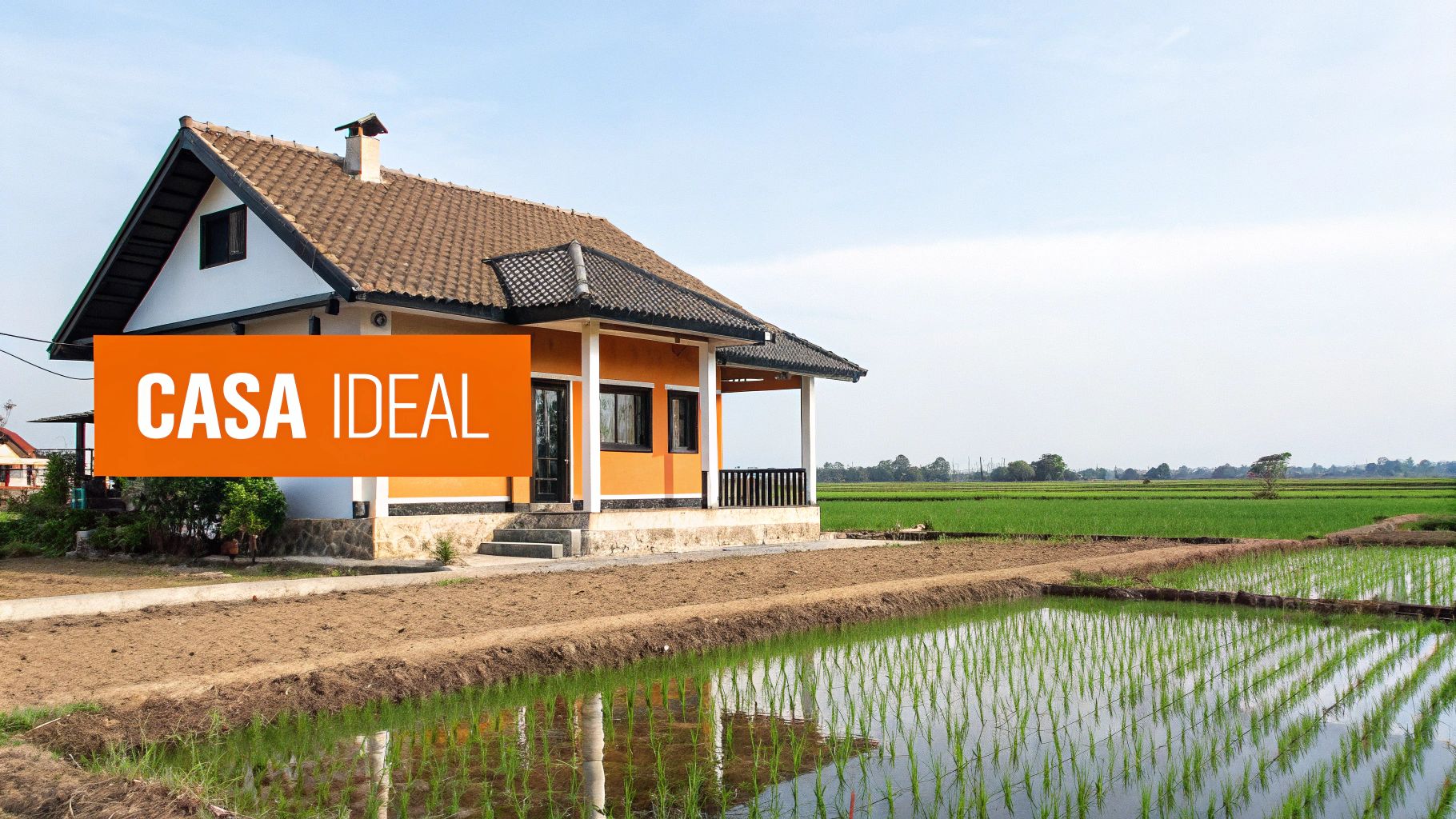
Each type of accommodation gives you a different experience. Before booking, think about your plan: immersing yourself in history, enjoying space as a group, travelling consciously or staying with a dog. With that starting point, the rest of the choice is easier.
Traditional barracas for a cultural immersion
Barracas are the icon of the Delta: farmers' houses with thatched roofs and white walls, where people lived and worked among the rice fields. Many have been renovated with all the comforts and retain their original appearance.
Sleeping in a barraca brings you closer to the relationship between people and the landscape that has forged this land. They are a suitable option for couples or small families looking for an authentic getaway with character.
Farmhouses and estates for groups and families
A restored farmhouse provides space and privacy for a large group, with friends or with the whole family. They are spacious country buildings, designed for living several days without space constraints.
Many include large gardens, barbecue areas and a swimming pool. This way you can combine communal life with moments of intimacy and organise your time and space with freedom.
Think about the plan: an outdoor dinner after a day exploring the Delta, or an afternoon of games by the swimming pool while the rice fields change colour with the sunset.
It is advisable to confirm how many places each house has and what extras are included before finalising the dates.
Sustainable accommodation for the conscious traveller
The Ebro Delta is a Natural Park, so the sustainability of its accommodation is a necessity and not a trend. Many rural houses opt for an ecological model that reduces their impact on this fragile ecosystem.
These houses usually use renewable energies, water recycling systems and local building materials. They also promote the consumption of zero-kilometre products, which connects you directly with local producers.
If you choose a rural house with an ecological certification, your trip contributes to the destination. Look for it when booking and ask about its practices before finalising the dates.
Pet-friendly rural houses so no one is left behind
Travelling with your dog through the Ebro Delta is possible: many rural houses in the area allow pets. They are accommodations designed for those who do not want to leave their dog at home and are looking for a peaceful plan in the countryside.
These houses usually have enclosed outdoor spaces, so your dog can run around safely while you rest. Additionally, it is common for them to be near routes and beaches where dogs are welcome, so you can go for a walk without searching too much.
Some provide information on nearby veterinary services in case something unexpected arises.
If you want to complete your getaway with another activity, you can book an exciting hot air balloon flight over the Ebro Delta.
Essential activities to experience the Delta to the fullest
Leave your suitcases at the rural house and head out to explore the Ebro Delta: the landscape is known by walking through it, not by looking at it from the window. Rowing through the channels and cycling among rice fields that disappear into the horizon are two good ways to start.
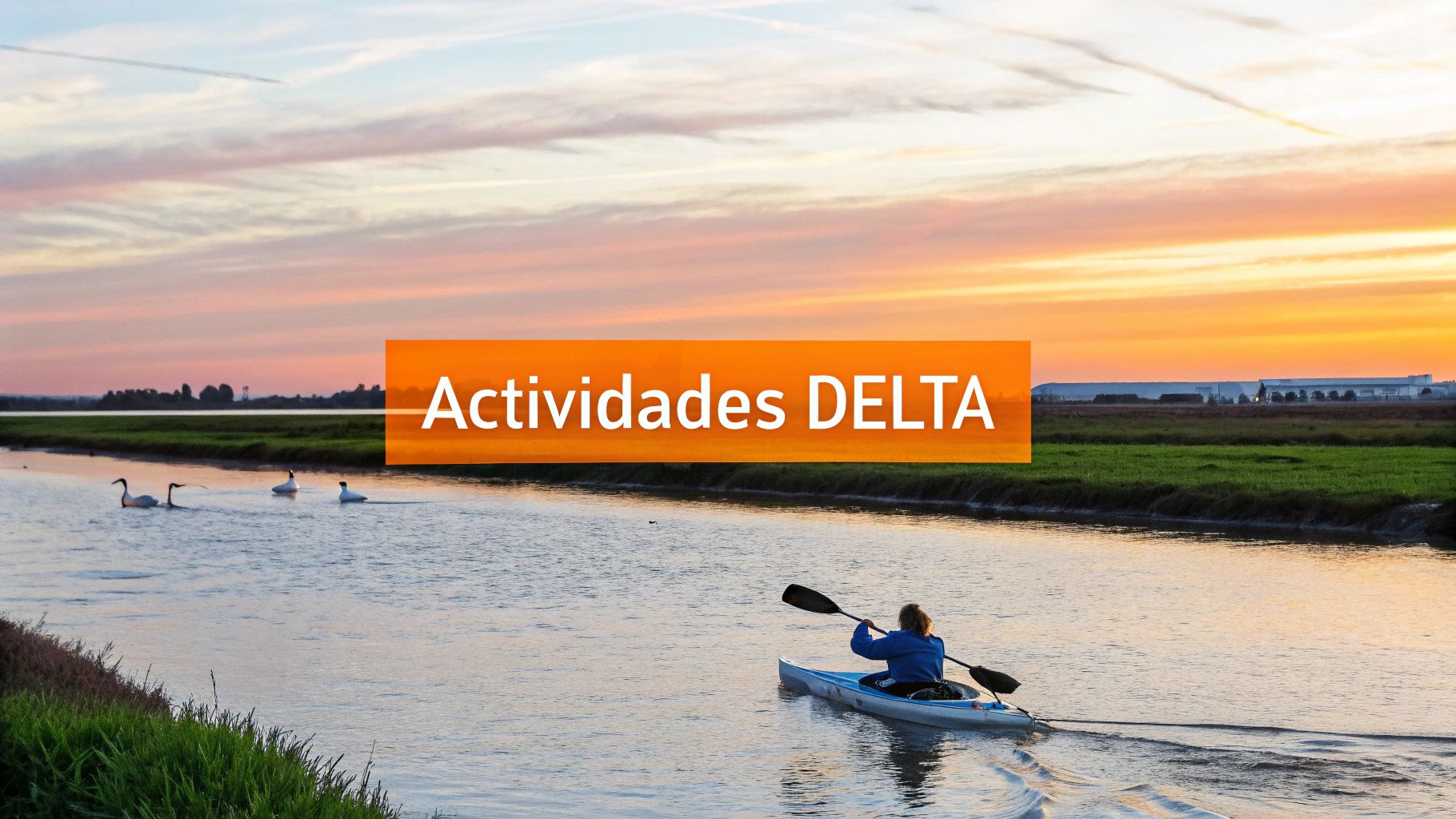
The idea is simple: dedicate each day of your getaway to a different activity. This way you get to know the environment thoroughly and spread the effort between water, paths and viewpoints.
Hiking and cycling routes for all audiences
The Delta is an almost perfect plain, without hills. This makes it suitable for walking and cycling as a family, from the little ones to the most experienced.
The network of rural paths allows you to enter the rice fields and reach corners that cannot be accessed by car.
You can rent a bike in Deltebre or in Riumar and follow itineraries that border the river or lead to long and solitary beaches. For walking, the paths surrounding the Tancada and l'Encanyissada lagoons are great at a leisurely pace.
Allow half a day for short routes and the whole day if you want to combine river and beach.
Kayaking the Ebro
The Ebro is travelled by kayak to see the Delta from the water and to enter the labyrinth of channels and the final stretch of the river without making noise. You paddle at your own pace and the landscape changes with every stroke.
Kayaking on the Ebro is like reading the landscape in its original language. You feel the pulse of the river and you become, for a while, part of the ecosystem.
The waters are very calm and you don't need to be an expert, so the activity is suitable for couples and families. You paddle alongside reed beds and see waterbirds in their habitat without disturbing them.
Many local companies offer hourly rentals and guided excursions, especially at sunset.
The birdwatching paradise
Observing them is just as rewarding for experienced ornithologists as it is for those who simply enjoy nature.
Greater flamingos are the big stars: their colonies can be seen in the Tancada Lagoon and in the old Sant Antoni salt marshes. Bring binoculars and a bird guide to identify the species.
At the MónNatura Delta viewpoint and the Riet Vell viewpoint, there are observatories designed for birdwatching. Spring and autumn are the best times due to migrations, although there are birds all year round.
Gastronomy as a central experience
In the Ebro Delta, eating is the quintessential cultural activity: the cuisine reflects the landscape, with rice from the fields, seafood from the bay and European eels from the river. Arroz a banda, fish suquet and Delta Mediterranean mussels are the dishes you must try.
Many restaurants work with a zero-kilometre philosophy, with ingredients that go from the producer to the plate. For this reason, it is advisable to book a table in advance, especially during high season and on weekends.
Combining a morning bike route with a good meal afterwards is one of the greatest pleasures of the Delta. You have an adventure that combines cycling, food and nature in the Ebro Delta for a full day.
Plan your own adventure with our itineraries
Organising a getaway to a rural house in the Ebro Delta takes less time if you start from a pre-planned route. This section brings together several flexible roadmaps for a day, a weekend or longer holidays.
Each itinerary marks the main points and the order in which to visit them. From there, you adapt it to your pace and to whatever you feel like each day.
The idea is to save you hours of planning. This leaves you more time for the delta's natural environment.
1-day itinerary: the essence of the Delta in one day
In the afternoon, you go to the Tancada Lagoon and observe greater flamingos and other waterbirds from their viewpoints. Bring binoculars for birdwatching in the afternoon.
Weekend itinerary: a complete immersion
A weekend offers much more than a one-day trip. With two days in the Ebro Delta, you can combine active exploration with moments of calm, so the trip adjusts to what you are looking for: walking, cycling or simply stopping to look.
The plan works just as well if you travel as a couple, with friends or with children.
Day 1: Water and postcard sunsets
The key to the day is arriving an hour before sunset and walking through the dunes to the lighthouse.
The sun sets over an almost desert-like landscape surrounded by water, one of the most memorable images of the Delta. Bring water and closed footwear for the sand, and plan your return trip while there is still light: the lighthouse is far from the car park.
Day 2: Cycling between rice fields and infinite beaches
At 10:00 it is time to rent bikes and head out onto the network of paths that wind through the rice fields. The terrain is completely flat, so it is an activity for everyone. The fields change colour depending on the season: a sea of green or gold.
There, the seafood arrives fresh, with the Mediterranean mussels and oysters from the bay as the protagonists.
3-day itinerary or more: experience the Delta at a slow pace
With three days or more, the Delta is explored without rushing: less frequented corners appear and local culture gains importance in the trip. The plan divides each day between water, rice fields and birds.
Day 3: Kayak adventure and local culture
From 10:00 to 13:00, rent a kayak and paddle along the Ebro or through the calmer channels: you will see fauna and flora that cannot be appreciated from land. At 13:30, have a picnic in a designated recreational area or in a restaurant near Casa de Fusta to optimise your time.
If you want to finalise the details before leaving, you have a complete step-by-step guide to planning a rural getaway.
Practical tips to make your rural getaway perfect
You already have accommodation, the type of rural house and activities. The details of the booking and the stay remain, and that is where much of the trip is decided.
Choosing the right time of year and packing your suitcase are the two aspects that make the biggest difference on a getaway to the Ebro Delta. Check both before confirming the dates and settle the booking well in advance.
The goal is simple: arrive with everything ready and focus on enjoying yourself, without last-minute surprises.
Choose your ideal season
The Ebro Delta changes with every season, so the best time depends on what you want to experience. There is no single answer: first think about what you are looking for and then choose the month.
In spring, the birds are in the middle of breeding season, so it is a good time if you are interested in birdwatching.
Summer works well for the beaches and the lively atmosphere of the towns, but if you choose this season, book your Ebro Delta rural house well in advance.
In autumn, the light is almost magical and the temperatures are much milder: a perfect time for photography and for finding calm.
Logistics and luggage: what you cannot do without
A car makes all the difference in the Ebro Delta. You can reach some villages by public transport, but to explore the most hidden beaches, viewpoints and corners of the natural park, you need the freedom of movement that a vehicle provides.
Binoculars cannot be missing from your suitcase: they are essential for observing the variety of birds in the Delta. Also, take a good mosquito repellent, especially during the warmest months, to avoid discomfort at sunset.
If you are looking for more comfort, you can choose country houses with heated pools to relax after a day of exploration.
We answer your questions about your getaway to the Ebro Delta
Organising a getaway to a country house in the Ebro Delta leaves practical doubts: when to go, what to pack or how to move around the area. Here we have gathered the most common questions so you can resolve them before booking.
The idea is simple: that you arrive with everything clear and only have to pack your bags and disconnect. Read the answers that interest you and proceed to the booking with your ideas already organised.
When is the best time to visit the Delta?
Each season changes the landscape of the Delta, so the best time depends on what you are looking for.
In spring, from April to June, the rice fields are flooded and reflect the sky, and the birds are in full swing. It is the best option if you are going to take photographs or birdwatch.
Summer, July and August, is high season: sun, beach and a lively atmosphere in the coastal villages. Autumn, September and October, coincides with the rice harvest and the landscape turns golden, with softer light, pleasant temperatures and much fewer people.
In winter, from November to February, there is total calm, without noise or crowds. It is a good time to observe the birds that spend the cold season here.
If you are looking for tranquillity and good light, aim for September or October; if you want the beach, July or August. Book in advance during summer and during the spring and autumn bank holidays.
Do I need a car to move around there?
Yes, and it is worth being clear about this before booking: there is some public transport between the larger villages, but the most remote corners of the Delta can only be reached with your own vehicle.
With a car, you can explore Trabucador beach at your own pace, reach bird viewpoints that do not appear in guidebooks and travel along the rural paths between rice fields. These paths wind between the rice plots and allow you to stop wherever you like.
If you travel without one, organise transfers from Tortosa or Amposta and limit your plans to the villages with service.
And... what about the mosquitoes?
Yes, there are mosquitoes in the Ebro Delta. The stagnant water in the rice fields is part of the ecosystem, and you will see them especially during the hottest months, normally from May to September.
During key hours, long-sleeved clothing and long trousers help a lot to avoid bites.
The Ebro Delta is a treasure full of secrets to discover. At Picuco, we have hand-picked the best experiences and accommodation so that your getaway is as unique as you. Start dreaming about your adventure and find that perfect country house at https://www.picuco.com.