Introduction
A territory of contrasts that invites you to move
Aragón goes from the glaciers of the Pyrenees to the Los Monegros desert in just a few hours of driving. Mountains, limestone canyons and steppe plains follow one after another with elevation changes, living rivers and clear skies almost all year round.
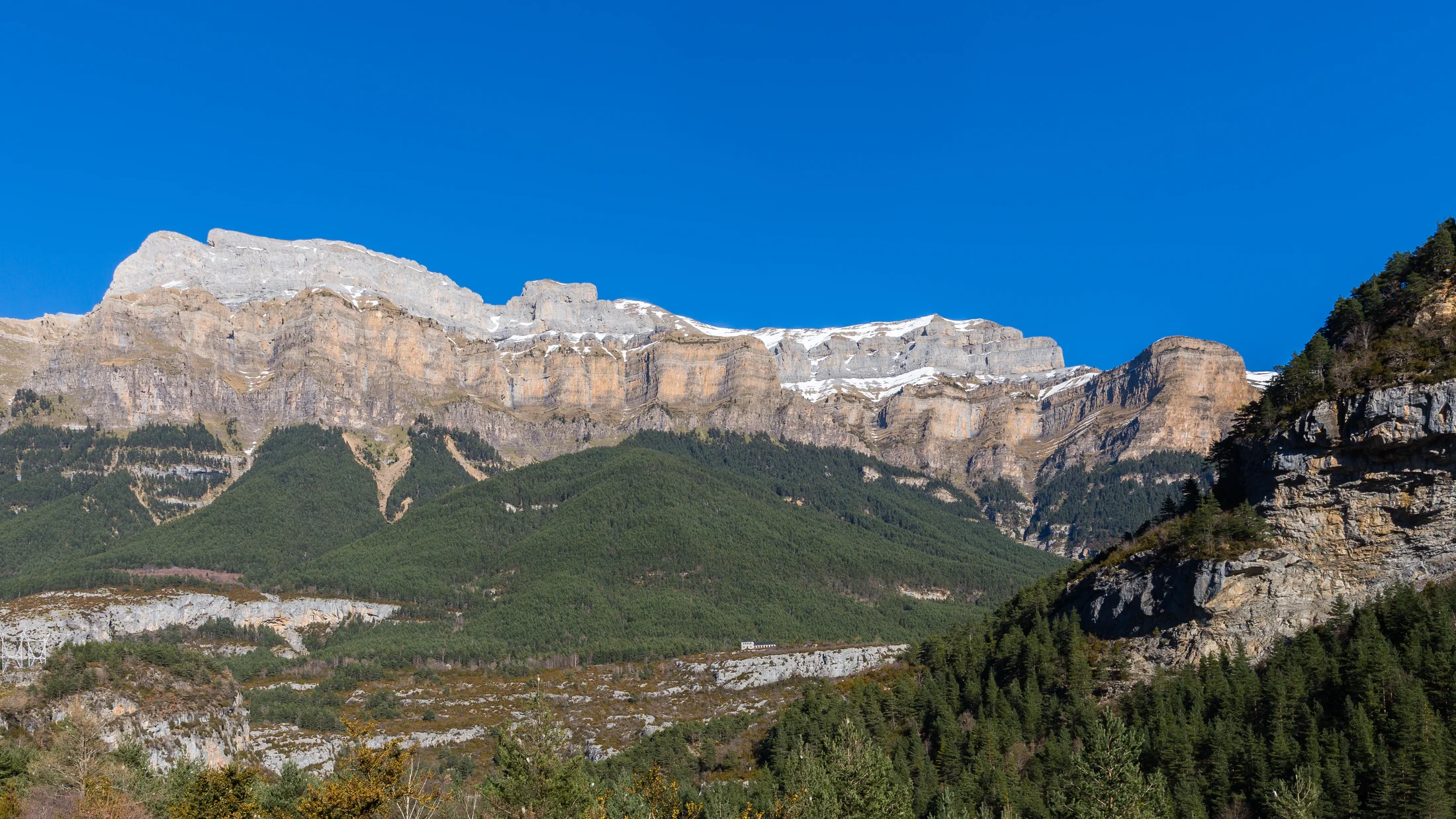
The Aragonese Pyrenees exceed 3,000 metres in altitude, with Monte Perdido at 3,355 m, and concentrates valleys such as Benasque, Tena or Ordesa. There, you can practice hiking, skiing and free flight, and a large part of that terrain is protected in the National Park. In the Pre-Pyrenees, the Sierra de Guara is an adventure park for canyoning due to the combination of water and rock.
Towards the southeast, Los Monegros and the surroundings of las Bardenas form a semi-desert landscape that calls for thick tyres, early starts and respect for the heat. The Ara, Ésera and Gállego rivers channel the snows of the Pyrenees: in spring, with floods, they are ideal for rafting and kayaking, and autumn offers long lights and mild temperatures for cycling or walking.
Close your eyes and hear how the water hits the rock and the wind combs the pines.
The guide proposes 12 representative experiences —mountain, canyons, via ferratas, snow, bike and flight— with clear data to help you plan better.
What you take away from this article
Twelve practical micro-guides to move around Aragón with routes, seasons, levels and recommended bases. Each one tells you when to go, how to move, which permits to check and when it is convenient to book.
The article adds safety, basic equipment and a frequently asked questions section with common doubts. The idea is for you to come away with a possible itinerary according to your time, with logical combinations between valleys and deserts.
Think of the smell of common box in Guara in the morning and the crunch of gravel under the wheels at sunset. With that in mind, choose how many days you have and start fitting the pieces together.
Picuco te puede ayudar
Does something here catch your eye?
Tell us.
Write to us on WhatsApp or email: we answer questions, find the best options and help you sort out the booking.
The essentials for planning your active trip
When to go and climate: get the season right
In the Aragonese Pyrenees, there is snow from December to March. Spring arrives with the thaw and summer is temperate at altitude.
In the Pre-Pyrenees ranges, spring and autumn are the best seasons for walking and cycling without extreme heat. Summer is the time for canyoning with sufficient water flow.
In semi-desert areas such as Monegros and the surroundings of Bardenas, avoid the middle hours of the day from June to August. If there is a heatwave, do not exert yourself between 12:00 and 17:00 h.
The air smells of cold in the Pyrenean shade and of thyme in the Pre-Pyrenean sunny slopes.
In Monegros and near Bardenas, camping, overnight stays and the recreational use of drones are prohibited. If you go by car, drive only on authorised tracks, at a maximum of 40 km/h and without groups of five or more vehicles. Park in the designated places, without obstructing and without damaging the environment. In summer, there may be temporary closures for the protection of nesting birds.
By activity, these are the windows that work:
- Canyoning: from May to September, depending on water flow.
- Alpine and cross-country skiing: from December to March; consult the official snow report from the resorts.
- Via ferratas: from April to October, avoiding extreme heat and storms.
- Paragliding: spring and autumn in Pyrenean valleys, with moderate thermal conditions and winds.
For canyoning in the Sierra de Guara, wear a 5 mm suit and check the water flows, which vary. The mountain range preserves walls with rock paintings from 10,000 years ago, declared a UNESCO World Heritage site.
For MTB and gravel, get up early in summer. Alquézar, with its Romanesque collegiate church overlooking the Vero canyon and medieval streets of golden stone, has accommodation, restaurants and parking.
Permits and bookings: avoid surprises
In the protected spaces of Aragón, there are permits, quotas and rules that it is advisable to check before leaving home. A little bit of prior consultation saves you a wasted trip.
In Ordesa y Monte Perdido, motorised access to the Pradera is limited during the season and is done by shuttle bus from Torla. On peak dates, book in advance. In the Sierra de Guara, there are temporary regulations due to the nesting of cliff-dwelling birds that affect climbing and some itineraries: check the local council notices and the signage on site.
In natural and national parks, recreational drone flight is usually prohibited without express authorisation. Verify the AESA regulations and those of the protected area before flying. The wooden signage, smelling of resin, brings you back to earth: the local rules rule here.
If you hire guides, rafting or canyoning, choose authorised companies with official qualifications. During high demand seasons (August, long weekends, Holy Week), book at least 2–4 weeks in advance and confirm the cancellation policies.
How to get there and move around: distances and transport
From Zaragoza, the motorway takes you into the Pyrenees via Huesca, which also has a train.
To enter through the western valleys, Lleida (Cataluña) and Pamplona (Navarra) are nearby. As a road reference, Zaragoza–Torla is ~160 km (2 h 15 min) and Zaragoza–Alquézar, ~120 km (2 h).
Moving between valleys requires flexibility: a rental car makes it easier to adapt to weather changes. There are buses to bases such as Jaca, Benasque or Aínsa, but frequencies do not always align with the activities.
Aínsa is connected by a regular line linking Boltaña, Aínsa, Labuerda, Escalona, Salinas, Bielsa, Aragnouet, Saint-Lary, Arreau and Loudenvielle. Benasque has the regular T02-02 line with year-round service; the T02-03, which connects Cerler, operates year-round only on Tuesdays and Thursdays.
To combine the Pyrenees and the desert in a few days, plan 2–3 bases and transfers in stages. From the asphalt, the mountains rise in your windscreen like blue candles at sunset.
Twelve experiences from the Pyrenees to the desert
1. Ordesa and Monte Perdido: hiking between glacial walls
In Ordesa, you walk through a valley shaped by ice and water, between walls of more than 800 metres. The best-known route goes down the valley floor to the Cola de Caballo: 17–18 km round trip, from 5 to 7 h, with medium physical difficulty and a positive elevation gain of between 450 and 500 metres.
- The roar of the Arazas accompanies you like a soft drum as you ascend.
The initial section goes along a comfortable track through forests and meadows, and the end narrows from the Gradas de Soaso. If you are looking for something tougher, the Senda de los Cazadores and the Faja de Pelay form a demanding circuit.
The best window is from June to October: in spring the waterfalls have high flow and in autumn the beech forests change colour. In summer, avoid afternoon storms.
Bring mountain footwear, a lightweight waterproof jacket and a map or topo on your mobile and on paper. Until July, residual snow patches may remain at high altitudes, so check the National Park report.
In high season, access is regulated with a shuttle bus from Torla to La Pradera, with in-person sales; in low season, you can drive up if there are no restrictions.
2. Via ferratas in the Pyrenees: adrenaline with cables and steps
Via ferratas allow you to climb up walls equipped with a lifeline and anchored steps. In the Aragonese Pyrenees, there are three very different ones, and one morning per route is enough.
The Sorrosal via ferrata, in Broto, is vertical and runs alongside a waterfall, of grade K3. La Foradada del Toscar, in Ribagorza, is aerial and panoramic, of grade K3-K4, and is considered one of the essential via ferratas. To start, Santa Elena, in Biescas, offers an introductory route of grade K1-K2.
- The rock warms your hands and the void breathes beneath your boots.
These routes go well if you already handle altitude or if you go with a guide. You need a helmet, a harness with a shock absorber, and gloves. The K3-K4 routes require arm strength and composure for the exposure. Always use an approved shock absorber and lifeline; if you have doubts, hire a qualified guide.
In summer, it is advisable to go up early because of the heat and to avoid unstable weather. Broto, Aínsa, and Benasque are comfortable bases, with equipment hire and companies with regular departures. With 2-3 nights, you can combine the via ferrata with nearby hiking or canyoning.
To reach La Foradada del Toscar, take the N-260 towards Aínsa: after passing the village of Foradada del Toscar (approx. km 414), there is a dirt track on the right with signs. You park next to the N-260, at the end of the pass, near some spears in honour of King Gonzalo. Santa Elena is 3 km from Biescas, following the road of the Tena Valley, with a signposted detour to the right towards the Ermita de Santa Elena.
3. Snow in Aragón: skiing, ski touring, and snowshoeing
Winter in Aragón opens another map: ski slopes, silent valleys, and white peaks.
For ski touring and snowshoeing, the valleys of Benasque (Llanos del Hospital for cross-country), Tena, and Hecho-Ansó allow for safe routes on stable days. Check the avalanche report and the avalanche risk before heading out. The snow crunches dry under the snowshoes and the air smells of wood and fireplaces.
For ski touring, carry an avalanche transceiver, shovel, and probe; for mountaineering, a helmet; and for snowshoeing, poles and gaiters. If you choose ski touring, go with a UIAGM high mountain guide: winter orientation is complex.
January, February, and March are the best months. December is variable and April can gift you spring days at altitude. After snowfalls, the roads require chains or winter tyres.
Two or three days of snow combine well with an early spring white water descent or with thermalism and the villages of the valley.
4. Paragliding and free flight in Pyrenean valleys
Castejón de Sos is the cradle of paragliding in Spain and the epicentre of Aragonese free flight. Valley take-offs and nearby slopes generate thermals with views of massifs such as Posets-Maladeta.
The Liri take-off is at 2,350 m, with a drop to the valley of 1,450 m, and there are lifts departing from Castejón. From the air, you fly over Arasán, Liri, Castejón de Sos and the Ésera river. The silence in flight is only broken by the vario when a gentle thermal embraces you.
You fly in Ribagorza (Castejón de Sos and surroundings), in the Tena Valley, with local take-offs and schools, or in Benasque. The season runs from 1 June to 30 September; in summer, choose the first or last hour due to strong thermals.
If you are starting out, take a tandem flight with a certified company: the maximum weight and minimum age depend on the provider. In summer, wear trainers, a sweatshirt or windbreaker, sunglasses and sun cream. Check the local reports: strong northern wind (cierzo) makes flying very dangerous.
The accommodation and flight package in Panticosa costs from 107.50 euros. A morning of tandem flying followed by a ferrata or a short trail in the afternoon fits well.
5. Canyoning in the Sierra de Guara: water, light and rock
The turquoise water cools your ankles and the light paints dancing patches on the wall.
The canyons of the Sierra de Guara offer jumps, scrambles and rappels of varying difficulty, so there are options for almost all levels.
You need a 5 mm wetsuit, helmet, harness and descender. If you do not master flows and escapes, go with a guide. Formiga and Vero are suitable for beginners; the lower Mascún is entered with two consecutive 40-metre rappels.
Sudden floods arrive after storms. Check the weather and local reports before entering the canyon.
Book 2–3 full days in Guara before crossing towards the high Pyrenees or Monegros. The area is well connected via the A-23 motorway.
6. Climbing in Mallos and reference schools
The Mallos de Riglos are reddish conglomerate towers and a benchmark for classic and sport climbing, with bolt routes, bulges and a sustained atmosphere. In the area, the Mallos de Agüero and the sport climbing schools of Rodellar and Alquézar, in the Sierra de Guara, also stand out.
- Hands feel bolts warmed by the sun while a vulture cuts through the sky.
Rodellar is a village in the municipality of Bierge, in the region of Somontano de Barbastro, within the Sierra y Cañones de Guara Natural Park; most of its routes are situated between 7a and 8c. It is about 60 km from Huesca and 45 km from Barbastro, with a long journey via mountain roads.
Choose the season according to the school. In Riglos and Rodellar, spring and autumn; in summer, better in the shade or at altitude. In Rodellar, you can climb in winter in south-facing sectors on sunny days.
Bring double rope and friends/nuts for classic climbing, and a helmet is mandatory due to the risk of falling bolts and stones.
Respect the temporary closures for the nesting of vultures and Egyptian vultures published by the Government of Aragón; on some walls, vulture nesting takes place from February to July.
Book 1–2 days and combine it with a ferrata, trail or nearby canyon.
7. Rafting and kayak in the Pre-Pyrenees rivers
The Ésera, the Ara and the Gállego are the rivers for rafting and kayak, with family descents and intense rapids. The white water descents have levels for everyone, so you can choose the section according to your experience.
Rafting is suitable for groups and families; kayak requires specific training or a guide. In the boat, there are 4 to 8 people per raft, and the kayak can be individual or in a pair (double). The boat bounces on the cold wave and the droplets taste like melted snow.
Indicative prices are from 30 to 50 € per person for rafting and from 20 to 40 € per person for kayak. Companies have bases at the riverbank and transfers are included, and photos are optional. Before setting off, they give you a helmet, life jacket, wetsuit, qualified guide and a prior briefing; the minimum age varies, from 6–8 years in level II‑III sections.
The best time is from May to August, with maximum flow in May-June due to the snowmelt. In July and August the descent is gentler, with schedules depending on the water release.
A half day of rafting is combined with a via ferrata or a nearby path. If you want to try introductory kayak, add another day.
8. Bardenas Reales: semi-desert for walking, cycling and photographing
Hills and plains form the semi-desert landscape of Bardenas Reales, a natural park in Navarra. It is traversed via tracks open to walking and cycling, although after rains some routes are closed to protect the terrain.
Sunrise and sunset are the best times for photographing: the sun carves out reliefs such as Castildetierra. Visiting hours are from 8:00 until one hour before dusk.
It is worth knowing that camping and overnight stays outdoors are prohibited throughout the territory, and that drones cannot be used for tourist or recreational purposes. You must also not leave the tracks or step on the mud after the rains.
The best time is from October to April, due to the mild temperatures; in summer, only go out at the first or last hour. On a bike, choose gravel or MTB with wide tyres and take extra water and a cap.
The main entrances are Arguedas and Tudela, in Navarra. From Aragón, Ejea de los Caballeros or Tauste are comfortable bases to combine with Monegros, and the Natural of Alto Ebro and Rudrón fits into the same route. Book 1 day of tracks and photo, and 1–2 more days in Monegros to complete the Pyrenees-desert contrast.
9. Monegros on MTB: steppe tracks and long horizons
The Monegros are a steppe of esparto, Spanish juniper and gentle undulations, one of the least populated areas in Europe: fewer than 8 inhabitants per km2. The landscape resembles that of the Orbea-Monegros race, with long horizons and tracks that never end.
Gravel and MTB routes link wide tracks, ramblas and valleys. Orientation is simple, but the heat rules: the wheel bites into fine gravel and the wind whistles like a taut rope.
The difficulty is low or medium technical and medium physical due to the wind and exposure. Alberuela de Tubo works as a meeting point to start.
Go preferably between October and May and avoid days of extreme wind; in summer, only go out very early. Carry a GPS track, basic spares and capacity for 2–3 litres of water per person.
If you come from the Pyrenees or from Guara, 1–3 days of biking in Monegros close the trip with an opposite landscape.
10. Cycle touring and bikepacking: greenways and great routes
Aragón has long greenways and natural paths for pedalling with panniers. The Vía Verde de Ojos Negros totals more than 160 km over the old mining railway, with a compacted surface and tunnels.
In the Western Pyrenees, cycling the GR-11 allows you to traverse a little more than 30% of the route, alternating sections of trails with tracks. The favourable sections are the 1st stage (Cabo de Higuer to Bera), the 5th stage (Burguete to Villanueva de Aezcoa) and two thirds of the 8th stage (Ochagavía to Isaba). In Ordesa y Monte Perdido, the use of bicycles is prohibited on trails and restricted paths.
Plan stages of 40–80 km/day depending on the surface and elevation gain, and check the food and water points. Carry waterproof panniers, a multi-tool, lights and a lightweight raincoat. The scent of cereal and resin enters and leaves your helmet like a metronome.
The journey adds cultural interest: Teruel Mudéjar, Monasterio de Veruela, villages of the Somontano and castles such as Loarre. The best time is from March to June and from September to November; in summer, ride at sunrise and take a long siesta.
Dedicate 2–5 days to the route or integrate 1–2 greenway stages within a mixed trip.
11. Speleology and cavities: the world beneath your feet
Beneath the ground of Aragón, there are chambers 16 metres high and pits that can only be descended with ropes. Speleology combines geology, orientation and technique in fragile environments, and for this reason, it is advisable to start with a visitable cave.
To get started, the Grutas de las Güixas (Villanúa) offer interpretive guided tours with walkways. The Catedral chamber, 16 m high, and the Chimenea or Dolina stand out. You must book in advance and buy tickets online; private access is prohibited as it is a protected area (LIC).
In Teruel, the Grutas de Cristal de Molinos are officially visitable and are declared a Natural Monument. Access is from the village of Molinos with good signage.
In all of them, you need training, equipment and, preferably, a qualified guide.
Basic equipment is a helmet with lighting, a jumpsuit, a harness or anchor line and, for verticals, ropes and ascenders. Take introductory courses before entering technical cavities and do not go alone. Inside, the air is cool and humid, and the droplets sound like a slow clock upon the calcite.
Respect conservation: do not touch the speleothems, because any touch leaves a mark. Some cavities have access regulated by conservation or by ownership, so inform yourself at town halls or at the federation before setting out.
12. Activities for families and beginners: easy, safe and fun
With children or without previous experience, Aragón has low-exposure plans with great educational value. Short marked routes in Ordesa, such as the Beech Forest, horse riding trips in pre-Pyrenean valleys, adventure parks with adapted zip lines and canoeing through the calm waters of the Eriste lake.
Many companies offer family packs with equipment included and instructors. Ask about ages before booking: from 6–8 years old for easy rafting and kayaking, and from 8 years old for children.
The company provides the equipment in most cases, but always wear a helmet, a life jacket in the water, sunscreen and a cap in summer. 2–3 hour sessions work well; avoid the central hours with heat.
A good combo is a morning of multi-adventure and an afternoon in a village with an ethnological museum or natural pools. For the route fit, book 1–3 days focused on valleys with services and easy access.
Aragonese Pyrenees: mountain, snow and flight in detail
In the Aragonese Pyrenees, the weather, altitude and neighbouring valleys dictate the plan. Have a lower alternative ready if the sky closes in and another higher one if the weather is stable.
For hiking, the classics of Ordesa, the Posets-Maladeta lagoons (Benasque) and the Anayet ibones (Tena) offer high mountains without the need for climbing. Adjust the elevation gains to the group and get up early to avoid summer storms. In autumn, the beech forests show their full colour between mid-October and early November, with fewer crowds. At sunrise, a white light washes the meadows and the peaks ignite like cold embers.
For alpine skiing, compare the reports from Formigal-Panticosa, Cerler, Astún and Candanchú and decide based on orientation, altitude and slope conditions. Astún has 50 km of skiable slopes and an elevation between 1,658 m and 2,265 m altitude; its highest peak is La Raca (2,278 m) with 650 m of vertical drop, and the Pinos descent is one of the most renowned in Spain. Candanchú, inaugurated in 1928, is one of the oldest ski resorts in Spain and has an elevation between 1,530 and 2,230 m. If you are a beginner, look for areas with wide runs and active schools: they reduce stress.
For traversing, choose introductory itineraries near resorts and with safe orientation. Do not cross into shaded slopes loaded with snow after a snowfall and learn to read the snow report. Snowshoeing is a friendly gateway: look for forests and valleys with gentle profiles, such as Llanos del Hospital, Candanchú-Somport or high areas of Panticosa when the snowfall is good.
The via ferratas of the Pyrenees offer a complete range. To start, Santa Elena (Biescas) and family proposals near Benasque or Broto work as a vertical baptism. Bring an approved energy absorber, helmet, harness and gloves. If the group is tight on time, invest in a guide: they reduce times, choose the appropriate line and teach rope handling and efficient progression.
Free flying provides the aerial finishing touch: Castejón de Sos concentrates schools and take-off points with good logistics for pickups and accommodation. If it is your first flight, book a tandem flight in the morning, when the atmosphere is usually smoother; confirm the weight limit and bring warm clothing, even on mild days. If you already fly, respect priorities during take-off and landing and pay attention to the local briefing: valley breezes, orientations and restricted zones. Always leave a plan B on the ground if the wind strengthens.
Distribute your shopping and dinners in the base villages (Torla, Benasque, Panticosa, Aínsa): that economy sustains refuges, small shops and guides who look after trails and heritage. Alternate intense days with afternoons strolling through historic centres, thermal baths and visits to local museums.
Moving water: rafting, kayaking and canyoning
May and June are the months with the best water levels for rafting in Aragón. The spring floods fill the Ésera, with sections II-III and some IV passages depending on the group's level, the Gállego, with the classic Murillo and its playful waves, and the Ara, the last great Pyrenean river without dams in its upper course.
The Ara runs for 67 km without dams: it rises at 2,620 m in the Viñamala massif and flows into the Cinca at an altitude of 528 m, near Aínsa, amidst river vegetation. Its descents are wilder and require more experience and quick adaptation to changing levels. The smell of damp neoprene mixes with the sun warming your skin after every "rapid".
In summer, the sections regulated by reservoirs maintain water schedules: ask companies about release windows and difficulty. If you start with kayaking, look for calm waters or classes on class I-II rivers to learn paddling technique, basic eskimo rolling, and reading currents. Ask for guide/client ratios and the company's certifications.
Check updated reviews of Formiga, for playful initiation; Vero, for aquatic and scenic views; and Peonera, with jumps and siphons that are best avoided if you haven't mastered them.
Includes jumps of up to 7 metres, siphons, flooded narrows, boulder fields, natural slides, rapids, aerial approaches, and dry and waterfall rappels.
Bring a full 5 mm wetsuit, helmet, harness with seat, descender, rope if there are rappels, waterproof dry bag, and a basic first aid kit. Secure your glasses and keys and note the escapes. Never descend a canyon without knowledge after a storm: flash floods are sudden and dangerous.
With family, look for companies with children's or family programmes and class II sections for rafting, and ask about minimum age and weight, which determine access to equipment and safety. Leave margins for rest: the water demands more energy than it seems.
Safety, permits and equipment: enjoy with your head
Safety and risk management
Before heading out, leave your itinerary and return time known, and carry a paper map and an app with the offline track. Check the AEMET forecast by valley and, in winter, the snow bulletins.
In activities with exposure, such as via ferratas, ski touring, or canyoning, training makes the difference: a course reduces errors and expands safe options. In via ferratas, you need a helmet, harness, and energy absorber, and it is advisable to avoid storms and large groups without experience.
In winter terrain, with skis or snowshoes, carry an avalanche transceiver (ARVA), shovel, and probe, and work on your progression technique and avalanche management. In canyons, check water levels and escapes, and only jump if you know how to read the environment; check anchors before every rappel. In whitewater, follow the guide's orders and do not stand up in the current to avoid entrapment.
Consider accident and mountain rescue insurance; if you practise several activities, a federative licence can be worthwhile. And if something doesn't feel right, such as a sudden wind, a storm, or tiredness, turn back.
Permits, respect for the environment and responsible tourism
In Ordesa, motorised access to the Pradera is limited during the season with a shuttle bus from Torla. Before heading out, inform yourself about the local regulations: in national and natural parks, there are access limitations, schedules, sensitive zones and prohibited activities.
Respect temporary closures due to nesting in climbing areas. In Bardenas Reales, drive only on authorised tracks and do not step on the mud after the rains. In Guara, there are temporary regulations due to the nesting of cliff-dwelling birds that affect climbing and some itineraries.
Leave no trace: pick up all your rubbish and avoid opening or using secondary paths. In rivers and canyons, avoid soaps and do not build dams.
Shop at local businesses, hire local guides and spread your spending among the villages. If you are carrying a drone, consult the AESA regulations and the airspace regulation: most national and natural parks prohibit them without a permit.
Basic equipment and recommendations by activity
In Aragón, the material you carry decides whether the day goes perfectly or becomes complicated. Before heading out, check the condition and the certifications of everything you are going to use.
In the mountains, you need boots, waterproof layer, fleece, cap, sunglasses, headlamp, first aid kit, map and water. For via ferrata and climbing, bring a helmet, harness, energy absorber or slings and gloves; for classic climbing, a double rope and friends. In snow, the kit is ARVA, shovel and probe, helmet, snowshoes or skis, high-category goggles and gloves. In water, 5 mm neoprene, helmet and harness or descender for canyoning; life jacket and helmet for rafting and kayaking.
If it is your first time, rent the equipment. If you repeat or travel often, invest in key pieces such as a helmet, harness and footwear.
Frequently asked questions and conclusion: organise your trip
What is the best time for active tourism in Aragón?
The answer changes depending on what you want to do. Snow calls for December to March; canyons, from May to September; and trekking, via ferratas, cycling and flying are better in spring and autumn.
In Monegros and in semi-arid areas, avoid the central hours of summer and look for sunrises and sunsets. If you want to combine the Pyrenees and the desert in the same trip, aim for May-June or October.
Do I need a guide for canyoning or via ferratas?
If you cannot demonstrate experience, yes. A guide reduces risks and helps you make the most of your day.
In canyons, the guide manages water flows, escapes and rope manoeuvres. On via ferratas, they adjust the grade to your level and teach you how to progress safely.
When hiring, look for companies with official qualifications and good guide/client ratios.
What physical level is required for these 12 experiences?
The level varies greatly depending on the experience you choose. There are family options such as K1 via ferratas, level II rafting, horse rides and gentle snowshoeing. Demanding proposals include Mascún and high mountain traverses.
If you walk 4–6 hours with 600–800 m of elevation gain, you will move well in most experiences. Alternate hard days with light days to adjust your effort.
How do I manage permits and bookings in protected areas?
In high season, book guided activities 2–4 weeks in advance and confirm the cancellation policies. This way, you ensure your spot and know what happens if you change your plans.
For the shuttle bus and potential quotas for the Ordesa National Park, check the park's website before leaving. In Guara and other protected areas, regulations can be found on the Red Natural de Aragón websites.
Check those pages a few days before your trip: quotas and rules change depending on the season and the influx of visitors.
How do I move between the Pyrenees and desert areas?
A car, either your own or a rental, is the most practical way to link valleys and towns with schedules tailored to you. There are buses to bases such as Jaca, Benasque, Aínsa or Alquézar, but frequencies do not always align with the activities.
Plan 2–3 bases and short transfers in stages. This way, you save time in each area and do not depend on a schedule that does not fit with your outing into the field.
Where can I see options and book experiences?
At Picuco you have selections of active tourism by activity and region, with verified providers and filters by level, season and duration. This way, you narrow down your search to what fits your level and the dates you are travelling.
Before booking, compare options, read the requirements and confirm what the price includes.
Book your experience — discover active tourism activities in Spain with providers verified by Picuco.
Conclusion and call to action
In Aragón, you can go from the Pyrenees to the Monegros in just a few hours, with rivers, climbing walls and towns that sustain the territory. That proximity between such different environments is what makes it so easy to put together a varied trip in just a few days.
The article brings together 12 key experiences and the logistics to fit the Pyrenees, Guara, Monegros and the surroundings of Bardenas according to your level and your calendar. With that base, organising the trip is reduced to three decisions: choose a season, set two or three bases and book the activities that interest you with plenty of time to spare.
Bring appropriate equipment and respect the regulations of each area. With that, the rest is enjoying the journey.