The essentials of Sierra del Montsec

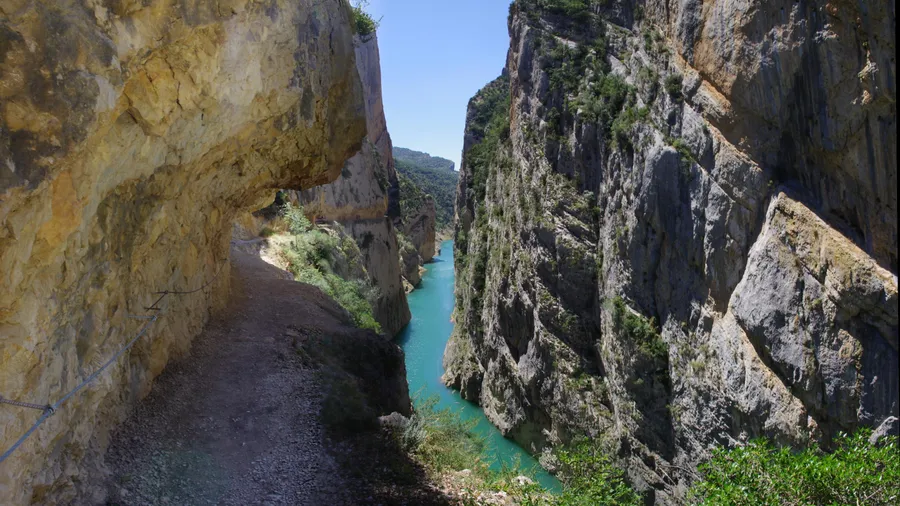
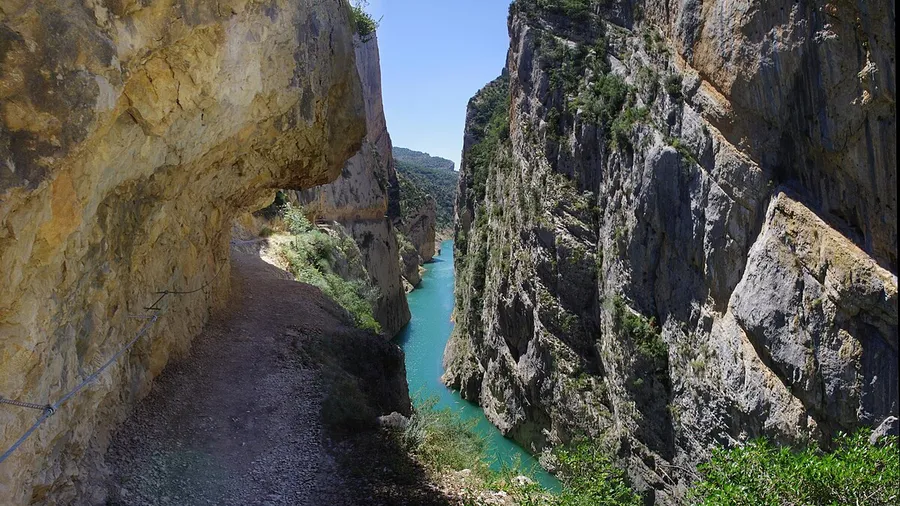
  • • Congost de Terradets: vertical-walled gorge carved by the Noguera Pallaresa river
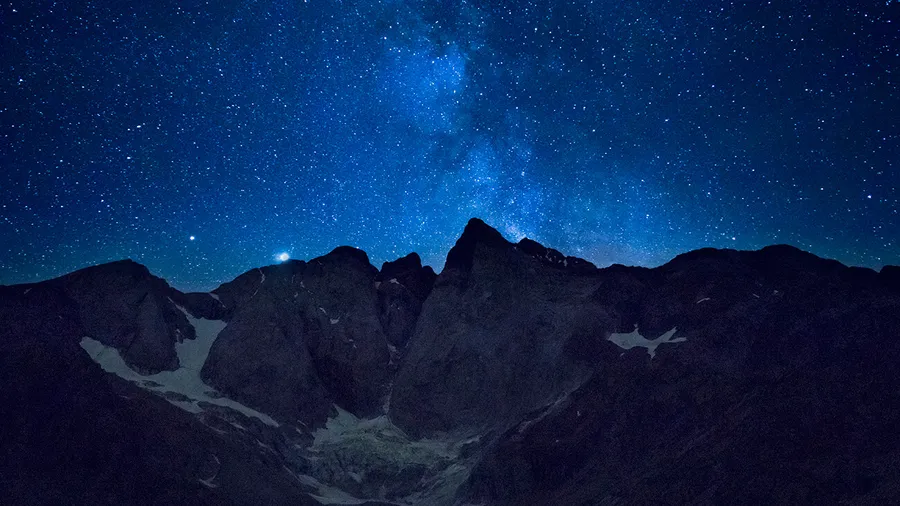
  • • Starlight Reserve with the Milky Way visible to the naked eye almost year-round
  • • Over 600 climbing routes on limestone at the Àger and Finestres sectors
  • • Technical canyoning in Barranc del Bosc for various skill levels
  • • Depopulated Pallars Jussà landscape: empty farmhouses, silence and undisturbed wildlife

Description

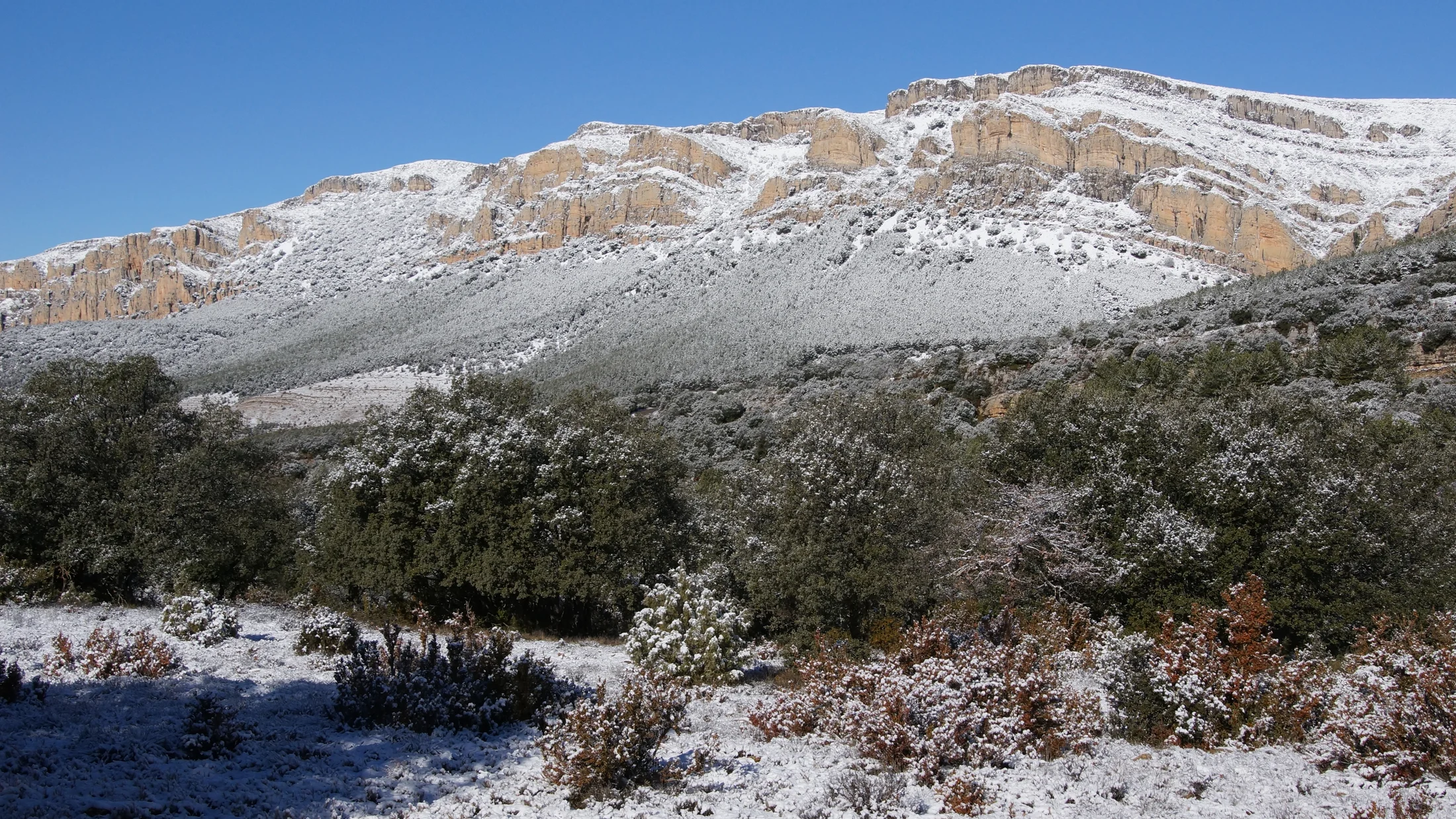
Sierra del Montsec is a limestone anticline that rises abruptly between the Ebro depression and the Lleida pre-Pyrenees, reaching 1,678 m at the Tossal de Montsec. From the valley road along the Noguera Ribagorçana river, the grey limestone wall appears almost vertical: not a gradual slope but an 800-metre rise that geologists attribute to Alpine folding combined with river erosion. The Noguera Pallaresa, for its part, has carved the Congost de Terradets, a gorge of smooth vertical walls where water against rock creates a constant sound that drowns everything else. The first time you see this fracture in the landscape, you stop.

The territory around Montsec is sparsely populated. Farmhouses in the Pallars Jussà region have seen their populations fall for decades, and many remain empty or converted into rural accommodation. For the visitor this has a direct consequence: silence. In the ravines draining the northern slopes — Barranc de la Maçana, Barranc del Mas de Novell — you can walk for hours without meeting anyone. Black pines and holm oaks form dense understorey that absorbs sound, and in winter the mist rising from the Camarasa reservoir adds a visual texture that landscape photographers know well.

The sierra is one of the few places in the Iberian Peninsula where light pollution is low enough to see the Milky Way with the naked eye for most of the year. The Centre d'Observació de l'Univers in Àger, managed by the Consorci del Montsec, combines public-access telescopes with interpretive astronomy sessions. New-moon nights between late September and early November offer the best atmospheric transparency for deep-sky observation.

Climbing is a principal activity: the sectors at Àger, Finestres and La Pertusa have over 600 equipped routes on good-quality limestone, graded from 4a to 8c. Canyoning in the Barranc del Bosc and Congost de Terradets offers varying technical levels, with options for beginners and more committing descents for experienced groups. Mountain bike routes use the forest track network and adapted sections of the GR-1.

Extensive livestock farming in the Pallars Jussà—mainly native breeds of sheep and cattle—has shaped the open landscape of the limestone terraces where box and juniper replace closed woodland. In the villages of Àger, Camarasa and Artesa de Segre, dry-stone architecture and Romanesque bell towers mark the centuries when this sierra lay on the frontier between Christian and Andalusian territory. The Camí de l'Alt Pirineu long-distance route crosses the northern edge of the sierra, linking valleys and villages in stages of 15 to 25 km suited to fit walkers. The Camarasa reservoir, built between 1917 and 1920—one of Spain's earliest large dams—creates a still-water mirror that doubles the cliff silhouette on windless mornings.
Practical information

Everything you need to know for your visit to Sierra del Montsec

How to get there
From Lleida, take the C-13 toward Tremp to the Àger turnoff or the Terradets gorge. From Barcelona, the C-14 via Artesa de Segre reaches the area in under two and a half hours. There is no regular bus service into the sierra itself.
Area Information
The Pallars Jussà region has its administrative centre in Tremp. The municipality of Àger is the activity hub for adventure tourism. The local economy combines irrigated agriculture in the valley floors, active tourism and extensive sheep and cattle farming.
Geography
East–west limestone anticline approximately 40 km long. The Tossal de Montsec reaches 1,678 m. The Noguera Pallaresa and Noguera Ribagorçana rivers flank the sierra and have carved the congosts (gorges) that cut transversally through the anticline.
Flora & Fauna
Black pine and Aleppo pine on the slopes, holm oak woodland on the lower areas and box on the limestone ledges. Notable fauna: bearded vulture in the nearby pre-Pyrenees, griffon vulture nesting on the cliffs, otter in the Noguera rivers and a stable population of Spanish ibex.

Things to do

Find the best plans and things to do in Sierra del Montsec

20

Accommodations

Best accommodation options in Sierra del Montsec

Loading accommodation options...

Frequently Asked Questions

Get answers about Sierra del Montsec

The centre is about 4 km from the village of Àger along a paved road. Night-time astronomy sessions are booked through the Consorci del Montsec website. Daytime sessions with solar telescopes and guided visits to the Parc del Cel outdoor interpretation area are also available.
The Àger sector has routes from 4a to 8c, making it suitable for beginners progressing on limestone as well as advanced climbers. The La Pertusa sector concentrates the most technical sport climbing. Consulting the current local guidebook is advisable as some routes are re-bolted periodically.
Free camping is prohibited across most of the sierra. Designated camping areas exist in some Pallars Jussà municipalities, and several hostels and rural houses offer affordable accommodation in Àger, Camarasa and Artesa de Segre. Booking in advance is recommended on high-season weekends.
The Terradets gorge can be paddled by kayak when the Noguera Pallaresa has sufficient flow, generally in spring and early summer. Several local operators run guided descents. During low-water periods paddling is not viable, and the Terradets dam gates control water levels at all times.
Yes, particularly between October and February in the Noguera Pallaresa valley and near the Camarasa reservoir, where temperature inversions generate persistent fog. However, above 800–1,000 m the sky is typically clear above the fog layer, creating optimal conditions for astronomy and landscape photography.