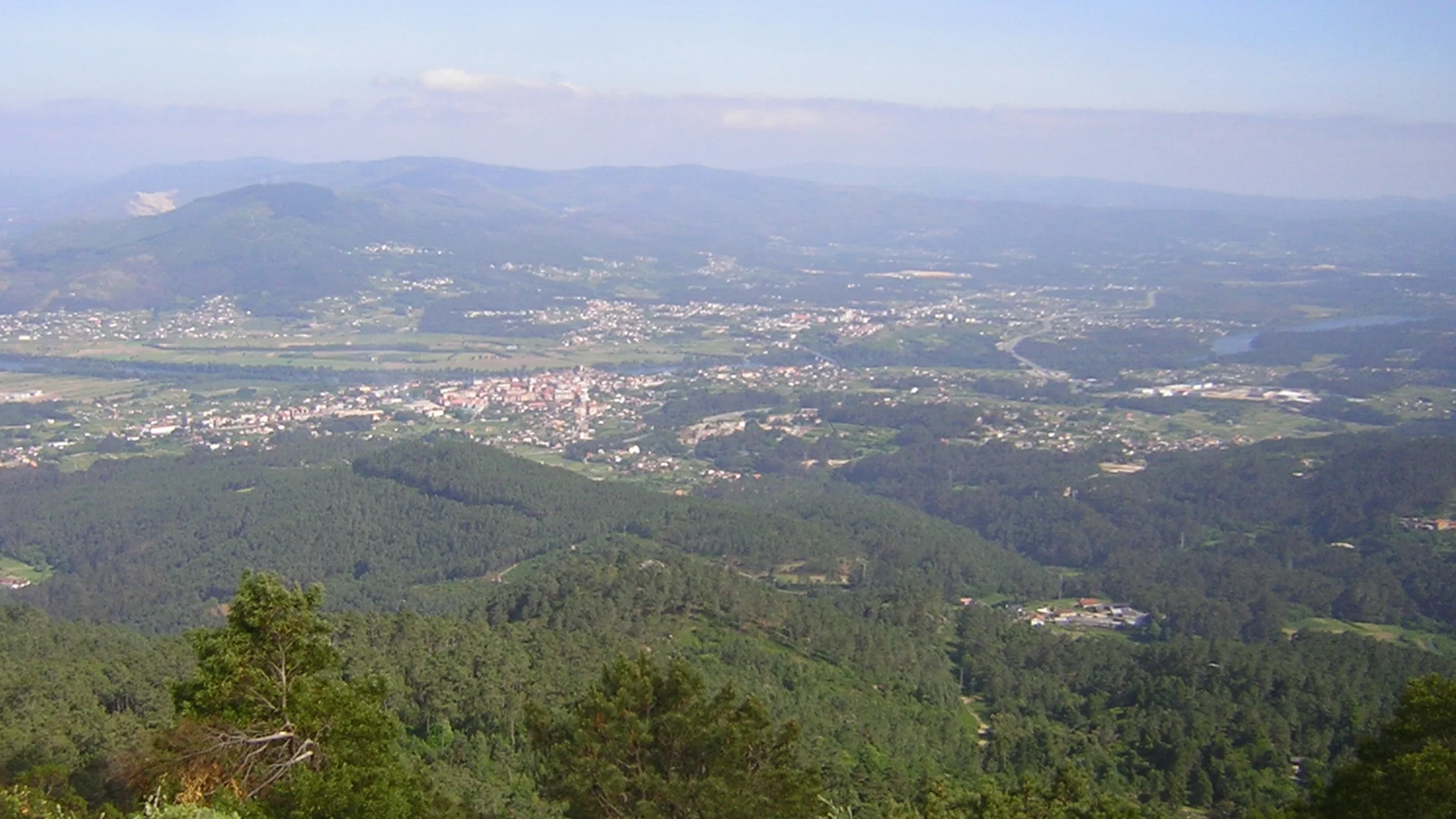
Monte Aloia Natural Park was the first to receive this protection status in Galicia, declared on 4 October 1978. It covers 746 hectares in the municipality of Tui, in southern Pontevedra province, and is part of the Natura 2000 network. Its highest point, Alto de San Xiao, stands at 631 metres, and from its six viewpoints visitors look out over the Miño river along the Portuguese border, the Louro valley, the Sierra de O Galiñeiro, and on clear days the outlines of the Cíes and Ons islands on the Atlantic horizon.
The park's flora includes over 500 plant taxa, with around 30 documented Iberian endemics. Much of the woodland dates from a century-old reforestation programme started by forestry engineer Rafael Areses in the early 20th century, which introduced cypresses, firs and cedars of Lebanon alongside native species. Today eucalyptus, pines, pedunculate oaks and chestnuts coexist, forming a mosaic of vegetation uncommon in Galicia. An understorey of gorse, heather and ferns covers the more exposed slopes, and in spring the gorse bloom colours the forest clearings yellow.
The fauna stands out for its density of amphibians and reptiles: 11 of the 14 amphibian species found in Galicia live here, including the Iberian newt and the gold-striped salamander. Among reptiles, Seoane's viper and the Schreiber's green lizard are Iberian endemics. Mammals include fox, wild boar, red squirrel, common genet and horseshoe bat; year-round resident birds include the common kestrel, the common buzzard and the tawny owl. The streams hold the bermejuela, an Iberian endemic fish classified as vulnerable.
Eight marked trails totalling around 10 kilometres start from the Casa Forestal Ingeniero Areses Visitor Centre in Frinxo (Pazos de Reis). Routes connect six viewpoints and five recreation areas, passing historic structures: the flour mills of Tripes and Paredes, seven in total accessible along the trails, and the remains of a cyclopean wall at the summit, a pre-Roman structure encircling the mountain. The Botanical Path (700 m) works as an introduction for families with children; the Muralla route (3.2 km) is the most demanding and provides the best panoramic views. The damp scent of earth beneath the eucalyptus and the sound of water in the streams running towards the Miño accompany every step through a park that, despite its modest size, holds a biological diversity and cultural heritage beyond what its 746 hectares might suggest.