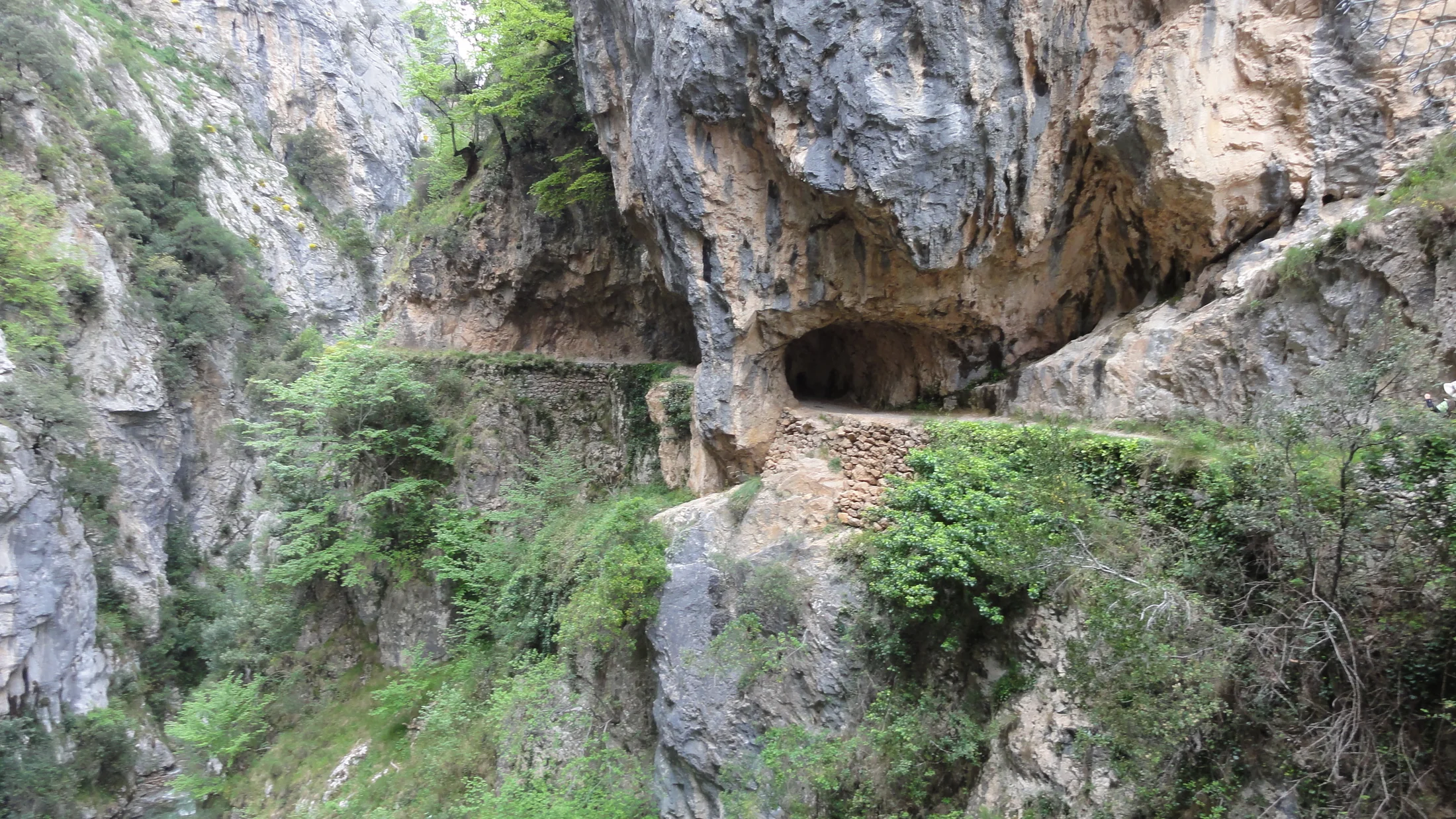
Why the Cares Route enchants and demands planning
The Cares Route connects Poncebos (Asturias) and Caín (León) via a path carved into the rock, alongside the canal that supplies the Poncebos power station. It is a classic of the Picos de Europa and, at the same time, a hike that requires decisions before you lace up your boots.
The path follows the hydraulic canal and does not have technical labyrinths, but it does have sections exposed to the void and high crowds during high season. It suits regular hikers who know how to measure their strength and their pace.
It is a linear traverse: you can go and return via the same path or do only the outbound journey and return with a transfer. Upon crossing a tunnel excavated in the fresh rock, you emerge onto a natural balcony with the river gasping below.
Before heading out, decide on your return, the daylight, the weather, and where to park. Also, take into account the rules of the National park and book the transfer if you choose the one-way option.
Cares Path: history and context
The Cares Path was widened between 1945 and 1950 to facilitate transit through the canal that carries water to the Poncebos hydroelectric station. Today, that service road is one of the best-known routes in the Picos de Europa.
It traverses the councils of Cabrales (Asturias) and Posada de Valdeón (León).
It attracts visitors with its route hanging over the gorge, its tunnels, and the constant views. On clear days, the limestone seems to burn in the sun and the river looks emerald green. It is also a destination for photographers: bridges, deep chasms, and contrasts of light at every bend.
Before heading out, keep four things in mind. Access by bicycle is prohibited. There is a danger of falling rocks due to natural causes or animals, and the section between Caín and Poncebos lacks side protection at the precipice. There is no potable water available during the route, so bring your own.
What you will find here and how to make the most of it
This guide to the Cares Route is designed to help you choose quickly and walk safely. If you are planning in a hurry, consult "Essential information" and "How to get there and park": there you will find the location, duration, the best time, and the Poncebos car park.
For more detailed organisation, go through "Accommodation", "Description and variants", "Points of interest", "Equipment", "Tips", and "Frequently asked questions". The guide includes one-way options with a transfer, short sections for families, and combinations with other mountain trails.
You will also find difficulty levels per section, common risks, and basic emergency protocols. Touching the rock railing and feeling the freshness coming from the tunnels, like a mountain breath, is part of the way.
Make use of the sections with lists to decide quickly and save the article to consult it on your mobile without signal.
Picuco te puede ayudar
Does something here catch your eye?
Tell us.
Write to us on WhatsApp or email: we answer questions, find the best options and help you sort out the booking.
Location, duration and best time to walk
The Cares Route connects Poncebos (Cabrales, Asturias) with Caín (Posada de Valdeón, León), within the Picos de Europa National Park. It is called "the divine gorge" and runs along a limestone ledge next to the hydraulic canal.
It is a linear trek, not a circular one: approx. 12 km in each direction, or 24 km round trip. From Poncebos to Caín, the net positive elevation gain is about 300–350 m, with accumulated ups and downs.
Important
During episodes of adverse weather, the Park may recommend not using the path or closing specific access points. Check notices at the Picos de Europa National Park and in the town halls of Cabrales and Posada de Valdeón.
The physical difficulty is moderate if you only do one way, and moderate-high if you go and return, due to the length. The technical difficulty is low when dry, although there are sections without railings with exposure. Estimate 3–4 h per direction without long stops and 6–8 h round trip with breaks.
The best time is from May to October, with long days and less ice. In summer, the heat is intense at midday and there is more crowds; in spring and autumn, temperatures are mild and there are fewer people. In June and July, sunrise arrives around 6:45 and sunset around 22:00.
In winter, there is a risk of ice, snow and rockfalls, with potentially dangerous sections or occasional closures for maintenance or safety. Check the status before going and avoid ice and gusty winds: a slip on an exposed section can have serious consequences.
Check the AEMET forecast the day before and on the day: after heavy rain, rockfalls and mud at the access points increase. Start early to avoid the heat and the crowds, and carry a headtorch if there might be a late sunset.
The crunch of boots on fine gravel and the constant sound of water set the rhythm of the day. Carry offline maps from the IGN or the "Mapas de España" app and extra battery; the signage is continuous.
The access points are at 43.2617°N, -4.8311°W (Poncebos) and at 43.2134°N, -4.9056°W (Caín).
How to get there and park in Poncebos and Caín
Reaching Poncebos or Caín requires mountain roads, with curves and narrow sections. Allow plenty of time for the journey and do not rush your schedule.
It is advisable to set off with a sufficient fuel tank: the route between both points runs through mountain areas, far from service stations. In the open curves, the limestone turns white as if it were emitting its own light.
If you only do one way of the route, prepare a return plan from the arrival point in advance. Leave your car in the car park at the starting point and organise your return by taxi or with someone to pick you up.
By car: routes, roads and signage
Reaching Poncebos from Oviedo takes 1 h 45 min–2 h: A-64/N-634 towards Arriondas, N-625 to Cangas de Onís, AS-114 to Arenas de Cabrales and AS-264 to Poncebos. From Santander, the route goes via the A-8 to Unquera, the N-621 to Panes and the AS-114 to Arenas, with a final detour via the AS-264.
The asphalt is in good condition, but there are curves and narrow stretches. After the rain, the valley smells of resin, the asphalt steams and cowbells ring on a nearby farm.
To reach Caín from León, take the N-625 towards Riaño and Posada de Valdeón and then the LE-2441 to Caín. It is a very narrow mountain road with low visibility.
From Madrid to Caín, it takes 5–6 h depending on traffic. In winter, some stretches may have ice or occasional closures due to snow.
At the final detours, you will see signs for “Poncebos”, “Arenas de Cabrales” and “Caín/Valdeón”. Drive slowly, use low gears on descents and respect priority at narrow passages.
Parking without stress: Poncebos and Caín in high season
The Poncebos car park is next to the start of the path and the power station, with limited spaces that fill up early in summer and during bank holidays. On cool mornings, it smells of cut grass as the first cars arrive in silence.
Practical advice
In July-August and during bank holidays, arrive before 9:00 or park in Arenas and go up by bus/taxi. You will avoid traffic jams and fines for improper parking.
When the valley becomes saturated, in Arenas de Cabrales you have 3 designated car parks to leave your car and go up to Poncebos by shuttle bus. The ticket to Poncebos costs 1,55 € and the return journey is 3 €.
To reach Sotres from Poncebos, you must use minibuses: 2,60 € for a single ticket and 5 € for the return journey. In July and August, access is restricted for private vehicles.
Caín has spaces in the centre and designated areas during the season, but the road is narrow and regulations change. From Caín to Poncebos there are 11 km, so the return journey totals 22 km.
Costs and schedules may vary, and some private car parks in the valley charge a daily fee. Arrive very early or consider staying overnight nearby to avoid driving around. On peak days, leave your car in Arenas and use a transfer so as not to block access.
Public transport and possible combinations
During the season, a local bus connects Arenas with Poncebos and increases its frequency in summer. It is the simplest way to reach the start of the route without searching for parking.
Towards the Leonese side, bus connections reach as far as Posada de Valdeón. If there is no connection to Caín, you can use a transfer/taxi service between Caín and Poncebos. The gentle rattling of the bus as the gorges open up in the background and a cold breeze enters through the window accompanies the journey.
Schedules vary depending on the month and the day of the week, so it is advisable to check them for updates before leaving.
Changing schedules
Bus and shuttle schedules are adjusted every season and weekend. Check the municipal websites of Cabrales and Posada de Valdeón or the bus company the day before your trip.
For the return journey, a coordinated transfer or taxi between Caín and Poncebos avoids repeating the route on foot. Prices are variable and must be confirmed in advance. Another option is the double car: leave one in Caín and start in Poncebos, or vice versa.
Where to sleep to get a head start
Sleeping near the start or the end of the route saves you stressful travel on the day of the hike and lets you set off with the first light. The limestone of the gorge takes on pink tones at sunrise and golden tones at sunset.
Choose your base according to your plan: round trip, one way with a transfer, or a family trip with plenty of time. This way, the early start doesn't eat up your day and you arrive at the trail with a rested body.
Poncebos: perfect if you want to set off at dawn
Sleeping in Poncebos puts you right at the foot of the path before the crowds arrive. Staying here, or just a few minutes away by car, allows you to wake up early and start the route while the light is still low.
There are simple hostels, rural houses in nearby villages and, heading down to the valley, campsites and hotels in Arenas de Cabrales. In July, August, and during bank holidays, book in advance: capacity is limited and demand is high.
The advantage is clear: you park, walk, and have better control over your schedule and the temperature. Parking is limited and fills up quickly, so sleeping nearby gives you the leeway to set off without rushing.
At sunrise, you feel the freshness of the river and the crunch of the early gravel, with no voices around. Poncebos can be reached by car and by public transport.
Before you go to bed, ask about an early breakfast or request a picnic to take away. That way, you set off at dawn with everything sorted.
Caín: sleeping where the path ends
Sleeping here fits if you do Poncebos→Caín and stay to rest once you finish.
Book in advance, especially in summer: access is narrow and the supply is limited. You finish the route and you are already accommodated, without rushing to get back, and the afternoon light allows you to take the final photos of the gorge.
The main drawback: if you left your car in Poncebos, you will need a transfer, a taxi, or a second vehicle. Services are basic, so buy water and snacks the day before. At night, the deep sound of the river resonates between the houses.
Surroundings: Arenas, Cangas and Covadonga
Puente Poncebos is 45 minutes away by car. The two towns serve as a base for longer stays or family trips, and to combine the Senda del Cares with the Lakes of Covadonga, gentle routes, or cultural visits.
In Arenas de Cabrales, you have three parking areas for private vehicles. The Ovar parking lot, between Arenas and Poncebos, has 146 spaces and limited capacity. Buses depart from 8:15 to 13:00 and from 17:00 to 19:00, approximately every hour.
Lakes Enol and Ercina are of glacial origin. During periods of rain and snowmelt, Bricial, a third temporary lake, can form.
At sunset, the smell of cider and Asturian cuisine floats through the streets while your boots dry.
Staying here is convenient if you want several days of hiking and excursions, are travelling with children and value parks, pharmacies and services, or are looking for a more flexible budget and last-minute options.
Itinerary and variants for walking the Cares
The Ruta del Cares can be traversed in several ways, and choosing well makes all the difference. Here you have the step-by-step route and how to adapt it to your time and physical fitness.
You can do it as a round trip, one way only with a transfer, in the reverse direction, or in short sections. The light changes with every tunnel, so the same path looks different depending on the time.
Before heading out, decide how many hours you have and how much you want to walk. With that answer, choose the option that suits you best and book the transfer if you need it.
1. Complete Poncebos–Caín route: step by step
The complete Ruta del Cares is about 12 km between Poncebos and Caín, with a ledge carved into the rock, short tunnels, and continuous views of the gorge. The path follows the canal that carries water towards the Camarmeña power station and advances hanging over the cliffs.
From Poncebos, you cross the river and climb via zigzags to reach the level of the canal. Afterwards, the path softens and alternates between metal bridges and crossings over the canal. There are narrow ledges, 1–1.5 m in some points, without a handrail: pay attention if you suffer from vertigo. The excavated tunnels require a headlamp on very dark days.
Poncebos→Caín is done in 3–4 h with short stops. The physical difficulty is moderate and the technical difficulty is low when dry; watch out for loose gravel. In summer, start before 8:00 and bring 1.5–2 l of water and a cap.
If you do a round trip, control your return time: calculate 6–8 h plus stops.
2. One way to Caín and organised return
Walking from Poncebos to Caín and returning by transfer, taxi, or with an organised car removes the need for the return journey on the same day. The route is known as the "Divine Throat", and doing it in one direction changes the plan significantly.
The cool wind coming out of the tunnels clears things up when the sun warms. With the one-way trip, you avoid the sunset rush and the fatigue of the return, and you have more time for photos and breaks.
The return by transfer or taxi is booked in advance between Caín and Poncebos. The price is variable, so it is advisable to coordinate the schedules. With two cars, you leave one in Caín and start in Poncebos; upon arrival, you recover the other.
The variant has its fine print: it requires coordination, can involve an extra cost, and in mid-to-low season, you depend on schedules. Confirm the transport the day before and have a plan B. If you are in a group, share keys and car locations using shared location.
Access is easy by car and by public transport from Poncebos, although parking in Poncebos is limited.
3. Reverse variant and nearby combinations
The path was originally built for a supply canal for a power station (1921).
The logistics of access to Caín are more delicate in summer due to regulations: check if there are shuttles and parking restrictions.
The route has no technical difficulty, but the edges of the gorge have no protection. Go with caution due to possible falling stones and the presence of animals grazing above. Avoid adding technical routes (stony canals or exposed climbs) on the same day: fatigue spikes the risk.
On the Asturian side, leave a short walk for Bulnes, a parish of the Asturian council of Cabrales, for different days, never on the same day as the full crossing.
4. Short sections and options if you have little time
A well-chosen half-day offers plenty in the Ruta del Cares. If you do not have a whole day available, choose a short section with high scenic value and return by the same way.
From Poncebos, you can advance to areas of wide cornices and short tunnels, and return. It is an option for families accustomed to walking. From Caín, walk to the first tunnels and walkways, and return: with morning light, it is very photogenic.
Do not take shortcuts or unofficial paths, because the limestone breaks without warning. Control your time, as even a short section can be extended with photos and breaks. Always carry hiking footwear, sufficient water, and a windbreaker. If you suffer from vertigo or if there is strong wind, avoid the narrow sections.
What to see and do on the Senda del Cares
The Senda del Cares covers 21 km between Posada de Valdeón and Poncebos, with 899 m of descent and 160 m of ascent. The difficulty is medium: the layout is simple, but the route is long and takes between 3 h 20 min. and 5 h 30 min.
The path advances between carved cornices, natural balconies over the gorge with views of the enclosed river. It passes through tunnels and galleries opened by hand and with gunpowder in the 20th century, some dark and others illuminated by natural windows. It also crosses bridges and crossings over the canal, metallic or masonry, which are very photogenic. For the best views, stop at the tunnel exits and on the bridges over the canal: there, the framing gains depth. If you are looking for a high point, take a look at this viewpoint.
Near Caín, the Cares runs clean and turquoise; after rains, it runs milky due to the load of sediments. That turquoise colour is due to glacial sediments rich in calcium carbonate that reflect sunlight. In spring, the walls ooze moisture and ferns and lichens grow in the cracks. Creeping junipers, saxifrages, and small flowers cling to the rock.
The fauna accompanies the journey: griffon vultures, Egyptian vultures and, with luck, a golden eagle soaring. Observe them in silence and from a distance. On the high slopes, at sunrise or sunset, chamois may appear.
For Photography, take a polariser to tame the glare from the water; a lightweight tripod will serve you for a long exposure in the shade. Compact binoculars and offline identification apps are enough to observe birds. If you have a picnic, look for safe landings that do not block the path, and pack all your rubbish back out with you.
It is advisable to plan the light: the morning illuminates the path towards Caín from Poncebos better, and the afternoon, the return. Reserve 30–45 extra minutes each way for stops and photos. Once, when exiting a tunnel, the breeze brought the scent of thyme and hot rock.
Precautions are part of the plan. Do not approach edges without protection, because the rock is loose, and there is a danger of falling stones due to natural causes or animals. The section between Caín and Poncebos has no lateral protection and runs alongside a precipice. Swimming can be dangerous due to currents and cold water: assess the flow and respect the protected environment. It is forbidden to travel the path by bicycle.
Equipment and physical preparation
The path is easy to follow, but 24 km round trip turns the day into something serious. Bring suitable equipment, eat well and adjust your ambition to your physical fitness.
In your backpack, hiking footwear with a gripped sole, a trainer or boot, is essential. Calculate 1.5–2 l of water per person in summer, because there are few reliable fountains. Add a windbreaker or lightweight raincoat, as the mountain changes quickly, and sun protection with a cap, sunglasses and SPF 30+. A small headtorch will solve the dark tunnels and unexpected light issues, and a basic first aid kit with bandages, medical tape, painkiller and a thermal blanket covers emergencies.
Recommended: folding poles to take the load off your knees on the return, an offline map or track of the PR-PNPE-3 with an external battery and a thin thermal layer in spring-autumn. Eat a hearty breakfast and bring salty and sweet snacks (nuts, bars, a sandwich). Drink in regular sips and, if it is hot, add mineral salts.
One way (12 km) is suitable for regular hikers; children used to walking can do short sections. Round trip (24 km) requires endurance: calculate 6–8 h net plus stops. With children, avoid strollers and use a technical baby carrier if necessary, taking exposure into account. Choose short sections from Caín or Poncebos and stay away from the narrowest areas on windy days.
It is not an ideal route for nervous dogs due to the exposure. Do not pet or feed the guard dogs of the flocks: there are Mastiffs to protect the livestock.
The use of bicycles is restricted to roads and tracks permitted for motor vehicles; it is prohibited on paths or cross-country.
As evening falls, a cool breeze descends through the gorge and you will appreciate a dry layer in your backpack.
Tips and safety in the Cares
The key in the Cares is well-planned logistics and responsible behaviour on the route. Before setting off, it is advisable to know the Park rules and know how to act in the face of unforeseen events.
At midday, the heat concentrates on the rock, so avoid the central hours of the day. It also helps to choose time slots with less crowds: you will walk more calmly and with fewer waits in the narrow sections.
Crowding: when to start and useful tricks
The Cares Route gets very crowded between June and September, especially on weekends and long holidays. Early in the morning there are fewer people and more silence.
Sleeping in Poncebos or in Caín and setting off with early light puts you ahead of the crowds. If you go late, choose a short section so as not to coincide with everyone's return.
Enter via Caín if there is regulation and shuttles, and verify the schedules before leaving. In narrow sections, yield the way and form orderly queues if there is a bottleneck.
Park rules and respect for the environment
The Cares Route runs through a National Park, so the priority is the ecosystem and those who inhabit it. In the villages, it may smell of manure and straw: it is the sign that you are in living territory.
All your rubbish goes back with you. Dogs must always be on a lead, out of respect for livestock and wildlife.
Lower your volume: the birds and chamois will appreciate it. Temporary restrictions may exist due to works, landslides or traffic management at the access points, so verify the day before with the National Park and in the town halls of Cabrales and Posada de Valdeón.
Emergencies, coverage and signalling
In sections of the gorge, mobile signal is lost, so it is advisable to set out with a clear emergency plan. Coverage is irregular throughout the entire route.
If you need help, call 112: it is free and available 24 hours a day, 365 days a year. It works with any operator if there is GSM coverage, and it is not possible to call in areas without a network. When calling, indicate the approximate kilometre point and the direction of travel.
The path is obvious and continuous alongside the canal, but respect the danger signs. Before setting out, share your itinerary and estimated return time with someone. Carry offline maps from the IGN or Mapas de España and activate shared location.
If the weather changes, put on a windbreaker, assess the return, and avoid running in exposed sections. In the event of an injury, place the person in a safe and visible area, keep them warm, hydrate them, and notify 112 with clear details. A thermal blanket weighs grams and is very useful if the cold air catches you by surprise at the last minute.
Frequently asked questions
1. How long does it take to complete the Ruta del Cares?
The complete Ruta del Cares, round trip, takes most people between 6 and 8 hours. The pace, stops, and weather make the difference, and almost everyone takes a longer break halfway through the day to eat.
In summer, allow extra time: the heat is intense and narrow sections become crowded, so you will have to wait. If you are going with children or in a large group, consider breaking the route into short sections and returning to the starting point.
Check the daylight according to the season and set off before 8:00 to arrive with plenty of time. If you are only doing the outbound journey, you can set off in the afternoon and return by transfer.
2. Is it suitable for children or pets?
The Senda del Cares is not technically difficult on dry ground, but it has exposed sections without railings and severe drops. With children, it is viable to do short sections from Poncebos or Caín if they are used to walking, are obedient, and are not afraid of altitude. Avoid going with strong winds or damp ground and always maintain distance from the edge.
With babies, forget the pram: use a technical baby carrier if you have experience, knowing that the exposure does not disappear and stability is key. With dogs, the Park regulations require a lead; choose a harness and short lead to control them well in narrow passages and crossings. It is not an ideal route for nervous dogs or those prone to pulling. In summer, look after the dogs' paw pads due to the heat and carry extra water.
If anyone in the group suffers from vertigo, at the slightest sign of discomfort, turn back without hesitation.
3. Where can I park safely?
The Poncebos car park is next to the start of the path and fills up very early in high season. If you cannot find a space, leave your car in Arenas de Cabrales and go up by bus or taxi.
In Caín, there are spaces in the village and designated areas depending on the season, and the access road is narrow. Do not park outside of permitted areas: you could obstruct emergency services and expose yourself to a fine.
If you do not want to depend on parking, organise two cars, one at each end, or a return transfer. Do not leave objects in sight and check that the vehicle is not in ditches or narrow passages. Check the municipal information the day before to learn about last-minute changes in regulation and availability.
4. Do I need a permit or are there seasonal limitations?
Under normal conditions, walking the Ruta del Cares does not require a permit. The path is within the Picos de Europa National Park, so strict rules apply: dogs must always be on a lead, you cannot make fires, and camping or bivouacking is not allowed along the route. Also, look after your rubbish and noise levels.
In winter and after storms, there may be closures or recommendations not to travel due to ice, snow, or rockfalls. Added to this are maintenance works on the canal and actions due to geological risks, which cause occasional closures.
During the season, road access regulations to Caín may include controls, deterrent parking, and shuttles. If you are going with an organised group or preparing a specific activity, such as filming, check the authorisations beforehand.
Before your visit, check the notices on the websites of the National Park and the town halls of Cabrales and Posada de Valdeón. Plan with plenty of time and confirm the day before.
5. Can it be done by bicycle or with reduced mobility?
The Senda del Cares does not allow bicycles: it is narrow, has exposure, and intense pedestrian traffic, and it is not permitted.
In the Lagos, private vehicles circulate without restrictions the rest of the year, and access to the Santuario de Covadonga is free, subject to parking availability.
If you have any doubts, contact the local tourist offices to receive adapted options and always prioritise safety and comfort.
Book your experience — discover active tourism activities in Spain with providers verified by Picuco.
Conclusion
The Ruta del Cares is a linear and obvious path between Poncebos and Caín, but its exposure and logistics require planning. Choose the right time, get up early, monitor the hours of daylight, and decide between a round trip or a one-way trip with an organised return.
The coolness of the tunnels and the echo of the river accompany the journey. Before setting off, check the weather on AEMET and any possible notices from the National Park.
Sleeping in Poncebos or in Caín allows you to start early or finish without rushing. If you only do the outbound journey, book the transfer in advance or coordinate two cars.
Carry enough water, sun protection, a windbreaker, and a headtorch. You are walking through inhabited territory: respect correct parking and keep quiet near the herds.
If you have two days, organise the route into two stages. Save the guide on your mobile, download offline maps, and share your itinerary with someone before leaving.