Ordesa y Monte Perdido at a glance: nature, culture and essential routes
An ancestral landscape protected for generations
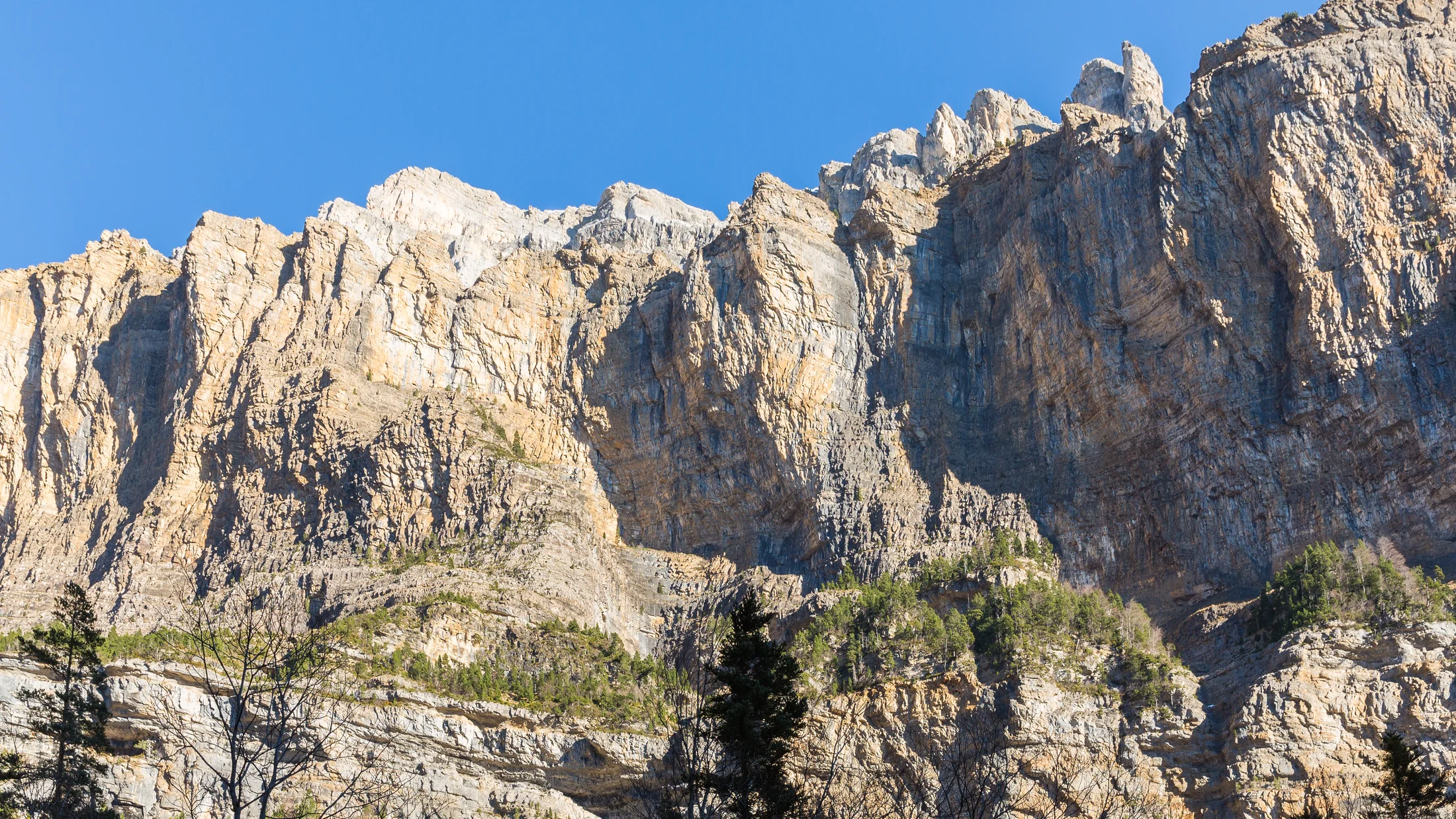
Ordesa y Monte Perdido is a unique limestone massif in the central Pyrenees with glaciated "U" shaped valleys and deep canyons. Since 1918, it has been a National Park and, as "Pyrenees–Monte Perdido", a UNESCO World Heritage Site since 1997 for its natural and cultural value. Here, cirques such as Soaso and Pineta were carved, along with canyons like Añisclo, with walls that tell 200 million years of geological history. The water from the Arazas or the Cinca polishes terraces and waterfalls, while beech and fir forests give way to alpine meadows with edelweiss, Pyrenean chamois and bearded vulture. The sound of the river beneath the beech forests in summer refreshes your skin as if it were opening a window to the high mountains. If you are looking for great classic routes (Cola de Caballo), aerial traverses (Faja de Pelay), demanding ascents (Monte Perdido, 3,355 m) or family strolls, this valley offers clear, signposted options with enormous landscape value. Sources: Ordesa y Monte Perdido National Park (MITECO, regulations and conservation), UNESCO (inscription and cultural values) and AEMET (high mountain climate).
What you will find and key data for planning
Four valleys, a 3,355 m peak and a track with restricted access: that is how Ordesa is prepared. The Ordesa y Monte Perdido National Park is in the Sobrarbe region (Huesca, Aragón) and is organised into four valleys: Ordesa, Añisclo, Escuaín and Pineta, with access from Torla, Escalona/Escuaín and Bielsa.
The Ordesa valley is traversed by the Arazas river and opens in an east-west direction. The Pineta valley is the most accessible, with a road that runs from Bielsa to its bottom.
Here you have essential routes, accommodation bases, how to arrive without fines, seasonal safety and equipment by level. Also ideas for Añisclo, Pineta Valley and Bujaruelo with times, elevation gains and alternatives.
The best time is spring and autumn for hiking, summer for high mountains and winter for snowshoes and ice with a guide. The climate is Atlantic mountain, with frequent afternoon storms in summer and persistent snow in shaded areas. To navigate without signal, carry IGN MTN25 maps and reliable GPX tracks.
Picuco te puede ayudar
Does something here catch your eye?
Tell us.
Write to us on WhatsApp or email: we answer questions, find the best options and help you sort out the booking.
How to arrive and move around without complications
The N-260 Pyrenean axis passes through Aínsa, Boltaña, Fiscal and Sabiñánigo, with the N-260a bypass via Broto and Biescas. You reach Torla via the A-135 from Broto, and Bielsa via the A-138.
The A-138 (91.5 km) runs through the head of the Cinca river valley: it starts at the junction with the N-123 in Barbastro and ends at the Bielsa-Aragnouet tunnel, on the French border. From Zaragoza, follow the A-23 to Huesca and join the N-260; the A-23 runs from Sagunto to the Somport tunnel. From Pamplona, the A-21 reaches Jaca, where it joins the A-23 and the N-330.
Each valley has its own entrance. Torla–Ordesa drops you off at La Pradera de Ordesa, the starting point for Cola de Caballo and the Senda de los Cazadores towards Faja de Pelay. Bielsa–Pineta leads to the Pineta cirque, the Pineta Balcony and the Llanos de La Larri. Escalona–Añisclo/Escuaín opens up the Añisclo Canyon and the Escuaín viewpoints.
Book in advance. In summer, arrive before 08:30 to park without stress and catch the shuttles with time to spare.
Ask if there are park-and-ride lots in Broto/Sarvisé and if authorised 4x4 taxis operate towards viewpoints via restricted tracks. In Añisclo, there are sections of narrow roads and specific one-way regulations: respect the temporary traffic signs.
Move around by shuttle, carpool, avoid peak hours and do not park outside of designated areas.
Where to sleep and which base to choose: Torla, Broto, Bielsa and more
Torla puts the shuttle at your doorstep and Bielsa lets you wake up facing the Pineta cirque. The base you choose decides how much time you spend in the car and which valley you reach first.
Torla is the most direct option for the Ordesa valley: the shuttle leaves from the Torla-Ordesa Visitor Centre and reaches La Pradera de Ordesa via a direct route with intermediate stops. It is 4 min by car (3.2 km) from Puente de los Navarros, or 42 min on foot. In summer, however, prices rise and there is high demand.
Broto has more services and varied accommodation options, in exchange for a little more daily travel. Bielsa and Cebollar offer tranquillity and views of the cirque: the Pineta valley extends more than 12 km from the Pineta Cirque to Bielsa, and you are 1 h 8 min (77.6 km) from Torla-Ordesa.
Escalona and Escuaín are less crowded areas, with access to the Añisclo canyon right by the exit of the A-138. The roads are narrow and regulated. Logistics are limited and it is advisable to enter with care.
Typical accommodation includes rural hotels and village houses, apartments for families or groups, campsites and bungalows near rivers, and mountain refuges at key access points like Góriz, in high mountains. If you are travelling as a family, look for apartments in Broto and Sarvisé, campsites with pools in summer and accessible walks. Groups can find rural houses in surrounding villages such as Aínsa, Oto or Linás de Broto depending on availability and price, and couples can find charming hotels in Torla or Bielsa to wake up without rushing.
At sunset, the stone facades retain the heat and the smell of firewood mixes with that of hay.
Book in advance in July and August and during bank holidays. Confirm cancellation policies and shuttle schedules to coordinate early departures.
Essential routes of the Ordesa valley
1. Cola de Caballo: The classic route to the emblematic waterfall
From Pradera de Ordesa to Cola de Caballo there are 17–19 km round trip, 500–600 m of elevation gain and 6–7 hours of walking. It is the classic route of the park and the one most people do.
The itinerary is very well marked: it goes through the beech forest to the Arripas, Estrecho and Cueva waterfalls, and climbs up through the Gradas de Soaso to the glacial cirque. The physical difficulty is medium if you walk regularly and the technical difficulty is low, with wide paths, footbridges and well-maintained terrain.
The mist from the waterfalls wets your face like a fine drizzle that brightens the greens.
Spring and autumn are the best seasons: the snowmelt in one, the colours and lower crowds in the other, although in autumn the days get shorter. In summer, set off very early to have soft light and fewer people, and return with plenty of time before the afternoon storms.
The viewpoints of the Estrecho Waterfall, the Gradas de Soaso in wide shots and the Soaso meadows with the Cilindro and Monte Perdido in the background are the photographic highlights of the route. Families with children accustomed to walking will do well: bring snacks, sun protection and water supplies.
2. Senda de los Cazadores: Viewpoints and the classic climb to the valley
The Senda de los Cazadores climbs from the Ordesa meadow up to the Calcilarruego Viewpoint, at 2000 m altitude. From that point, in the widest part of the valley, you can see the Cotatuero cirque and its waterfall.
The climb is constant and demanding, with well-marked zigzags and some sections with a sense of exposure. The physical difficulty is high due to the slope and the technical difficulty is medium in the exposed sections; with dry ground, there are no mandatory scrambles. If you are not in shape, do not take it as your first route: consider using poles and a controlled ascent pace.
A gentler alternative is the round trip to Calcilarruego. If you want to expand the view, check the Viewpoint.
Go in summer or autumn, without snow. In early spring and winter, the ground can freeze and the route is not recommended without equipment or experience.
You set off and return to the Ordesa meadow. Get up early to overcome the first elevation gain in the shade. In summer, you must use the bus from Torla; in low season, you can access it by car.
3. Faja de Pelay: Panoramic ridge through the heights of the valley
The Faja de Pelay is a natural ledge hanging on the wall of the Ordesa valley. It runs horizontally along the sunny slope and offers a comprehensive panorama of the valley floor, the Soaso cirque and the peaks of the Monte Perdido massif. The warm wind brings the scent of resin and vultures soar at shoulder height.
The classic section measures about 7.2 km. Combined with the Senda de los Cazadores, the full route totals 18–22 km. The physical difficulty is medium-high for the whole trip and the technical difficulty is medium, with narrow sections and an airy sense of emptiness: you need a steady step and footwear with good grip.
It is not suitable for people with severe vertigo or for children without supervision. Do not walk it with snow or ice or on wet ground, and avoid it in strong winds. Do not do the route in reverse: the descent via the Senda de los Cazadores is dangerous.
You can start and finish in Calcilarruego, after climbing via the Senda de los Cazadores, or descend to the valley floor and return via Cola de Caballo. Plan for water and shade, because the sun hits the slope and the heat is noticeable by mid-morning. During the season, the shuttle from Torla-Ordesa is mandatory.
4. Circular through waterfalls and Gradas de Soaso: Half day with a taste of the valley
An 18.73 km loop with 553 m of elevation gain traverses the lower waterfalls of the Ordesa valley and overlooks the Gradas de Soaso. It is a half-day route, with low-medium difficulty, featuring well-maintained paths, walkways, and some short climbs.
The route starts from the Pradera and continues through Arripas, el Estrecho, the Cueva, and the intermediate meadows, returning via the other bank. In the Pradera, there are interpretive panels that help you read the landscape. The valley is a UNESCO World Heritage Site.
Spring, with the snowmelt, fills the waterfalls with water; autumn tints the beech forest. In summer, it is advisable to avoid the middle hours. The route is suitable for introducing children, with several spots to rest: do not approach the edge without railings and watch out for wet walkways.
If the group responds well, extend it to the Gradas de Soaso and return; if not, close the loop at the Cascada de la Cueva. During high season (summer, Holy Week, and long weekends), access to the Pradera is only available by OrdesaBus from Torla, with a round-trip ticket costing 6 € (under 10s are free). The last bus up leaves at 19:00 and the last bus down is at 22:00: organise your return time with a margin for the shuttle.
5. Ascent to Monte Perdido: The classic for experienced mountaineers
Monte Perdido (3,355 m) is the highest altitude in the Ordesa y Monte Perdido National Park and the highest limestone massif in Europe. Climbing it is high mountain mountaineering, not a hiking trail: it requires experience, equipment, and planning.
The route is done in two stages from Ordesa. The accumulated elevation gain from the Pradera is ≈2,045 m, with scree slopes and late snowfields.
The difficulty is high. The Escupidera section has exposed drops and serious risk with snow or ice, and that is where accidents are statistically concentrated, especially in mixed conditions. Carry a helmet due to rockfall, crampons, and an ice axe well into summer depending on the season, a headtorch, and maps. For groups with less experience, add a rope.
If you do not master navigation, snow progression, and risk management, hire a guide. Bivouacking is regulated only in high mountains and during nighttime hours, so confirm the current Park rules.
In summer, access to the Pradera de Ordesa is prohibited and you must use the bus from Torla.
The crunch of ice at dawn, under your boots, warns you that real high mountain climbing is beginning.
6. Interpretative walk through the Ordesa Meadow and accessible paths
Next to the Ordesa Meadow, there are short and flat itineraries, with almost no elevation gain, featuring panels about the forest, the river and the geology. They are perfect for arriving late, going with children or observing flora and birds calmly.
The route combines an accessible path through the meadow, short detours towards river viewpoints and marked circular returns. The panels are in Spanish (including Braille), French and English. The walk ends in a rest area facing the Cotatuero cirque, with views of the Cotatuero waterfall, which is 200 m high.
There are compacted sections and boardwalks, so it is advisable to ask at the Visitor Centre about the day's conditions. You will see European beech, fir and maple in autumn, traces of Pyrenean chamois in the mud and vultures flying; with luck, also bearded vultures.
Bring lightweight binoculars, a bird and plant guide and a quiet attitude: it is a great plan for macro photographers. At the start of the route, there is parking for people with reduced mobility (PRM) and adapted toilets in the initial area of the meadow, near the restaurant.
With a route of 1,200 m and barely 30 m of elevation gain, you can traverse the valley without rushing.
Beyond the central valley: Añisclo, Pineta and Bujaruelo
Añisclo Canyon: Paths, viewpoints and descents into the heart of the canyon
The Bellós river has carved a gorge of vertical walls and riverside forests that contrasts with the open valley of Ordesa.
Access is from Escalona via a narrow road with seasonal regulations. Park in the designated areas and use the marked stopping zones: there is a risk of rockfalls. Another entrance is from Escalona via Puyarruego, crossing the bridge over the Bellós river towards Buerba.
The marked paths enter the canyon from Gallisué, Vió, Buerba or Sercué. The Vió pass offers wide panoramas of the canyon. Along the way, the San Úrbez rock sanctuary appears, at 960 m altitude and 1.8 km from the start. The humid air brings the scent of earth and wet leaves.
The difficulty ranges from low to medium-long depending on your objective. The terrain can be damp and slippery, so wear footwear with grippy soles. Avoid floods, which occur in spring due to snowmelt and storms, and do not approach the edge of the polished rock pools.
A good combination is one day in Ordesa and another in Añisclo, to see the contrast between the open valley and the gorge. Before going, check local tourist information for road closures and temporary one-way traffic.
Pineta Valley: Lakes, glacial cirque and routes for all legs
The Pineta Valley can be explored from Bielsa to the bottom, where there is parking and meadows to start walking.
The most family-friendly route leads to the Llanos de La Larri: 2–3 h round trip and 300–400 m+, via track and path, with continuous panoramas. You set off from the Pradera de Pineta car park, at the end of the A-2611 road, next to the Parador de Bielsa.
The Cinca Waterfalls and their viewpoint require a bit more slope and stony ground.
The Balcón de Pineta and Marboré Lake are for strong legs: 7–9 h round trip and 1,350 m of ascent.
There are initial flat walks, several fountains and rest areas in the meadows, so the valley also works well with children or for those wanting little effort. In August, the influx is high: arrive early or choose the first or last hours of the day.
Spring brings the flow, autumn brings colour and stability, and summer allows you to gain altitude, keeping an eye on afternoon storms. Bring a windbreaker even in summer: the currents come down cold from the cirque.
Bujaruelo: Quiet valleys and charming alternatives
Next to the Ara River, Bujaruelo is the quiet alternative to Ordesa: it is suitable for family routes and for long approaches. The tinkling of water under the Romanesque bridges sets the morning rhythm.
The Otal Valley is the simplest route to start: 10–12 km round trip and 300–400 m of positive elevation gain, with wide meadows and good views. It works well for a picnic with children. Most of the route goes via a comfortable and wide forest track, with a cumulative elevation gain of 315 m. The valley has a U-shaped glacial morphology and allows you to spot Alpine marmots.
Bujaruelo Pass is the border between Spain and France and historically connects with Gavarnie. The ascent starts in San Nicolás de Bujaruelo (1,340 m), next to the inn-refuge and the camping area. There is no tree cover or water fountains during the route, so carry water before you set off.
From Bujaruelo, the GR-11 connects towards Ordesa and Góriz for more technical treks. In season, there are basic services; respect the marked parking areas. Summer weekends are lively, but with less density than Ordesa, and sunrise and sunset provide soft light and calm.
Bujaruelo complements a trip with more discreet routes, meadows for resting and close contact with the Ara. If you travel with a dog, respect the Park regulations and the bordering areas: short leash and respect for livestock and wildlife.
Waterfalls, viewpoints and wildlife: activities to complete your trip
Walking is not the only thing you can do in Ordesa: you can also observe birds, photograph waterfalls and head up to viewpoints with views over the valley. Set aside time for these activities and spread your day out according to the light and the season.
For wildlife, bring 8x32 to 10x42 binoculars and keep your distance. The bearded vulture, the Egyptian vulture and the golden eagle soar over the area; Pyrenean chamois appear on cool slopes at sunrise and sunset, and Alpine marmots can be found in high mountain areas in late spring. If you are looking for adventure beyond classic hiking, there are via ferratas and canyoning in authorised areas of the surroundings, outside the National Park, with certified companies: confirm requirements and the season before booking.
In the southern sierra are the Ordesa viewpoints, accessible via restricted tracks by authorised 4x4 taxis from Nerín or Torla, depending on the season. The Escuaín viewpoints are visited by car and with short walks.
Cold sunrises at the Sierra de las Cutas viewpoints tint the valley a liquid orange. For photographers, the Estrecho and Cueva waterfalls in Ordesa, the Gradas de Soaso, and the Bellós falls in Añisclo. The Cinca waterfall can be reached from the designated car park before arriving at the Pineta National Parador, via a simple route; the river forms crystalline falls with turquoise blue pools. The Estrecho waterfall requires a slight detour from the main path, although the route is signposted.
Bring a lightweight tripod and an ND filter for the waterfalls, and do not step on live moss or wet edges. In summer, leave your car in Torla and use the bus to reach the Ordesa meadow.
Guided activities include interpretive routes on flora and geology with local environmental educators and birdwatching with accredited guides. Nature workshops and interpretive walks are great for families; for photographers, the first and last light; for mountaineers, guided ascents and winter safety training.
Equipment, safety, permits and practical tips
Essential equipment and by route
A day pack in Ordesa is light, but what you carry inside decides the day. Prepare a common base and add pieces depending on the route you choose.
For any route, bring a lightweight 20–30 l backpack, mid-cut boots with grippy soles and 1.5–2 l of water per person. Add a headlamp, a basic first aid kit, a waterproof layer and a light thermal, even in summer. Add sunscreen, a cap and category 3–4 sunglasses.
On valley routes, such as Cola de Caballo and the waterfalls, pack telescopic poles, a raincoat, an IGN MTN25 map, a powerbank and salty snacks. In spring and autumn, thin gloves and a neck gaiter.
The Fajas and the Senda de los Cazadores require footwear with grip, a windbreaker and 2–3 l of water. An optional helmet is useful for sections with rockfall. Bring your GPS/GPX loaded and spare batteries for your headlamp.
When climbing Monte Perdido, wear rigid or semi-rigid boots, a helmet, warm gloves, an extra thermal and an emergency blanket. If there is snow, add crampons and an ice axe. Glacier glasses and lip balm complete the kit, and for groups with less experience, a rope and harness.
Before setting off, review this express checklist: weather confirmation, shuttle schedules, map, GPX, battery, water, warmth/rain, first aid kit, food, documentation and cash.
Safety, seasonal risks and recommendations by difficulty
In the Ordesa valley, the weather changes in a few hours: afternoon storms in summer, ice patches in shaded areas, sudden rises in canyons and blizzards at altitude. Check the AEMET forecast before setting off, with warnings by Pyrenean regions, and the snow report if applicable.
Register your plan with someone and set a deadline for your return. On the route, drink and eat at intervals and adjust your thermal layer when stopping. Avoid wet edges on waterfalls and exposed passes with wind; if it thunders, leave ridges and open spaces and descend to a lower altitude.
The difficulty of each route determines what you need. For family or valley routes, prioritise short ones if there is heat or rain and use poles. For the medium difficulty of Faja de Pelay, do not do it with ice and, if in doubt, turn back halfway. For the high difficulty of Monte Perdido, count on a guide if you do not master snow, snow patches and managing the Escupidera.
Keep children and dogs on short leashes in sight, and be careful with livestock. It is necessary to book in advance.
Permits, times, maps and useful apps
What is worth having clear before setting off are the rules and access to the Pradera.
Dogs must always be on a lead and fires and drones are not permitted. Bivouacking is only regulated in high mountains and during nighttime hours, so confirm the current regulations of the Park before going. In high season, access to the Pradera is only by shuttle bus on certain days: check the updated schedules.
To orient yourself, carry the IGN MTN25 physical map and rely on IGN Mapas and Iberpix. Download the verified GPX track and save it offline. For the weather, consult AEMET and Meteo-France.
The smell of damp paper from an unfolded topographic map invites you to plan the route calmly. Calculate times by adding 300–400 m of positive elevation gain per hour when walking with a light backpack. On stony or exposed terrain, add a 20–30% margin to the estimated time.
What is the best time to go to Cola de Caballo?
Late spring and autumn provide the most beautiful flows and less heat on the path to Cola de Caballo. In summer you have more daylight hours, but also more people on the trail.
In winter and early spring there may be ice or snow patches in Soaso. Check the condition of the trail before setting off.
Do I need to book parking or a shuttle in summer?
In summer you cannot drive up to the Ordesa Pradera. The restriction on private vehicles applies during Holy Week, from 20 June to 15 September and on weekends and holidays until 1 November. Outside of these periods, car access is open until the car park is full.
During the restriction, you go up by shuttle bus from the Torla-Ordesa Visitor Centre car park. Arrive early and check schedules and possible bookings or advance sales at the Torla-Ordesa Town Hall, the Park and www.ordesabus.com.
Do I need a guide to climb Monte Perdido?
If there is snow or ice, or if you have doubts, hire an accredited guide and carry crampons and an ice axe. Before climbing, check the weather report and the condition of the route at the Góriz refuge.
Are there bars or services in the Ordesa Pradera?
Carry enough water and food for the route you have planned.
The base villages, Torla and Broto, are a few minutes from each other. There you can eat or shop before heading up to the valley.
Which routes are best with young children?
It is advisable to avoid ridges and demanding paths until the children have experience. On the walkways, always keep an eye on the children.
Can I bring a dog on the routes?
Yes, you can bring a dog on the valley routes, always with a short lead and constant control. Respect the livestock and the wildlife of the surroundings, and avoid hot days by carrying water for the animal.
Before setting off, check the specific restrictions of the Park, as they can change depending on the season and the trail.
Book your experience — discover active tourism activities in Spain with providers verified by Picuco.
Conclusion
Ordesa and Monte Perdido bring together glacial valleys, canyons, waterfalls and high mountains. Plan ahead, choose your base carefully and adjust the route to your fitness level.
Leave some margin to spot a bearded vulture in flight. Walk along the paths, leave no trace and take your waste with you.
Before setting off, coordinate your dates and confirm the shuttles and accommodation.