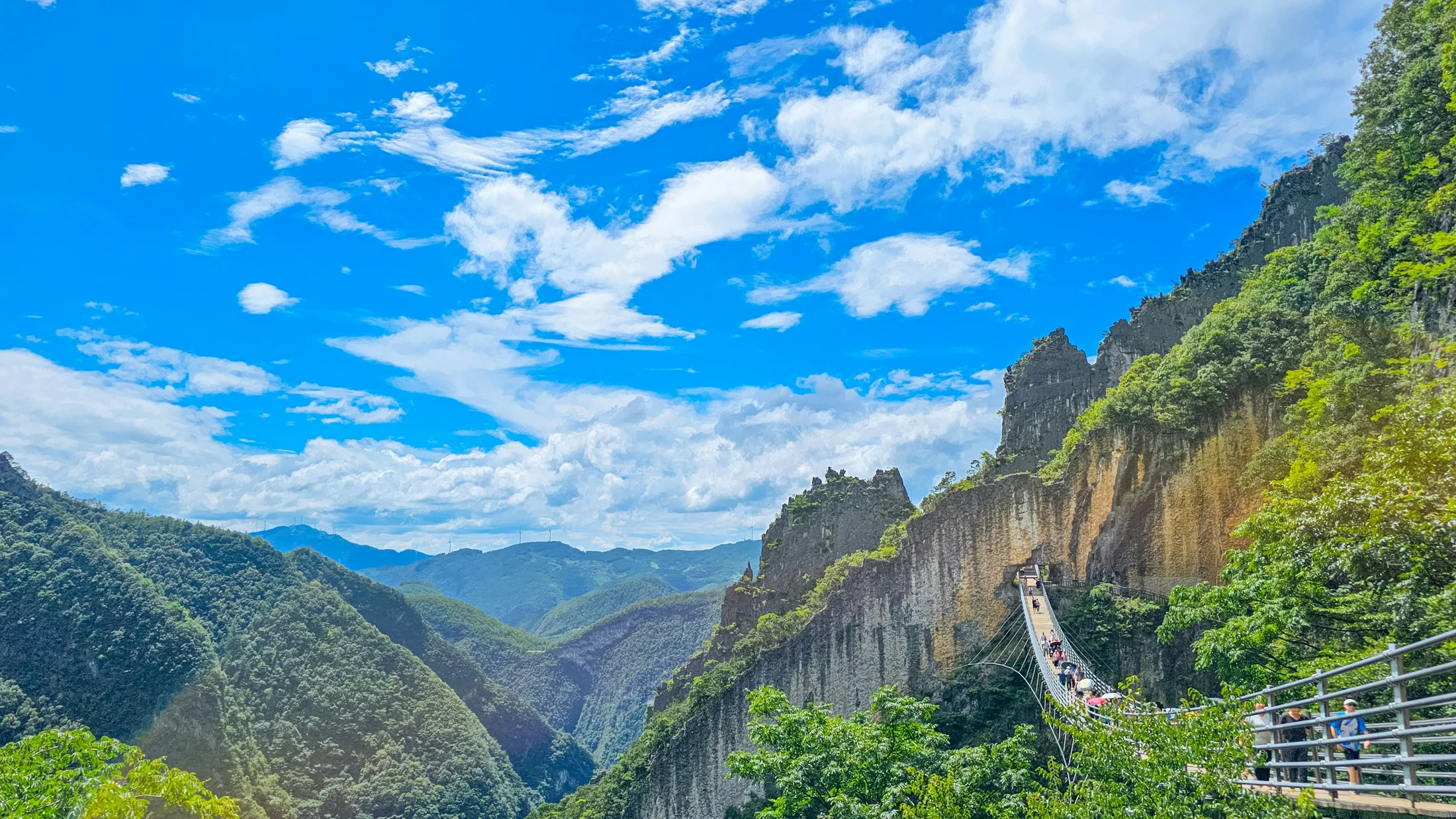
Vertigo with a view: where the void becomes landscape
Twelve walkways and aerial paths over canyons and rivers in Spain, with the void at your feet and the landscape ahead. This list brings together itineraries of simple engineering, hiking tradition and geological settings, from well-known names like Caminito del Rey, Ruta del Cares or Congost de Mont-rebei to less crowded corners.
There are proposals for experienced hikers, for those who head out with a photography camera and for those who are afraid of heights and want to take a first step. Each route is presented with its approximate distance, average time, altitude above the river and access requirements when there is capacity control or reservation.
At the end, you will find combined itineraries and answers to the most common doubts: safety with vertigo, reservations, physical level and weather changes. If you are looking for more plans of this type, you have the adventure section. Always visit with respect for the territory and for the communities that live in it.
Picuco te puede ayudar
Does something here catch your eye?
Tell us.
Write to us on WhatsApp or email: we answer questions, find the best options and help you sort out the booking.
Why choose walkways and aerial paths over canyons
A handrail and a rock wall beneath your feet completely change the way you look at a canyon. These walkways and aerial paths run along carved walls or sections anchored to the rock, and place you inside the landscape instead of just leaving you facing it.
The adrenaline here is controlled: railings, anchors and periodic maintenance reduce the risk when you follow the rules. Overcoming a section with a stable footing leaves an immediate sense of achievement. And the altitude provides clean vanishing lines, layered frames (river, wall, forest, sky) and glancing light at sunrise and sunset.
Each route has its own character. Caminito del Rey (Málaga) raises your steps more than 100 m above the Guadalhorce. Congost de Mont-rebei (Lleida/Huesca) runs through a limestone gorge with sections excavated into the rock. Ruta del Cares (Asturias/León) is a historic ledge opened to maintain a hydraulic canal and today is a benchmark of Spanish hiking.
Many of these infrastructures also protect the terrain: they prevent erosion on the riverbank, organise the passage of visitors and look after the flora and fauna. In Beceite (Teruel), the elevated sections preserve the crystal-clear pools of the Matarraña. There, the route is about 8 km, lasts about 3 hours and adds about 350 m of positive elevation gain.
The difficulty varies greatly, so choose according to your moment, your group and the weather. There are family-friendly and short options, such as Los Cahorros de Monachil, and long and exposed routes that require physical fitness, such as Cares. Sleeping in rural houses, eating in village bars and hiring guides who know the mountain boosts local economies.
The essentials for planning your visit
Location and maps
The walkways and aerial paths are spread across several regions, so you can organise your trip by areas. In Andalusia, you have the Caminito del Rey (Málaga) and Los Cahorros de Monachil (Granada). In Aragon, Alquézar (Huesca) and the Parrizal de Beceite (Teruel).
The Desfiladero de la Hermida is in the Valle del Deva (Cantabria), in the Picos de Europa, and the Ruta del Cares is in the Picos de Europa, between Asturias and León. In Galicia, the Ribeira Sacra has balconies overlooking the Sil and the walkways of the Mao river. The Congost de Mont-rebei is located between Aragon and Catalonia.
Short distances help you chain visits together: Los Cahorros de Monachil can be reached in about 24 minutes by car. To orient yourself, combine IGN maps and orthophotos with Google Maps and hiking apps such as Wikiloc and AllTrails. Download the tracks before setting off when coverage is limited.
In Alquézar, access to the Chimiachas shelter is via San Pelegrín (a hamlet of Alquézar) through a well-signposted path. The site is protected with fences and guided visits are organised by the Centro de Arte Rupestre del río Vero in Colungo.
Before setting off, consult the IGN maps and the Iberpix viewer, the forecast by municipality on AEMET, local signage, and visitor centres.
Best time and weather
Spring and autumn are the safest bets: moderate temperatures, soft light, and fewer convective storms than in the height of summer. The best light for photos arrives two hours after sunrise and before sunset.
In the south, with Málaga and Granada as reference, the recommended season is from October to May. In summer, head out at sunrise and avoid the central hours of July and August due to the heat.
In the Pre-Pyrenees and the Pyrenees (Huesca, Lleida), aim for May–June and September–October, paying attention to afternoon storms. In the Cantabrian region (Hermida, Cares), the window is from May to October, although there may be light rain all year round.
In high-altitude areas such as Cares, Añisclo, or Mont-rebei, winter brings ice in shaded areas and wind channelled through the canyon. In Galicia, the Ribeira Sacra calls for September–November for the autumnal colours, with morning mists.
Consult AEMET and mountain reports the day before. If there is a warning for strong winds, reconsider exposed walkways.
How to get there by car and public transport
A car gives you the flexibility to link towns and the schedules of the various walkways and paths. You reach the Caminito del Rey from Málaga via the A-357 to Ardales and then via the MA-5403 to El Chorro. The Congost de Mont-rebei has access via La Masieta (Catalonia) and via Montfalcó/Viacamp (Aragon) through local roads. The Ruta del Cares begins in Poncebos (Asturias) or in Caín (León), connected by narrow mountain roads.
For public transport, it is advisable to combine train or bus with local taxis or shuttles where they exist. The Caminito del Rey operates a shuttle bus between its access points. In high season, the municipalities of the Cares area enable services to decongest the car parks.
To travel sustainably, you have several options: train to nearby capitals (Málaga, Granada, Huesca, Lleida), regional bus to valley heads (Aínsa, Potes, Parada de Sil), and electric bicycle or shared taxi for the final stretch. Check the schedules on the regional transport websites and confirm them the day before: in rural areas, they can change depending on the season.
Where to sleep and nearby services
Sleeping near the canyon allows you to head out at sunrise, when the path is empty.
Book in advance during bank holidays and summer. In autumn, weekends fill up in Galicia and the Pyrenees.
To eat, rely on village bars and buy local bread and cheese for the route. Before setting off, ask at the visitor centre about closures or diversions. If it is your first time on exposed routes or you are travelling in a group, hire accredited guides and thus support the local economy.
The scent of burning wood at dusk accompanies the return to the village.
12 walkways and aerial paths with vertigo in Spain: quick facts
1. Caminito del Rey: historic classic over the Guadalhorce (Málaga)
The Caminito del Rey hangs over the Desfiladero de los Gaitanes, in the Paraje Natural Desfiladero de los Gaitanes (Ardales/Álora, Málaga). It is Spain's iconic walkway and the ideal debut for those seeking thrills with good infrastructure.
The difficulty is easy–moderate: there is constant exposure, but with railings and a stable platform. The route measures 7.7–8 km linear, of which about 3 km are walkways, and reaches a maximum altitude of ~100–105 m above the riverbed. Its history (original walkway from 1901–1905), its continuous verticality and clear logistics make it unique.
Mandatory booking with a time slot, limited capacity, mandatory helmet and closures due to wind. It is not suitable for wheelchairs and is prohibited for children under 8 years old; the minimum age must be proven with an official document. It opens from Tuesday to Sunday all year round, except on 1 January and 24, 25 and 31 December.
Choose the first slot to avoid groups and heat; in summer, carry 1.5 l of water per person. The route goes from north to south, with a shuttle bus between El Chorro and the northern access: it costs 2.50 € per person (not included in the ticket), is paid in cash to the driver and operates from 07:40 to 20:00. There is municipal parking (P1) in Ardales, regulated, for 2 €. It is necessary to book in advance.
2. Pasarelas de Alquézar: balconies over the Vero river (Huesca)
At the foot of the collegiate church, the Pasarelas de Alquézar run through the Vero river canyon with aerial sections, bridges and emerald green pools. It is a short, photogenic excursion and perfect for active families. The freshness of the water rises like a minty breath from the bottom of the ravine.
- Location: Alquézar (Huesca), Parque Natural de la Sierra y Cañones de Guara
- Difficulty: easy–moderate (sections with stairs and narrow walkways)
- Length: 3–4 km circuit; walkway sections of about 350–500 m
- Maximum altitude: 10–25 m above the river, with an aerial sensation
- Estimated time: 1.5–2.5 h
- Requirements: access ticket (5 € adult) which is advisable to buy online in advance, especially in high season
- Access: signposted start from the centre of Alquézar
- Accessibility: not suitable for strollers; children with supervision
- Unique for: combination of geology, water and medieval heritage; caves with rock art in the surroundings (regulated visits)
Tip: avoid peak hours (11:00–15:00); in summer, get up early or hurry in the afternoon. The “Pasarelas de Alquézar” are very popular on weekends.
3. Congost de Mont-rebei and Montfalcó walkways (Lleida/Huesca)
The Congost de Mont-rebei is a limestone gorge with a path carved into the wall. At its Aragonese end are the Montfalcó walkways, a route through stairs anchored to the rock: more aerial than technical, but imposing.
The gorge has vertical walls of more than 500 m and a minimum width of 20 m. The Montfalcó stairs overcome a height difference of 83 m and 291 steps. The difficulty is moderate and exposed, so it is not suitable for people with severe vertigo.
Calculate between 8 and 14 km depending on whether you go round trip or take a variant, with an estimated time of 3.5 to 6 h. It is not suitable for very small children, and dogs must be on a lead and experienced.
The La Masieta car park is paid and it is advisable to book; outside of the season it only opens on weekends. There are occasional closures due to the risk of fires.
The gorge is part of the Sierra del Montsec Natural Interest Area and its turquoise waters allow for kayaking. Navigation is regulated: consult the rules of the Hydrographic Confederation and the manager of the Natural Area before taking your own boat or book with authorised operators.
4. Ruta del Cares: the “divine gorge” (Asturias/León)
The Ruta del Cares is a path carved into the mountain between Poncebos and Caín, with tunnels and cliffs overlooking the canyon. It is worth it because of the scale of the gorge and the chamois and vultures seen from the path.
The route is long, very exposed in sections and physically demanding if you do it round trip. It is not suitable for people with severe vertigo nor for small children without experience.
The data you need to plan it:
- Length: 12 km each way (24 km round trip).
- Estimated time: 6–8 h round trip; 3.5–5 h one way.
- Total height difference of about 300 m, with the greatest height difference at the start in Poncebos.
- There is a 21 km variant (one way only) from Poncebos to Posada de Valdeón.
The path was originally built as a canal for a hydroelectric plant inaugurated in 1921 in Camarmeña-Poncebos. There is no entry ticket. In high season (July, August, long weekends and Holy Week) the Poncebos car park is paid (4-5 €/day) and is free outside of the season.
In high season there are shuttle buses from Cangas de Onís to Poncebos, with limited schedules; there are also seasonal shuttles depending on the local councils. In winter, closures due to snow and landslides are frequent.
You arrive via mountain roads to Poncebos and Caín. If you do not want to retrace the path, coordinate two vehicles or combine a taxi and a shuttle. Bring a headtorch for the tunnels and a windbreaker, because the sun hits hard and the shade is cold.
5. Ribeira Sacra and Mao river walkways (Ourense/Lugo)
The Ribeira Sacra draws deep meanders of the Sil between terraced vineyards and Romanesque monasteries. The small canyon of the Mao river, a tributary of the Sil, has wooden walkways that allow you to enter the fragile riverbank without stepping on it.
The walkways are in Parada de Sil (Ourense) and the other bank of the Sil is in Lugo. The PR-G 177 Mao river trail totals about 16 km, but the walkway section covers nearly 1 km and is easy to do. With 1–2 h you have plenty of time for the walkways and the viewpoints by car.
The morning mist smells of damp earth and young wine. Autumn, at the end of October and in November, paints the hillside with colours and is the best time to visit.
You reach Parada de Sil via local roads.
Combine the Mao walkway with two viewpoints. A Cruz viewpoint is reached from O Castro de Ferreira, towards Deade, Frontón and Lornís: after passing Seragude and before the Campo de la Fiesta de Frontón, follow a road to the right towards Rigueiro and then a track to the left to leave the car. You can walk to the Balcones de Madrid from Parada de Sil (approx. Several viewpoints have easy access and the walkways have steps.
6. Parrizal de Beceite: wood over emerald waters (Teruel)
In the Parrizal de Beceite, in the Matarraña region, you will walk suspended just a few metres above the crystal-clear waters of the Matarraña. Bridges and shallows complete a dynamic and safe route, designed for hot days and for families eager to explore.
The Estrets del Parrissal form a canyon 1.5 m wide, 60 m high and 200 m long. The difficulty is easy–moderate: there are narrow passages and slippery walkways if it rains. The "La Fenellassa" rock paintings are included along the way.
You need a ticket per person, which includes individual insurance, and it is purchased on the Beceite website (www.beceite.es). Swimming is prohibited in the protected sections: respect the authorised swimming areas outside of that section. Wear footwear with an adhesive sole. It is not suitable for strollers and children must be supervised.
You reach it from the town via a 5 km paved rural path, narrow and without a pedestrian verge, up to signalled car parks.
7. Los Cahorros de Monachil: suspension bridges and gorges (Granada)
Los Cahorros de Monachil, in Monachil (Granada), combine suspension bridges, rock crawls, and paths above the river in a cool canyon even in summer. It is an accessible and fun half-day excursion, in the heart of Sierra Nevada.
The route follows the Monachil River Path (SL-A 294), which is officially signposted. The difficulty is easy–moderate, with occasional scrambling, narrow passages, and moderate exposure; it is not suitable for people with severe vertigo. The short circuit measures 6–8 km and the main suspension bridge is around 63 m, with railings on the aerial sections. Estimate 2–3.5 h for the route.
There is no entry ticket. Parking is limited and there may be occasional closures due to rising water levels; there is free parking on Huenes street, in Monachil. You can reach it from Monachil village via local roads. From Granada, you have bus 183 (Monday to Saturday, except holidays) and 181 (Saturday afternoons, Sundays, and holidays) from Paseo de los Basilios.
The tapping of the bridge planks sets the rhythm of the valley. The route works well for families used to walking, and dogs must be kept on a lead. Go during the week or at sunrise to avoid queues at the bridges; in summer, wear a cap and bring 1 l of water per person.
8. La Hermida Gorge: balconies and paths in the Deva valley (Cantabria)
The Deva river has excavated 18 km of Paleozoic rock and has left a corridor with viewpoints and embedded paths. La Hermida Gorge is not a single walkway stroll: it is a catalogue of natural balconies.
The N-621 runs through the gorge, with signposted diversions to viewpoints and routes. In summer, parking is scarce, so it is advisable to get up early.
The climb to Tresviso from Urdón is something else: a 5.8 km journey, 825 m of positive elevation gain, and about 2 h 45 min of climbing. It follows an old mining path opened in the second half of the 19th century to extract minerals from the Ándara and Tresviso mines. The route is demanding and has exposure: if you do it, get up early and bring poles.
Choose the option according to your group: there are accessible viewpoints and demanding routes. Check the weather before heading out, because rain makes the rock very slippery.
9. Birth of the Mundo River: walkways and safe platforms (Albacete)
After the rains and the snowmelt, water bursts under pressure from a cave 15 m wide and 25 m high in Riópar (Albacete).
Walkways and short platforms allow you to see waterfalls and caves without stepping on fragile areas. The excursion is easy and suitable for families: conditioned paths measuring between 1 and 3 km depending on the viewpoints you visit, with an estimated time of 1–2 h and drops of ~80–100 m of accumulated elevation gain at the main waterfall. There are conditioned sections, but not all viewpoints are wheelchair accessible.
Arrive via the CM-3204 road and follow the signposted diversions to "Los Chorros". Vehicle access to the main car park is regulated according to the season and, if it is full, a queue is set up from Puerto del Arenal. From the main car park, there is a simple 800 m path to the walkways and viewpoints; from Puerto del Arenal, it is an additional 3 km on foot to the main entrance.
There may be closures due to rising water levels. After rain episodes, it is advisable to arrive early, as the parking capacity fills up quickly. Bring a light raincoat even if it is sunny: the mist gets you wet.
10. Añisclo Canyon: hanging paths in a sacred Park (Huesca)
The San Úrbez route is easy-moderate; the longest and most exposed sections are of moderate difficulty. The canyon routes range from 1.8 km to 11 km depending on the chosen itinerary, so there are short options for families and others with more elevation gain.
The canyon road is high mountain terrain, with vertical walls and a risk of rockfalls. The HU-631 is one-way and access to the main parking area is only from the south, in the direction of Aínsa / Puyarruego; the junction towards the canyon is signposted. Access is restricted for caravans and motorhomes due to lack of space.
Arrive from Aínsa via the A-138 with diversions to Escalona and Puyarruego, or via Tella using mountain roads. Visit during the week and avoid July and August to avoid crowds and ensure parking; it is advisable to get up early to park in Puyarruego or San Úrbez. Before setting off, check the National Park report, avoid stormy days, and respect the signage to preserve the area.
11. Hoces del Río Duratón: vulture balconies in Segovia
In the Hoces del Río Duratón, you walk along the edge of the canyon and the void accompanies you the whole time.
The largest colony of griffon vultures in Europe lives here, with more than 700 pairs. You can see them soaring just a few metres away, and the nearby flapping sounds like a carpet being unrolled.
The difficulty is easy–moderate, with cliffside paths without continuous walkways, and allow between 1.5 and 4 h depending on the route. The viewpoints can be reached by car, but the routes have irregular terrain.
From 1 January to 31 July, you need authorisation from the Casa del Parque Natural to transit through the Reserve Zones. For canoeing in Reserve Zone 3, there is a maximum of 8 canoes per day from Wednesday to Sunday, and the activity is not permitted on Monday and Tuesday.
Arrive from Sepúlveda and Villaseca via local tracks and roads. The only access point by car to the bottom of the canyon is the Villaseca bridge recreational area, with a dirt parking lot and a snack bar.
Respect the nesting areas and temporary closures, and use binoculars and a telephoto lens so as not to disturb the birds.
12. Less crowded options: vertigo without crowds
Four aerial paths with walls nearby and water at the bottom, without queues and good for a summer day or an improvised getaway.
In Asturias, the Desfiladero de las Xanas is a "mini-Cares" with an excavated path and bridges, of moderate difficulty and without a ticket. Part of the path was excavated by hand during the Civil War, and the route starts at the Argame-Pedroveya road car park.
The Mao River Canyon, between Lugo and Ourense, is a less visited variant of the Ribeira Sacra, with wooden sections and deep forest. The route goes from the light factory to the mouth of the Sil river, with interpretive panels about the biodiversity of the surroundings. Access is from the Albergue A Fábrica da Luz, and parking is very limited: a few spaces on the OU-0605 road and a few others next to the hostel.
Before setting off, confirm opening hours, possible conservation tickets, and weather-related closures at the town hall or visitor centre. Always carry a headlamp, water, and grippy footwear: even the "small" things demand respect.
Recommended itineraries and combinations
Four proposals by time and profile, with estimated travel times, to fit in several walkways without rushing.
Weekend in eastern Andalusia (Granada). On Day 1 you dedicate it to Los Cahorros in Monachil (2–3 h) and an afternoon in Granada, with Albaicín and tapas. It is an ideal plan for couples and active families; in summer it is advisable to head out at dawn to avoid the heat.
This block suits photographers and intermediate hikers; in summer it is advisable to avoid afternoon storms.
In Montfalcó–Mont-rebei the starting point is the Montfalcó hostel, where parking is available. The path is marked and well-signposted, and you cross a hanging bridge over the Canelles reservoir. You can do a 16 km round trip with 930 m of positive elevation gain, about 6 h, or choose the one-way trip with a transfer of 8 km with 350 m of positive elevation gain, about 3 h.
On Day 2 you do Urdón–Tresviso or its partial variant (4–6 h) and finish with Lebanese cuisine. It goes well for adventurous groups in good shape; pay attention to rain and wet rock.
On Day 2 you take a boat trip on the Sil at sunrise and visit viewpoints. On Day 3 you take a gentle route through terraced vineyards with a tasting. The Ribeira Sacra route begins next to the Albergue A Fábrica da Luz, with parking a few metres away. It is an ideal plan for couples and lovers of autumnal landscapes.
Book accommodation with flexible cancellation in high season and alternate long days and short days to avoid fatigue. Bring a picnic and water so as not to depend on roadside bars, and check AEMET reports and park notices the day before.
What to do nearby: viewpoints, swimming and villages with soul
The walkways are the core of the trip, but the day is completed with viewpoints, swimming in legal pools, villages and cultural heritage. Many of these sites are just a few minutes from the canyon and deserve a stop.
The one in Valdeón is between the Panderruedas pass and Posada de Valdeón, next to the road, with views of the valley framed by the Picos de Europa.
In the Ribeira Sacra, the Balcones de Madrid are one of its most spectacular viewpoints. In Cantabria, the Santa Catalina viewpoint overlooks the gorge from Mount Santa Catalina, above La Hermida (Peñarrubia), and is best at sunset; the Santa Catalina hermitage is between Piñeres and Cicera, in Peñarrubia.
To refresh yourself, in Monachil you can dip your feet in the pools without altering the riverbed or the fauna. In the Duratón, you can navigate in a canoe with a permit, during regulated seasons and quotas.
Dining also counts: Alquézar is in Guara, Aínsa in Sobrarbe and Potes in Liébana. The silence of a Romanesque cloister after the canyon is a balm for your legs.
The rock art in the Alquézar area is visited via regulated tours.
For photography, look for sunrise and the last light, using a polariser for water and rocks. Bring binoculars: you will see vultures, hawks and, with luck, bearded vultures in the Pyrenees.
Safety and essential equipment
Safety on a walkway begins before you set off: walk without running, respect the railings and signage, and maintain distance from the person in front of you on narrow sections. If you feel vertigo, look at the horizon, breathe, and move forward with short strides. When you feel blocked, look for a wide spot and return.
Do not step off the path or lean over the outside of the railings. Avoid selfies on the edges and hold your mobile or camera with a strap. With minors, one adult per child on aerial crossings, and in groups, pass through bridges and aerial stairs one by one.
With heart disease, severe vertigo, or balance problems, choose short and less exposed routes, such as Nacimiento del Mundo, or hire a guide to support you. In strong winds, ice, or storms, postpone your outing: the ozonic smell before a storm is a clear warning.
The minimum equipment is hiking footwear with an adhesive sole, water (1–2 l per person), salts in summer, and energy-rich food. Add a waterproof layer or windbreaker, a cap, and sunscreen. Carry a headlamp or torch for unforeseen events, a fully charged mobile with an extra battery, an offline map, and a whistle. Include a basic first aid kit and your documentation; travel and mountain insurance are recommended.
In autumn and winter, add gloves, a hat, and microspikes if there is ice in shaded areas. Walking poles help on descents and irregular terrain.
Practical tips: bookings, accessibility, pets and weather
Before setting off, check if your walkway requires a reservation: in high season, anticipating this avoids queues and changes of plan. Caminito del Rey sells tickets with an assigned time and limited capacity, so book in advance and check the conditions for changes due to meteorology. In Parrizal de Beceite, access and parking are regulated, and the boats of the Sil, in Ribeira Sacra, require a reservation.
Accessibility depends on the route. There are viewpoints and short sections suitable for reduced mobility, but narrow walkways and stairs rule out wheelchairs on most aerial routes.
With a dog, take it on a short lead and a muzzle if it gets nervous, and avoid the heat of the day. In Ordesa y Monte Perdido National Park, the introduction of loose dogs is prohibited, except for rescue work, livestock companion or guard dogs, guide dogs, or dogs authorised for park management. Carrying dogs without a lead in protected natural spaces carries fines between 100 and 1,000 euros.
The weather rules. Consult AEMET and the park reports two days before and on the same day: with rain, wood and polished rock become slippery, and with wind, walkways may close. The day before, contact municipal or park visitor centres to confirm closures or restrictions.
If you organise the route with Picuco, you will find similar experiences and operational updates in a single view.
Frequently asked questions
Are these walkways safe if I have vertigo?
Vertigo is an alteration of balance that generates a sensation of spinning. The fear of heights is something else: an intense emotional response to exposure.
Walk looking at the horizon, not into the void, breathe rhythmically, and hold the railing with one hand.
Avoid peak hours to go at your own pace. If it is your first time, go accompanied by someone you trust or hire a local guide. If you suffer from clinical vertigo or episodes of instability, choose accessible viewpoints or consult your doctor before planning.
Do I need to book in advance and is there a cost?
Caminito del Rey requires a prior reservation with a specific time slot and usually sells out on weekends and long holidays. It is advisable to buy weeks in advance. In Ribeira Sacra, boats on the Sil require a ticket and fill up quickly in autumn.
The Ruta del Cares, Mont-rebei, Los Cahorros and most viewpoints do not have a ticket, but car parks may be regulated during peak periods. Fees, when they exist, are usually between 4–12 € per person for conservation or service, so book in advance.
Los Cahorros is the Monachil River Path (SL-A 294): 7-8 km round trip, with a vertical gain of between 250 and 300 metres and moderate difficulty. The path has iron steps, wooden walkways and two suspension bridges over the river.
To get there from Granada you have a bus: line 183 from Monday to Saturday (except holidays) and line 181 on Saturday afternoons, Sundays and holidays. From the stop in Monachil, it is a 15-minute walk to the river. On weekends, leave before 09:30 to avoid crowds.
To save money, check for combined tickets (for example, boat + viewpoint in Ribeira Sacra) or regional tourist cards.
What physical level is needed and how do I choose the right walkway?
To choose a walkway, classify them by three variables: total distance, exposure (feeling of emptiness) and vertical gain. With those three in mind, each route orders itself.
If you walk occasionally, start with short and well-maintained routes: Nacimiento del Mundo, the Mao river walkways or Los Cahorros. With some experience, try Alquézar or Parrizal de Beceite, which combine aerial sections and gentle terrain.
If you already do routes of 10–15 km, opt for the Cares (one way only or partial round trip) or Mont-rebei/Montfalcó, which are more exposed. In summer, reduce your ambition: the heat is heavy.
Always carry enough water, food and a headtorch, and check the times so you do not return at night. The group's level is set by the least experienced person.
What do I do if the weather changes during the visit?
The weather in a canyon can change in half an hour. Look at the sky and the forecast before crossing a walkway, and be clear about what you will do if it worsens.
With rain or a storm, avoid metal bridges and walkways and seek shelter away from isolated trees and narrow riverbeds. With strong wind, suspend aerial crossings: some walkways close due to protocol. If there is a flood warning, do not enter narrow canyons, because the water rises quickly.
Before starting, locate evacuation points, shelters such as hermitages or visitor centres and the emergency number 112. Check the AEMET forecast the day before and on the day; in national parks, always follow the signage and official warnings.
If your entry was with a reservation, as with Caminito, check the conditions for refunds or changes due to adverse weather. A timely retreat is a victory: your safety is worth more than the photo.
Book your experience — discover active tourism activities in Spain with providers verified by Picuco.
Conclusion: steady steps and a wide gaze
A walkway over a canyon turns vertigo into landscape and doubt into achievement. This guide brings together twelve proposals, from Caminito del Rey to Mont-rebei and from Cares to Ribeira Sacra, with data on difficulty, lengths, altitudes and requirements.
To plan without any setbacks, keep in mind the best time, access points, accommodation and options for all levels. Before heading out, check the map, confirm the forecast and book when necessary. Also support the communities that keep these territories alive.
Share the guide with your group and set your dates. As you lean over the railing, breathe and go at your own pace, with respect for the mountain.