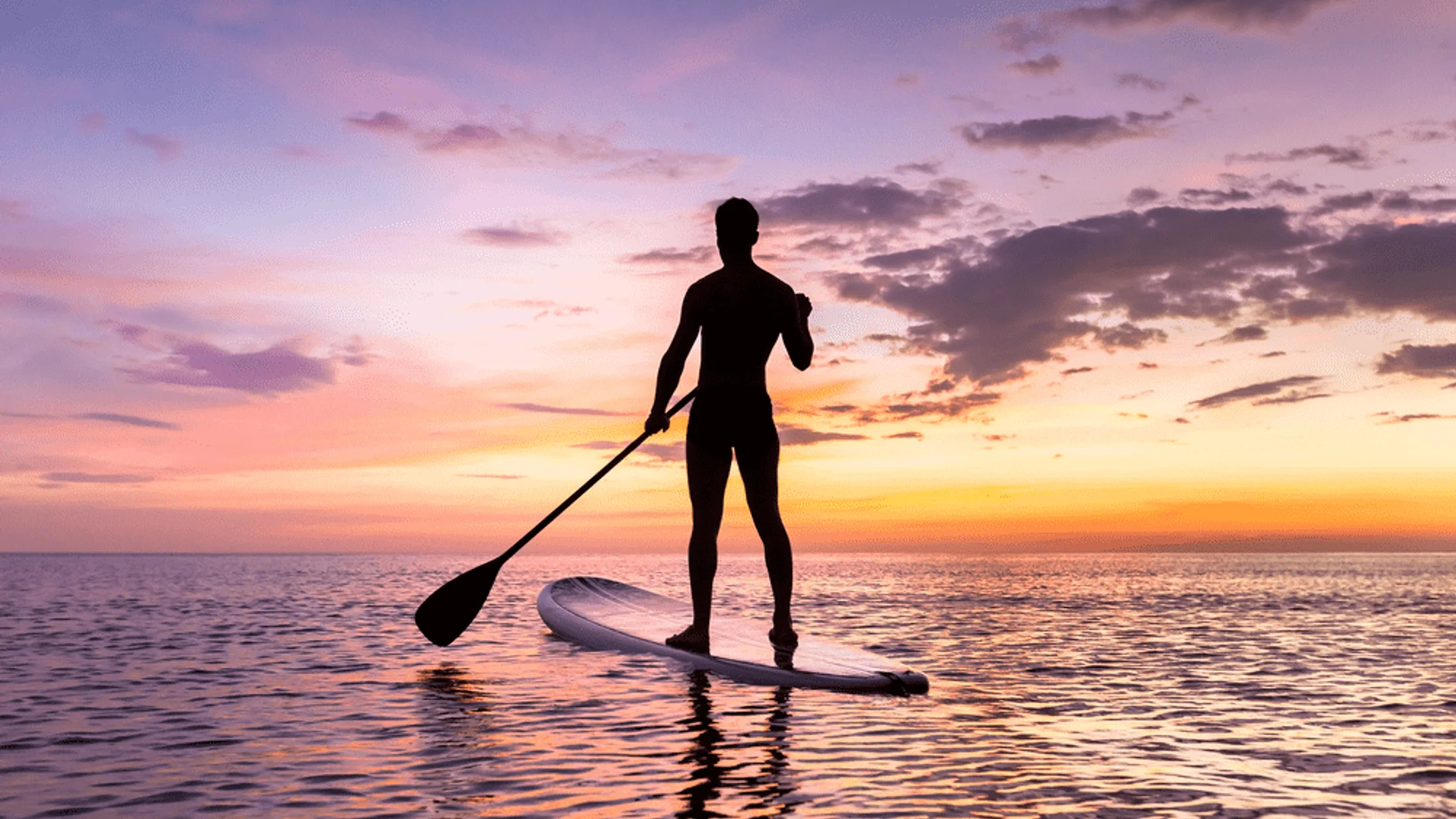
Why choose open water paddle surfing in Spain
In the open sea, the wind, the swell and the currents are in charge, and the board behaves differently. Ocean paddle surfing is practised away from the shore and requires a different mindset than SUP in calm waters: reading the water before paddling.
Spain has scenic and varied corners to progress with intelligence, from a first outing in the open sea to more technical crossings.
The selection of destinations is based on seven factors: safety (protected areas, scalable routes), swell and surge (exposure to swell), accessibility (launch points, parking), services (schools, rental, nearby rescue), visibility (water clarity), natural and scenic value (landscape, geology, marine life) and the availability of schools and rentals.
Weight is given to places where you can link coves, skirt around capes with a suitable weather window or map out small coastal crossings with clear escape routes. The low rumble of the Atlantic beneath the board reminds you that moving forward is about reading the water, not fighting it.
Before heading out, check the swell buoys, the wind forecast for 3–6 hours ahead and the coastal exposure maps. The forecast can change in hours even if the morning starts calm.
Picuco te puede ayudar
Does something here catch your eye?
Tell us.
Write to us on WhatsApp or email: we answer questions, find the best options and help you sort out the booking.
How to choose a destination wisely: safety, swell, access and services
Before booking, check the hourly wind on AEMET, the swell height and period on the nearby Puertos del Estado buoys and local wind models on the coast. The swell is swell generated far away that arrives with long periods: with 10–12 s a small wave can push more than it seems.
For beginners, choose low wind windows (≤10–12 knots) and moderate swell (≤0,8–1 m). Look for protected areas: south-facing coves with cliffs to the windward, sheltered bays and coastal lagoons. Avoid exposed areas, such as open beaches without barriers, capes and points, especially those facing north/east during prevailing storms.
Each type of coastline requires a different reading. Rocky coves provide clear water and less breaking waves, but they have rebound effects against the walls. In the cliffs, there are channelled winds and local currents, so it is advisable to exercise extreme caution. On open beaches, the shore break (the wave that breaks on the shore) can complicate entry and exit.
Look for ramps, small harbours and beaches with a clean entry, and avoid peak bathing hours. Identify escapes every 1–2 km (coves, jetties or beaches) to leave if the wind picks up. Carry a whistle, a strobe light and a mobile phone in a waterproof bag; a thin life jacket can make the difference.
If you start in the open sea, plan short distances of 3–5 km round trip, routes close to the coast and to the lee, a waist or ankle leash always, PFD recommended and an outing with a guide or school and in a group. Technical crossings, of more than 6–10 km and with crossings of bays or capes, only with a stable forecast: a touring-type board, a repair kit if it is inflatable, water and food. Prepare a plan B and share the track and the expected return time.
Verify that schools and rentals have qualified instructors and inspected equipment, and confirm the insurance and rescue coverage with the operator. Check the mobile coverage and the presence of the coastguard or Salvamento Marítimo in the area. Respect local regulations: marine reserves, landing channels and marked bathing areas, with 200 m from the beach and 50 m from rocky coasts.
Where to paddle in the ocean: the best destinations in Spain
Menorca: sheltered coves and coastal routes
The south coast chains together white sand coves and rock walls that calm the tramontana; the north preserves secluded coves and wild landscapes when the weather is mild.
The island has excellent visibility and marine reserves such as the Menorca North one. These stretches allow you to progress safely, with an introductory to intermediate level.
Two routes work well depending on your experience. Cala Galdana–Macarella–Macarelleta can be extended to Cala Mitjana if the weather allows. Addaia–Arenal d'en Castell runs through a protected bay with little swell, ideal for starting out.
Fornells Bay is the best option for beginners: waters protected from the swell and shallow depths near the shore. Set sail from the piers of Addaia and Fornells in the north, or from Cala Galdana beach in the south.
Go from May to October. In summer, get up early: the thermal wind arrives at midday and in the early hours you will find the sea calmer. In July and August, book several days in advance; courses in Fornells are held in the mornings, from 10:30 to 13:30.
Ask about specific open sea SUP courses.
On the Cala Galdana route, there are free car parks to leave your car, and watch out for south winds, which can make entering the caves difficult.
To complete the day, go snorkelling over the Mediterranean tapeweed meadows and eat in the fishing villages.
Costa Brava: rocky coves and steep landscapes
The Costa Brava has rock needles, sea caves and clear water, with sheltered stretches alternating with exposed points where the garbí or the tramontana rule. This variety of mini coastal routes and rocky passages with calm water at sunrise makes it a convenient destination to start and with room to progress.
The Sa Tuna–Aiguafreda route, in Begur, is a circular route of less than 3 km round trip, taking 30-45 min and at an easy level. It is sheltered, has a favourable section and includes 27 m descent stairs towards Cala de Ses Vaques. Sa Tuna cove has little fishermen's houses, medium-sized stone sand and is protected by Punta d’es Plom.
Another option is the Tossa de Mar–Cala Pola–Cala Giverola route: 4 km one way, about 8 km round trip, with clear escapes, and you set off from Playa de la Mar Menuda. On the El Golfet route, the starting point is the viewpoint over Cala del Golfet, and on the descent stairs there is a mosaic with a poem by Joan Maragall.
The difficulty is introductory-intermediate with calm sea. At the points of Begur and Tossa, you need technique if the swell increases.
To get started, you have beaches like Llafranc and Calella and small ramps in local harbours. Introductory classes cost from 25 €/h. Sa Tuna is 10 min by car from Begur and has a car park with about 50 spaces, free out of season and paid in summer.
Do not enter caves with swell and keep a prudent distance from the walls due to the rebound.
Cabo de Gata: volcanic landscape and crystal clear waters
In the Cabo de Gata-Níjar Natural Park, the water reveals tongues of black rock and sandbanks that change tone with the sun. Volcanic cliffs, lava arches and pristine beaches form a coastline with unique geology, contrasting seabeds and long undeveloped beaches.
Mónsul and Genoveses can only be accessed via a barrier: entry is only permitted on foot, by bicycle or by dedicated bus. The bus departs from San José with stops at Genoveses, Barronal, Mónsul, Media Luna and Cala Carbón, with a frequency of one hour; it costs €3 return and €2 for transfers between beaches or one way.
Cala Higuera can be reached via a dirt track from San José or via a path of about 30 minutes, and the car park has capacity for fewer than 10 vehicles. Its seabeds, with stone blocks and rich biodiversity, are a good option to combine with snorkelling.
For a walking route, the one from La Fabriquilla to the Lighthouse is 4 km return with easy difficulty, featuring the Arrecife de las Sirenas and the Torre de la Vela. You can also combine SUP with routes through the Salinas and the Cabo de Gata lighthouse, or with visits to Rodalquilar.
Thermal winds and the levante/poniente mark the day, so pay attention to the swell at the headlands. The level is beginner-intermediate in bays and intermediate-advanced when crossing headlands. Respect the protected areas, do not anchor on Mediterranean tapeweed and check the local currents near the headlands.
For a tranquil paddle surf in Cabo de Gata, choose windless mornings and plan your route along the coast.
Tabarca Island and Alicante coastline: marine reserve and visibility
Tabarca measures 1,850 metres long by 450 wide and is surrounded by very clear water. It is the first marine reserve declared in Spain, protected since 1986, and its seabeds can be seen just a few strokes from the shore.
The Island has Mediterranean tapeweed meadows in an optimal state of conservation and fish that approach the shore. The main route is the circumnavigation of Tabarca: 4–5 km in calm, avoiding buoyed areas. The level is beginner-intermediate and in summer it is advisable to head out early due to nautical traffic.
In the reserve, the regulations are strict: do not touch the Mediterranean tapeweed, no free anchoring and maintain distance from vessels. Management is the responsibility of the Ministry of Agriculture, Fisheries and Food (MAPA), through the General Secretariat of Fisheries, together with the Generalitat Valenciana.
There are operators with rentals and guided trips in Alicante and Santa Pola; it is advisable to check insurance and qualifications. You can arrive by boat from Santa Pola (Tabarkeras) or from Alicante (Kontiki).
To complete the day, go snorkelling in the meadows, stroll through the walled old town and the lighthouse, and finish with the sunset at nearby lighthouses.
La Concha Beach: Urban SUP with friendly open sea
Leave the hotel and in minutes you are paddling in La Concha bay, with Santa Clara Island as an accessible goal. La Concha is the urban SUP option in open sea: total accessibility and city services.
There, Eduardo Chillida's work (1924–2002) awaits you, made up of 3 steel pieces of 10 tonnes each, with the furthest one located 80 metres away. The ensemble includes 7 air tubes on the ground that emit sounds when the seawater splashes in the form of a geyser.
The bay is open to the northwest but usually buffers the swell. With high swell or storm conditions, do not go out.
Respect the marked bathing areas. If you go beyond the bay, you assume open sea conditions: carry a life jacket and communication devices. You can park near the Tennis Club or on Satrustegi Hiribidea street (blue zone).
Combine the session with a walk to Igueldo Mountain or Zurriola Beach, near La Concha Beach.
Mar Menor and Cabo de Palos: warm waters and coastal crossings
The Mar Menor is a 170 km² lagoon with a maximum depth of 7 metres, temperate and semi-enclosed. Progressing with the technique without rushing is easy in its waters, and Cabo de Palos opens the door to the Mediterranean with sea stacks and high-visibility bottoms.
The La Manga del Mar Menor separates the Mediterranean from the lagoon with a width of between 100 and 1200 m and extends from Cabo de Palos to the Salinas and Arenales de San Pedro del Pinatar. In Cabo de Palos, you paddle between coves of the Cabo de Palos - Islas Hormigas Marine Reserve, the cliffs of Cala Flores, and the Calblanque Natural Park.
The most common routes are the coastal crossing through La Manga del Mar Menor linking islets and shores, short crossings towards salt marshes and channels (pay attention to the currents in the "golas") and, in open sea, protected stretches south of Cabo de Palos bordering coves with planned returns. They depart from beaches with a beaching channel in La Manga and from areas in Cabo de Palos with authorised access.
The beginner level fits in the Mar Menor; for going out to open sea, an intermediate level and very calm days are advisable. Conditions are usually favourable all year round, with a preference for spring and summer for those with little experience.
There are rentals and courses on the shore of the Mar Menor and operators in Cabo de Palos with guided departures when the forecast allows.
Respect the navigation channels and signage, and avoid moving away from the coast on days with sustained breeze. Combine the session with snorkelling in the coves of the cape, a walk through the salt marshes, and birdwatching.
Map and quick comparison to help you decide better
A useful map for SUP brings together departure points and jetties, nearby car parks, verified schools and rentals, swimming buoys and protected areas such as Marine Reserves and Natural Parks on a single screen. It also adds lighthouses, caves and viewpoints, which are often the excuse for choosing one cove or another.
It is worth adding activatable layers with exposure to prevailing winds and suggested routes with distances and escape routes every 1–2 km. Links to parts of AEMET and to State Port buoys let you see wind and swell in almost real time before heading out.
To use it, filter by level (beginner, intermediate, advanced), season and type of landscape. By clicking on a route, you see distance, estimated time, wind exposure, local regulations and services open during the season. At Picuco, you can cross-reference the map with available experiences and their dates.
| Destination | Indicative price | Level | Extras |
|---|---|---|---|
| Menorca (Balearic Islands) | Rental 15–25 €/h | Beginner and intermediate | Snorkel, lighthouses and coastal hiking |
| Costa Brava (Girona) | Classes or guided excursions 25-50 €/h | Beginner and occasional technical level | Camí de Ronda, coves and caves without swell |
| Cabo de Gata (Almería) | 2-hour baptism with instructor: 28 € adults and 20 € children | Intermediate and advanced at the headlands | Snorkel, viewpoints and pristine beaches |
| Tabarca–Alicante | Rental 35 €/hour | Beginner and intermediate | Snorkel, historic centre and lighthouses |
| La Concha (Donostia) | — | Urban beginner and intermediate | Rides, gastronomy and viewpoints |
| Mar Menor–Cabo de Palos (Murcia) | Rental 12–22 €/h; 1-hour SUP baptism for 20 € | Beginner in the lagoon and intermediate at the headland | Birds, salt marshes and snorkel |
In Menorca, rental costs 15–25 €/h and the water is very forgiving, so it works well for starting out and taking your first technical steps. In Costa Brava, there are routes of about 30 minutes that reach coves with pebbles inaccessible by land, with cormorants, other birds and schools of fish in sight.
Cabo de Gata has a 2-hour baptism with an instructor for 28 € for adults and 20 € for children, and a guided tour through the park from 3 to 4 hours. The cliffs protect the waters and leave them calm; at the headlands, the level rises to intermediate and advanced. You set off from San José beach and its bay.
In Tabarca, rental costs 35 €/hour and includes board, paddle, life jacket, wetsuit depending on the season and insurance. La Concha is the urban option for beginner and intermediate levels, with rides, gastronomy and viewpoints to finish. In Mar Menor, rental goes from 12 to 22 €/h and the 1-hour SUP baptism costs 20 €: the lagoon for starting out and the headland for the intermediate level.
For the map design, use clear icons (anchor, board, lighthouse), colours by level and dashed lines for exposed sections. Link each spot with a "Book" button and with the local weather report.
Board, equipment and school: getting it right from day one
A wide (32"–34") and stable all-round board forgives mistakes on your first day. For crossings, the touring board (12'6"–14') glides better and maintains course in chop.
The inflatable is practical and resistant to hits on soft rock. The rigid one performs better against the wind and has an advantage on long stretches.
To calculate the volume in litres, add your weight plus your equipment (water, life jacket) and add 20–30%. More volume provides buoyancy and forgiveness; less volume provides agility and sensitivity. A longer keel stabilises the course when touring, and in shallow coves, use low-profile keels.
Always carry a leash: ankle leash in calm water and waist leash for rescues and safety if you are doing crossings or going with a guide. For personal safety, a life jacket (50N) is recommended, along with a mobile phone in a waterproof bag, a whistle and a light if it gets dark.
Clothing changes with the season. In summer, lycra/UV protection, a cap and hydration; in mid-season, 2–3 mm neoprene; in winter in the north, 4/3 or 5/4 with booties and a thin windbreaker.
When choosing a school or rental, look for certified instructors, a low ratio and a safety briefing. The equipment must be well-maintained, with various sizes and life jackets and leashes included. Check that there is third-party liability insurance and accident coverage, and a clear cancellation policy due to weather.
When booking, ask about the recommended wind and wave window for the route, about the exits every 1–2 km and the landing channel, and if it includes a life jacket, leash and communication with land. The breeze on the launch ramp will tell you more than the car park: if it is already blowing there, it will blow harder out there.
Open sea safety: forecasting, currents and signalling
Before entering the water, read the weather report: it is the first safety measure. Check the intensity and direction of the wind by the hour and, if the return wind is crosswind or offshore, change the plan.
In the swell, in addition to the height, assess the period: 0.8 m at 12 s can be more demanding than 1 m at 6 s. Also, look out for seagulls gliding fixedly: they indicate sustained breeze at altitude.
Identify currents before entering. Look for rip currents on beaches (channels without foam), movements at the points and accelerations due to the venturi effect between islands and capes. If you get caught in a current, stay calm and conserve energy: paddle parallel to the coast to get out of the channel and then to land diagonally.
Before setting off, consult the report from AEMET, nearby buoys (wind, wave and period) and the tide where applicable. Define a route with marked exits and a plan B, and check your equipment: valves, keel, leash, life jacket, water and sun protection.
To go far out, carry a Personal Locator Beacon (PLB) or a portable VHF with Channel 16. Carry your mobile phone in a waterproof bag with emergency contacts and note down the numbers for Salvamento Marítimo and 112. Regarding signalling, add a whistle, a strobe light at sunset and bright colours on your life jacket and leash.
Communicate your plan and estimated return time, and set off in a group or with a guide: one goes ahead and the other stays at the back. If the wind picks up, kneel down to lower your profile to the wind and move forward stably.
With an initiation-intermediate level, do not cross capes with uncertain conditions, do not enter caves with swell and respect the marked zones. Safety does not subtract adventure: it multiplies it.
Frequently asked questions
What level do I need to start in the open sea?
Before heading out to the open sea, check that you have mastered basic turns, re-entries and that you can maintain a course for 30–40 minutes in calm waters. With that foundation, the leap can be made with confidence.
Choose days with little wind and routes close to the coast. Go out with a guide or a school and plan routes of 3–5 km: these are distances that allow you to return without rush if the sea changes.
Can I rent equipment if I am a beginner?
Yes, you can rent equipment as a beginner, but ask beforehand if the rental includes a safety briefing, a life jacket and a leash. Those three details make a huge difference to your first outing into the ocean.
To start, choose simple routes and outings with small waves. Booking an open sea beginner class helps you learn how to read the swell and how to enter and exit the water with small waves.
What is the best time in each Zone?
Before deciding on a date, check the AEMET forecast and the Puertos del Estado buoys. With that data, you can choose the area and the day with the least wind and the best sea.
Tabarca has integral zones, which are more restrictive, and reserve zones, with permitted activities. Check which zone you are going to navigate in before heading into the water.
Do I need insurance or a licence for SUP in the open sea?
To do SUP in the open sea, no recreational licence is required. However, if you are going to do crossings, it is advisable to have accident and civil liability insurance.
Some marine reserves have specific rules. Inform yourself with the local authority before heading out and respect the buoys and marked channels.
What do I do if I get caught in a current or the wind picks up?
If the wind picks up, kneel on the board to lower your profile to the wind. This way you gain stability and stop offering so much surface area to the air.
If you get caught in a current, paddle parallel to the coast to exit the current channel and look for a nearby escape. Do not paddle against it: move sideways until you feel it letting you go.
If the situation worsens, ask for help via mobile or VHF and conserve energy. Keep your mobile in a waterproof case and do not waste strength trying to return via the same path.
Can I combine SUP with snorkelling or kayaking in marine reserves?
Yes, you can combine SUP with snorkelling or kayaking in marine reserves, provided that you respect the regulations of each zone.
The basic rules are few and clear: do not touch the Mediterranean tapeweed, do not feed the wildlife and maintain distance from vessels. In Menorca Norte, the activity starts from Fornells, a marine protected area with fishing restrictions.
Book your outing and equipment in advance, and ask at the starting point which zones are open that day.
How do I choose a reliable school?
Before paying, look at two things: that the instructors are certified and that the equipment is well-maintained. With that, you rule out a large part of the problems.
Ask if the school includes insurance and if it has a cancellation policy due to weather. Ask for references, find out the student-to-instructor ratio and confirm that there is a briefing before entering the water.
Book your experience — discover active tourism activities in Spain with providers verified by Picuco.
Conclusion: the sea is waiting for you, but the forecast rules
Spain has coves in Menorca, crystal-clear waters in Tabarca, urban bays like La Concha and the Mar Menor for paddling at your own pace. Choose your spot wisely: safety, swell, accessibility, services, visibility and natural value.
The golden shimmer on the water at sunrise is the most honest signal to set off. Before heading in, check a reliable weather forecast and respect protected areas.
Use the map and select a route according to your level. If you want to speed up your learning, book a lesson or a guided outing with verified local operators.
Check the forecast the day before and on the morning itself, note down your departures and share your plan with someone.