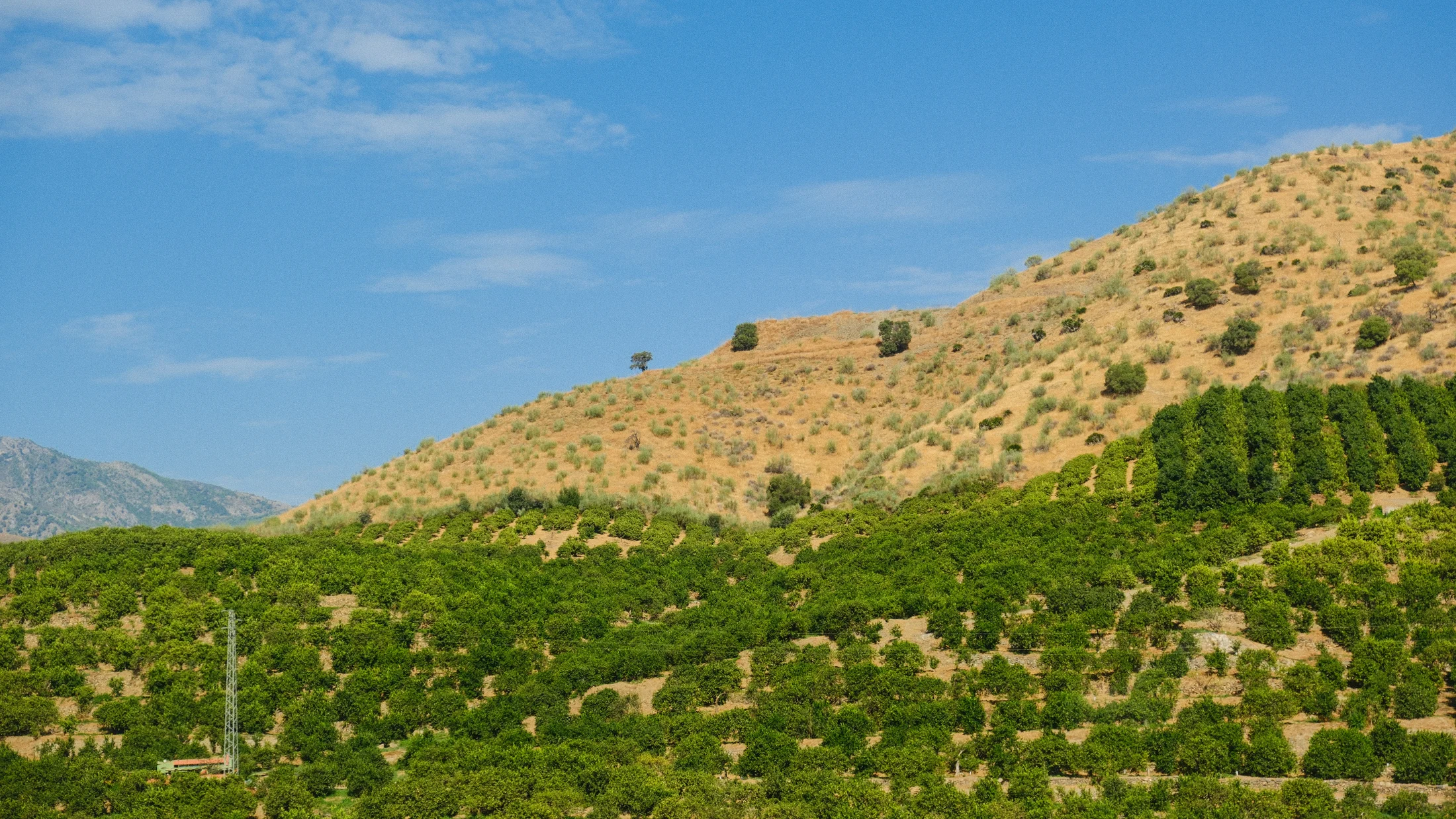
Breathe green just a step from the Giralda
When the thermometer rises in Seville, in less than an hour you can be walking among trees, listening to birds and looking for shade by the water. That short radius reduces travel time and leaves you with half-day plans, with a lower carbon footprint than a long trip.
By car, the one-hour limit means moving within a perimeter of 30 to 80 kilometres depending on roads and traffic. By public transport, you have Cercanías lines and metropolitan buses with stops close to natural spaces.
Parque Natural de la Sierra Norte de Sevilla
Here you have 10 green getaways with the essentials to help you choose: shaded walks, viewpoints, wetlands with birds, tranquil riverbanks and nearby beaches. Each entry summarises the main attraction, physical effort, how to get there and a local tip.
If you are going to walk, look for short routes with code PR-A or SL-A (small route and local path). To observe fauna, prioritise wetlands and marshes during migratory periods.
The reference climate (AEMET 1991-2020) marks mild springs, very hot summers, pleasant autumns and temperate winters. Avoid the central hours in summer and take advantage of the long mornings in autumn.
Bring water, a cap and comfortable footwear. The marsh breeze at sunset smells of salt and rockrose.
Picuco te puede ayudar
Does something here catch your eye?
Tell us.
Write to us on WhatsApp or email: we answer questions, find the best options and help you sort out the booking.
Mind map and essential distances
Four quadrants are enough to organise your getaways from Sevilla. To the north lies the Sierra Norte; to the west, the Corredor del Guadiamar and Doñana; to the southeast, the countryside and banks of the Guadalquivir; to the northwest, small mountain ranges and reservoirs. With that division in mind, you can choose a destination based on the time you have and what you want to see.
Spring (March-May) brings flowering, temperatures of 18-26 ºC and moderate water flow. Autumn (October-November) adds clear skies, 16-24 ºC and bird migration. In winter (December-February) there are 12-18 ºC, clear light for photography and short days. In summer (June-September) the thermometer reads 30-40 ºC in Sevilla: leave early and look for shade and water.
Practical advice
Before leaving, check the AEMET forecast by time slots and check the Red de Espacios Naturales de Andalucía for possible seasonal restrictions (access to dunes, fire risk).
Half a day is enough for shaded walks by the water, sunset viewpoints and recreational areas. A full day calls for a linear or circular route, lunch in the village and a short cultural visit. For the weekend, aim for the Sierra Norte or Doñana with two activities: hiking and birds, or dunes and marshland.
In summer, plan from 07:30 to 11:30 and from 19:00 to 21:00, and avoid 12:00 to 18:00 due to extreme heat. After rain, tracks and clay become slippery, so consult the notices from the Junta de Andalucía regarding protected spaces. Drawing circles of 30, 45 and 60 minutes around Sevilla and marking key nodes (Aznalcázar, El Ronquillo, Villanueva del Río y Minas, San Nicolás del Puerto, El Rocío, Guillena) helps you see combinations and escape routes if there are delays.
To read the landscape: to the west, marshes and pine forests; to the north, dehesa and holm oak forests; to the southeast, countryside and river plains. With little time, prioritise peri-urban parks and the Guadiamar; with a full day, aim for Sierra Norte or Doñana. For birds, the spring and autumn passage concentrates waders and dabbling ducks in the marshes. For swimming, the beaches of Doñana require a bit more travel time, although on smooth days they fit within the one-hour limit.
Quick reference by destination:
In the Dehesa de Abajo, access is free and the main entrance is at the interpretation centre, which is signposted. It hosts one of the largest white stork colonies in Europe, with hundreds of nests in the stone pines, and you can observe species such as the moorhen and the marbled duck.
How to get there without complications
A car offers flexibility, public transport avoids stress, and sustainable options balance comfort and footprint.
Plan your times
Leave 15-20 minutes before sunrise in summer and allow a 30-minute buffer for the return journey during rush hour. Park in permitted areas and never on vegetation or wildlife crossings.
Heading west by car, the A-49 leads to Benacazón and Sanlúcar la Mayor, and the A-473 continues towards Aznalcázar. From Sevilla, take the A-49 exit 16 towards Benacazón to connect with the A-473, which joins the A-8076 with Aznalcázar passing through Benacazón. For El Rocío and Almonte, the A-483 begins at the A-49 at the altitude of Bollullos Par del Condado.
Heading south and east, the SE-30 connects with Coria del Río via the A-8058 (exit 15A). You reach Los Palacios y Villafranca via the AP-4, the A-4/N-IV and the A-362, and Carmona via the A-4, which crosses the municipality between pK 490 and 523.
A car adjusts your timing, lets you combine several points in one day, and allows you to carry binoculars or a cooler.
By train, the C-1 line goes towards Lora del Río and the C-3 towards Cazalla-Constantina. By bus, El Rocío/Almonte and Coria del Río depart from Plaza de Armas, and La Puebla del Río from Paseo de las Delicias.
Public transport is sustainable, with stable prices, and allows for linear routes without returning to the car. Frequencies decrease on Sundays and in the afternoons, and in winter the last returns are early. Check updated schedules and buy return tickets during off-peak hours to ensure a seat.
Car sharing with apps or local groups reduces costs and emissions. On an electric bike, the Corredor Verde del Guadiamar and the Dehesa de Abajo are cyclable: avoid the heat of the day. Cercanías allows bicycles outside of rush hours, and the riverside paths from intermediate stations are a good option to combine train and bike.
The golden light of the early hour turns the motorway into a corridor of promises.
Where to sleep and set up your base
Choose your base according to your plan: proximity to trails, nocturnal silence, family options or an active atmosphere. Rural houses, cortijos, campsites and small hotels turn a stroll into an escape.
Rural houses and cortijos are great for groups and families, with equipped kitchens and patios. Campsites and bungalows are located next to reservoirs and pine forests, with a swimming pool in summer. Small rural hotels have full services, homemade breakfasts and a central location in the villages.
Aznalcázar is the gateway to the Guadiamar and La Puebla del Río to the Dehesa de Abajo. Aznalcázar is 35-40 min from Seville and La Puebla del Río is about 30 minutes (19 km) away.
El Ronquillo is near the Gergal and La Minilla reservoirs and their viewpoints. Villanueva del Río y Minas is about 52-54 min from Seville, next to the banks of the Huéznar and its waterfalls; San Nicolás del Puerto, on the same bank, is 1 h 31 min away. Carmona offers monumental heritage and a river plain with agricultural paths, 35-45 min from Seville. El Rocío and Almonte provide access to the marshes and Doñana.
Before booking, look at three things: that there are marked PR-A/SL-A routes without moving your car, services nearby (shop, pharmacy and restaurant open during the week) and a quiet environment for families or activities such as kayaking or cycling. Spring and autumn concentrate the demand for hiking and birds; on long weekends and weekends, book 2-4 weeks in advance.
Contact the host directly for arrival times and local recommendations. If you prioritise silence, stay on the edges of the urban centre; if you want to eat well without taking the car, look for places with life. In hot seasons, ask about shade, natural ventilation and a swimming pool for the late afternoon.
The 10 green escapes less than 1 hour away
1.Sierra Norte de Sevilla: forests, trails and mountain villages
The Sierra Norte de Sevilla is the classic hiking option near Seville: forests, dehesa and clear rivers less than an hour from the city. It serves for a morning short walk or for an entire day of trekking.
Las Cascadas del Huéznar, Natural Monument, are about 2 km downstream from San Nicolás del Puerto.
To start, the SL-A 37 Nacimiento del Huéznar route is 4.80 km and very easy. If you want more distance, the Vía Verde de la Sierra Norte has 18.70 km and takes 4 hours one way, with a comfortable surface. The effort ranges from easy to moderate, with gentle gradients and abundant shade.
A half-day is enough for the Nacimiento del Huéznar and Isla Margarita, a recreational area. On weekends, arrive early at the Nacimiento area to park without stress and respect the walkways so as not to erode the riverbank.
You can also climb up from the Estación de Cazalla, on the SE-168, at the altitude of Isla Margarita, or descend from the mining settlement of Cerro del Hierro, with a landscape of needles, hollows and a short open-air path through the karst modelling of the former mining exploitation.
2. Guadiamar Green Corridor: wetlands and birdwatching
The Guadiamar Green Corridor connects Sierra Morena with Doñana via an ecological corridor, and it was the first Protected Landscape declared in Andalusia. It is a comfortable getaway near Seville to go with children and binoculars.
Its attraction lies in the wetlands, the taraja groves, and the walkways with observation hides. In the reedbed, the buzzing of dragonflies over the water breaks the silence.
The sections of the Vía Verde del Guadiamar are easy and almost flat, and near Aznalcázar and Benacazón there are signposted local paths.
Go in autumn and spring for migratory birds, in winter for waterfowl, and in summer at sunrise. Bring binoculars, a pocket bird guide, sun protection, and mild repellent. You can do it almost all year round, with caution in Entremuros during floods or rising river levels.
Ask at the municipal information point about open observatories and avoid noise in the hides: the birds set the pace. Motor vehicle traffic is prohibited, except for authorised ones.
By car, arrive via the A-49 with the Benacazón/Sanlúcar la Mayor exit and the A-473 towards Aznalcázar.
3. Doñana (El Rocío/Almonte): marshes and nearby beaches
From El Rocío, the marsh opens into a plain of water and reeds where birds concentrate.
In the pine forest and nearby lagoons, there are easy and shaded interpretive paths. The terrain is flat and the effort ranges from low to moderate: half a day for the marshland walk, the hermitage, and the sandy town, or a full day with marshland, pine forest, and beach walkways.
Autumn and winter bring large concentrations of birds, and spring brings breeding. In summer, go at sunrise or sunset to avoid the heat. If you like photography, bring a telephoto lens: the safety distance from wildlife is mandatory.
Doñana is a National Park with regulated access in several areas. Stay on the walkways and respect the signage. The pedestrian path to Cuesta Maneli may close temporarily due to erosion at the base of the structure.
Arrive via the A-49 to Bollullos/Chucena and continue via the A-483 to Almonte and El Rocío. There are daily buses from Seville (Plaza de Armas). From Seville, it is 1 hour 19 minutes (100 km).
4. Reservoirs and riverbanks: walks and lakeside viewpoints
What hooks you are the wooded banks, the viewpoints, and the perimeter tracks. You can walk and do landscape photography, observe raptors and wintering waterfowl, and fish in the authorised areas with a valid licence. The effort is low, with sections of gentle ups and downs.
By the water, avoid wet slopes and muddy banks, and do not let children approach the edge without supervision. Plan for 2-4 h of walking and photos, or 4-5 h if you add a picnic. Choose a weekday sunset to find fewer people and bring a headlamp if you stay to photograph the blue hour.
In El Agrio, there is a main dam and a diversion dam that creates a counter-reservoir with a recreational area. Two routes depart from there: the 11.8 km low-difficulty Nordic Walking circular route, and the 9.3 km La Zarcita path, which starts from Aznalcóllar.
To reach El Agrio by public transport, the M-176 bus (Seville – Camas – Gerena – Aznalcóllar) leaves from the Plaza de Armas station on Sundays at 10:00 and at 13:00, and the ticket is purchased on board for 3,00 €.
5. Sierra de Aracena area: caves and dehesa
La Gruta de las Maravillas, in Aracena, is the main visit of this getaway through rolling dehesa and chestnut groves. The sierra is already in Huelva, just an hour's drive from Sevilla.
The environment mixes holm oaks, cork oaks and chestnut trees with donkeys, sheep and goats. The dehesa is traversed via shaded tracks and paths, with effort ranging from easy to moderate.
With a half-day, you have time for the walk through the dehesa and the historic centre, with viewpoints and little effort. If you add a viewpoint to the route, the getaway becomes a full day. Between Aracena and Linares de la Sierra, there are short paths through the dehesa.
To eat, try Ibéricos, seasonal mushrooms and artisan cheeses. The Museum opens from 10:15 to 14:00 (last entry 13:30) and from 16:00 to 18:45 (last entry 18:15); in summer, from 01/06 to 15/09, from 10:15 to 13:30 and from 18:00 to 20:15. Present yourself at least 10 minutes before the visit time: no changes, cancellations or telephone bookings are allowed.
Arrive via the N-433 from Sevilla or Portugal, or via the N-435 from Extremadura or Huelva. During bank holidays, book in advance and park in the designated access areas, far from the centre during peak hours.
6. Nearby beaches of the western coast: walks and sunsets
About 100 km from Sevilla, the beaches of Doñana and the Huelva coast are the closest sand and dune escape. Fossil dunes, coastal pine forests and Atlantic horizons mark the plan.
The effort is low: boardwalks and flat beach. Stroll along the dune edge, swim during the season and look for the sunsets. Go at sunrise or sunset to avoid the heat and the crowds.
With a half-day, you have time for the walk and a swim outside of peak hours; if you stay the whole day, add the inland pine forest and a picnic area. Bring a bag for your waste and check the flag and access notices during high season: the coastline is fragile.
There is also a bus from the Sevilla Bus Station to Matalascañas, with increased frequencies in summer. Use the signposted car parks, which fill up quickly in summer, and do not park in ditches or on vegetation.
7. Viewpoints and small sierras: panoramic views and short routes
North of Sevilla, the gentle reliefs offer viewpoints over reservoirs and holm oak dehesas, with short routes and little elevation gain. It is terrain for walking without haste and stopping to look.
Castilblanco de los Arroyos is 34 km north of Sevilla, in the foothills of Sierra Morena, within the Sierra Norte region. El Ronquillo is located at 334 metres altitude and features a viewpoint with views over the El Ronquillo sierra.
Around Gergal and La Minilla, there are tracks towards natural viewpoints. The Gergal peri-urban park is just over a kilometre from the centre of the village, accessible via an avenue with a promenade and cycle lane.
The Gergal section is approved as the PR-A 218 trail. The Gergal reservoir dam is especially striking during water discharges.
The effort is low to moderate, suitable for families with children used to walking, and the signposted circuits from El Ronquillo are of low difficulty. For photography, bring a 24-70 mm lens for landscapes and graduated filters for the glowing winter skies.
Bring a windbreaker even in summer: at altitude, the breeze can be surprising and allows you to extend your walk.
How to get there: via the A-66 towards El Ronquillo or Guillena and signposted diversions to viewpoints and recreational areas.
8. Peri-urban green spaces: natural parks and recreational areas
La Corchuela, in Dos Hermanas, La Dehesa de Abajo, in La Puebla del Río, and the riverside parks of the Guadalquivir provide shade from pine, holm oak, or eucalyptus.
La Corchuela Peri-urban Park has tables, children's playgrounds, and flat tracks. In the southern area, there is a holm oak dehesa and in the northern part a forest of wild olive trees; the Hornillo stream provides riverside vegetation with poplars, willows, tarajes, or reeds. A route circles most of the park with interpretive signs, and there is parking. It opens Saturdays, Sundays, and holidays from 10:00 to 18:00 h.
In La Dehesa de Abajo, you can see a lagoon, colonies of white storks, and passing flamingos. In the Ribera del Guadalquivir, in Coria del Río, there are riverside walks and waterfowl watching.
The effort is low: it is suitable for strollers and for a first contact with the countryside. You can combine it with a walk and a breakfast or afternoon snack in a nearby village, or with a gentle bike ride on compacted tracks. On sunny Sundays, arrive early: the tables fill up.
Arrive via the SE-30 and the local roads towards Dos Hermanas and La Puebla del Río, or by the frequent metropolitan buses. In the Ribera del Guadalquivir, there is a ferry bridge for cars and pedestrians that connects with Isla Menor and Dos Hermanas.
9. River routes and riverside walks: water and shade
They are galleries of alders, ash trees, and tarajes, with walkways and embankments where the murmur of the water seeps through the alder leaves.
The routes are easy: stretches of the Guadiamar in Aznalcázar and walks along tracks in the Brazo del Este, flat and open. The Guadiamar Green Corridor has an itinerary of nearly 67 km through the middle and lower stretches of the river, and circular paths of 30.5 km and 16.7 km, ideal for cycling.
You can traverse it almost all year round, with caution in the Entremuros area during floods or rising river levels. The effort is low, but watch out for mud after the rain. In summer, go out at sunrise or late in the day; in winter, midday provides light and pleasant temperatures.
At sunset, there are mosquitoes in the wetlands: wear light long sleeves and bring repellent. Use footwear with a gripped sole, because the clay is slippery when wet.
To reach Brazo del Este, take exit 549 of the A-4, taking the road to Isla Menor and the Los Puntales royal track until Caño de la Vera; access to the area is free. You can also enter from Coria del Río by crossing the Guadalquivir by barge and following the SE-3300 to the junction with the SE-3206, or from Utrera via the A-362 towards Los Palacios y Villafranca and then the SE-9020. To reach Guadiamar, take the A-49, Benacazón/Sanlúcar la Mayor exit, and the A-473 to Aznalcázar.
10. Villages and rural paths: nature + local heritage
Carmona, Santiponce and Utrera are 20-45 minutes from Seville: in one morning you go from the city to the river plains. Combine a natural stroll with heritage and gastronomy and you will have a full day.
Carmona has alcázares, viewpoints and agricultural paths of the river plains. The Vía Verde de los Alcores measures 25 km and connects Alcalá de Guadaíra with Carmona; it is walked or travelled by bicycle on an albero surface.
In Santiponce you can see Itálica in the morning and approach the banks of the Guadalquivir in Coria del Río at sunset. Utrera adds a square, parishes and the nearby countryside. The effort is low or moderate, with a mix of urban and rural.
To eat, spoon stews, traditional sweets and olive oil from the countryside. Calculate half a day of culture plus 2-3 h of rural walking.
Ask at the tourist office about local SL-A paths and open municipal roads: they will indicate routes with shade and benches. Arrive via the A-4 to Carmona or via metropolitan connections to Santipence.
What to do there: hiking, birds, beaches and viewpoints
In these getaways, the activity rules: there are plans for families, couples and groups, from accessible strolls to moderate routes, landscape photography and wildlife watching. Choose according to the energy you have and the season of the year.
Note: only part of the itinerary is signposted and the detours to the waterfalls can be confusing; to reach the largest waterfall you have to cross the river via a log.
If you want something requiring more effort, the perimeter tracks of reservoirs add between 6 and 12 km of undulating terrain. The circular route of El Gergal starts from "La Cantina" (opposite the reservoir) and measures 9.50 km: it reaches an old station if the water level allows, and cannot be completed when the reservoir is full.
The season changes the plan. Spring and autumn are good for the open stretches; in summer, go out at sunrise and look for riverside routes.
Birds have their own calendar. In Dehesa de Abajo, storks, flamingos and waterfowl are seen in winter; in Guadiamar, waders in passage, herons and raptors; in Brazo del Este, rice fields and marshes with great variety. Bring 8x32 or 10x42 binoculars, a bird guide and a notebook or app.
On the coast, stroll at the first and last hour and swim with a green flag; avoid spring tides if you are going with children and consult the information at the entrance. As a freshwater alternative, the shores of reservoirs are suitable for picnics and photography, without swimming where it is prohibited.
For the views, go up to the viewpoints over Gergal and La Minilla, look for marshland horizons in El Rocío or dehesa hills in Sierra Norte. A polariser helps with water reflections, and the golden and blue hour with a light tripod gives the best photos.
Adjust the plan to the audience: with families, 1-2 hours of walking and a recreational area; if you are athletes, more elevation gain and kilometres; as a couple, sunsets and villages with a dinner of local produce.
Itineraries to nail it the first time
Setting out with a schedule simplifies decisions and gets the heat off you. These three proposals fit into a half-day, a full day, and a family plan.
Half-day. You leave Seville at 07:30 and start walking in Aznalcázar at 08:15. The route is circular and approximately 20 km long, starting at the Puente romano, on the left bank of the Guadiamar, next to the urban centre. 100 m from the start is the Centro de Visitantes, where you can learn about the history of the natural space's recovery. At 10:45 it is time for a light picnic in the shade and at 11:30 you return to Seville.
Motor vehicles are not allowed to circulate in the space except for authorised ones; you can travel by any other means of locomotion. Bring 1,5 l of water per person, a cap, sun protection, and binoculars. With strong wind, choose more wooded sections; with fog, wait 30 minutes: the light improves and the birds become active.
Full day. Departure from Seville at 08:00, route from 09:00 to 12:00, lunch at 13:30, activity at 16:00 and return at 18:30. Bring footwear with a marked sole, fruit and savoury snacks, and a small towel to refresh your feet in permitted areas. With heat, cut the afternoon short and return to the river early.
Family plan. Departure at 09:00, short walk and bird hide at 09:45, snack and quiet games at 11:30, walk through the village at 12:30 and return at 14:00.
For this plan, bring an all-terrain buggy if necessary, light change of clothes and mild repellent. With heat, shorten the walk and look for continuous shade; with wind, move the plan to the interior of the nearby pine forest.
Always have a plan B within a 10-15 minute drive of plan A: it avoids surprises if the parking is full or the track is muddy.
Practical and safety tips
In spring and autumn, calculate 1.5-2 l of water per person; in summer, 2-3 l. Wear hiking boots with a gripped sole and reserve closed sandals only for boardwalk sections. Add a cap or visor, sunglasses, SPF 30+ sun protection and thin layers in winter.
In your backpack, a basic first-aid kit with plasters, painkiller and bandages, a headtorch if you go out at sunset and a bag for waste. In summer, avoid the hours from 12:00 to 18:00 and look for shade and water. In winter, it is better between 11:00 and 15:30, due to light and temperature. After rain there is mud and puddles, and some lightweight poles help in clay terrain.
Orientation pro tip
Use map apps with relief layers and download the track if you follow a PR-A/SL-A; without coverage, the GPS will keep working and saves you from going in circles.
The autumn-winter season is the most recommended as it has fewer visitors and pleasant temperatures. The guided itineraries of Doñana have limited places, so book them in advance. The Centro de Visitantes José Antonio Valverde is accessed via unpaved tracks.
If you fish, you need a licence and must respect the quotas of the current Andalusian regulations. The use of drones is restricted in protected spaces: consult the regulations before flying. Take your waste with you and do not feed the wildlife, because it alters their behaviour and their health. With a dog, keep it on a lead in breeding areas and wetlands and consult the local signage. In peri-urban recreational areas there are reserved parking spaces and accessible tables.
In case of any emergency, call 112, a free service with permanent and multilingual assistance in the main languages of the European Union. The free 112 Andalucía app allows you to send your exact location and photos of the incident. Mobile coverage is variable in mountains and marshes: let someone know your plan, share your real-time location and carry an offline map or a screenshot of the route.
Frequently asked questions
Can I really see all this in less than an hour from Seville?
Yes, almost everything: most of the proposals are 20-60 minutes away by car with normal traffic. They are short distances, designed for going out and returning on the same day.
The beaches and Aracena can approach 60-75 minutes during peak hours. If you want to stay within the one-hour range, leave early and avoid morning departures on working days.
Do I need a guide to visit Doñana or Sierra Norte?
For viewpoints, boardwalks and local signposted paths, you do not need to hire a guide. You can walk them at your own pace and with your own plan.
To go deeper into regulated areas of Doñana or to learn about fauna and geology, it is advisable to book guided routes with companies with environmental certification. Book in advance, especially in high season.
Are there good options with small children or strollers?
Yes. La Corchuela has firm flat ground, shade and rest areas, so you can go with a stroller and with small children without any complication.
In summer, avoid the middle hours of the day and bring water, a cap and something to snack on.
When is the best time to see birds?
Spring and autumn concentrate the migratory peaks in the marshes and in the river corridors. These are the two windows with the most bird movement near Seville.
In winter, waterfowl and waders abound. In summer, it is advisable to go out at sunrise to see activity and avoid the heat.
Can I move around efficiently using public transport?
Yes. The Cercanías lines C-1 and C-3 connect Sevilla with the vegas and the Sierra Norte, and there are frequent buses to Aznalcázar, La Puebla del Río and El Rocío/Almonte.
Before leaving, check the updated timetables and plan your return: on many of these getaways, the last bus of the day leaves early.
Are dogs allowed?
In general, dogs are allowed, but always on a lead and respecting specific signage, especially in wetlands and during breeding seasons. Before leaving, check the rules for each natural space.
Bring water for your dog and avoid the hottest hours to protect their paws.
Book your experience — discover active tourism activities in Spain with providers verified by Picuco.
Conclusion and resources for planning
The plan can combine accessible walks, moderate routes, birdwatching and, when appropriate, sand and dunes.
To go one step further, combine two environments on the same day: a cool riverbank in the morning and a viewpoint at sunset, or marshland at sunrise and a village with a slow after-dinner conversation. Adjust the plan to the season, confirm transport schedules and respect the rules of protected spaces.
Before leaving, check the hourly forecast and weather warnings on AEMET. The Red de Espacios Naturales de Andalucía brings together the regulations, access points and temporary restrictions for each space. To travel by train, Renfe Cercanías Sevilla has the C-1 and C-3 lines, with information about bikes and timetables.
If your route reaches Aracena, the tourist office is on calle Pozo de la Nieve, s/n, and is open from 10:00 to 14:00 and from 15:30 to 18:00. There, you can manage tickets for the Gruta de las Maravillas, the Castillo and the Museo del Jamón. You can also see the interior of the Gruta using 3D glasses, and the establishment has wheelchair access.
When you decide on your plan, wake up a little early, bring plenty of water and consider staying for the golden hour.