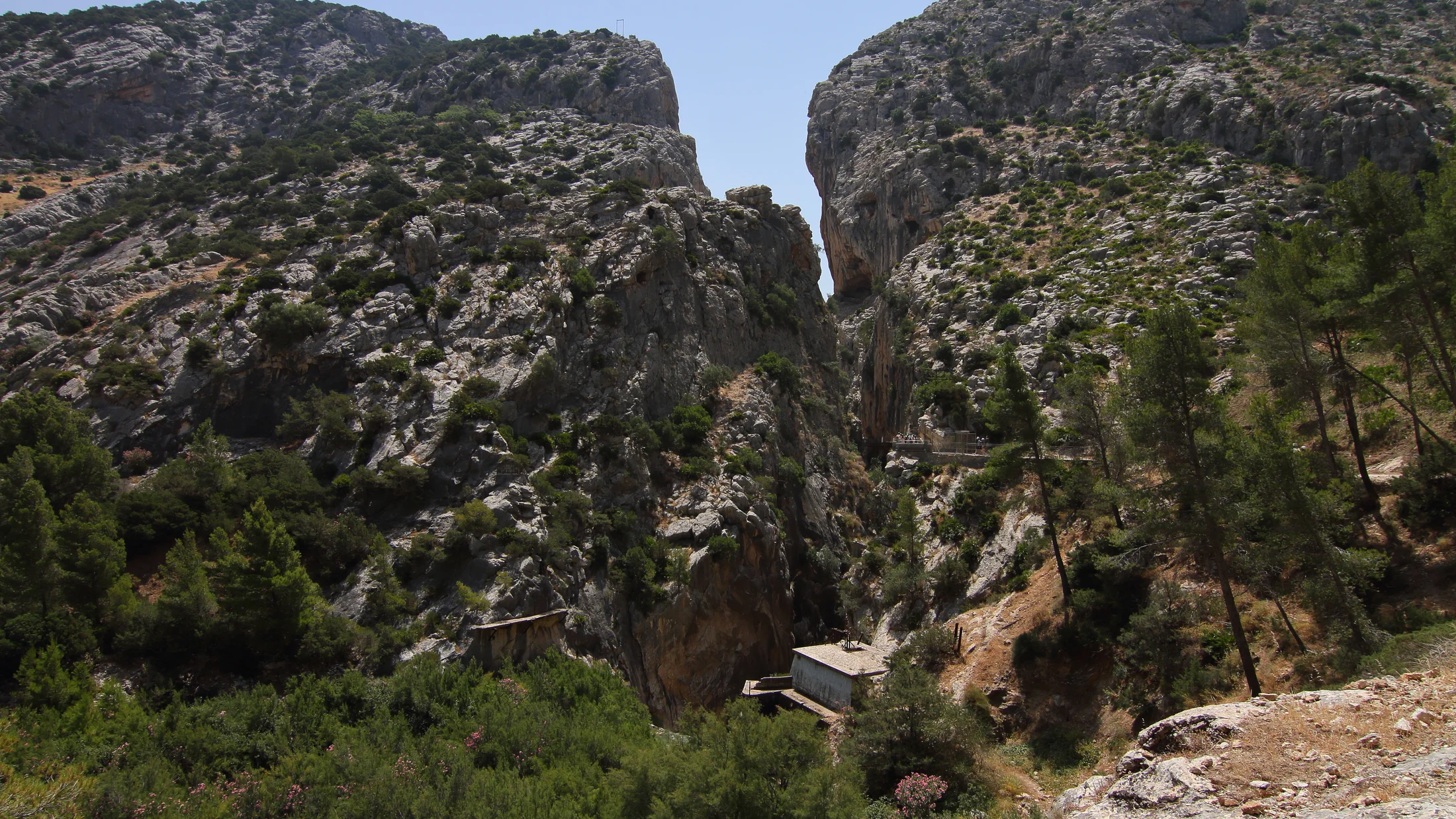
Why the Caminito del Rey hooks you at first sight
The route mixes history, controlled adrenaline and landscape. That is why it hooks you at first sight: you walk clinging to the wall, with the river far below, and every section changes the view.
Before you go, book your ticket with a specific time and choose a weekday if you can. The visit is done in one direction and at a set pace, so allow for the whole morning.
Context about the Caminito del Rey
The Caminito del Rey was born at the beginning of the 20th century to serve the dams and the El Chorro hydroelectric plant, hence its name. It was fully rehabilitated and reopened in 2015 with modern safety measures, and today it is an icon of the interior of Málaga.
The route goes along walkways anchored at 100 metres altitude and through a gorge that shows, layer by layer, the geology of the Guadalhorce valley. The total distance is around 7.7–8 km and is completed in 3–4 hours.
What you will learn in this guide
Before booking, it is worth knowing where the Gaitanes gorge is and what the route is like. This guide tells you everything from the beginning.
Here you have the tickets, the schedules, the duration of the route and the best time of year to avoid heat or rain. You will also find the step-by-step booking process: the official website, alternatives and some tips to secure a spot.
Transport has its own section: how to get there by car, by train and with the Caminito del Rey shuttle bus. Afterwards, we review the requirements and safety, including permitted ages, the helmet, protocols and what to do in case of an incident.
Before you set off, check what to bring and what not to bring, and how to plan photo stops without missing your turn. At the end, we answer the frequently asked questions with clear and actionable answers.
The guide is equally useful for an adventure as a couple, for an outing with children over 8 years old or for a photo safari.
Picuco te puede ayudar
Does something here catch your eye?
Tell us.
Write to us on WhatsApp or email: we answer questions, find the best options and help you sort out the booking.
Where it is and what this gorge is like
The Caminito del Rey crosses a 3 km canyon with walls up to 300 m high, carved by the Guadalhorce River. It is located in the Gaitanes Gorge Natural Area, between Ardales, Álora and Antequera, in the interior of the province of Málaga.
The north access is in Ardales and the south access is in Álora; the gorge also extends through the municipality of Antequera. At its narrowest point, the gorge measures only 10 m in width.
The current walkway is a wood and steel structure anchored with bolts to the living rock, separated from the old original path. The remains of the old path can still be seen beneath your feet.
How to get there and when to go
From the north access, in Ardales, these are the distances by road with normal traffic:
- From Málaga centre, 60–65 km and 60–75 min.
- From Antequera, 32.2 km and 43 min.
- From Ronda, 55–65 km and 60–75 min.
- From Sevilla, 155–175 km and 2 h 15 min–2 h 45 min.
The climate is inland Mediterranean: summers are very hot, with peaks above 35 °C in July and August, and autumns and springs are mild, between 18–25 °C. In the canyon, the channelled wind intensifies the thermal sensation and in winter the shadows prolong the cold. The early morning hours or the late afternoon slot provide better contrast for photos and less heat.
Fauna, rules and logistics
In this area, Spanish ibex, griffon vultures, red-billed chough and birds of prey such as Bonelli's eagle, peregrine falcon and Eurasian eagle-owl live, in addition to Spanish juniper and holm oak adapted to the crevices. Observe without interfering with nesting.
Respect some basic rules: stay on the marked itinerary, do not approach the edge or enter closed areas, do not throw anything into the void, do not make fires or smoke in the nearby forested areas, take all your rubbish with you and avoid excessive noise, especially in spring. The 'Los Embalses' path remains temporarily closed from 12/02/2026.
From the north access, next to "El Kiosko" in Ardales, two parallel paths, the long tunnel one and the short tunnel one, lead to the Gaitanejo entrance control. The exit leads to the El Chorro station, in Álora, where you can take the shuttle to return to the north.
The Caminito is an economic engine for the nearby towns: it is worth consuming in the bars of Ardales or El Chorro and respecting the schedules so as not to overwhelm the environment.
The step-by-step route: pace, viewpoints and heritage
The Caminito is walked suspended between rock and sky for 3–4 hours, with an affordable effort. Below, the murmur of the river sets the pace.
It is advisable to do it from north to south, from Ardales to Álora: the elevation gain works in your favour and at the end you have the shuttle bus. In total, it is approximately 7.7–8 km, of which about 2.9–3.0 km are walkways and the rest are access paths and the exit. The cumulative elevation gain is moderate, with sections of stairs and ramps; it is not a via ferrata, but there are handrails and aerial points.
The start is at the car parks and the "El Kiosko" restaurant area. From there, two signposted variants lead to the Gaitanejo access control: the long tunnel one, which is more comfortable and shaded, measures 2.7–2.8 km; the short tunnel one, which is more direct, 1.5–1.6 km with slightly more slope. At the Gaitanejo control, a helmet is mandatory and the entry time is verified.
The Gaitanejo viewpoint offers views of the narrow canyon and the Guadalhorce river winding at a great altitude. Alongside the path remain the remains of the historic layout: the old cracked concrete platform, a testimony to early 20th-century engineering.
It is frequent to see vultures soaring on thermals here, so bring compact binoculars.
The suspension bridge is about 35 m long and is more than 100 metres above the river. Then comes the final section of walkways and stairs towards the south control.
At the exit, a signposted track goes down to the El Chorro station, about 1.18 km away (about 15 min on foot), where the shuttle bus is located. The bus costs €2.50 per person, is not included in the ticket, and can only be paid in cash to the driver.
Arrive 45–60 min before your time slot for the north access and allow 20–30 min initially for the tunnel or the approach without rushing. Groups enter every 10 minutes and you must be at the access 45–60 minutes before. On the walkways, walk steadily and only stop at the passing places; avoid queues on the bridge.
For photos, avoid large tripods and use a mini tripod or a handheld stabilizer; keep your camera tucked away at narrow crossings. The light is better in the early time slots; at midday, a polarising filter helps to control reflections on the water.
The difficulty is moderate for regular hikers and it is not suitable if you suffer from severe vertigo. There are stairs, steps on the walkway and the bridge; the handrails and the non-slip surface help. On windy days, staff may regulate the flow: always obey their instructions.
The use of walking poles, crutches, wheelchairs, trolleys or similar items is prohibited. In light rain, umbrellas are not allowed: a waterproof jacket is mandatory.
Caminito del Rey tickets: schedules, duration and the best time
The time slot you choose changes the visit: early on, the light paints the walls in amber and the temperature is less heavy. Book in advance and decide the time thinking about the light, the heat and transport.
In summer, July and August, it opens approx. from 9:00 to 17:00, with intense heat during the central hours. Calculate 3–4 hours door to door, counting the north access, the walkways and the south exit. Add 30–45 min extra if you are going to use the shuttle or want to eat when finished.
March–May and October–November are the best time: mild temperatures, pleasant light and less risk of storms. Avoid the middays of July–August due to heat and exposure, and the days after heavy rains due to the possibility of closures. Weekends, bank holidays and Holy Week concentrate demand, so look for tickets with 4–8 weeks of margin. Check the calendar on the same day that new dates are published: they usually release monthly or bimonthly blocks.
Choose the first slots (9:00–10:30) for light and temperature. If you travel by public transport, do not book the first slot if the train arrives just in time: always leave 60–90 min of buffer. If you are going with photographers or children, avoid the last slot so you don't walk against the clock at sunset.
If they close due to wind or rain, follow the instructions in the official email or SMS to manage your case. Check the AEMET forecast and have a plan B in the surroundings (reservoirs, viewpoints) in case you have to reschedule.
How to book your tickets step by step
Booking your Caminito del Rey ticket is simple if you use the official channels and organise yourself in advance. Before paying, decide three things: the date, the time slot and the type of visit.
Prices are subject to change, so check the updated prices on the official website before booking. Book in advance: it is necessary to secure your time slot.
1. Book online on the official website
Book in advance: Caminito del Rey tickets sell out in high season. Go to the «Caminito del Rey tickets» calendar on the official portal, choose the date and available slot and, if it is hot, prioritise the morning.
When buying, enter the name and the DNI or passport of each visitor, one per ticket. Payment is made by card through a secure gateway and confirmation arrives instantly.
Download the tickets in PDF or save them on your mobile with enough battery. Check that the locator, the date and the time match your plan, and check your spam folder if the email does not arrive.
Carry your identity document on the day of the visit: they may request it at the checkpoint. The official website publishes closure notices and changes, so it is advisable to consult it before going.
2. Alternatives: agencies, packages and guided tours
When the official calendar appears sold out, agencies and packages with slots managed by operators become a real way to get a ticket. They also make sense if you are travelling without a car and prefer organised transport from Málaga or Antequera, or if you want an accredited guide to explain the geology, fauna and heritage of the gorge to you.
The logistics are sorted: bus or van, schedule control and a pace adapted to the group, with expert accompaniment throughout the route. In exchange, you pay more than for the free entry and you have less margin to change the time or the date.
Before booking with third parties, check recent reviews, the cancellation conditions and whether the price includes the Caminito del Rey shuttle bus. Be wary of supposed "last slots" with disproportionate surcharges or without an invoice.
Buy on recognised platforms or at Picuco, where the operators are verified.
3. Changes and cancellations policy
Before paying, it is worth knowing what margin you have if an unforeseen event arises. The conditions depend on when you give notice and who issues the ticket.
Changing the date or the time is subject to availability and may incur a charge if you request it at the last minute. If you cancel of your own accord, you might not get your money back within the 48–72 h prior.
When the closure occurs due to weather or technical reasons, they usually offer rescheduling or a refund, with priority for official tickets. If you receive an SMS or an email regarding a closure, follow the management link and do not go to the access point.
In case of any incident, keep proof of payment, emails and booking references. Take screenshots of the calendar at the time of purchase and note down the customer service phone numbers and emails that appear in the confirmation. If you need to make a claim, also document the associated expenses, such as non-refundable transport.
4. Tips to get tickets during high season
During high season, Caminito del Rey tickets sell out before you realise it. Booking in advance is mandatory, so it is advisable to act with weeks of margin.
For weekends, bank holidays and Holy Week, book 4–8 weeks in advance. If you go on a weekday in spring or autumn, 2–4 weeks is usually enough.
Log in to the website in the early hours of the morning or first thing: that is when new time slots and cancellations are released. Also try searching for 1–2 individual spots, because sometimes there is more availability than in large blocks.
If free entry is sold out, look at the guided tours. Avoid resales on social networks without guarantees: ask for an invoice and confirm the booking reference. Pay with secure methods that allow you to dispute the charge if something goes wrong.
How to get there and move around: car, train and shuttle
You can get to Caminito del Rey by car from Málaga or from Antequera via the A-92, and by train through El Chorro station. All three will leave you in the vicinity of the reservoirs, so the choice depends on where you are staying and whether you want to return to your starting point.
The final kilometres to the access point run through pine forests next to the reservoirs. Allow margin for that final stretch and for parking, because access to the route is made at a specific time.
By car: routes, signage and parking
The Caminito del Rey is travelled in one direction, so you must think about the car before setting off. From Málaga, take the A-357 towards Cártama–Árdales and detour via the MA-5403 towards El Chorro / Caminito del Rey. If you are going to the north access, in Ardales, follow the signs towards the El Kiosko area.
From Antequera and the A-92, connect with the A-7077 or the MA-5403 depending on your point of origin, in the direction of Ardales–El Chorro. There are designated parking areas near El Kiosko (north) and next to the El Chorro Station (south).
On weekends, car parks can fill up early: arrive with a 60–90 min margin. Some areas may be paid or regulated, so respect the signage and do not block forest tracks.
Public transport: trains and regular buses
The Media Distancia train drops you off at the "El Chorro–Caminito del Rey" station, with connections to Málaga and Sevilla. From Málaga-María Zambrano, the journey takes 45–60 min.
Train frequencies are limited. Leave a 60–90 min buffer between your arrival and your entry time slot for the transfer to the north access (shuttle + approach). If you are relying on the first train, avoid booking the first time slot.
Another option is Cercanías to Álora and combine it with a local taxi to the north or south access; allow an additional 30–40 min from Álora.
Regular buses cover the final stretch:
- The M-347 connects the El Chorro (Álora) and Pantano del Chorro (Ardales) accesses: from Tuesday to Friday every hour (12:30-20:30 in El Chorro; 13:00-20:00 in Pantano del Chorro), Saturdays, Sundays and holidays every 30 min (12:30-20:30 at both points) and no service on Mondays.
- The M-236 operates on Saturdays, Sundays and holidays, with departures from Málaga at 08:30 and 15:00 and departures from Caminito del Rey/El Chorro at 11:45 and 18:45.
Check the return schedules on the same day: the last bus may depart before you finish your visit. Keep your return ticket on your mobile and a screenshot in case the signal fails.
Shuttle and organised transport services
The official Caminito del Rey shuttle takes about 15-20 minutes to the El Kiosko Restaurant stop. It departs approximately every 20-30 minutes during operating hours, so the journey won't force you to wait too long.
The stops are signposted next to the El Chorro Station (south) and in the "El Kiosko" area (north). Look for the bus that says "Caminito del Rey shuttle autobús".
Keep your shuttle ticket until the end: sometimes they check it when boarding. If you are travelling with children, stand near the doors to get off quickly at the access stop.
There is parking at the Visitor Reception Centre for €2/day. You can reserve a space on the website during ticket purchase or directly upon arrival, subject to availability.
If there is no availability on the official website or you prefer door-to-door, there are organised transport packages with departures from Málaga or Antequera that include entry and a guide. They cost from €60.00 and last about 7 hours. Book in advance.
Safety, rules and tips to enjoy it
The route is designed so that you feel the vertigo just enough to have a sense of control. The walkways and railings allow you to look at the gorge without fear making your pulse race.
A helmet is mandatory throughout the entire route. You will be given one upon entry and it is advisable to adjust it well: in some sections it brushes against the rock and ducking down a little is part of the walk.
Requirements and safety: age, helmet and regulations
To enter the Caminito del Rey, you must be 8 years old on the day of the visit. Your ID is checked at the entrance, and minors under that age cannot pass.
A helmet is mandatory: the walkway runs beneath rocky walls and protects you against small falling stones or accidental bumps. Always keep one hand free for the handrail and store bulky backpacks in the car if they are not essential.
Entrance controls limit capacity and stagger groups to avoid crowding, so book in advance. Animals are not allowed, except for assistance animals with authorisation.
There are no toilets on the walkway: use the ones at the entrance before entering.
The route is suitable for regular hikers. If you have balance problems, severe vertigo, or heart conditions, consult a doctor before going. Trained staff monitor the path and have evacuation protocols: follow their instructions and, if they ask to stop due to wind, cooperate without hesitation.
Practical tips: what to bring, footwear and physical preparation
The Caminito del Rey should be walked in footwear with a grippy sole: a trail shoe or a light boot is enough.
Add sun protection with a cap, sunglasses and SPF 30+ cream, and a windbreaker or a thin raincoat depending on the forecast. Also pack a bar or a snack: there are no sales halfway through the route.
If you are interested in Photography, use a strap or a wristband for your camera, because the wind can be surprising on the bridge.
Leave bulky objects and extendable poles at home: they get in the way on the narrow walkways. Do not smoke or throw cigarette butts either, due to the high environmental risk, and do not sit on the edge or jump over the handrails.
Physical preparation is simple. With 20–30 min of daily walking the week before, you will activate your legs and ankles. If stairs fatigue you, practise with them: there are sections with steps.
Parking, nearby accommodation and final planning
To sleep, Ardales and El Chorro have rural houses, hostels and small hotels; Álora adds more options and restaurants. Staying nearby allows you to choose the first time slot and avoid the heat.
Guadalhorce reservoirs: inland small beaches and viewpoints.
If you want to extend the day, the karst landscape of El Torcal de Antequera is 50–60 min away.
Check your time slot and the time of the last shuttle. Bring a picnic for afterwards to eat in permitted areas, never on the walkways.
Frequently asked questions and final preparations
Before booking, resolve your doubts and finalise the logistics of the visit. This way, you arrive on the day of entry with everything sorted.
Keep this in mind when choosing footwear and clothing: the route spends a large part of the time between rock walls.
Where to officially buy tickets?
Caminito del Rey tickets sell out frequently, so book in advance. Buy only through official channels and check that your ticket has a valid time and locator before leaving home.
If you cannot find availability for your date, look for verified options on Picuco, also with packages that include a guide and transport.
What happens if the weather is bad and they close?
With strong winds or heavy rain, the management may close the Caminito del Rey for safety reasons. If this happens, they will notify you via email or SMS with the steps to reschedule your visit or request a refund according to the current policy.
If you are notified of the closure, do not go to the access point and keep your proof of purchase. This way, you will be able to manage the change or the refund without any problems.
Is it accessible for wheelchairs or strollers?
No, it is not accessible for wheelchairs or strollers: the use of wheelchairs, strollers, or similar items on the walkway is prohibited.
As an alternative, you can visit the outdoor viewpoints to see the gorge without entering the walkway.
Can I enter if I arrive late for my slot?
The entry margin is short: if you arrive outside of your slot, access may be denied due to capacity and safety regulations. Arrive 45–60 min before at the north access for the approach path and security check.
If you are running short on time, contact visitor services to enquire about relocation options.
Is it safe to go with children?
Yes, you can go with children aged 8 and over, with a mandatory helmet. Always keep children by your side and explain the rules to them before entering.
In summer, avoid the middle hours of the day and bring extra water, a cap, and sunscreen.
Can I fly drones or carry a large tripod?
Drones are not allowed due to site regulations and aerial safety.
Bring a mini tripod and only take photos from the designated stopping points, without blocking the path.
Planning checklist and final verification
The eve of the Caminito del Rey is sorted with a short list and a final check. Review these points the afternoon before and your day will be sorted.
Save the booking reference and the ticket PDFs on your mobile and carry your ID or passport in your backpack. Confirm your entry slot, set a reminder in your calendar, and check the AEMET forecast 24 h before.
In your backpack, pack non-slip footwear, a cap, sunscreen, and a snack. Depending on the season, add a light layer and a power bank. Keep your phone charged and emergency contacts at hand.
Book your experience — discover active tourism activities in Spain with providers verified by Picuco.
Conclusion and call to action
Now you know where the Caminito del Rey is, what the route is like, how to choose a slot, book, and move around with plenty of time. With that foundation, the rest depends on you: prioritise safety, book in advance, and organise transport and schedules to enjoy without rushing.
Check the official website for your Caminito del Rey tickets, confirm your time slot, and prepare a backpack with just the essentials. As you cross the bridge and feel the wind on your face, you will understand that every step was worth it.