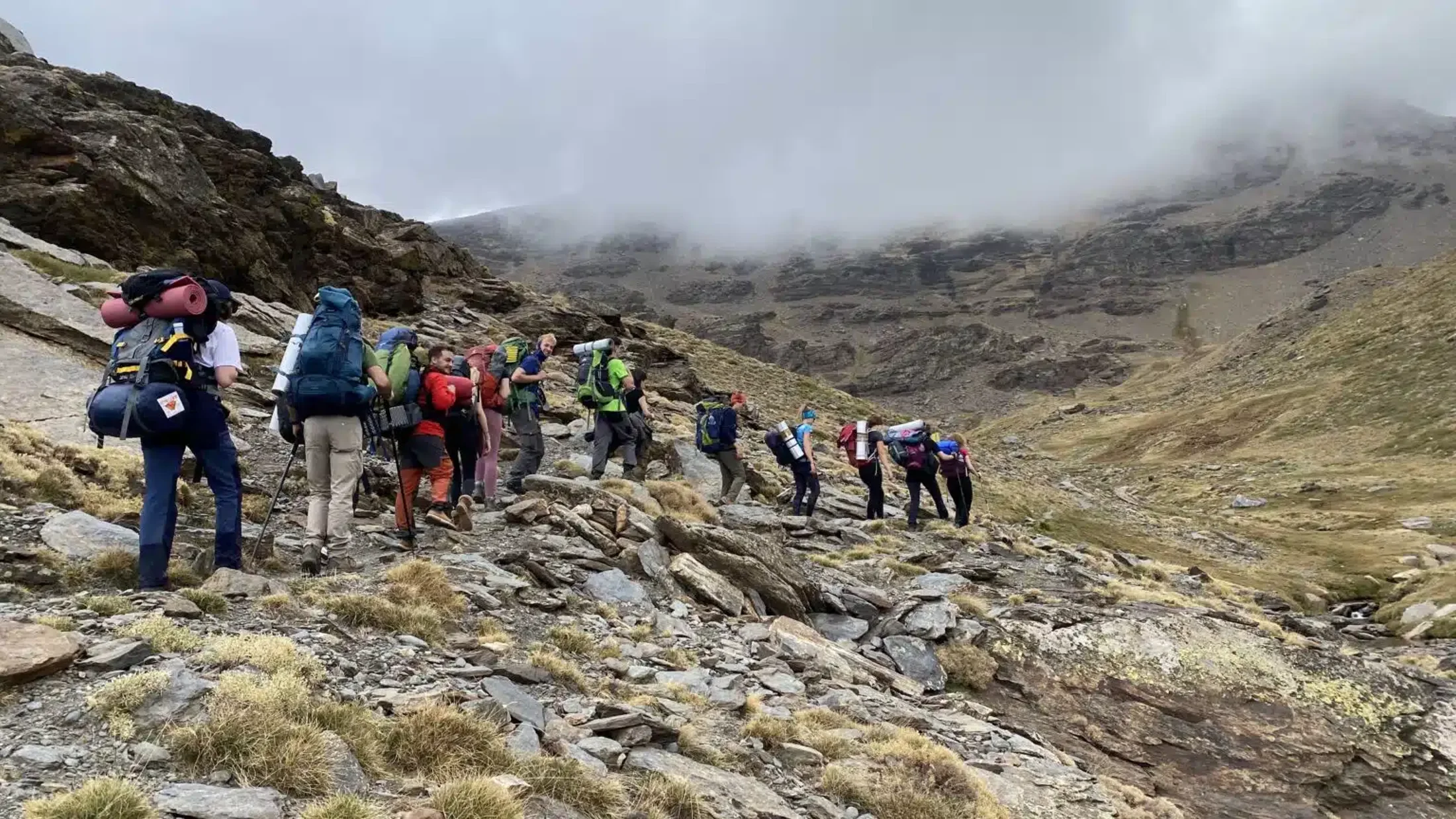
Why Sierra Nevada is your next adventure getaway
In Sierra Nevada you can climb a 3,000-metre summit and be down at the beach the same day. Few places in Spain bring together snowy peaks and the mild breezes of the Costa Tropical in so few kilometres.
Active tourism here has two sides. In summer, hiking rules, with ascents to peaks such as Mulhacén and a later descent to the sea. In winter, skiing takes you to sunny slopes with one of the greatest skiable vertical drops in southern Europe.
The altitude, of up to 3,479 m, the biodiversity and the proximity to Granada city explain its appeal. In the morning, the light falls on slate hillsides and borreguiles, with the scent of thyme.
Plan according to the season: hiking from June to September and skiing in winter. Book accommodation and your ski pass in advance in high season, and allow for the altitude when working out times and energy.
A high, close and diverse massif
Less than an hour from Granada you go from river plains and olive groves to snowfields and glacial lakes. The National and Natural Park of Sierra Nevada is the only Spanish Mediterranean mountain with all the region's bioclimatic zones.
The park protects unique habitats and a network of trails with classics such as the Vereda de la Estrella and ascents to three-thousanders. On a clear day you can see the Mediterranean from the Veleta ridge, and the Canal de la Espartera presents a 400 m drop from the Boca de la Pescá.
Active tourism here is not limited to walking: mountain biking, climbing, night crossings and stargazing under clear skies are added to the mix. In winter, the resort offers approximately more than 100 km of slopes and services for all ages.
The air is sharper at altitude and sounds fade until all you hear is your poles marking the rhythm. Set aside a full day for the high area and check the forecast before going up: snow and wind change the plan.
What you'll find here
Seven Sierra Nevada experiences with the details to hand: location, duration, difficulty, indicative prices and best season. Each listing helps you decide before you leave home.
The section also explains how to combine summits and beaches of the Costa Tropical de Granada without exhausting yourself, and how to get around from Granada. There are options for trekking, families, skiing, cycling and dark-sky observation.
At the end you'll find safety tips, frequently asked questions and an interactive map with routes, mountain huts, car parks and access points. Finishing a climb drinking cold water as the sun drops towards the sea is one of the images you can take away from here.
Picuco te puede ayudar
Does something here catch your eye?
Tell us.
Write to us on WhatsApp or email: we answer questions, find the best options and help you sort out the booking.
The 7 best experiences to enjoy the Sierra at your own pace
1. Mulhacén: ascent to the roof of the Peninsula
Mulhacén measures 3,479 m and is the roof of the Iberian Peninsula. Reaching the top is within reach for a hiker with good planning.
From the southern slope, you set off from Hoya del Portillo or Capileira, with the option of staying overnight at the Poqueira Refuge.
The difficulty is medium-high due to the length, the altitude and the loose stone terrain. In winter, you need crampons and an ice axe. The best time is from June to October: avoid afternoon storms and early frosts. It is a summit for hikers with basic experience in mid and high mountains who want a 3,000 m peak without technical sections.
By public bus, Alsa covers the Granada Bus Station to La Alpujarra with 5-6 daily buses to Lanjarón and Órgiva, from approximately 08:30 to 16:00, and 3 daily buses to other villages up to Trevélez at 10:00, 12:00 and 16:30. The bus to Trevélez stops in Lanjarón, Órgiva, Carataunas, Soportujar, Pampaneira, Bubión and Capileira. From the Capileira Information Point, the SIAC minibus goes up to Alto del Chorrillo with mandatory booking at reservatuvisita.es.
The ridge steams with heat at midday and crackles with ice in the early hours, like two mountains in one. Acclimatise, drink 0.5 l/h, use 50+ sunscreen, carry an offline map and a thermal jacket even in August. If you sleep in the refuge, book in advance.
2. Veleta: high-altitude panoramas from Hoya de la Mora
Veleta reaches 3,398 m and can be climbed in a single day from Hoya de la Mora. The old service road leaves you near the 3,000 m mark without technical difficulty, and from there you can see the northern ridge and the winter corridors.
The route leaves from Hoya de la Mora (2,500 m) via track and path, returning via the same itinerary. Calculate between 3.5 and 5 hours round trip, with +900 m of elevation gain and approximately 11-14 km. The difficulty is medium due to the altitude and exposure to the wind; in summer, the terrain is comfortable and obvious. At the summit, there is an IGN geodetic vertex and numerous radio and television antennas.
The best time is from June to October. Avoid evolving cloud cover and storms, and keep in mind that in winter it is alpine terrain. The wind at the summit sounds like a deep and constant breath.
The climb is great for panoramas, for active families with teenagers and for starting out on the 3,000 m peaks in summer. If you stay until late, sunset photography with the Mediterranean in the background and high-altitude astrotourism are extra incentives.
Carry thermal layers, a windbreaker and a headtorch if you set off late. Check AEMET and load GPS tracks. In the National Park, dogs must be kept on a lead, and it is advisable to book the National Park bus in advance to secure a seat.
You arrive via the A-395 road from Granada in 40-50 min, with parking in Hoya de la Mora. You can also approach in a motorhome or van.
3. Skiing and snowboarding at the Sierra Nevada resort
When the first snowfalls arrive, the Sierra Nevada resort deploys approximately more than 100 km of slopes, with sun and good vertical drops. It is the province's snow option and the ski area ranges from Pradollano (2,100 m) to altitudes close to 3,300 m.
There are wide green and blue slopes to progress, technical red ones and demanding black ones. Off-piste is left to those who have experience and good conditions.
The typical season goes from late November to April or May depending on snowfall. Families, beginners, intermediates looking for sun, and advanced skiers wanting vertical drop come here.
There is also a taxi with a fixed stop at Plaza de Pradollano, next to the Meliá hotels.
The morning snow crunches under the edges while the air smells of pine and coffee at the base. Before heading down, check your helmet, the correct binding adjustment, hydration, and intense sun protection.
4. Night treks and dark skies of high mountains
In Sierra Nevada, the Milky Way can be seen with a clarity that is hard to find in other parts of Spain. The altitude and dry air leave serene nights, with little light pollution and clean horizons, turning the mountain range into a great setting for astrotourism.
In summer, you can follow the steps of the Milky Way, identify constellations, and do star photography. The Sierra Nevada Observatory operates in Loma de Dílar and does not allow spontaneous visits.
For the night, you need a headtorch with red light, extra warm clothing, a hat and gloves even in August, and a flask with a hot drink. Avoid the full moon if you want deep sky; in winter, there is winter terrain and the risk of snow slabs.
Pedestrian access is permitted on paths, but motorised night traffic is restricted: consult the Park regulations before setting out. Plan a short return route, bring fully charged batteries, and share your location with someone in Granada. It is an activity for curious families, photographers, and hikers who want another perspective of the mountain.
The meeting point is at Plaza de Andalucía (Pradollano) and access is by cable car to Borreguiles, chairlift to 3,000 m, and on foot passing by Laguna de las Yeguas. It includes the main telescopes with 1.5 m and 0.9 m apertures and the control room.
Groups are limited to 25 people per visit for safety reasons, and it is mandatory to wear warm clothing and suitable mountain footwear.
5. Mountain bike descent through Natural Park tracks
On mountain bikes, you ride on authorised terrain, and this is how paths and fragile soils are preserved.
The area hosts the Ride Sierra Nevada Enduro MTB race. The usual routes go up by track and come down by that same track or through authorised loops. The physical difficulty is medium-high and the technique is low-medium on track, higher if there are stony sections. As evening falls, the fine dust rises like a golden trail over the pine forest.
Avoid narrow paths marked as pedestrian. During the season, there are qualified guides with regular departures. To return, use the local road and, if you wish, a support car.
Do not take shortcuts, brake gently, give priority to pedestrians, and do not ride through fragile high mountains.
6. Via ferrata and climbing in nearby sectors
Granada boasts more than 15 equipped via ferratas between Sierra Nevada, the Lecrín Valley, Moclín and the Alpujarra. Added to this are limestone walls and schist slabs with equipped climbing schools.
To start in the vertical, there are several via ferratas signposted with life cables and rock steps, ranging from K2-K4 levels. Most are located less than 45 minutes from the centre of Granada, with signposted car parks and short approaches via local PR paths.
The rock, warm in the sun, holds the dry echo of every carabiner hitting the harness.
You need a harness, energy absorber, helmet and gloves. A guided via ferrata costs between 45 and 80 € per person. Equipment hire requires previous experience and the knowledge to move autonomously.
Before heading out, check the anchors visually, progress in a triad (always two carabiners anchored) and do not advance under another climbing party.
7. Hiking and sea: from the Sierra to the Costa Tropical in one day
Finish a trail between irrigation channels and bathe in a clear-water cove on the same day. The combination of mountain and beach works especially well in spring and autumn, when the heat is less intense in both settings.
The Ruta de Los Cahorros, in Monachil, is the most direct hike to start: 8 km round trip, 3 hours and easy-moderate difficulty, with walkways and hanging bridges. It is not recommended for people with vertigo and is suitable for those over 8 years old.
Afterwards, the Costa Tropical awaits you with a rugged coastline of cliffs, coves and mainly pebbly beaches due to the proximity of the Betic System. You can choose the coves of La Herradura, the family beaches of Salobreña or the promenade of Almuñécar. The area is ideal for windsurfing, scuba diving, sailing, water skiing, golf, tennis, squash or horse riding.
The plan suits couples and families looking for a slow pace and thermal contrast between the mountains and the sea. Keep a change of clothes and a towel in the car, book to eat late on the coast and avoid peak hours on the A-44.
Quick facts: use the key data to your advantage
Each experience in the article comes with a quick fact sheet with the data you need to decide in 30 seconds. If several fields match your profile, it is your plan; if any fail, especially the difficulty or the altitude, look for an alternative.
The fact sheet starts with the exact location: starting point and valley, for example Hoya de la Mora, Capileira or Monachil. This way you can calculate actual travel times before setting off. Next come the duration and the elevation gain, with the total time and the metres of ascent, to compare them with what you usually do comfortably.
The difficulty is explained in plain language, covering both the technical and physical aspects: loose terrain, wind exposure. The indicative price is given as a range per person, and it is advisable to confirm it with the operator or consult options on Picuco. The best time marks the optimal window for weather, light and safety, and the "ideal for" section indicates the recommended profiles: families, intermediate and advanced.
The key points are the places that give meaning to the route: passes, viewpoints and refuges. In access and booking, you will see how to get there via the A-395, the A-44 or by bus, and whether it is worth booking refuges or shuttles.
Organise the fact sheet by what affects you most: first the time of year, then the available time and finally the technical level. Cross-reference the data with IGN/Mapy.cz maps, AEMET or Meteoblue weather, and a time estimator, and add a 20% margin for photos, pauses and altitude. If cost is key, prioritise activities without a guide or share a group to reduce expenses.
Summits and sea in a single trip: itinerary ideas
Climb early, descend in daylight and sleep one night at a low altitude before demanding more from your body.
You rest in Granada or on the coast and you have just over an hour until the Granadan coast, so you can climb early, descend in daylight and sleep one night at a low altitude before demanding more from your body.
The Poqueira Refuge is at 2,500 m altitude and has toilets, showers, free kitchen, terrace, climbing wall, helipad and equipment hire. It is accessed from Hoya del Portillo (2,150 m), a recreational area 13 km from Capileira, which you can reach by car if there is no snow.
In this plan, you can skip the summits and move in stretches of 1 h to 1 h 30 min.
Avoid driving after a very long day at altitude. Book in advance at refuges and on the coast during bank holidays and summer.
Location map: routes, access and beaches
The interactive map brings together the starting points for routes to Veleta and Mulhacén, the Vereda de la Estrella, the Hoya de la Mora and Pradollano car parks, the relevant staffed and unstaffed refuges, and the A-395 (Granada–Station) and A-44 (Granada–Coast) road connections. It also marks the beaches of Almuñécar, La Herradura and Salobreña to calculate real travel times.
The A-395 is 38.59 km long, includes the Granada South Ring Road and is the main road access to the Alhambra by car. After the Serrallo tunnels, it becomes a conventional single-lane road in each direction up to the Sierra Nevada ski resort. The A-44 is a motorway of the State Road Network that begins at a junction with the Southern motorway (A-4) in Bailén.
La Herradura beach is 2050 m long and 40 m wide on average, and can be accessed on foot, by car or by boat.
When you open the map, there are selectable layers: difficulty, altitude, nearby water sources and services open during the season. The suggested layers are difficulty by colour (green/blue/red/black), altitude and shaded slopes, services (refuges, bus stops, car parks, equipment hire) and seasonal status (open pistes, snowy paths, temporary restrictions).
To use it, filter by starting point (Granada, Güéjar Sierra, Capileira) and by available time. Export tracks, mark useful POIs (water, escapes, viewpoints) and download it offline if you are going to lose coverage. Just like when you push aside low branches and the entire valley suddenly appears, the map reveals alternative routes to you without you getting lost.
Logistics and safety: arriving, moving around and packing well
During the season, there are daily buses with stops in Pradollano and Hoya de la Mora; in winter, they also stop at the Palacio de Congresos, on the side of the Paseo del Violón.
A car has its limits. In Hoya de la Mora, parking is very limited, so in Pradollano it is convenient to use the covered and surface car parks, which are signposted. Capileira and Hoya del Portillo are reached via mountain roads, with caution in winter. The last 13 km from the 2500 m altitude mark (Hoya de la Mora) to Hoya del Portillo can only be travelled by motorised vehicles previously authorised by the Sierra Nevada Natural Park.
Between June and October, the Natural Park usually offers the "High Peaks Interpretation Service" (SIAC) through an administrative concession, with minibuses and guides to take you closer to the summits. The seasonal shuttles to Alto del Chorrillo have limited spaces and require prior booking; the staffed mountain refuges must also be booked, and it is advisable to confirm schedules and water availability.
Inside the National Park, walk along the paths and keep dogs on a lead. Drones require a permit, motorised traffic is restricted in high mountains, and all waste must be carried back with you.
Equipment changes with the season. In summer at altitude, wear boots or shoes with good grip, a cap, 50+ sunscreen, category 3-4 sunglasses, a windbreaker, and a thermal layer. In winter, add an extra thermal layer, gloves, crampons, and an ice axe if there is ice or snow; if you go off-piste, you need an avalanche transceiver (ARVA), shovel, and probe, along with specific training. For cycling, bring a helmet, gloves, a multi-tool, a quick link, a spare tube or patches, and 2 water bottles; at night, a headtorch with an extra battery and a lightweight down jacket.
The altitude is noticeable: headaches, nausea, and fatigue are signs of altitude sickness. If it worsens, descend; stay hydrated and eat salty and sweet foods at regular intervals. Carry a minimal first-aid kit with bandages, plasters, a thermal blanket, and basic pain relief.
Share your plan before setting off, use your mobile's coordinates, and download offline maps. Book refuges, shuttles, and accommodation in advance during the high season.
Choose wisely according to your profile and the season
The activity you will enjoy most depends on your energy, your technique and the month you travel. Before booking, consider how much you enjoy climbing, the actual time you have and the forecast weather.
If you ski, the Sierra Nevada station awaits you in winter with more than 100 km of slopes.
Three MTB routes serve as a reference:
- Route 1 is 37.4 km, it is circular-linear, with difficult effort and easy technique, with 1,485 m of ascent and descent.
- Route 2 is 21 km, it is linear, with difficult effort and easy technique, with 1,621 m of ascent and 223 m of descent.
- Route 3 is 16.68 km, it is circular, with medium effort and very difficult technique, with 972 m of ascent and 973 m of descent.
The season changes the plan. In spring, there is residual snow at the top, so it is time for hiking at medium altitudes and MTB on tracks, with the coast at 18-22 °C. In summer, aim for the three-thousand-metre peaks and lagoons, or night treks: it is hot below and the sea is perfect. Autumn brings colours and stability, with the first snowfalls on the summits. In winter, there is skiing and snowboarding, and snowshoeing at medium altitudes with a guide; watch out for ice and strong winds.
Use the Virgen de las Nieves / Peñones car park: there is a shuttle bus from the Peñones car park and you can also walk up the road in about 40 minutes. The road closes at 07:00.
Frequently asked questions
What is the best time to climb Mulhacén?
From June to October, when there is no snow and the days are long.
It is advisable to get up early to avoid the heat and winds, and to descend before the afternoon storms.
Do I need a guide for Mulhacén or Veleta?
In summer, it is not mandatory to hire a guide to climb Mulhacén or Veleta if you have experience and basic navigation skills. With snow or ice, or if you are unsure about the weather, it is advisable to hire a qualified guide.
Can I combine mountains and beach in a single day?
Yes.
The route to Veleta from Hoya de la Mora takes 4 to 6 h, so it is advisable to start early to reach the coast in daylight. For Mulhacén, it is better to dedicate 2 days.
Where can I easily do astrotourism?
Sierra Nevada has observation points that can be reached by car with hardly any walking. Look for a clear spot far from the lights of the village and park with enough time to return.
To observe the sky, it is advisable to avoid the full moon. Dress warmly even in summer and use a headtorch with red light.
What level is required for Vereda de la Estrella?
Vereda de la Estrella has no technical passes, so you can do it walking, without climbing equipment. However, it is a long mountain route: prepare your pace and water before setting off.
The best times to do it are autumn and spring. In summer, the heat is intense and in winter you may find snow or ice on the path.
Is there equipment rental and classes at the station?
Yes.
On peak dates, it is advisable to book in advance, both the equipment and the class. This way you ensure your size and time before heading up to the station.
How do I get there by public transport from Granada?
During the season, there are regular buses from Granada to the Sierra Nevada station. For La Alpujarra, bus lines run with stops in Órgiva and Capileira.
Before travelling, check the updated schedules: they change according to the season and the day of the week.
Can you go cycling on any path?
No. When cycling, you must stick to the authorised tracks and lanes of the Natural Park and respect the signage. Avoid pedestrian paths and fragile areas.
Book your experience — discover active tourism activities in Spain with providers verified by Picuco.
Conclusion
Sierra Nevada combines accessible three-thousand-metre peaks and ski slopes with winter sun, and less than two hours away you have the warm beaches of the Costa Tropical. Few places in Spain allow you to go from snow to salt water in a single day.
In these mountains, every decision counts: waking up early, hydrating, respecting the regulations, and choosing routes that suit you. The image you take away with you, a blue sea against a dark slate ridge, compensates for any early start.
Plan with the quick facts, consult the map, and prepare a combination that excites you. Upon your return, share your experience: help other travellers find their rhythm between summits and waves.