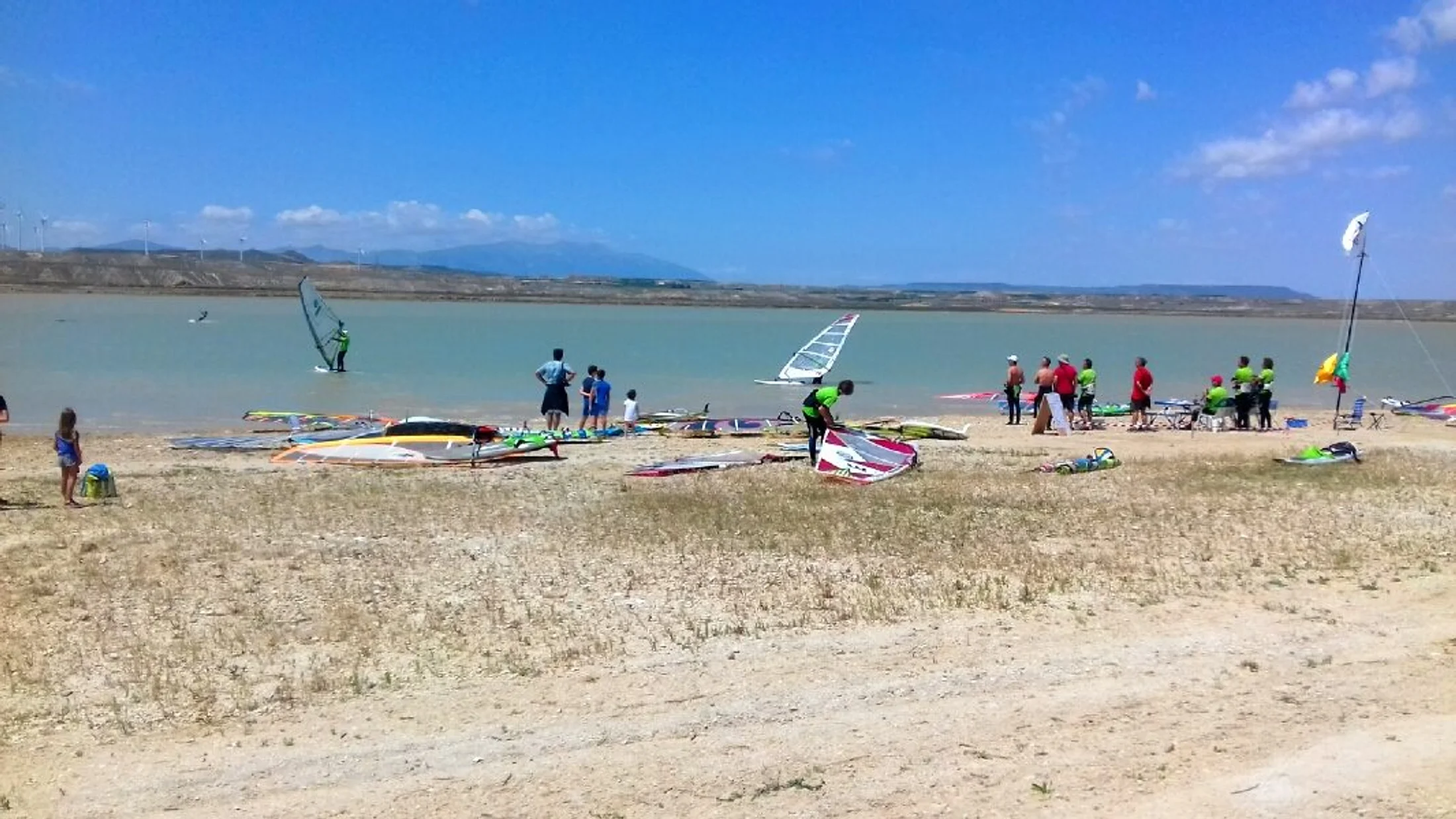
Embalse de La Loteta spreads over 1,087 hectares of water surface in the Campo de Borja district, northwest of Zaragoza province, making it one of the largest bodies of water in Aragón. Opened in 2008 across municipal land belonging to Gallur, Bisimbre and Luceni, the reservoir was built to regulate the Imperial de Aragón and Lodosa canals, but its sheer size and location in the steppe of the middle Ebro valley have turned it into a prime habitat for waterbirds and a magnet for wind sports.
The landscape surrounding the reservoir is cereal steppe: barley and wheat fields stretching to the horizon under an enormous sky, dotted with almond and olive trees at field edges. The water surface breaks this flatness with a mirror that reflects the clouds and, depending on the time of day, can shift from leaden blue to blazing orange at sunset. The cierzo wind, blowing from the northwest, arrives frequently and forcefully, generating waves on the reservoir surface and creating the conditions that have attracted Zaragoza's kitesurfing community.
La Loteta has been designated a Special Protection Area for Birds (SPA) by the Government of Aragón, a recognition stemming from the more than 200 bird species recorded at the reservoir and its surroundings. During the autumn (October-November) and spring (March-April) migrations, flocks of common cranes, mallards, common teal, northern shovelers and sandpipers gather. In winter, the stable presence of greater flamingos — unusual in inland Spain — has made the reservoir a birdwatching site with national reach. The embankments along the shores host nesting bee-eaters, sand martins and European rollers during the warm months.
Kitesurfing is the sport that put La Loteta on the map. The cierzo blows reliably for much of the year (frequencies above 40% of days between October and May), with gusts reaching 40-60 km/h. The reservoir's size allows long runs downwind without obstacles, and its average depth of 10 metres provides a reasonable safety margin. The main launch area sits on the northern shore, accessible via a dirt road from the A-127.
Around the reservoir, a perimeter of agricultural tracks allows walking or cycling along parts of the shoreline, though no complete waymarked circuit exists. The southern shore, with restricted access during nesting periods, is the quietest and the one favoured by birdwatchers, who set up their telescopes on elevated points along the embankment.
The Campo de Borja district adds a gastronomic and wine complement to the reservoir. Wineries within the Campo de Borja Designation of Origin — known as 'the empire of Garnacha' — produce red wines from old dry-farmed Garnacha vines, some over 60 years old, in a terroir of clay and limestone at 400-700 metres altitude. Several wineries offer tastings. Nearby towns (Borja, Magallón, Ainzón) preserve Mudéjar churches with brick towers, and Borja is internationally known for the Ecce Homo of the Sanctuary of Misericordia.