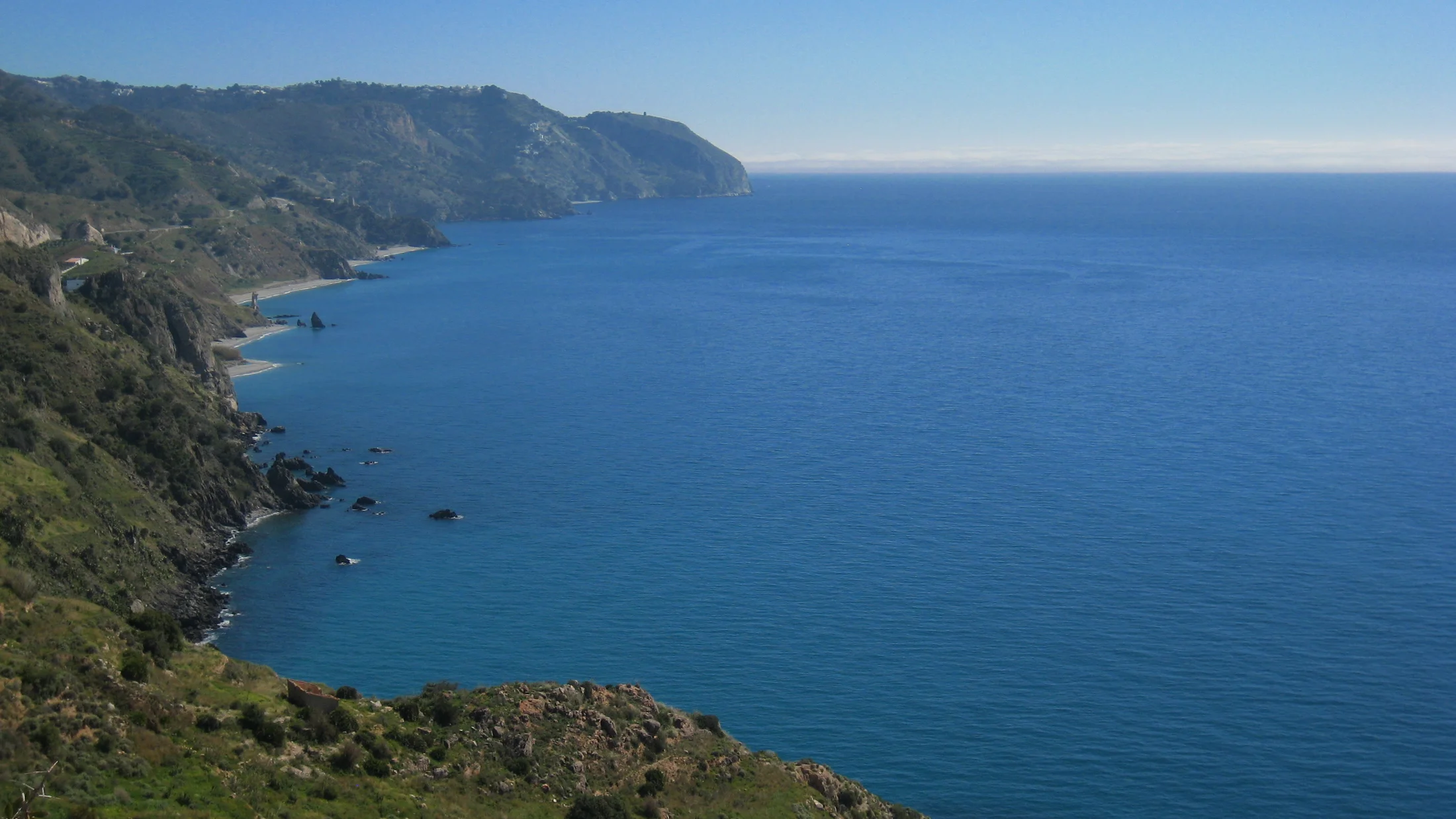
The Spanish coast offers much more than afternoons with a towel and umbrella. In the Maro-Cerro Gordo Cliffs, the marine fauna is exceptional and there is a possibility of seeing dolphins from the viewpoints. Tarifa lives off the wind for kitesurfing and Famara beach lives off the Atlantic swell for surfing. Here you have a different activity on each coast, with what you should know before booking it.
Maro-Cerro Gordo Cliffs: kayak and snorkel under the cliffs
From the viewpoints, there is a possibility of spotting dolphins, so it is worth looking up from the water every now and then. Picuco organises Kayak and snorkel in the Maro-Cerro Gordo Natural Area to explore the area from the sea and snorkel in its depths.
Picuco te puede ayudar
Does something here catch your eye?
Tell us.
Write to us on WhatsApp or email: we answer questions, find the best options and help you sort out the booking.
Ribadesella: coasteering on the coast of the dinosaurs
Ribadesella is a municipality in Asturias with a coast that holds dinosaur footprints and corners that can only be reached by skirting the rock. Coasteering combines walking along the coastline, swimming and jumping between rocks, always with equipment and a guide. Picuco organises Guided coasteering on the coast of Ribadesella, Asturias to explore the coast of the dinosaurs with a guide. If you come by car, you can leave it in the Bus Station car park.
Tarifa: learn kitesurfing with levante and poniente
Tarifa is a municipality in the province of Cádiz, in Andalusia, and has become famous for its strong levante and poniente wind gusts. That constancy is what has turned the town into the mecca of kitesurfing and windsurfing. Picuco organises Learn kitesurfing in Tarifa, Cádiz to take your first steps with equipment and accompaniment.
Famara Beach: surf on a sandy beach open to the Atlantic
Famara is a world centre for surfing, with constant Atlantic swell and reliable coastal crosswinds. The beach, of pale golden sand, measures almost three kilometres and is in the municipality of Teguise, about 30 kilometres northwest of Lanzarote Airport. There is free parking at the foot of the beach with several access points, and bus line 20 connects Arrecife and Caleta de Famara, although with limited schedules. Picuco organises Surf classes for all levels at Famara Beach, Lanzarote.
Laredo: paddle surf in the capital of the Costa Oriental
Laredo is a municipality and town in Cantabria, capital of the Costa Oriental region, with a bay that invites you to paddle near the shore. Paddle surfing allows you to move standing up on the board and view the coast from a different altitude. Picuco organises Paddle surf class in Laredo to help you start with technique and safety.
Zahara de los Atunes: horse ride on the beach
Zahara de los Atunes is a local autonomous entity belonging to the municipality of Barbate, in the province of Cádiz, Andalusia. Its long and open sandy beach is well traversed on horseback, with the water on one side and the dunes on the other. Picuco organises Horse rides on the beach of Zahara de los Atunes to get to know the shore at a different pace.
Menorca North Marine Reserve: snorkel in Fornells
The Menorca North Marine Reserve covers 5,119 hectares of sea from the bay of Fornells to cabo Gros, in Es Mercadal. Throughout the entire reserve, trawling and the fishing of threatened species are prohibited, and it is easy to see moray eels, groupers, octopuses and red mullets. Picuco organises Snorkeling in the Fornells Marine Reserve, Menorca to explore these depths with a guide.
Cabo de Palos: scuba diving baptism in the marine reserve
The Cabo de Palos-Islas Hormigas Marine Reserve has maintained its international prestige for years as one of Europe's best diving destinations. Picuco organises Scuba diving baptism in Cabo de Palos to give you your first dive with accompaniment. There is parking next to the lighthouse, which is free but has limited spaces.
Protection rules in the Northern Menorca Marine Reserve
In Zone A, the maximum protection zone, any type of spearfishing and the extraction of marine flora and fauna is prohibited. In Zone C, spearfishing is prohibited, with some exceptions.
Frequently asked questions
What to do at the beach besides swimming?
Picuco organises guided activities on different coasts: kayaking and snorkelling in Maro-Cerro Gordo, coasteering in Ribadesella, kitesurfing in Tarifa, surfing in Famara, paddle surfing in Laredo, horse riding in Zahara de los Atunes, snorkelling in Fornells and scuba diving baptism in Cabo de Palos.
Where to go snorkelling in Spain?
Picuco organises guided snorkelling outings in Maro-Cerro Gordo, on the coast of Málaga and Granada, and in the Fornells Marine Reserve, in Menorca. In northern Menorca, it is easy to see species such as moray eels, groupers, octopuses and red mullet.
Where to learn kitesurfing in Spain?
Tarifa is a place for practising kitesurfing and windsurfing, and has become famous for its strong easterly and westerly wind gusts. Picuco organises kitesurfing classes for beginners in Tarifa.
Can you go paddle surfing in the Cantabrian Sea?
Yes. In Laredo, in Cantabria, Picuco organises paddle surfing classes for you to get started.
What water activities are there on the Spanish coast?
There are jet ski routes in Ribadesella, surfing at Famara beach, which is a world centre for practising surfing with constant swell and reliable crosswinds, and snorkelling outings, baptisms for beginners and PADI courses in the Northern Menorca Marine Reserve. The Cabo de Palos-Islas Hormigas Marine Reserve has maintained its international prestige for years as one of Europe's best diving destinations.