Why these landscapes make you feel off the Earth
Geological and visual context
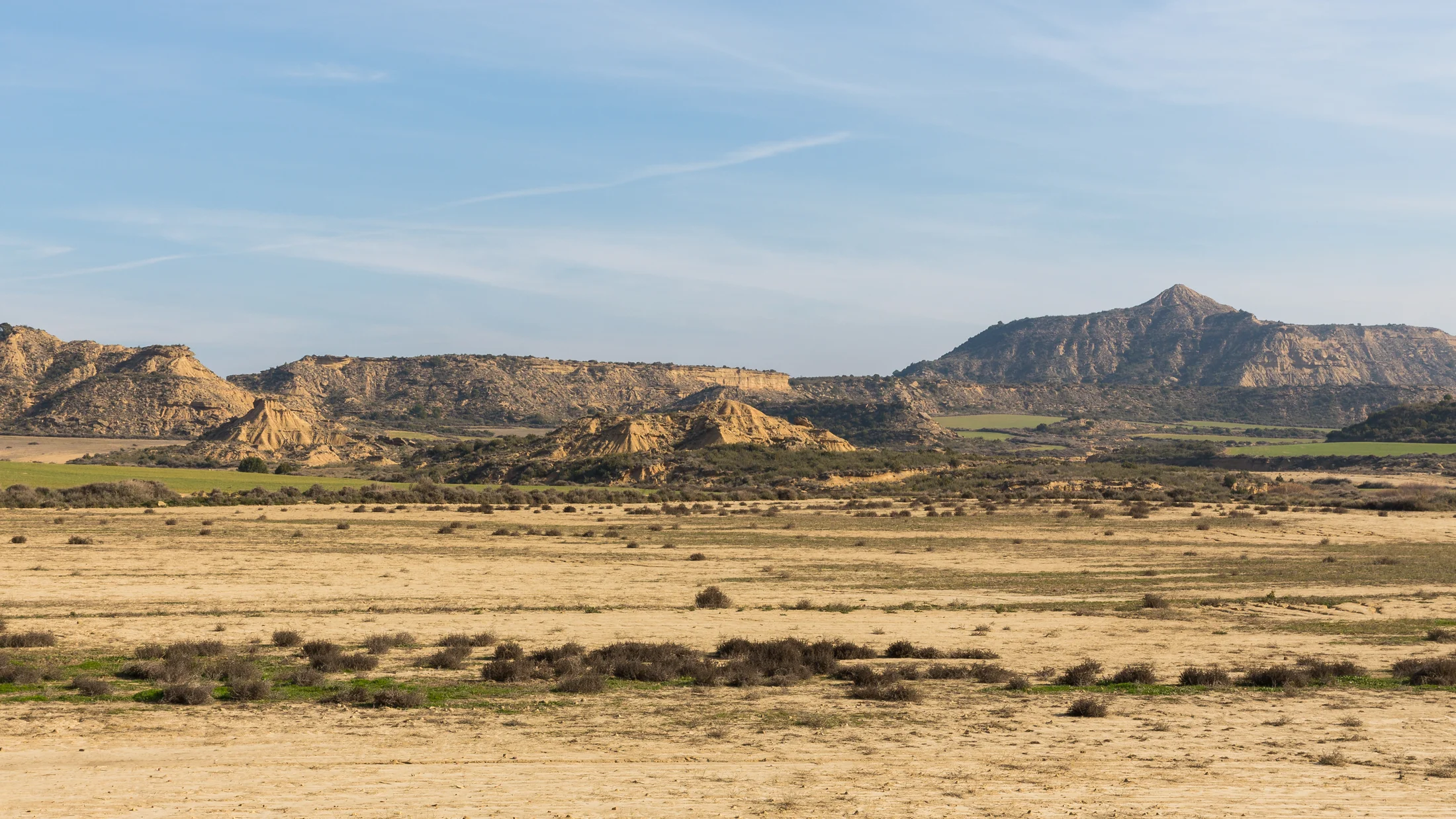
In Bardenas Reales, Castildetierra looks like a clay rocket about to take off. They are badlands: relief of gullies and ravines carved by erosion in soft sediments, where water and wind sculpt cones, hills and chimneys over thousands of years.
The aridity of the Ebro valley and of the south-east of the peninsula enhances this natural sculpture: it rarely rains, the sun beats down and the sparse vegetation leaves the terrain exposed. In every location, the low-angled light paints long shadows and a mineral silence.
Each area has its own matter. Bardenas Reales (Navarra) mixes marls, clays and layers of gypsum that dissolve into impossible shapes. Tabernas (Almería) has a pure semi-arid climate, with ramblas and bare hills that captivated cinema. Gorafe (Granada) unfolds a labyrinth of striated slopes in a thousand ochre tones.
Los Yesos de Sorbas form a complex of caves, canyons, dolines and geodes excavated by the Aguas river, with a karst relief of rock dissolved by water; access is open and requires prior reservation. Monegros (Huesca-Zaragoza) extends an undulating steppe where sandstone outcrops and "torrollones" appear.
Before setting off, check the forecast: the light in the early morning and late afternoon makes all the difference, and in summer it is advisable to avoid the middle hours. Book in advance in Sorbas and carry water and closed footwear in all these terrains.
What you will learn and who this guide is for
A sunset with warm sand in your boots and a light breeze that lifts the scent of wet earth after a short storm. This is how the deserts of Spain are remembered, and this guide helps you organise your visit to each area.
Gather the essentials: how to get there, the best time to go and 1–3 day itineraries with approximate times. You will also find places to sleep, recommended activities and safety and photography tips to return with great images.
The guide is designed for independent travellers, couples, families who want to learn geology live and photographers looking for golden light. To optimise the route, it includes quick summaries by area and reference coordinates in a simple format.
Picuco te puede ayudar
Does something here catch your eye?
Tell us.
Write to us on WhatsApp or email: we answer questions, find the best options and help you sort out the booking.
Where they are and what makes them unique
1. Bardenas Reales: Castildetierra and the clay icon
In the south-east of Navarra, near Tudela, Bardenas Reales has been a Natural Park and a UNESCO Biosphere Reserve since 2000. Its most famous postcard is Castildetierra, a fairy chimney with a hard rock "hat" that protects a softer clay shaft.
The contrast between the grey marl hills and the reddish ridges creates a lunar palette, with cliffs, ravines and cracked plains. At sunrise, the walls turn peach and the silence is broken only by the wind.
The park combines three clear units —Bardena Blanca, Bardena Negra and El Plano—, each with different textures. It is a living landscape, managed by local communities that graze sheep and maintain traditions linked to transhumance.
Getting there is simple: there are marked tracks, viewpoints such as the Castildetierra area and information signs. You can also travel perimeter routes by bike or by car, always with caution. Check Natural before setting off.
2. Tabernas Desert: film set in Almería
Between the Sierra de Alhamilla and the Sierra de los Filabres, about 30 km north of Almería capital, the Tabernas Desert stretches out. It is the only true desert area in Europe, protected by the Junta de Andalucía since 1989; the rest of the continent's arid landscapes are considered semi-desert.
Its ramblas and striated hills have served as the backdrop for classic westerns, Lawrence of Arabia, and recent productions. Sparse rainfall and very dry summers leave the slopes bare, with micro-craters, fairy chimneys, furrows, and deep gullies. The result is a chain of gullies, grey marl hills, ochre badlands, and ravines that flow into ramblas.
In addition to the landscape, you can explore historic film sets and small local museums, testimony to decades of filming that drive the local economy. There are viewpoints along the A-92, and secondary tracks allow you to move forward with a high-clearance vehicle. Always drive on authorised paths and avoid riverbeds after it rains.
3. Gorafe Desert: badlands labyrinth in Granada
In Gorafe, the slopes are filled with parallel "ribs", deep ravines, and narrow plateaus. It is the badlands landscape of the Granada Geopark, recognised by UNESCO in 2020.
The colour of the terrain ranges from cream to red depending on the iron and clay present, and the sunset light sweeps across the ridges. It is not a pure climatic desert, but its erosive modelling gives it a desert aesthetic. What attracts most people here is texture photography and short routes along the ridges.
The Granada Geopark extends across the regions of Guadix, Baza, and Huéscar, covering 4,722 km², and stands out for its geological, geomorphological, and Quaternary paleontological richness. In the Gor valley, there is a megalithic park with three marked routes, 37 restored dolmens, and 66 prepared for visits; the interpretation centre is in the village of Gorafe. The valley terrain consists of conglomerates and limestones eroded by riverbeds during the Pleistocene.
The network of dirt tracks links farms and country houses: drive with respect and ask in the village about the condition of the paths. Wear suitable footwear and bring a desire for silence to explore the viewpoints and the routes over the hills.
4. Sorbas Gypsum: karst and lunar landscapes
In Sorbas (Almería), water has been dissolving gypsum for thousands of years, leaving behind dolines, lapies, and a complex system of caves. It is a gypsum karst, one of the rarest landscapes on the peninsula.
The gypsum outcrops in white, brittle surfaces that look like elevated salt flats, around 37.09°N, -2.11°W. The light bounces off the walls with a milky glow, and stepping softly, you can hear a dry crunching under your boots.
The most interesting part is underground: galleries and gypsum speleothems that can only be visited with a guide authorised by the Natural Park regulations. On the surface, there are short marked paths to see whitish hills, cracks, and outcrops with geological layers like the pages of a book.
The environment is fragile and very sensitive to trampling and mineral collection. Visiting responsibly helps to conserve it and supports the local economy that organises the routes. Book your guided visit in advance and wear footwear that you don't mind getting dirty.
5. Monegros: steppe, scrublands and infinite horizons
Between Huesca and Zaragoza lies Monegros, an Aragonese region of semi-arid steppe. The Monegros are exactly that: kilometres of open terrain where the view is lost.
The tozales and "torrollones" are sandstone pillars that resist erosion from wind and water, alongside gentle ravines and dry valleys. The low vegetation cover and the open texture of the terrain create a desert aesthetic: the nights are black and the day has a murmur of wind that bends the esparto.
In Jubierre, there are five marked itineraries of low difficulty. The Jubierre Badlands are an Area of Geological Interest.
The observation of steppe birds —black-bellied sandgrouse, little bustard, Dupont's lark— is part of the natural attraction, with protection figures in several SPA. It is a place of great distances, quiet villages and a culture linked to ancestral water management.
Respect the network of agricultural tracks and paths, for safety and for coexistence with farmers and livestock breeders. To reach Jubierre from the A-131 road (Sariñena-Fraga), take a track 6 km from Sariñena towards Sena; from the Castejón de Monegros road, there is a detour 4 km towards Valfarta.
Location, climate and best time to travel
The five landscapes share soft soils and dry climates, but each has its own window. In general, avoid the extreme heat of midday in summer and seek the low light of sunrise and sunset, when shadows highlight the textures.
The best time is March-June and September-November; in summer, get up early and carry water. On windy days, the atmosphere gains clarity, ideal for telephoto lenses.
Tabernas has long and very dry summers, with maximum temperatures that can exceed 35 °C and scarce rainfall concentrated in autumns with torrential downpours. In May and September, it is advisable to seek shade and wear a hat. After rain, avoid the ramblas due to sudden flash floods.
The north wind cleans the air and enhances the reliefs in backlight.
If you are going to photograph, keep the light in mind. In clay badlands (Bardenas, Gorafe), the golden blue hour and twilight highlight the striations, and it is advisable to avoid midday with clear skies; in the gypsum areas (Sorbas), the first and last hours avoid the overexposure of the white and the polarising filter should be used with moderation.
To compare at a glance:
- Monegros: 300–400 mm of annual rainfall.
Bardenas Reales: how to arrive and move around safely
Bardenas Reales is located in the southeast of Navarra, with Tudela as a reference point. The main access is from Arguedas via the NA-134, towards the Aguilares access and the Castildetierra area, and there is also an entrance from El Paso.
From Tudela, via Arguedas (N-134), a 25 km track borders the Bardena Blanca. The two main routes are the perimeter track from Arguedas or the track that from El Paso (Carcastillo) joins the perimeter track. In the Bardena Blanca, you can see formations such as Castildetierra, Pisquerra, El Rallón and the plains of La Ralla and Alfarillo.
Access hours are from 8:00 until one hour before sunset (in winter, before 16:30). Drive only on authorised tracks and slowly, at 30–40 km/h as a safe reference. The perimeter of the Bardena Blanca, about 34–36 km depending on variations, can be travelled by bike or car in 2–3 hours with stops.
There are temporary closures due to bird nesting or due to activity in the Shooting Range. Closed areas are marked with signs and, if you see red flags or hear sirens on manoeuvre days, do not enter.
Normal tourism is sufficient in dry conditions, but after rain, the clay mud makes some tracks impassable. Sports cars and minibuses are not allowed. Carry tyres in good condition and a spare wheel.
Download an offline map, because data coverage fails in low-lying areas. Basic signage exists, but it does not replace the map.
Organised activities, drones and large groups may require prior authorisation from the Park and from AESA in the case of UAS. Check this in advance at the official information centre.
Avoid driving at night for wildlife, safety and conservation regulations. It is forbidden to light fires in open spaces for recreational purposes.
Do not drive off the track or step on the fragile crusts, and do not collect stones or damage the formations: every footprint leaves a lasting mark on the clays and gypsum. Take all your rubbish with you, including cigarette butts.
As you move forward, the grey hills open up a sea of undulations and the air brings a dry taste of thyme and fine dust.
Where to stay: base towns and rural options
Sleeping near the landscape you are going to visit saves hours of driving and allows you to arrive for sunrise. Choose your base according to each day's plan.
In Valtierra, there are rehabilitated caves for sleeping. If you are going photography hunting, Arguedas and Valtierra are the closest bases to the sunrises.
The Tabernas Desert extends across the municipalities of Tabernas, Gádor, Santa Cruz de Marchena, Alboloduy and Gérgal. Almería capital offers more services, about 30–40 min via the A-92. There are hostels, rural houses, bungalows on estates and campsites; in summer, consider accommodation with a swimming pool and air conditioning.
In the Gorafe Desert, the bases are Gorafe, Villanueva de las Torres, Purullena and Guadix, which has more services. You will find cave houses with good thermal inertia, cool in summer and temperate in winter, as well as rural hotels and apartments. Its dark skies make it ideal for astrophotography.
Visits to the Yesos de Sorbas caves are carried out with authorised guides and can be done all year round depending on the site's management schedules.
Look for accommodation that accepts early starts and late check-in if you are chasing the golden light.
Three tips according to your plan:
- For photography, prioritise proximity to the main access and a terrace or outdoor space to check your equipment at dawn.
- For hiking, choose a base with shops and a bakery to pack picnics and ask about drinking water on the route.
- For the night sky, look for towns with low light pollution (Gorafe, Monegros areas) and flexible accommodation with flexible hours.
Opening the door while it is still night, hearing a distant rooster and feeling the dry cold on your face before the first beam of light.
Activities and itineraries by Zone
1. Bardenas Reales: routes, viewpoints and ideas for 1–3 days
Bardenas Reales is explored by combining viewpoints, scenic tracks and short paths. The clay folds and the wind through the esparto mark the rhythm of the visit.
The perimeter route can be done by bike or by car with stops at the most notable formations. Signposted secondary tracks can always be explored within the Park's regulations.
With one day, you have plenty to do. Afterwards, the perimeter of the Bardena Blanca with stops at the cliffs (2–3 h) and a picnic in the shade of authorised embankments. Head out in the afternoon.
If you have 2–3 days, spread the routes across different zones and leave room to return to the viewpoints with different light.
- Day 1 as above.
Calculate the full day: the tracks are long and access is slow. Carry water, sun protection and ensure your tank is full before entering.
- Day 2: Bardena Negra via authorised forest tracks (3–4 h), more vegetated and with more contrasts.
Spend the second day in Bardena Negra, the most vegetated area of the park with the most contrasts. Explore it via authorised forest tracks and allow between 3 and 4 hours.
In the afternoon, go up to the Mirador de las Cortinas, which offers panoramic views of Las Cortinas. The low light cuts the silhouettes of the cliffs well.
If you have 3 days, add El Plano, one of the three areas of Bardenas Reales. On that third day, head out at dawn to take advantage of the blue hour, and rest during midday.
Before setting off, check two things: avoid areas closed due to spring nesting and check the condition of the tracks after rainfall. Carry water, minimum 2 l/person/day.
2. Tabernas Desert: routes, film sets and plans for 1–3 days
In Tabernas, Almería, the landscape is explored alongside film towns and sets, including one of Sergio Leone's most authentic ones. The desert is visited by combining landscape and film culture.
The most direct way to see it is to walk through ramblas such as the one in Tabernas and stop at the viewpoints along the A-92 to get panoramic views. The film towns and sets offer tours and small exhibitions, and during the season, there are authorised 4x4 routes via marked tracks with specialised companies.
With more days, you have the margin to add authorised 4x4 routes via marked tracks and more film towns and sets.
Bring water and sun protection: the rambla is flat, but it has no shade. Book the 4x4 routes in advance if you travel during high season.
-
Day 1 as above.
-
Day 2: vehicle circuit via authorised secondary tracks (3–4 h) with stops for texture photography.
Finish the day with a sunset at altitude, when the desert's layers of colour look their best.
If you have three days, alternate mornings in the landscape with afternoons indoors when the thermometer rises. And if the forecast predicts rain, avoid the dry riverbeds and switch to a plan B with heritage in Almería or on the nearby coast.
For the loose terrain, wear footwear with gripped soles and high sun protection. In summer, carry 3–4 l of water per person. Drive only on permitted tracks and park without blocking agricultural crossings.
3. Gorafe Desert: paths, panoramas and badlands circuit
In Gorafe, the ridges are natural walkways that demand a firm step. Choose routes of 3–8 km between hills and viewpoints, and combine them with visits to marked dolmens.
As evening falls, the ridges light up in orange and the air brings a mineral freshness. At night, the clear skies and low light pollution make astronomical observation excellent: note the phases of the moon if you want to capture nocturnal textures.
With one day, you have enough for the panoramas and the dolmens. With two, add textures and night: walk during the day and reserve the second day for the sky.
-
Day 1 as above.
-
Day 2: circuit via tracks to link photogenic ravines, with stops every 2–3 km.
You dedicate the second day to the Gorafe Desert, in the municipalities of Gorafe and Villanueva de las Torres.
At night, it's time for a simple astrophotography session, with a tripod and 15–20 s exposures. Leave some margin in your calendar to retry the skies if the wind kicks up dust.
On the dry clay slopes, it is advisable to avoid slipping: after rain, the top layer becomes like soap. Bring poles for the descent sections. If you are in doubt about a track, ask in the village: there are private properties that you must respect.
4. Sorbas gypsum: guided tours, trails and bespoke karst
Sorbas is a gypsum landscape with an important underground world. The gypsum caves are visited with guides authorised by the Natural Park administration and with specific equipment: helmet, light and jumpsuit.
The introductory speleological visit lasts from 1½ to 2 hours and allows you to discover galleries and gypsum crystals. It is advisable to book the guided tour in advance, as access is only possible with authorised guides and provided equipment.
On the surface, there are short marked trails to see lapies (sharp grooves) and dolines (depressions formed by dissolution) from safe viewpoints. The dry, salty breeze caresses your skin like a sea breeze in the middle of the interior.
-
Day 1 as above.
-
Day 2: mid-morning route through white hills and, if appropriate, a second cavity with an intermediate level under safe conditions.
If conditions are safe, add a second cavity with a low intermediate level. In the afternoon, rest in Sorbas.
Schedule outings at sunrise to avoid the strong glare of midday. A single step off the track can break fragile crusts formed over decades.
Conservation rules: do not extract crystals or stones, do not enter without a guide and step only on consolidated rock following the marked paths.
5. Monegros: steppe routes, birds and open horizons
In Jubierre, you move slowly along its marked tracks. It is open steppe, with long horizons and few elevation changes, and you will enjoy it more if you take the day calmly.
On a gravel bike, you roll through almost flat plains, but check the wind before setting off: it can change the plan. To see birds you need binoculars and patience, and you can use the car as an improvised hide. Always do this from public paths, without disturbing the wildlife or agricultural work.
On days with the cierzo wind, the wind fills the field and the steppe smells of dry esparto.
With one day you have enough for a complete plan: in the morning, the marked circuit of mounds; in the afternoon, a quiet track to observe pin-tailed sandgrouse and little bustard in soft light. If you stay for two days, add gravel biking and the viewpoints. Bring water, sun protection and warm clothing for the wind, and check the forecast before taking the bike.
-
Day 1 as above.
-
Day 2: 40–60 km gravel loop route from Sariñena or Castejón, with sections of compact agricultural tracks.
Get up early if you want to see wildlife, and save the sunset for a sandstone outcrop: from there, you can read the layers of colour and the silhouettes of the landscape. If the wind blows hard, shorten the route and dedicate the time to static photography.
With one more day, the 3-day option gains rural depth: villages, local hostels and interpretation centres. Book accommodation in the area if you travel on a weekend.
Respect the environment while you pedal. Do not enter sown fields or leave the path, and stop at the widenings so as not to obstruct agricultural machinery. In summer the risk of fires is very high: no fire and be careful with the exhaust pipe over dry grass.
Practical tips: safety, equipment, photography and sustainability
In a desert, logistics weigh as much as the landscape. Calculate your water before setting off and adjust your equipment according to the light you are going to find.
Carry 2–3 l of water per person per day in temperate seasons and 3–5 l in the heat, and add salts or dried fruits. Protect your skin with a wide-brimmed hat, SPF 50+ cream, UV filter sunglasses and light long sleeves, and maintain a slow pace at midday. Use footwear with grip soles for loose clay and cracked gypsum, and trekking poles for descents.
Navigate with offline maps and a power bank, and if you are going alone, let someone know your plan. On tracks, check your tyre pressure, drive slowly and avoid ramblas after rain; if you are in doubt about the conditions, turn back.
For ridges and caves, a wide-angle (14–24 mm) works well; a standard (24–70 mm) covers the views and a telephoto (70–200 mm) compresses the layers. A weak polariser helps in the gypsum, a soft ND allows for silky clouds and a graduated filter solves sunsets. A lightweight but stable tripod is key for the blue hour and night shots (15–25 s, ISO 800–3200). Add a dust bag, a rocket blower for the sensor and a microfibre cloth.
Sunrise and sunset highlight textures and avoid harsh glares: compose with the lines of the gullies. At night, take advantage of quarter moon phases to have detail in the reliefs without losing the sky, and focus with hyperfocal distance using a dim torch. Cloudy days provide soft colours and uniform contrasts, ideal for details.
Do not stray from the tracks and paths: the crusts and soils degrade with a single pass. Spring is a sensitive time for birds, so avoid drone flights and loud noises. Everything comes back with you, including wipes and cigarette butts. Buy bread, fruit and petrol in the villages: your spending helps to maintain services and roads.
End the day with your face cooled by the sun and the low hum of the wind as you pack up your tripod without leaving a trace.
Frequently asked questions
Do I need permits to visit Bardenas Reales or Tabernas?
Organised activities, large groups, filming and drone flights do require specific authorisations from the Park or the competent administration. Request authorisation in advance if you are going with a group or want to record.
In Bardenas Reales, there are temporary closures due to nesting and the Shooting Range. Check the notices at the information centre before entering.
Can Bardenas Reales be toured by public transport?
Touring Bardenas Reales by public transport is not practical: you need a rental car, a taxi or an organised excursion. Your own car or a rental car will serve you to reach the main access, in Arguedas or Aguilares, and to move between viewpoints.
The distances within the park are long and there are no regular schedules, so relying on the bus would eat up your day. If you do not want to drive, book an organised excursion in advance and allow half a day or more for the tour.
Which are the best months to avoid extreme heat?
In Bardenas and Monegros, aim for March–June and September–November; if you go in summer, get up early and rest at midday.
Gorafe is enjoyed in spring and autumn. In winter it can freeze, and after the rains, mud makes access difficult.
Are they suitable for children and pets?
Yes, you can go with children and pets if you use common sense: choose short routes, avoid the peak heat hours and carry plenty of water. In gypsum and badlands areas, watch children near the edges of slopes and in crevices.
Pets must be controlled and, if regulations require it, on a lead to protect wildlife and livestock.
Is driving on tracks safe?
Driving on tracks is safe if you respect the open routes and reduce your speed to 30–40 km/h. Avoid driving after heavy rains and do not enter ramblas if storms are forecast.
Park without blocking agricultural paths and carry a spare wheel and a compressor. If the clay soil sticks to the wheels, turn around before you get stuck.
How to get good photos without crowds?
Get up early and choose weekdays: the early morning light and the calm of the desert work in your favour. Walk 10–15 minutes away from the car parks and you will find clean angles, without people in the frame.
Carry a lightweight tripod and look for grazing light, with diagonal ridges to organise the composition. At sunset, patience usually rewards you with 10 minutes of intense colour after the sun has set.
Book your experience — discover active tourism activities in Spain with providers verified by Picuco.
Conclusion
Planning with care allows you to enjoy a trip of gentle adventure, photography and rural culture. Go during the temperate season and take advantage of sunrises and sunsets to explore and photograph the landscapes. Move only via tracks and open paths.
Support the villages by buying and booking local tours, especially in Sorbas and Bardenas, where land management maintains the balance between use and conservation. Choose your base, mark the coordinates on the map and go out to find these desert landscapes within Spain.