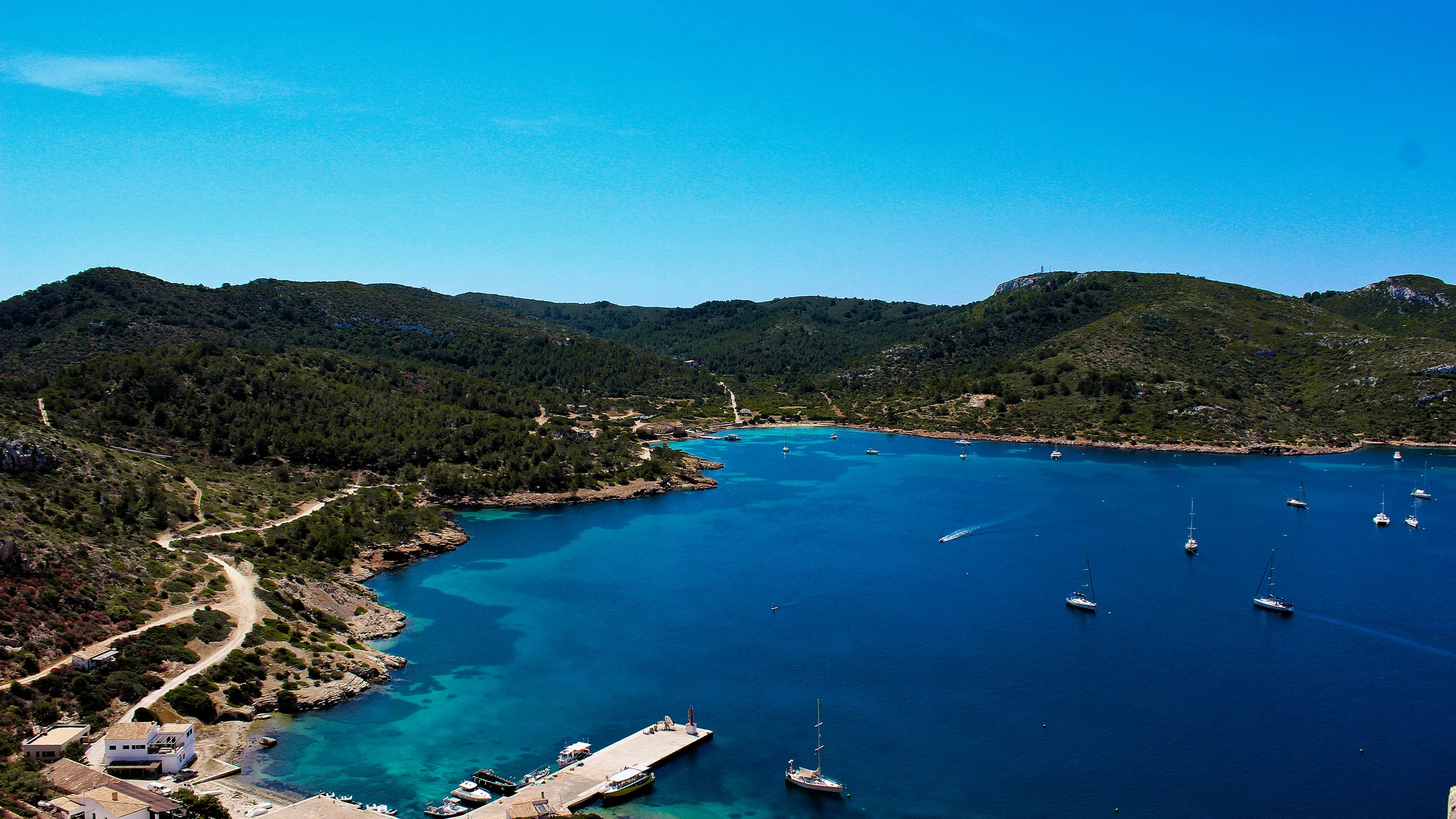
The Cabrera Archipelago National Park is the only maritime-terrestrial national park in Spain and the southernmost in the country. Located 17 kilometres south of the Mallorca coast, it groups the main island of Cabrera — 16 km² in area — and 18 smaller islets and rocks emerging from an exceptionally well-preserved seabed. The park in its entirety covers 10,021 terrestrial and 8,703 marine hectares, protected since 1991 by Law 14/1991, the first specific legislation for an insular national park in Spanish history.
The archipelago's seabed holds the densest and most extensive Posidonia oceanica meadows in the western Spanish Mediterranean. This marine flowering plant, whose leaves can reach one metre in length, forms meadows down to 30 metres depth that oxygenate the water, stabilise the sediment, and provide shelter and food to more than four hundred species of fish and crustaceans. The clarity of the water around Cabrera — with visibility of 30 to 40 metres for most of the year — makes diving and snorkelling exceptional: the Cova Blava, accessible only by rowing boat or kayak, offers a unique chromatic experience when Mediterranean light enters filtered from below, tinting the cave ceiling in an electric blue that shifts through the day.
The archipelago's birdlife includes colonies of Yelkouan shearwater (Puffinus yelkouan) and European shag (Phalacrocorax aristotelis) nesting on the cliffs of the islets of na Redona and l'Imperial. Eleonora's falcon (Falco eleonorae) uses Cabrera as a seasonal breeding ground: it arrives in spring from Madagascar and breeds on the coastal crags, timing its chicks' hatching to coincide with the August–September migration of small passerines, which it uses as food. The osprey (Pandion haliaetus) nests as a resident species in the archipelago, one of the few breeding points in the Balearic Islands.
Access to the national park is regulated to protect its ecosystem. Daily excursions depart from Colònia de Sant Jordi, 45 kilometres south of Palma de Mallorca, with a visitor limit of 200 people per day on the main island. The ferry takes approximately one hour to cross the 17 kilometres; during the crossing it is common to spot bottlenose dolphins (Tursiops truncatus) and loggerhead turtles (Caretta caretta) at the surface. The only permanently inhabited settlement is the minimal military garrison at the Castillo de Cabrera and national park staff. The island has no tourist accommodation; overnight stays are reserved for private boats anchoring in the bay with a permit.