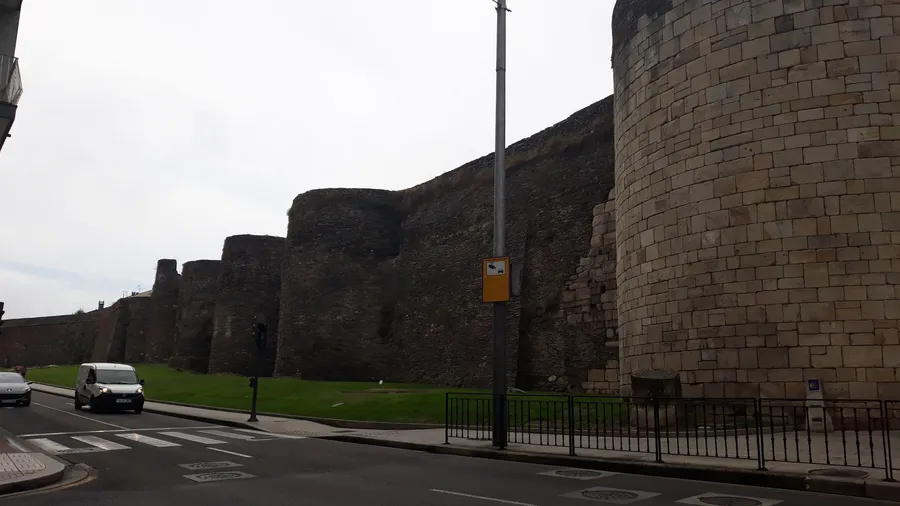
Highlights

  • • Over 2 kilometers of fully preserved perimeter
  • • 71 semicircular towers and 10 original gates
  • • Declared a UNESCO World Heritage Site in 2000
  • • Upper walkway with panoramic views of the historic center
  • • Built under Emperor Diocletian's mandate
  • • 3rd-century Roman defensive structure

Description

The Roman Wall of Lugo is a defensive structure built in the 3rd century AD that completely surrounds the historic center of Lugo, in Galicia. With a perimeter of over 2 kilometers, this wall is a tangible testament to the Roman presence on the Iberian Peninsula and is distinguished as the only Roman wall in the world to remain fully intact today. It was constructed to protect the city from potential attacks and control access, reflecting Lugo's strategic importance in Roman times.

Walking along the wall, you can observe its 71 semicircular towers and 10 original gates, many restored to preserve their historic appearance. The wall offers panoramic views of the old town, with its cobbled streets and historic buildings, as well as the urban and natural landscape surrounding the city. Strolling along its ramparts allows you to appreciate Roman engineering and the robustness of its walls, which reach up to 10 meters high in some sections.

Historically, the wall was built under Emperor Diocletian's rule, during a time when the Roman Empire was reinforcing its borders and cities against external threats. Over the centuries, the wall has witnessed various historical periods, from the Middle Ages to the present, adapting to urban and social changes without losing its original essence. In 2000, UNESCO declared the Roman Wall of Lugo a World Heritage Site, recognizing its historical and cultural value.

For visiting, comfortable footwear is recommended to walk the cobbled sections and to take advantage of the public access areas. Entry is free, and the tour can be completed in about 1-2 hours depending on pace and stops to enjoy the views. The wall is accessible to people with reduced mobility in some areas, though certain sections have stairs. No prior reservation is needed, and it is suitable for families and pets, always respecting conservation rules.

Key Information

Visit Duration

1-2 hours

Recommended Seasons

Spring, Autumn

Pricing

Free

Accessibility

Medium

Kid-Friendly Pet-Friendly No Booking Required

Guide

Essential information for visiting Roman Walls of Lugo

Location

In this area

Practical Information
Pricing
Free
Visit Duration
1-2 hours
Features & Services
  • Accessibility:Medium
  • Kid-Friendly:Yes
  • Pet-Friendly:Yes
  • Booking:No Booking Required
Planning Information

Recommended Seasons

Spring · Autumn

Best Time to Visit

Spring and autumn are the best seasons to visit the wall, with mild temperatures and fewer tourists, making for a comfortable and enjoyable walk.

Visitor Tips

To make the most of your visit, wear comfortable shoes and bring water, especially in summer. The wall has cobbled sections and some stairs, so plan your route according to visitors' mobility. Use the panoramic viewpoints to rest and take photos. Visiting early morning or at sunset can provide a quieter, more pleasant experience.

Historical Facts

Built in the 3rd century during Emperor Diocletian's reign, the wall protected the Roman city of Lucus Augusti. Its intact preservation is due to its integration into the urban fabric over centuries, preventing demolition and making it a unique example of Roman military architecture today.

Frequently Asked Questions

Get answers about Roman Walls of Lugo

Yes, the wall features an upper walkway that allows visitors to walk most of its perimeter on foot.
Some sections are accessible, but certain areas have stairs that limit full access.
No, visiting the Roman Wall of Lugo is free of charge.
Yes, pets are welcome as long as they are kept under control and site rules are respected.
The full route can take between 1 and 2 hours, depending on pace and stops.