Introduction
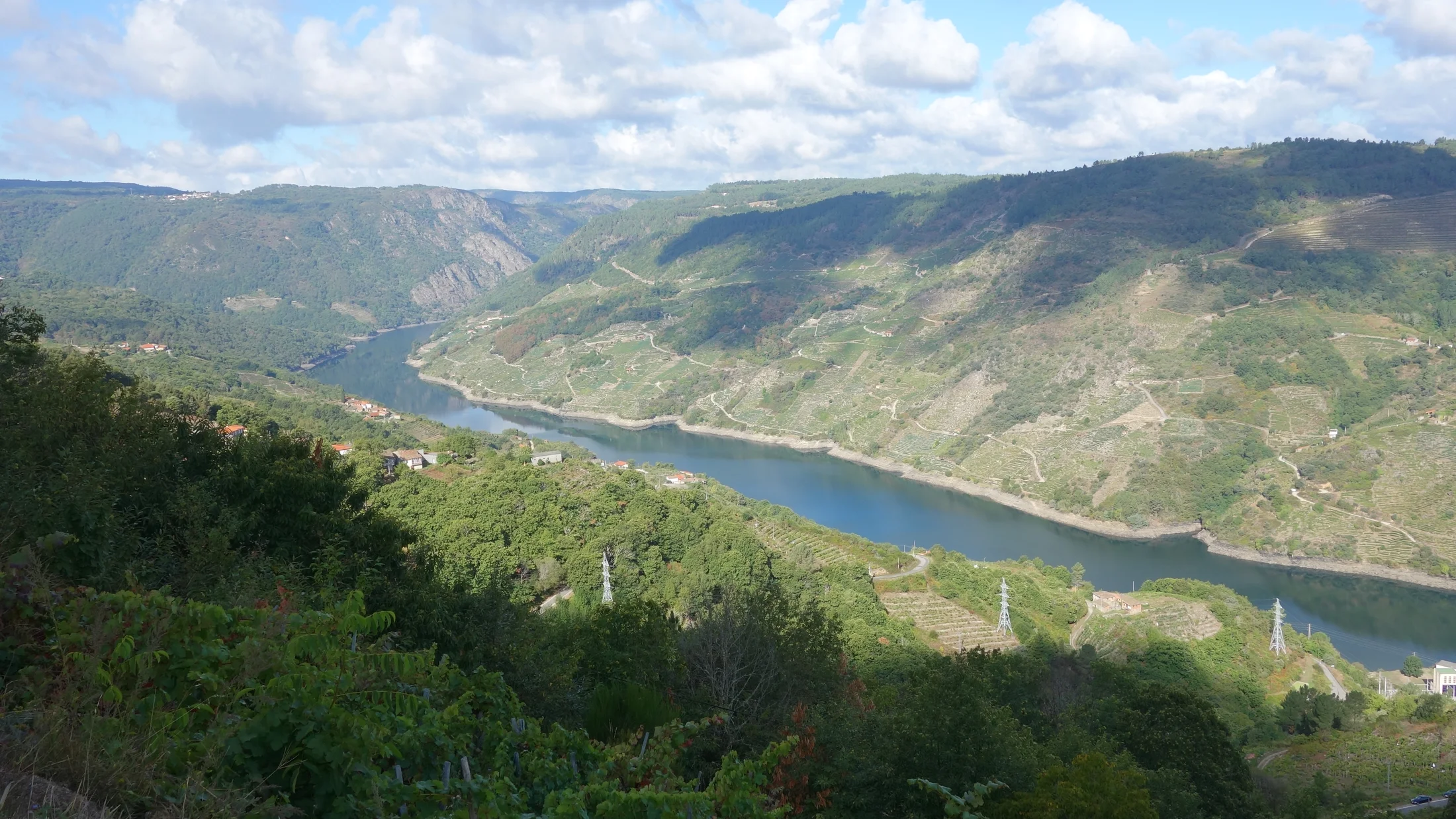
The river Sil has carved a canyon between terraced vineyards and Romanesque religious architecture. Exploring it by catamaran is to see that vertical landscape from the water, in the Ribeira Sacra.
The catamaran deck is low and stable, so the Ribeira Sacra is discovered in layers: dry stone walls, sloping hillsides and tranquil meanders. The engine sounds softly, the water laps against the hull and the sun illuminates the terraces.
The trip lasts as long as the shipping company specifies for each departure, so it is advisable to book your spot in advance and choose a time according to the light you want over the hillsides.
The Sil Canyon and the Ribeira Sacra in context
In the Sil Canyon, the slopes exceed 300–500 metres of accumulated elevation, with more than 500 metres in some points. This elevation explains why the landscape is better understood from the river than from the road.
The Ribeira Sacra comprises the banks of the Cabe, Sil and Miño rivers. It has been a wine Denomination of Origin since 1996, with five subzones: Amandi, Chantada, Quiroga-Bibei, Ribeiras do Miño and Ribeiras do Sil. Additionally, it was declared a Biosphere Reserve on 15 September 2021 and is a candidate for Unesco World Heritage.
Heroic viticulture, cultivation on terraces with steep slopes and manual labour, has shaped the landscape for centuries. In the early hours, the green and slate-like reflection on the water is only broken by the flapping of a grey heron.
The boat trip allows you to perceive proportions, textures and slopes that can only be sensed from the road, so book your spot in advance if you are going during high season.
What you will find here
A catamaran sails slowly between slate walls and terraced vineyards: that is how the Sil Canyon looks.
Here you have the guide to planning that trip: the best times, the embarkation points and how to get there from Ourense, Lugo or Santiago. You will also find specific routes through the Sil, from the short sunset trip with a tasting, with tips to choose according to the kind of traveller you are: with little ones, with a camera or with a craving for wine.
The guide is completed with Ribeira Sacra wineries open for visits, grape harvesting experiences and pairings, and with the key viewpoints. At the end, practical tips to enjoy the trip without rushing, with safety and respect for the environment.
If you are looking for a similar trip on another coast, you can book a catamaran.
Picuco te puede ayudar
Does something here catch your eye?
Tell us.
Write to us on WhatsApp or email: we answer questions, find the best options and help you sort out the booking.
The essentials for planning your Sil Canyon by catamaran
Planning the Sil Canyon by catamaran is about coordinating the river, the road and the wineries without missing the important things. With good information, you can adjust your timing and enjoy the visit at your own pace.
The landscape of slate and vegetation changes with the season: the scent of bay laurel after the rain and hot slate in summer.
Where it is and how the territory is organised
The Sil Canyon is nestled between the provinces of Ourense and Lugo, with banks dotted with parishes and piers in municipalities such as Sober, Parada de Sil, Nogueira de Ramuín or Monforte de Lemos. The Ribeira Sacra groups together the Sil and Miño valleys, and in the most narrow stretch of the Sil, navigation takes place over the Santo Estevo and San Pedro reservoirs.
The usual boarding points are the Santo Estevo (Nogueira de Ramuín) and Doade/Os Chancís (Sober) piers. You cannot reach the Santo Estevo pier by car: there is a designated car park about 200 metres away.
To organise your day, keep these road distances in mind: Monforte–Doade 14.5 km (23 min) and Lugo–Sober 75–90 km (1 h 30 min). Carry offline maps on your mobile and use map apps or cartography from the Instituto Geográfico Nacional for secondary tracks.
From the water, the geography fits together: walls, vineyards, granite quarries and patches of sweet chestnut stitch both banks together.
When to go: climate and seasons
Autumn tints the vineyards in ochre and garnet between mid-October and early November. If you are interested in the grape harvest, late September usually concentrates the activity.
In winter, low mists appear at sunrise and there are fewer people, although there are also fewer frequencies and days with cold wind. For photography, look for the early hours or the sunsets of May and September.
On deck, the breeze tastes of river and warm stone when evening falls. Book your trip in advance in summer and on autumn weekends, and bring a layer of clothing even if the day is clear.
How to get there and boarding points
The N-120 is the road that links Ourense and Monforte de Lemos with the Sil. By train, Ourense has AVE from Madrid (around 2 h 15–30 min). Monforte de Lemos functions as a regional railway hub.
Regional buses connect Ourense–Parada de Sil and Monforte–Sober with varying frequencies. Check updated schedules on Monbus or with local companies before setting off.
The Sil piers are Santo Estevo (Nogueira de Ramuín), Abeleda (Castro Caldelas), Ponte do Sil (Monforte de Lemos) and Os Chancís (Sober). From Os Chancís, routes for 12 people depart at 18 €.
Routes depend on the water level of the reservoirs and may be cancelled. For a boat trip on the Sil, arrive 20–30 minutes early: the bends, limited parking and access via tracks can delay you. In the early hours, the cold railings of the pier wake up your hands.
Where to sleep according to your plan
- Monforte de Lemos: regional railway hub with a historic centre, restaurants and pulperías.
- Sober and Doade (Lugo): the Doade/Os Chancís piers are in Sober.
- Parada de Sil and Nogueira de Ramuín (Ourense): rural accommodation and small hotels on the edge of the canyon, with quick access to viewpoints.
Advantages of staying near the boarding point: less driving and more margin for boat schedules and tastings. Advantages of staying in a larger hub: restaurants, supermarkets and cultural offerings. In high season (July–September and long weekends), book at least 2–4 weeks in advance and confirm cancellation policies. As night falls, an almost monastic silence envelops the valleys.
Catamaran routes through the Sil Canyon
Choosing a route means deciding on intensity, light and available time. The river is in no hurry and neither should you be. The boat's wake draws a white line over the dark green.
There are three types of departure and each one calls for a different traveller. The short or panoramic route lasts 40–60 min, without stops, and is perfect for families with children and tight schedules. You can see terraces, walls and cliffs, and it works best with morning light or late in the day.
The standard route with stops lasts 2–3 h, with stops at piers and viewpoints. It is the option for curious travellers and hikers, with vineyards, viewpoints and heritage in sight, and works best with morning light.
The themed route with tasting is chosen by photographers and wine lovers, and shines with sunset light: golden light, tasting and silence.
Before booking, check how much time you have and what time the boat departs. If you are going with children or have little margin, the short departure leaves the rest of the day free. If you want to get off at piers and viewpoints, book the standard one in advance during high season.
Short route: panoramic cruise
Forty to sixty minutes of tranquil navigation through a central stretch of the canyon: the panoramic catamaran cruise is the option for those short on time. It departs from the Os Chancís pier, in Sober (Lugo), and operates from March to October, closed on Mondays.
The catamarans are usually covered, with an open section for photos, and access is comfortable for families. A glass of D.O. Ribeira Sacra wine is included on board. On hot days, the shade of the awning and the breeze ease the journey.
For photos, sit on port side on the way out to capture south-facing terraces and switch to starboard on the return. Arrive in advance to choose side seats and bring a 70–200 mm telephoto lens to isolate walls and vineyards. Ask for the commentary or the guide on board to understand the sub-zones and the history of the canyon.
Pets are not allowed on board and children must remain seated during the journey.
Standard route: visit with stops and explanation
The standard route navigates a stretch of the reservoir and makes one or two stops at piers or access points to nearby viewpoints. On board, a guide explains what you see.
The usual plan is to sail up the reservoir, discuss heroic viticulture, disembark to see a viewpoint or a small marked path and return. During the crossing, the reading of the territory is explained: terracing techniques, varieties (Mencía, Godello, Brancellao) and the toponymy of every bend.
From the river, you can see stone steps, rails for taking out baskets and small cabins; from the viewpoint, the river looks like a silk ribbon.
If you are travelling with children, confirm the gradients and times of each stop to adjust footwear and water.
Thematic route: sunset, photography or with wine tasting
The side lighting of the sunset accentuates textures and colours, which is why it is the preferred outing for those photographing the canyon. The schedule is adjusted to the local sunset, so it is advisable to check MeteoGalicia before setting off.
In silence, the red autumn hillside burns when the sun brushes against the slate. For photography, bring a polarising filter to control reflections and light clothing even in summer.
Some outings include a glass on board or are paired with a subsequent visit to a vineyard or a winery. There are also premium experiences with small groups and a guide specialised in landscape or enology.
These variants are advertised mainly during high season and harvest: book in advance and confirm if there are places on deck.
Wineries and wine tourism: heroic viticulture in the Ribeira Sacra
In the Ribeira Sacra, wine is understood from the valley and from the river. The wineries in the area live clinging to those hillsides, and visiting the vineyard before tasting a glass places you right inside the landscape that produces the wine.
The visit to the vineyard and winery is accompanied by aromas of must, damp stone, and wood. Book in advance if you go during the harvest season, and allow half a day for the walk through the vines and the tasting.
Heroic viticulture: what it is and why it matters
The term is promoted by the CERVIM organisation and also encompasses terraced slopes, high altitudes, and plots inaccessible to machinery.
In the Ribeira Sacra, that work translates into terraces supported by dry stone walls, narrow paths, and manual harvesting with carrying. The river breeze brings a slight metallic and vegetal scent when the vine shoots are pruned.
That effort explains the planting densities, the moderate yields, and the fresh wines with a mineral identity. From the catamaran, you can see the logic of the system: south-facing orientation for ripening, walls to retain soil and heat, and ventilation corridors that dry the mists.
Understanding it increases the respect for every bottle and for those who care for hillside after hillside. If you do the route by catamaran, look at the terraces on the shore while you sail: the explanation is better understood with the hillside in front of you.
Featured winery 1: representative visit and tasting
A winery with a visitor centre is the simplest way to understand the heroic viticulture of the Ribeira Sacra. The typical visit includes a tour of the storage and barrel room, an explanation of the sub-zone (Amandi or Ribeiras do Sil, for example) and a tasting of 2–4 wines.
The indicative price is €10–20 p.p. for a basic visit and tasting, and €20–30 if it includes a nearby vineyard or an aperitif. Book in advance at picuco.com. These wineries usually coordinate schedules with river outings, so you can sail in the morning and taste at midday, or vice versa.
The cool silence of a stone winery relieves the heat after the river. If you are travelling without a car, ask about local taxis or arranged transfers.
When booking, ask about the language of the visit and the group size, if the tasting is seated and its estimated duration, and if they sell at the winery and offer shipping. When visiting, pay attention to the soils (slate, granite, or a mix), which condition the aromatic profile, and to the type of fermentation: stainless steel versus wood or concrete.
Featured winery 2: terrace tour and field experience
In Amandi and Ribeiras do Miño, some wineries open their terraces so you can walk between stone walls and finish the visit with a tasting at a natural viewpoint. The walk is guided and explains why each terrace faces south or west depending on the meander, how the walls retain soil and heat against erosion, and what role the tracks and windlasses played in the historical transport of the grapes.
Wear shoes with grippy soles and bring water, and avoid harvest days if the winery does not have them planned. In September, you can hear scissors, baskets, and laughter going up the rails.
Many estates are less than 20–30 minutes by car from the piers. Coordinate your catamaran route landing and add half an hour of margin to arrive without rushing.
Beyond the river: monasteries, viewpoints and activities
The Sil Canyon is the gateway, but the Ribeira Sacra continues inland with Romanesque architecture, oak groves, and villages with their own pace. The distant bell of a monastery marks slow hours, much like the river.
That is why it is worth booking an extra day for the trip. With that day, you can visit monasteries, viewpoints and activities beyond the river and complete the visit without rushing.
Emblematic monasteries and religious heritage
The nickname "sacra" comes from the number of medieval monasteries and hermitages scattered throughout the Sil valleys. One morning of sailing and one afternoon of temples are enough to understand why.
Santa Cristina de Ribas de Sil, in Parada de Sil, is a Romanesque jewel surrounded by centuries-old sweet chestnuts. Check the opening times before going: they vary by season and it usually closes at midday.
In Pantón, the San Miguel de Eiré complex and the Mosteiro de Ferreira de Pantón are witnesses to the Romanesque style of Lugo. Ferreira de Pantón, known as the "monastery of the Benedictine Mothers", is the only active female Cistercian monastery in Galicia and is located on the outskirts of the Ferreira hamlet.
It has the Cloister of the Knights and the Cloister of the Nursery, both Renaissance, as well as a Romanesque church and cloister called "of the Bishops". Today it operates as a Parador.
Inside the temples, the stone gives off coolness and smells of wax and humidity. Set aside time to stroll through the cloisters and nearby paths, and spread the visit between one or two temples per afternoon.
Essential viewpoints: views from land and from the river
From land, you can understand the total layout of the Sil Canyon; from the catamaran, you feel its height. The viewpoints provide that first perspective, the one the river does not provide.
On the cliff of Parada de Sil are the "Balcones de Madrid" (Os Torgás). Park in the designated area and walk 200 m along a dirt path to the viewpoints; you can also arrive on foot from Parada de Sil, about 1 km. Arrive early or at sunset to avoid crowds and have side lighting.
Cabezoás, also in Parada de Sil, looks at the riverbed from another ridge. Watch the edges and follow the railings.
On the Lugo side, Santiorxo and Pena do Castelo, near Doade, frame the Amandi terraces with the river in the background. Wear footwear with good grip and pay attention with children. Pena do Castelo is at an altitude of more than 600 m and 400 m above the level of the Sil river, above an ancient Castro settlement on the promontory.
To reach Pena do Castelo from Sober, drive for 25 minutes via the LU-P-5903 towards Doade; at the junction with the LU-903, continue straight towards the viewpoint and advance another 300 metres.
The wind at altitude smells of resin and rock thyme. For photos, a polariser and a lightweight tripod help with detail without blowing out the skies.
Complementary activities: hiking, kayaking and village visits
Next to the Sil viewpoints, there are short marked routes, 30–90 min long and with moderate elevation gains. They are the simplest way to stretch your legs before or after navigating.
Some sections of local paths pass through vineyards. Do not step on the terraces and respect private estates.
For the water, local companies rent kayaks and SUPs and offer guided routes on sections of the Sil and the Miño. The reservoirs have calm conditions and the best hours are in the morning, without wind. The level is for beginners: a life jacket is mandatory and a helmet is optional.
On land, Monforte de Lemos has a historic centre, Keep Tower, restaurants and pulperías. Castro Caldelas, declared a Historic-Artistic Site in 1998, adds a castle, narrow streets and views, and is a good complement if you sleep on the Ourense bank. Inside the castle, the Clock Tower, the Keep Tower and the courtyard of arms stand out. The Church of the Virgen de los Remedios, a 16th-century Renaissance building, functions as a Municipal Museum and has an atrium with a viewpoint.
The gastronomy of Castro Caldelas revolves around Caldelá breed meat, cured ham fed with chestnuts and bica sponge cake.
You can combine navigating in the morning, a short walk to a viewpoint and a late lunch, or reverse the order to see the sunset from the river.
Practical tips for enjoying the Sil Canyon by catamaran
The day in the Sil Canyon is won with margin: the road mixes river sections and curves. Alternate those sections calmly to avoid waits and scares.
Book in advance and arrive at the pier in time so you do not miss the catamaran departure. At the pier, the smell of sunscreen and pier wood announces the start of the day.
Safety on board and in nature
Boat trips through the Ribeira Sacra operate with safety measures: life jackets available, railings, and trained crew. Follow the staff's instructions, keep children seated during manoeuvres, and do not lean beyond the railings to take photos.
On deck, wear non-slip footwear and keep your hands free. Use a strap for cameras and mobiles.
At the viewpoints, walk along the marked paths and respect the railings: the edges can be unstable. In the vineyard, do not climb onto the terraces without a guide: the walls degrade with footsteps and can give way.
In the heat, hydrate frequently and protect your head; on windy days, dress in layers. The river smells different when the wind changes: stay alert for signs of rain or storms.
Bookings, prices and how to choose
The short 40–60 min route and the standard 2–3 h route with stops have indicative prices; from the Os Chancís pier, there are routes for 12 people for 18 €.
To choose, think about who you are travelling with and what you are looking for:
- If you are travelling with little ones, a short morning trip with guaranteed shade.
- If you prioritise the photo, a last-minute or sunrise route.
- If you are interested in wine, a standard route with an explanation or a themed route with a tasting.
Bring a digital copy of your ticket and arrive 20–30 minutes early. Confirm the exact location of the pier: some have several access points via tracks.
What to bring: practical checklist
On the Sil Canyon catamaran, the wind and sun change quickly, so clothing and protection weigh more than luggage. Prepare a small bag with the essentials and you will have the day sorted.
Bring your documentation and tickets on your mobile. Dress in layers, with a lightweight windbreaker even in summer, and use non-slip footwear with treaded soles. For the sun, a cap, SPF 30+ cream, and polarised sunglasses.
Add water, a snack, and a bag for your waste. Camera or mobile with a strap and a power bank, and a small dry bag for sensitive objects. Avoid single-use plastics and do not throw anything overboard.
If you are going for a short walk after disembarking, add lightweight walking poles and a small first-aid kit. The feel of the pier rope, rough and salty, reminds you that the river rules here.
Frequently asked questions
How long does a typical catamaran trip through the Sil Canyon last?
The duration depends on the mode you choose. Short or panoramic trips last 40–60 minutes and sail through the most scenic stretch without stops.
Standard routes, with an explanation and some stops at piers or viewpoints, take 2–3 hours. They are perfect for understanding heroic viticulture and stretching your legs.
To plan, add 30 minutes beforehand to park and board, and 15–20 minutes afterwards in case there are departure queues. With children, the trip fits well in the 11:00 to 12:30 slot, avoiding the peaks of heat.
The wake disappears in seconds, but the image of terraces hanging like amphitheatres remains.
Is it accessible for people with reduced mobility?
Many catamarans have ramps, wide walkways and interior space for wheelchairs, but not all piers are equally prepared. Before booking, confirm with the operator the type of access to the pier (ramp or stairs), if there are adapted toilets and the height of the walkway according to the reservoir level.
Nearby viewpoints also vary: some can be reached by vehicle with very short stretches and others require climbing irregular steps. If you need assistance, let them know in advance and ask for priority boarding.
On deck, the swaying is gentle and the staff helps with manoeuvres. To resolve doubts, the tourist offices of Sober, Parada de Sil and Monforte de Lemos are open in July and August from Tuesday to Sunday from 9:30 to 14:30, and the rest of the year from Tuesday to Saturday from 9:30 to 14:30.
Can I combine the catamaran trip with winery visits on the same day?
Yes, you can do the catamaran trip and visit a winery on the same day. It is one of the best ways to understand the Ribeira Sacra.
With those timings, a practical option is a morning trip of 40–60 minutes, a light lunch and a visit to the winery in the early afternoon. If you are looking for sunset light on the river, reverse the order.
If you want wine tourism at a relaxed pace, consider staying near Sober/Doade (Sil side) or Pantón/Chantada (Miño side) and splitting both experiences over two days. And if the tastings are generous, bring a designated driver.
What happens if the weather prevents the catamaran trip?
With strong winds, thunderstorms or compromised safety conditions, operators usually apply cancellation or rescheduling policies. It is common to offer a change of time or date, or a refund if it is not possible to sail. Check the specific conditions before paying.
If it wakes up with dense fog, some departures are delayed until visibility improves. With low fog, the canyon becomes a theatre of shadows and silhouettes. On days with fine rain, bring a waterproof jacket and you will be able to keep the booking.
MeteoGalicia and AEMET help you predict the scenario 24–48 hours in advance. If navigation is cancelled, take the opportunity to explore the land: monasteries, viewpoints accessible by car or a tasting in an indoor room.
What is the best time to see heroic viticulture and the grape harvest?
The vineyard changes from green to ochres and reds between mid-October and early November: that is when the terraces have their maximum colour. In May and June, on the other hand, the flowering and more vivid greenery accompany long days and mild temperatures.
The grape harvest is usually concentrated between late September and early October, depending on the subzone and the annual climate. During those weeks there is more activity on the slopes and some wineries limit visits.
If you want to take photographs, look for the early hours and sunsets with light mist. From the river, the contrast with the water multiplies the effect. The grape harvest basket hitting against the slate marks the ancestral rhythm of the Ribeira Sacra.
If your priority is to sail calmly and find open wineries, September and May are the most suitable months.
Book your experience — discover active tourism activities in Spain with providers verified by Picuco.
Conclusion
The catamaran lets you see the Sil canyon from the inside. The short route covers the essentials, the standard one adds viewpoints and context, and the themed one focuses on light and wine.
Complete the day with a winery on terraces, a Romanesque monastery and two viewpoints, one on each bank. Plan your access, book in advance during high season and travel light, respecting walls and paths.
With two days you have plenty of margin. Day 1, morning sailing, lunch in the village and an afternoon of monasteries. Day 2, vineyard on terraces, lunch and a sunset stroll on deck.