Hiking near Madrid: quick escapes less than an hour away
Why look for nearby routes?
Less than 60 minutes from the M-30, there are mountains, pine forests and reservoirs for half-day, full-day or weekend plans. This proximity works in favour of families, beginners and anyone who wants to head out after work in spring or autumn.
The Sierra de Guadarrama concentrates ridges and glacial cirques, with moraines and glacial lagoons above 1900 m altitude. Further south, pine forests and pastures provide shade and flat paths alongside rivers and dams. It smells of resin when crossing the pine forests and the wind brings the murmur of water when approaching the reservoirs.
Several reservoirs have perimeter tracks for walking or light running. With all this on the table, the goal is to decide quickly: which route to choose based on available time and level, and how to get there by car or public transport from Madrid.
How we select these 10 routes
Ten routes less than an hour from the centre of Madrid, counting from Puerta del Sol or the M-30 and with traffic on your side. All have good signage and some alternatives designed for beginners.
We look for a variety of landscapes: granite mountains and ridges, pine forests with shade and easy paths alongside reservoirs. The difficulty ranges from easy to moderate, with durations of 1.5 to 5 hours, services nearby and clear parking.
We also look at public transport access where it exists, via Cercanías or intercity buses, and the appeal for different audiences. The clinking of poles on a wooden walkway sums up the idea well: choose the route that best fits your day.
Each guide includes location and starting point, distance, elevation gain and estimated time, difficulty and best time of year, access, transport and possible costs. We also add the ideal audience and what to do nearby to complete the day.
Picuco can help you
Does something here catch your eye?
Tell us.
Write to us on WhatsApp or email: we answer questions, find the best options and help you sort out the booking.
Write to us
We guide you based on the type of plan you have in mind and reply by WhatsApp or email.
Ten routes less than an hour away: mountains, pine forests and reservoirs
1) La Pedriza (Manzanares el Real): granite, river and gentle adventure
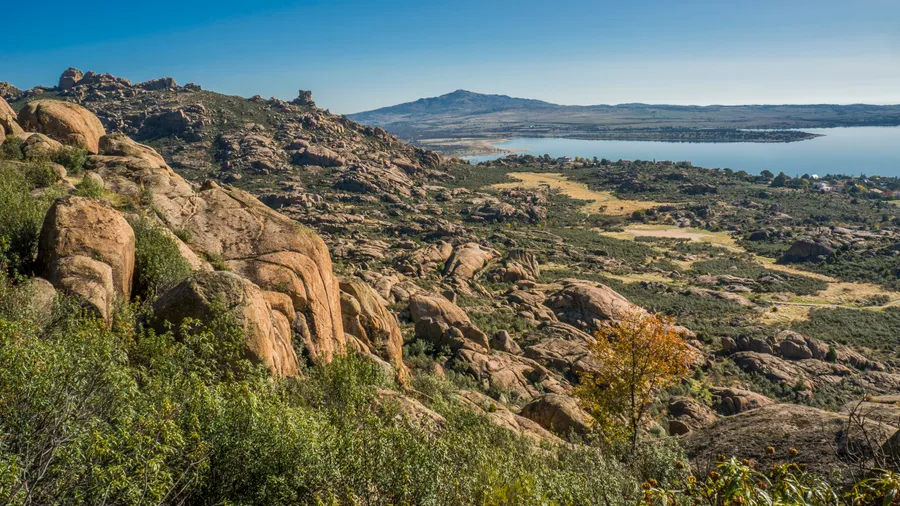
La Pedriza is the classic of the Sierra de Guadarrama: granite boulders, rockrose and pools of the Manzanares, with Charca Verde as the destination. It is in Manzanares el Real, about 50–60 minutes from the M-30.
The short circular route leaves from Canto Cochino towards Charca Verde and returns via the opposite bank. It is 4.8 km with 500 m of elevation gain, easy-moderate difficulty and scree terrain. The path is comfortable, with stony sections, and is great for families with children already used to walking.
Private cars have a limit: 270 vehicles per day at the La Camorza barrier. In Canto Cochino there are 10 bus spaces with prior reservation. At certain times of the year, a shuttle bus runs from Manzanares el Real to Canto Cochino; you can also arrive in intercity buses to the village and take a local taxi to the start. In June, July, August and September, you cannot park overnight, from 23:00 to 07:30.
Go in spring or autumn; in summer, get up early to avoid the heat. It is a route for photographers, families with older children and anyone looking for hiking near Madrid with a forest bath.
2) Siete Picos (Puerto de Navacerrada/Cercedilla): accessible panoramic ridge
The Siete Picos ridge runs through the Sierra de Guadarrama between reddish blocks, with views of Alto de Guarramillas and Cuerda Larga. Its highest point is Somontano peak, at 2,138 m.
You can do it as a round trip along the ridge from Puerto de Navacerrada, thus avoiding the aerial passes. If you want to extend the route, set off from Cercedilla. The classic Siete Picos itinerary starts from Puerto de Navacerrada and covers about 9.8 km with approximately 550 m of accumulated elevation gain.
It covers 8–10 km, 4–5 h and an elevation gain of +450–600 m. The difficulty is moderate, with rocky sections that require attention: avoid the Senda Herreros if you do not have experience in scrambling.
Spring and autumn are the best seasons. In winter, snow and ice mean you should only go with equipment and experience. Wear footwear with good grip and a windbreaker even in summer.
The mountain pass car park is limited on weekends, so arrive early or go up by public transport. The route is suitable for hikers with some experience and for those looking for panoramas; the sunset from the ridge is a special moment.
3) Laguna Grande de Peñalara: glacier and gentle high mountain
Laguna Grande de Peñalara is a glacial remnant at over 2,000 m, which you reach via a marked path through broom shrubs. Part of the way goes via boardwalks to protect the peat bog.
The route starts at the Puerto de Cotos car park and follows the Cotos – Mirador – Laguna Grande itinerary, returning via the same path. It is 6–7 km, between 2.5 and 3.5 h and 290 m of positive elevation gain. The difficulty is moderate due to the altitude and the sustained slope.
The light reflects on the water like a dark green mirror and the wind brings the scent of blooming juniper at the end of spring. It is an outing that works well for photographers, families used to walking and lovers of the mountain of Guadarrama with natural value.
The car park has limited capacity and fills up early on weekends.
In winter, go up only with light crampons, poles and experience. The lagoon has a fence to prevent people and livestock from accessing the water, and the National Park asks that you do not leave the path, do not swim and do not step on the peat bogs.
4) Santillana Reservoir (Manzanares el Real): walk by the water and castle
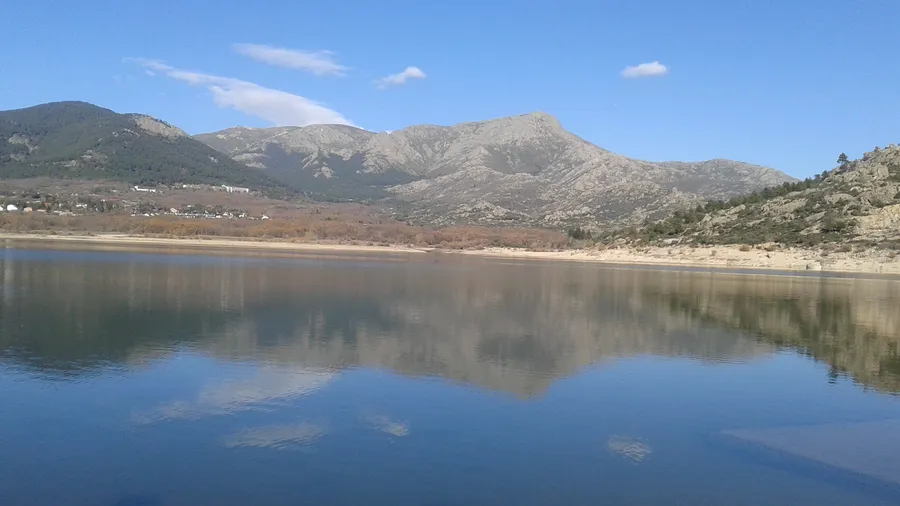
The Santillana Reservoir can be explored via flat tracks and paths, with La Pedriza and the Castillo de los Mendoza always in sight. It is located in the surroundings of Manzanares el Real, about 50–60 min from Madrid.
The route is practically flat and of easy difficulty.
The route is great for families, for birdwatching and for relaxed runners. In the area, there is a large colony of white stork, and the flight of great herons breaks the silence.
Combine the walk with a visit to the castle, the local picnic areas and the reservoir viewpoints.
By car, take the M-40 (exit 57), continue via the M-607, the M-609 to km 5, the M-862 and the M-608. There are several informal car parks and those next to local roads: respect the signage. By public transport, line 724 leaves from the Plaza de Castilla Interchange and stops in Manzanares el Real.
It is a water supply reservoir, so do not swim.
5) La Herrería Forest and Felipe II's Chair (San Lorenzo de El Escorial): pine forest and history
La Herrería Forest and Felipe II's Chair form a cultural walk among ash, holm oak and pine trees. The path rises gently to a natural balcony overlooking the Monastery and the mountain range.
The route goes from the Monastery to La Herrería Forest, continues to Felipe II's Chair and returns to the starting point. The difficulty is low-moderate and the paths are well-defined. It is in San Lorenzo de El Escorial, about 50–60 min away.
You can arrive by Cercanías train to El Escorial and continue on foot or by local bus to the start. In the shade, the ground smells of pine needles and hot stone.
It is an ideal outing for families, for cultural hiking and for photographers. Take the opportunity to visit the Monastery, try local mountain dishes and visit nearby hermitages. In summer, avoid the middle hours of the day and bring water and sun protection.
6) Valmayor Reservoir (Valdemorillo/El Escorial): flat, long and serene
Valmayor Reservoir is 12 km long and covers 755 hectares, receiving most of its water from the Guadarrama River through a transfer tunnel. Its shoreline route runs between holm oaks and views of the Sierra de Guadarrama, with tracks and perimeter paths.
The route is flat, so you can walk at a steady pace or jog gently. The difficulty is easy: it is suitable for families and for those looking for simple routes near Madrid. It is also great for family walks, relaxed runners and gravel cyclists on the permitted sections.
On the way, you can see cormorants and little grebes, and there are shaded areas for picnics. In summer, it is best to go early in the morning or at sunset.
The reservoir is managed by Canal de Isabel II: swimming and navigation without authorisation are prohibited, and fishing requires a licence where applicable. Also respect the livestock enclosures in the surrounding area.
You arrive by car via the M-600 and the M.510, near the Las Zorreras Cercanías stop. There are several parking areas on rural tracks, and interurban buses to Valdemorillo and El Escorial with a walk to the start.
7) Schmidt Path (Puerto de Navacerrada): a classic that never fails
The Schmidt Path connects the Puerto de Navacerrada with La Fuenfría among Scots pine and scree slopes. It is a historic path, and its traditional signage consists of yellow dots on tree trunks, which are easy to follow on clear days.
The difficulty is moderate due to the stony ground in certain sections. You can return via the same path or descend to Cercedilla. It connects with the GR-10 and the Roman Road of La Fuenfría to create variations.
The best time is from spring to autumn. In winter, it is often covered in snow, so avoid blizzards.
You arrive at the start by car via mountain road, about 60 min during off-peak hours to the Puerto de Navacerrada; parking is limited on weekends and public holidays.
8) El Pardo Mountain: nature right next to the city
Deer, wild boar and birds of prey live just half an hour from Puerta del Sol. El Pardo Mountain is a protected pastureland and pine forest of high ecological value next to Madrid, an ancient royal hunting ground cared for for hundreds of years.
The routes are flat or have gentle undulations and are well marked, with distances of 4.6–7.6 km. The difficulty is easy: it is suitable for families, for walking with a pram and for observing wildlife from a distance. At sunrise, the air carries the scent of thyme and the golden light ignites the tops of the holm oaks.
You arrive in about 20–30 min from the capital and there are signposted car parks; it is not advisable to park on the verges. There are also urban buses from Moncloa with stops in the centre of El Pardo.
Respect the mountain rules: dogs must always be on a lead, do not stray from the paths and do not feed the wildlife.
9) Guadarrama River river path (West zone): flat, green and family-friendly
The Guadarrama River river path runs through a flat and shaded stretch of walkways and paths between Villaviciosa de Odón and Boadilla/Brunete, within the Guadarrama River Middle Course Regional Park. You can walk without rushing, on a relaxed bike ride or with little ones and grandparents.
The route is 6 to 12 km long and takes 1.5–3.5 h to complete. The difficulty is very easy, so it works well as a family outing near Madrid. After the rain, the path smells of poplar and riverbanks.
There are several entrances with parking; it is advisable to check the Regional Park information boards. It is a route for families, for a gentle bike ride and for walking with your dog on a lead.
10) San Pedro Hill (Guadalix/Colmenar) or Cercedilla viewpoints: quick views with little effort
Two express summits for when you want views without spending the whole day walking: San Pedro Hill or the Poets' Viewpoint from Cercedilla. The first is a short but sustained climb, with panoramas over the mountains and the northern reservoirs. The second option goes through gentle paths among pines.
San Pedro Hill reaches an altitude of 1425 metres and from the top you can see the Santillana Reservoir, La Pedriza, Sierra de la Cabrera and Madrid. The route starts at km 7.5 of the M-625 road. In Cercedilla, the route is circular, 9.3 km long up to the Poets' Viewpoint, and starts from the Majavilán spring car park.
It covers 5–7 km and +350–600 m of elevation gain, with San Pedro Hill being the more demanding option. The duration is around 3-4 h. The difficulty is easy-moderate in Cercedilla and moderate in San Pedro due to the slope. The wind hits your face and brings the scent of rockrose as the view opens up 360 degrees.
You can go all year round, avoiding the heat and strong winds. It is an ideal outing for photography at sunrise and sunset. Bring poles for the descent and a windbreaker in any season.
Car parks are limited. In San Pedro, respect private entrances and do not invade the verges. By public transport, the Cercanías train reaches Cercedilla with the C8 and C9 lines of Cercanías Madrid and Medium Distance services: the C-8 has a train every 30 minutes and the C-9 has between four and five trains daily in both directions.
Where they are and how long it takes: map and times from Madrid
San Lorenzo de El Escorial is 57 km away and takes an estimated 43 min from Puerta del Sol. As you get out of the car, the scent of pine and the shimmer of the water welcome you.
The map is read by colours: grey for the mountains and rock, green for pine forests and pastures, blue for reservoirs and rivers. Times vary due to roadworks, weather, and weekend congestion, so leave early and have a plan B.
If an interactive version is made, each pin could carry the basic information from the fact sheet, the nearest car park, and a link to coordinates for the navigator.
Practical tips to choose your route and get it right the first time
With 2–3 hours ahead of you, look for flat terrain with shade: El Pardo, Valmayor or mid Guadarrama. If you have 4–5 hours, climb gentle ridges like Siete Picos for a round trip or complete the perimeter of a reservoir.
Mark the difficulty as "easy" if you do not exercise often and "moderate" if you already do 10–15 km weekly and are comfortable with elevation changes. If it is hot or windy, switch to wooded options or descend to a lower altitude.
By car, get up early and take a plan B if the car park fills up: the mountains fill up early. By public transport, the Cercanías trains to Cercedilla and El Escorial offer good options, and the buses to Manzanares, Navacerrada or El Pardo run well on weekends.
Wear footwear with gripped soles and carry poles on routes with scree. Calculate 0.5–1 l of water per hour of activity, more in summer, and add sun protection and a cap all year round. A windbreaker doesn't hurt in the mountains, even in August.
Download an offline map or a reliable track and do not improvise off-trail. In summer, get up early, look for shade and avoid ridges during the middle hours. In winter there is snow and ice at high altitudes: carry microspikes if there are ice patches. Autumn and spring offer better general conditions and fewer afternoon storms.
Respect the signage: swimming in supply reservoirs is prohibited. Dogs must always be on a lead, because sensitive wildlife and livestock share the path. Do not leave litter: carry a bag for your return.
For families, choose 4–8 km circuits with rest areas and shade, such as Santillana, mid Guadarrama or El Pardo. If you go with a dog, bring extra water, a fixed lead and bags, and avoid the hot hours and sharp terrain. To avoid crowds, visit during the week, enter through less obvious access points and set off early.
Frequently asked questions
Do I need a permit or pay to park?
On most routes, access is free. In areas with capacity limits, such as Canto Cochino, Cotos or the mountain passes, the car park fills up early and may require prior booking depending on the season.
How do I interpret the difficulty of a route?
An "easy" route is usually flat, with less than 300 m of elevation gain and good terrain. When you see "moderate", expect sustained slopes, scree or 400–700 m of ascent.
Adjust the difficulty to your fitness level, the heat and the altitude of the day. And keep in mind that descending over stones is as tiring as climbing.
Can I bring a dog?
Yes, you can bring a dog, but on a lead in protected areas and always under control. Avoid pools and supply reservoirs, and respect the local wildlife.
Carry extra water for the dog. On hot days, asphalt and stone burn paw pads, so choose cool hours and shaded sections.
Is there mobile coverage and signage?
In the mountains, mobile coverage may fail in valleys. Let someone know your plan and download the offline map before setting off.
The Schmidt Path and Peñalara are well marked, but fog or snow can cover the signs. Do not stray from the path.
In La Herrería there is hardly any signage, although the route is obvious and easy to follow. The difficulty is medium for people not used to walking.
Can you get there by public transport?
Yes, you can get there by public transport. Cercanías trains go as far as Cercedilla and El Escorial, and there are intercity buses to Manzanares el Real, Navacerrada and El Pardo.
Before setting off, check the weekend schedules and the last departures of the day. This way you avoid long waits when returning.
What do I do if the car park is full?
If you arrive and the car park is full, switch to another nearby route, use public transport from the nearest town or delay your departure until late in the day. Many of these routes have alternatives just a few minutes away by car.
Do not park in ditches or in livestock crossings: you could be fined and it makes it difficult for emergency services to pass.
Book your experience — discover active tourism activities in Spain with local providers.
Conclusion
Choose according to what you are looking for that day.
For panoramas, Siete Picos or Cerro de San Pedro. For shade and a peaceful walk, El Pardo or La Herrería. To combine water and easy kilometres, Santillana or Valmayor.
Set off early, with water and suitable footwear. If you want to extend the plan, complete the day with an interpretive tour or with a night in a nearby rural accommodation for a simple weekend.