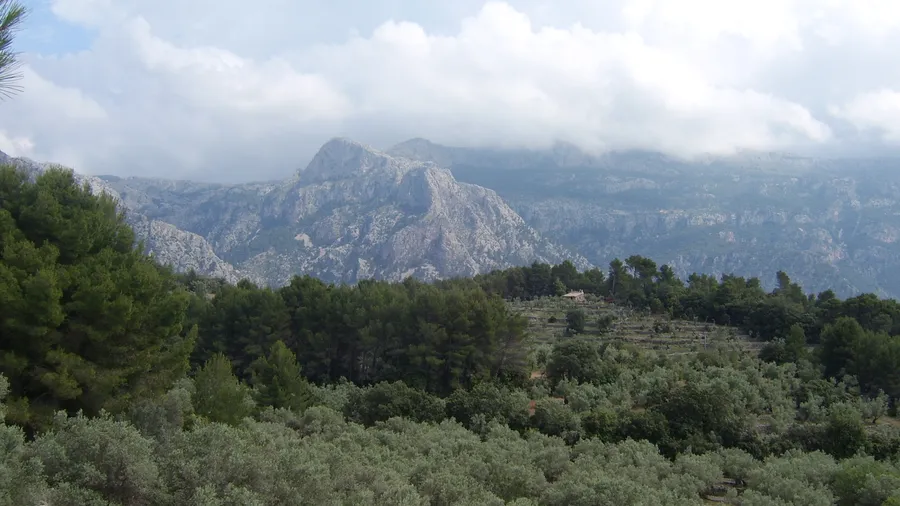
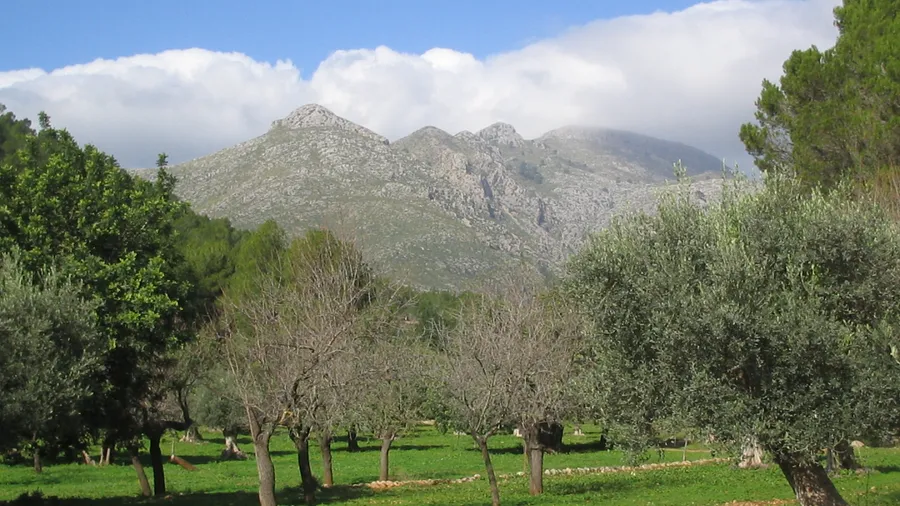
The Serra de Tramuntana is walked along a network of cobbled paths that the Consell de Mallorca keeps waymarked: the Ruta de Pedra en Sec GR 221 totals 261.1 km open and waymarked, of which 150.1 km are the main itinerary between Port d'Andratx and Port de Pollença. You can do it in stages, sleeping in the public mountain huts, or choose a classic one-day route. Here are the stages with their times and elevation gains, the best-known day routes, how to book the mountain huts and how to get around without a car.
Before you set off
Do not do the Torrent de Pareis when rain or storms are forecast: the stream can rise suddenly in flash floods. The Camí de s'Arxiduc from Valldemossa requires a prior permit from the Muntanya del Voltor reserve, and without confirmed access do not assume you can do it. The Tren de Sóller closes from 23 November 2026 to 1 February 2027.
The GR 221: the nine stages and how many days you need
The main itinerary of the Ruta de Pedra en Sec runs from the Port d'Andratx to the Port de Pollença in nine official stages. If you do one stage a day, the full traverse takes you nine days of walking. The highest point on the route is the Coll de ses Cases de Neu, at just over 1,200 metres. As well as the main line there are 111 km of waymarked variants (s'Arracó, Galatzó, Son Sanutges, the University, the Castell d'Alaró, Sa Costera, the Pas Llis and the Puig de Maria spur).
- Port d'Andratx–Sant Elm: easy difficulty, 9,150 m, 3 h 20 min and 372 m of cumulative ascent and 372 m of descent.
- Sant Elm–Estellencs: high difficulty, 24,741 m, 8 h 40 min and 1,010 m of ascent and 912 m of descent.
- Estellencs–Esporles: moderate difficulty, 14,404 m, 4 h 50 min and 670 m of ascent and 629 m of descent.
- Esporles–Can Boi: high difficulty, 23,120 m, 8 h 10 min and 1,325 m of ascent and 1,387 m of descent; the stage links Esporles, Valldemossa and Deià. The stretch that runs through the Son Cabaspre development is passable but not waymarked.
- Can Boi–Muleta: low difficulty, 9,902 m, 3 h 06 min and 362 m of ascent and 385 m of descent.
- Muleta–Tossals Verds: high difficulty because of the walking time and the elevation gain, 27,761 m, 9 h 05 min and 1,111 m of ascent and 696 m of descent; the Consell notes that the steep drop between the Coll de l'Ofre (900 m) and Sóller (30 m) makes the route faster in the Tossals Verds–Muleta direction.
- Tossals Verds–Son Amer: moderate difficulty, 15,131 m, 5 h 35 min and 869 m of ascent and 848 m of descent.
- Son Amer–Pont Romà: moderate difficulty, 17,450 m, 4 h 45 min and 189 m of ascent and 677 m of descent.
- Pont Romà–Port de Pollença: easy difficulty, 6,743 m, 1 h 25 min and only 2 m of ascent and 54 m of descent, from the Pont Romà mountain hut (53 m) to the Port de Pollença (1 m).
The Consell de Mallorca states that the GR 221, thanks to the island's climate, is practicable for most of the year. The network's mountain huts take guests every day with a prior booking. The network's high season runs from March to May: in that period in 2026 it received 17,443 visitors, 8% more than in the same period of 2025.
Picuco can help you
Does something here catch your eye?
Tell us.
Write to us on WhatsApp or email: we answer questions, find the best options and help you sort out the booking.
Write to us
We guide you based on the type of plan you have in mind and reply by WhatsApp or email.
Consell de Mallorca network mountain huts: booking, prices and services
The network has seven mountain huts on public estates (Galatzó, Tossals Verds, So n'Amer, Muleta, Can Boi, Pont Romà and Coma d'en Vidal) with a total of 264 places. Coma d'en Vidal, between Andratx and Estellencs, reopened on 10 June 2025 after more than three years closed, with capacity for 24 people in three rooms of 12, 8 and 4 places.
You book online on the Consell's official portal (seu.conselldemallorca.net/refugis) or by phone on 971 173 700, a maximum of 4 months and a minimum of 5 days in advance; after booking you receive a form by email and you have to transfer 80% of the cost of your nights. You can also submit the online application with payment or call 971 173 700 and 971 173 731, always between 5 days and 4 months before arrival.
The official listings publish these rates per person per night: shared dormitory 14 € (includes one shower), shared dormitory, up to 16 years, 9 €, bed linen hire 4.50 €, towel hire 2 €, breakfast 5.50 €, lunch menu 13 €, dinner menu 9.50 €, children's menu 5.50 € and picnic bag 8 €; the linked price ordinance is the one in the BOIB of 4 February 2017. The booking portal applies specific rates for users with a valid licence from the Balearic Mountaineering and Climbing Federation.
The mountain huts have shared dormitories and offer toilets, showers, electricity, hot water, heating, Wi-Fi, telephone and a fireplace, food and drink service, and bed linen and towel hire. The rules require you to sign in and register on arrival before 18:00 from 1 November to 31 March and before 19:00 from 1 April to 31 October, except in cases of force majeure. Doors close at 22:00 from 1 November to 31 March and at 23:00 from 1 April to 31 October; breakfast is served from 8:00 to 9:00, lunch at 13:30 and dinner at 20:30, and rooms must be vacated before 10:00.
Refugi de Tossals Verds
It stands on the Tossals Verds public estate (Escorca), at 525 m above sea level and on the GR 221, with 42 places in seven shared dormitories (one of 12, one of 10, one of 6, three of 4 and one of 2 places), a dining room and a meeting room. You reach it via stage 5 from the Muleta mountain hut and via stage 6 from the Son Amer hut, as well as via variant D (Castell d'Alaró) and variant F of the Pas Llis; there is a very limited parking area near the possessió (traditional estate) of Son Ordines and from there a waymarked path leads to the hut. There are no closures or access restrictions currently in force.
Classic day hikes
Torrent de Pareis
The Escorca town council's route sheet gives 8.46 km, 5 hours without stops, a difficulty rating of "Difficult", a start at les Cases d'Escorca (access via the Ma-10, km 25.9), a non-circular and unmarked route, with spring and summer as the recommended season. The Alpina "Tramuntana Norte" map guide puts it at 4 h and 600 m of elevation gain, with high difficulty. There are sections with scrambling up and down where you may need to use ropes; if you have no experience of this kind of route, it's advisable to go with a company of specialist mountain guides (a guide is not compulsory). The alpine guide calls for high-cut boots, good fitness and some mountain experience, and for safety it's worth carrying a 10 m rope, although it isn't essential.
The gorge is usually passable without a wetsuit from May to October and for about 10–15 days after heavy rain. If rain is forecast or there's a risk of storms, avoid the route entirely. On 5 April 2026 the Mallorca Fire Brigade warned of water build-ups and that the gorge "is not passable" without the right kit, including a wetsuit, after rescuing seven people the day before. The gorge is part of the Natural Monument of the torrents of Pareis, Gorg Blau and Lluc, declared by Decree 53/2003 of 16 May, and its planning falls under the park's natural resources plan (PORN) of the Serra de Tramuntana, approved by Decree 19/2007 of 16 March.
Puig de Massanella
The Escorca town council's route sheet starts at kilometre 14.8 of the Caimari to Lluc road, just before the Coll de sa Batalla. The summit stands at 1,364 m and is the second-highest peak in Mallorca. The final stretch is unmarked, guided by stone cairns over limestone pavement of loose, sharp rock, and near the summit there's a gap of several metres that means you must not stray from the cairns; there's no water to rely on along the route. The access road leads to the barrier at the Comafreda estate, where you have to pay the entrance fee; current rates are on the Puig de Massanella website. In the massif, 11 snow pits or "cases de neu" survive, declared an asset of cultural interest in the category of site of ethnographic interest on 8 March 2004.
Camí de s'Arxiduc from Valldemossa
This is a cobbled bridle path built on the orders of Archduke Ludwig Salvator in the 19th century, running high along the ridge above Valldemossa. The full circular variant, with the climb to the Puig des Teix (1,064 m), measures 14–16 km, with about 800 m of elevation gain and 6–7 h, and is rated demanding; the circuit without the summit is about 12 km, ~650 m and 5–6 h, and the short out-and-back to the ridge about 7 km, ~450–500 m and 3–4 h. A 15.01 km circuit from Valldemossa, going up via the Coma des Cairats and down via the Pla des Pouet, adds up to 790 m of positive elevation gain and 5 h 16 min in total, with a moderate grade by distance and elevation gain. You must request permission in advance from the Muntanya del Voltor reserve (private land belonging to Can Costa, Son Moragues, Son Gual and Son Gual Petit) and the permit is checked at the entrance barrier. From the centre of Palma, Valldemossa is 19 km away along the Ma-1110, about 35 minutes by car.
Barranc de Biniaraix
The Consell's official route sheet for the Camí Vell del Barranc de Biniaraix gives a circular route of 5,010 m starting and finishing at the plaça de la Concepció in Biniaraix (98 m), 421 m of ascent and descent, 2 h 22 min and low difficulty; it is not suitable for wheelchairs or pushchairs. The Camí des Barranc and Camí Vell del Barranc de Biniaraix paths are declared an asset of cultural interest in the category of Monument. From the Tren de Sóller station, the out-and-back to the upper part of the gorge takes about 3 or 4 hours and adds around 400 metres of elevation gain, with moderate difficulty; Biniaraix is about 2 km from Sóller. From 20 May 2026 the parking spaces on the camí de Biniaraix and the carrer de la Trinitat are a residents-only green zone for Sóller residents with a ZAR card or a combined ZAR and ORA card.
Puig de Tomir
The official route sheet for the Serra de Tramuntana Natural Area gives high difficulty, 6,200 m and 180 min. The official leaflet describes the route from the Santuari de Lluc along the old Lluc–Pollença royal path, the Ma-10 road, the public estates of Menut and Binifaldó and the Coll des Pedregaret to the summit, with passages that require scrambling with the help of metal handles and a metal cable as a handrail; it warns of a steep gradient and of not venturing out if there's a risk of fog. The summit is at 1,103 m. The Natural Area information centre (ca s'Amitger), on the Lluc–Pollença road at Lluc (Escorca), is open every day from 9:00 to 16:30. The public estate of Menut, in the Lluc valley, covers 358.84 ha and its main access is the Ma-10 from Lluc to Pollença.
Sa Calobra and the end of the gorge
Sa Calobra is the mouth of the Torrent de Pareis; from the small harbour you reach the gorge's beach through tunnels cut into the rock along the cliff, a five-minute walk. By boat, the Port de Sóller–Sa Calobra crossing takes approximately 1 hour each way and departures depend on the weather, with limited places. In 2026 the return ticket costs €35 per adult (€23 one way only), €27 per resident adult, €27 for young people aged 12 to 22, €18 for children aged 6 to 11 and free for ages 0 to 5, with a 10% discount if you buy online. The boat runs a reduced service in winter: from 1 November to 21 November 2026 there are departures only on Tuesdays and Saturdays (11:30 out and 13:45 back), and from 1 February to 31 March 2027 also only on Tuesdays and Saturdays (11:20 out and 13:40 back), with booking by phone on 971 63 01 70 compulsory. In high season, from 1 April to 31 October 2027, it runs every day: from the Port de Sóller at 09:50, 11:20, 13:00 and 15:00, and from Sa Calobra at 13:40 and 16:40. You can buy online or book on 971 63 01 70 or at reservas@barcosazules.com.
The best time and what changes in winter
The Consell de Mallorca states that the GR 221 is practicable for most of the year thanks to the island's climate. The Refugi de Tossals Verds listing indicates accommodation every day with a prior booking. The network's high season runs from March to May: in that period in 2026 it received 17,443 visitors, 8% more than in the same period of 2025.
In winter and early spring, your plan depends on transport. The Tren de Sóller does not run from 23 November 2026 to 1 February 2027, and the Sóller–Port de Sóller tram closes from 23 November to 22 December 2026 with a replacement bus service. The boat to Sa Calobra runs only on Tuesdays and Saturdays in the published winter periods, and between 22 November 2026 and 31 January 2027 its website lists no departures at all (checked on 19 November 2026). When it rains, the Torrent de Pareis is out because of the risk of flooding.
How to get around without a car
TIB line 203 (Port de Sóller–Sóller–Deià–Valldemossa–Palma) reaches the start of the routes in that area. According to the timetable in force from 1 to 30 November 2026, on weekdays there are 15 departures from the Port de Sóller towards Palma (the first at 6:05) and 15 from Palma towards the Port (the last at 22:00); on Saturdays, Sundays and public holidays there are 14 departures in each direction. On that line there is a pilot seat-reservation scheme for the 15:00 departure from the Port de Sóller, only for users with a Tarjeta Única or Intermodal card, by phone (617 365 365) or online, at least 48 hours and at most 7 days in advance. For Biniaraix, Sóller town council indicates line 212 (Sóller–Biniaraix–Fornalutx–l'Horta de Biniaraix–Sóller). With the TIB Tarjeta Única you travel on TIB buses, on the SFM train and metro and on EMT Palma buses, and the balance never expires. The on-board ticket is bought from the driver in cash, only with notes of up to 20 euros, and it cannot be used to transfer to other lines.
The Tren de Sóller links Palma with Sóller in about 60 minutes. Until 22 November 2026, the last day of the season, the winter timetable has 5 departures from Palma (10:00*, 10:30, 12:50, 15:10 and 18:00) and 5 from Sóller (09:00, 11:40, 14:00, 16:00* and 17:00), with the asterisk meaning "Check at the ticket office". The 2026 fares are 23 € each way and 30 € return between Palma and Sóller; the combined train + tram ticket to the Port costs 40 € and the tram on its own 10 €. Online sales are available only for the combined return Train + Tram ticket; the rest is bought at the ticket office on the day of the trip, and it is worth being at the station 30 minutes beforehand. Bicycles and electric scooters are not allowed, and animals travel only if they are guide dogs or in an approved carrier. There are no refunds once tickets have been issued, but date or time changes are allowed until 09:00 on the day of departure.
With a guide: when it is worth it
Hiring a guided outing makes sense on itineraries with scrambling or poorly marked terrain. On the Torrent de Pareis, Escorca town council recommends going with specialist mountain guides if you have no experience of this kind of route. On the Puig de Tomir, the Picuco listing "Senderismo técnico guiado en Puig Tomir, Escorca" sets out a 3 to 8 hour excursion with secured sections and a moderate to demanding fitness level, with scree and metal steps. For the Barranc de Biniaraix, the listing "Senderismo por el Barranc de Biniaraix en Mallorca" describes excursions of 2 to 7 hours with elevation gains and cultural heritage, and an option at 340 € that includes a qualified guide, insurance and hotel pick-up, with a route estimated at 3 hours plus 30 minutes of transport. On the Puig de Massanella, the listing "Trekking avanzado al Puig de Massanella en Mallorca" offers a guided route of 6-7 hours from the Santuari de Lluc, with a technical ascent, for 80 €. Listing prices checked in November 2026.
Choose according to your plan
If you're coming between December and April, the refuges in the network offer accommodation every day with advance booking, but the Tren de Sóller doesn't run from 23 November 2026 to 1 February 2027, and the Sóller–Port de Sóller tram closes from 23 November to 22 December 2026, with a replacement bus. Check the current TIB timetable before you go, because the service changes with the season.
If you're after a day hike without logistical complications, the Camí Vell del Barranc de Biniaraix is a loop of 5,010 m, 2 h 22 min, easy. If you want a summit, the Puig de Tomir is hard, 6,200 m and 180 min, and the Puig de Massanella reaches 1,364 m with a final stretch that is unmarked and crosses limestone pavement.
With children or little experience, stick to the waymarked paths: the Torrent de Pareis is not a loop, is unmarked and is rated "Difficult", with scrambles up and down where you may need to use ropes. If you're doing the GR 221 in stages, stage 9 takes 1 h 25 min and stage 6 takes 9 h 05 min; book the refuges between 5 days and 4 months before your check-in date.
Frequently asked questions
How many days does it take to walk the GR 221?
The main itinerary of the Ruta de Pedra en Sec, between the Port d'Andratx and the Port de Pollença, totals 150.1 km. The official stages range from 6,743 m to 27,761 m, and their walking times from 1 h 25 min to 9 h 05 min.
How far in advance do you book the Consell de Mallorca mountain huts?
The application is submitted at least 5 days before arrival and at most 4 months before. You can do it by phone on 971 173 700 or 971 173 731, or online with payment.
Which day route is the most accessible in the Tramuntana?
The Camí Vell del Barranc de Biniaraix, with low difficulty according to the Consell de Mallorca listing. It is 5,010 m circular with 421 m of ascent and descent, and it does not allow wheelchairs or pushchairs.
Can you do the Torrent de Pareis without technical kit?
Escorca town council warns that there are scrambles up and down where you may need to use ropes. The alpine guide recommends high-cut boots, good fitness and some mountain experience, and carrying a 10 m rope for safety although it is not essential.
How do I get to Valldemossa without a car?
TIB line 203 links Port de Sóller, Sóller, Deià, Valldemossa and Palma. In November 2026, on weekdays, there are 15 departures from the Port de Sóller towards Palma and 15 from Palma towards the Port.
What happens with the Tren de Sóller in winter?
The train does not run from 23 November 2026 to 1 February 2027. Until 22 November 2026, the last day of the season, it keeps 5 departures from Palma and 5 from Sóller.
Technical hiking in the Serra de Tramuntana, Mallorca — Walk technical mountain trails in the Serra de Tramuntana with an expert guide, on routes of 3 to 8 days and elevation gains of between 500 and 900 m.