Your year of mountains starts here
The rise of trail running in Spain
Spain has volcanic islands, alpine ranges, and mountain ranges just half an hour from a city. Trail running is experiencing a great moment here, and the map is filling up with races for all levels and climates.
Canarias, Pirineos, Sistema Central, and Picos de Europa concentrate most of the events. In Canarias, the climate is mild in winter and the routes pass through the GR-131, also known as El Bastón; its first stage goes from Puerto de Tazacorte to Roque de los Muchachos. The Pirineos demand high mountains and serious elevation gain: the GR-11 or Senda Pirenaica exceeds 800 km, goes from cabo Higuer (Cantábrico) to cabo de Creus (Mediterráneo), includes sections in Andorra, and is almost entirely signposted with white and red marks. In the Sistema Central, Guadarrama and Gredos offer medium technicality and easy access. Picos de Europa adds limestone terrain, technicality, and unique landscapes.
A trail running calendar in Spain serves to organise objectives, train sensibly, and plan trips in advance. If you are starting out, there are short and well-marked alternatives; if you already compete, there are iconic ultras with international prestige. At dawn, the crunch of pine under trainers before the first aid station sets the tone for many of these races.
The local community maintains paths, waymarks, and refuges: respect them as you pass. Plan with margin, avoid improvisations, and enjoy the journey as much as the finish line.
What you get from this calendar
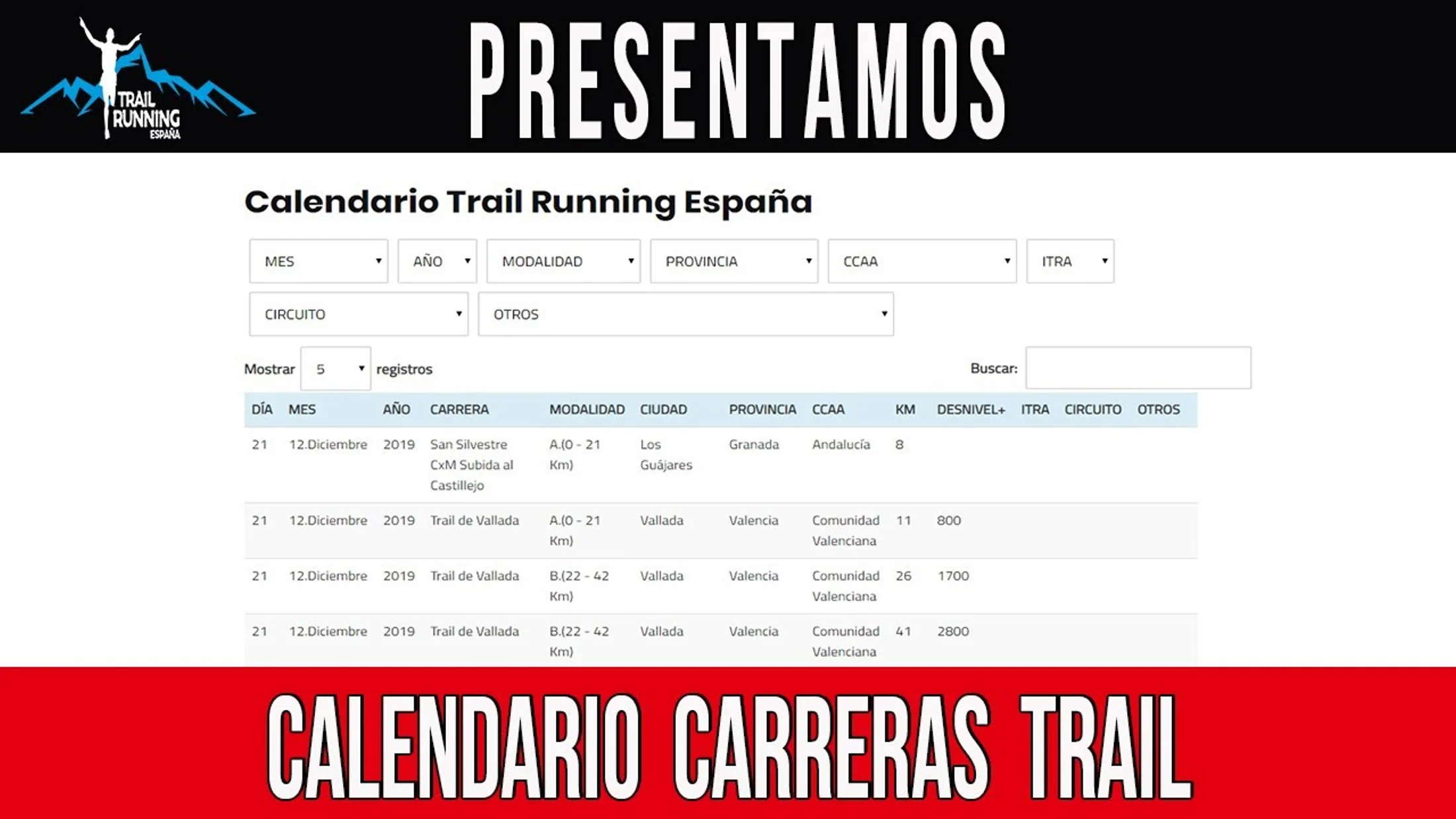
With this calendar, you can plan your entire trail season without jumping from website to website. It brings together a month-by-month calendar, the 20 most relevant events with practical fact sheets, and an interactive map to see where and when the running takes place.
You will also find tips for choosing a race according to your level, preparing your gear, and solving logistics. At the end, there is a frequently asked questions block for the questions that arise before you sign up.
The selection is based on five criteria: history and continuity, international prestige, diversity of terrain, accessibility of transport and accommodation, and the overall experience for the runner and companions. Priority is given to events with a proven organisation, good security services, and local volunteering.
Before booking flights or hotels, check the current year on the official race website: dates change between editions. Book in advance, especially if the event falls on a long weekend or in summer.
Picuco te puede ayudar
Does something here catch your eye?
Tell us.
Write to us on WhatsApp or email: we answer questions, find the best options and help you sort out the booking.
From January to December: this is how the season moves
The trail season in Spain is spread across the seasons, and choosing the right date changes the race. In winter, the Canary Islands rule; in spring, many mountain marathons and medium ultras arrive in the Mediterranean and the centre of the peninsula. Autumn brings second peaks in the Pirineos and Cordillera Cantábrica.
Summer is high mountain season: the days are long, but the heat and storms force you to be extremely cautious. August is reserved for select high mountain races and nocturnal formats that avoid the heat. September and October bring a second wave of tests, with the Ultra Pirineu as a reference, and November and December are dedicated to island and regional tests to close the year and evaluate your form.
In Guadarrama, there is a mountain race of less than 10 km through natural terrain; the current edition measures 9 km and some metres.
The dust of the trail dances at your pace when you choose the date well.
To plan, define 1–2 main objectives per semester and use B or C races to fine-tune. Filter on the map by month and distance and check the access points (airports, stations) and the natural parks. Adjust your trips to the peak tourist periods: Holy Week and summer make accommodation more expensive. In the islands, it is advisable to book in advance; in the Pirineos, plan for mountain refuges and mountain roads.
Top 20 of the calendar: files 1 to 10
1. Transgrancanaria: emblematic ultra of Gran Canaria
The Transgrancanaria runs through the mountains of Gran Canaria and is part of the World Trail Majors circuit. It is held from 4 to 8 March 2026, with start and finish lines that change depending on the format and the edition.
The classic test totals 126 km and almost 7,000 m of positive elevation gain, in a non-stop format. There are also short distances, designed for those who want to start in the mountains. The long race requires a good base and experience with elevation gain.
At dawn, the scent of Canary pine and wet lava accompanies the runners.
Bibs run out quickly, so book in advance. To sleep, look for accommodation in Maspalomas or Las Palmas and book soon; official transfers usually exist, but it is worth checking the schedules. You arrive from Gran Canaria Airport (LPA) and via intercity buses.
2.Transvulcania: a reference race in La Palma
Transvulcania traverses the volcanic landscape of La Palma following sections of the GR-131, with formats ranging from the marathon to the ultra. It is one of the reference races on the Spanish calendar and is usually held in May, with mild weather and clear skies.
The sustained elevation gain and Atlantic views define the race. The Ultramarathon accumulates 4,350 m of positive elevation gain and 4,057 m of negative elevation gain, and the Ultra start is usually at 06:00 at the Faro de Fuencaliente, with the finish in the plaza de España in Los Llanos de Aridane. The ash crunches like icing sugar under your trainers.
The recommended level is medium-high, with medium technique on volcanic terrain. There are formats to progress if you come from asphalt, so the event fits as an A goal after a winter base.
The prices are these:
- Ultramarathon: 90 € general and 70 € residents in La Palma.
- Marathon: 65 € general and 45 € residents.
- Half Marathon: 55 € general and 35 € residents.
- Junior Half Marathon: 30 € general and 20 € residents.
- Vertical Kilometre: 30 € general and 20 € residents.
Places are limited and the island fills up, so book in advance. To get around, rely on the island roads and the organisation's transfers at the start and finish; it is worth booking a car if you want to explore calderas and observatories. Outside of the race, the island offers the Caldera de Taburiente, its viewpoints, and astrotourism.
3.Zegama-aizkorri: the mountain classic in Euskadi
Zegama-Aizkorri is the mountain classic in Euskadi: a marathon in Aizkorri-Aratz (Gipuzkoa) that brings together the elite and a volcanic fan base. It takes place in May, with the start at 09:00.
The route measures 42.195 km through technical terrain, with mud and sustained climbs. It is a race for runners experienced in mountain marathons, with power in climbing and technical descending. Kílian Jornet is the top winner of the event, with eleven victories.
The public concentrates in Sancti Spiritu, where the fog opens like a curtain. Bib numbers are assigned by lottery: you have to register year after year and consider volunteering or solidarity bibs if they exist.
For logistics, look for accommodation in nearby towns, with limited places, and arrive by motorway from Vitoria and Donostia. Book in advance.
4.Tenerife Bluetrail: ultratrail around Teide
The Tenerife Bluetrail joins the sea with the high mountains in a single race. Its variants reach the Teide National Park and traverse sections of the GR-131.
It is the highest race in Spain, so the altitude weighs heavily. If you come from sea level, prepare your acclimatisation before the start.
The event is from 8 to 10 April. There is an ultra, marathon, and inclusive tests, and the climate is favourable in spring. The recommended level is medium-advanced for the ultra and medium for the marathon.
Prices and bibs vary by modality: confirm them on the official website. Public transport works reasonably well, but a car is advisable to explore the island. There is abundant accommodation in the north and the south, with booking necessary during event dates.
At dawn, the light paints the red of the pine forest and the grey of the lapilli.
5. Ultra Pirineu: a great test in the Catalan Pyrenees
Every autumn, Bagà becomes the centre of one of the reference trail running races in Spain. The Ultra Pirineu has prestige, atmosphere, and solid logistics, and its route passes through the Parc Natural del Cadí-Moixeró.
The race is held between September and October, with cool weather and golden leaves. The flagship event, the Ultra, measures 100 km with 6,600 m of positive elevation gain and has a time limit of 26 and a half hours: start on Saturday at 05:30 and finish on Sunday at 08:00.
There are several formats to choose from. The Mitja is 21 km with 1,200 m of positive elevation gain, and there are also the marathon and intermediate options to progress. The recommended level is intermediate-advanced for the ultra and intermediate for the marathon.
The highest point of the route is the collado de Bastanist, at 2,535 metres, and Pedraforca is the visual symbol of the race. The air smells of resin and hot soup in the mountain refuges.
Book in advance: once places are sold out, there is no waiting list. You can reach it from Barcelona by car in 90–120 min and it is advisable to look for accommodation early in the Berguedà region. To complete your trip, add Pedraforca, the Pyrenean valleys, and mountain cuisine.
6. Gran Trail Aneto-Posets: a challenge in the Aragonese Pyrenees
The Gran Trail Aneto-Posets circles two massifs of the Aragonese Pyrenees on a circular route that joins the valleys of Benasque. It is run in summer, when the snowfields recede and the days are long.
The race totals 105 km and 6,760 m of positive elevation gain, with 40.7 km above 2,000 m of altitude. The route consists of 10.1 km of tarmac, 20.8 km of track, 57.9 km of path, and 16.2 km off-trail. It requires technique on granitic terrain, altitude management, and self-sufficiency: it is a test for an advanced ultra profile.
Registrations are staggered and equipment checks are mandatory, so it is advisable to confirm requirements and prices before signing up. The limit is 350 participants and team registration opens in July, with teams of 2-3 people already registered individually.
Afternoon storms are typical in this area of the Pyrenees. Bring a waterproof jacket and a plan B in case the weather changes.
The warm granite in the sun contrasts with the cold of the ibones in the early hours. You reach it via the N-260, with limited parking and local buses.
7. Penyagolosa Trails: tradition and landscape in Castellón
Penyagolosa Trails is held in the province of Castellón. It brings together the historic MIM and the CSP, and is one of the most recognised trail running races in Spain due to its history and organisation.
The terrain is Mediterranean, with fast paths and intense climbs: intermediate level for the MIM and intermediate-advanced for the CSP. In the dry stone walls, thyme and rosemary perfume the air.
Carrying the equipment indicated by the organisation is mandatory, under penalty of disqualification. It is also not permitted to be accompanied by non-registered persons outside of the aid stations.
The price is in the medium range depending on the distance. It is advisable to confirm formats and rates on the official website (penyagolosatrails.com).
From Valencia, you can reach it in 1 h 55 min–2 h 23 min (approx. 137 km). To sleep, you have Castellón and the inland villages. If you want to complete your trip, add Morella, the Azahar coast, and the Tinença de Benifassà.
8. Madrid Alpine Marathon (MAM): a Guadarrama Sierra classic
The Madrid Alpine Marathon (MAM) climbs the emblematic peaks of the Sierra de Guadarrama, with technical climbs and stony descents. It is a classic for runners with experience in mountain marathons and granite technique.
The route measures about 44 km, accumulates 5,800 m of elevation gain and has a time limit of 9 hours. The altitude goes from 1,190 m to 2,430 m, and almost half of the route takes place above 2,000 m. 50% of the terrain is technical, with possible snow patches.
The race is held in June, starting at 08:00. The recommended level is intermediate-advanced, and the price and spots are limited: it is advisable to register as soon as places open. On the ridges, there are sharp changes in temperature, so prepare clothing for both versions of the day. In Cuerda Larga, the granite rings dry under your soles.
You can arrive by train and bus from Madrid. Parking at the mountain passes is limited, so you must arrive early.
9. Ultra Sierra Nevada: trail in the Andalusian summit
The Ultra Sierra Nevada starts and finishes in the surroundings of Granada and mixes tracks, paths and summit areas. It is usually held in spring, in April, and has distances of 25, 40, 60 and 100 km to choose from.
The Ultra adds up 100 km and 5,480 m of positive elevation gain. There are also relays in teams of 3 runners, with more than 2,500 m of elevation gain and a maximum altitude of 3,100 m.
The recommended level is intermediate-advanced: a strong base and experience in mixed ultras is advisable. If you link valleys with summit areas, control the heat and the altitude. Nights are cool up high and the valley is intense; the dry mountain air cuts your breathing at the first sun.
You arrive via the A-44. Depending on the season, there are cable cars and station roads, and a return bus from Granada to the Pradollano Ski Station (15€ the ticket for companions). Book your transport to the finish line in advance.
Rates and registrations vary according to the edition: check before you register.
10. Ehunmilak: great Basque Country ultratrail
Ehunmilak is run in July through Goierri (Gipuzkoa), with humid nights and changing weather. It is an ultra-endurance event that counts towards the UTMB (Ultra-Trail de Mont-Blanc), designed for the ultra-experienced.
The difficulty is high: continuous elevation gain and frequent mud and fog. Bring a headtorch and layers, because the night will catch up with you sooner than you think. The fine rain hits your raincoat like a nocturnal metronome.
The regime is semi-self-sufficiency: you can only refill water at the aid stations. Registrations close quickly, so confirm prices and mandatory equipment as soon as possible.
The start is in Beasáin, with access from Bilbao and Donostia by motorway. There is a network of rural accommodation in the area and it is advisable to book early.
Top 20 of the calendar: sheets 11 to 20
11.Cavalls del Vent: challenge through the Cadí-Moixeró
Cavalls del Vent is the circular itinerary of the Parc del Cadí-Moixeró that inspired ultra races. The competitive experience depends on the current edition and organisation, so it is advisable to check the official calendar before planning.
The full route totals 84.20 km and 5,600 m of total positive elevation gain. It passes near the north face of Pedraforca, the camino de los Empedrats, Prats d'Aguiló, the Moixa sierra, and the Jou pass.
The terrain is varied, with technical sections and areas of soft limestone rock with karst modelling. For this reason, an intermediate-advanced level is recommended.
It is usually run in autumn or at the end of summer, when the forests are reddened. It fits well as an autumn goal after a summer of elevation gain.
You can take out accident insurance with mountain rescue and cancellation cover. This way, you cover the technical sections and any changes of plan.
From Barcelona, you arrive in about 2 h. To sleep, you have circuit refuges and accommodation in Berguedà and Cerdanya.
If you stay for more days, Pedraforca, the Pyrenean villages, and mountain cuisine complete the visit.
12.Trail Picos de Europa: mountain and Cantabrian landscape
The Trail Picos de Europa distributes its races between Asturias, Cantabria, and León, with three distances: Ultra Trail 51K, Trail 31K, and Half Marathon 21K. The event takes place in June.
The limestone terrain is technical, with demanding scree slopes and gullies, so the recommended level is intermediate-advanced. Red-billed choughs whistle loudly while you trace zig-zags on the white rock.
Spring and summer are the best windows, with more stable weather. Registrations are staggered and places are limited by modality in small villages, so it is advisable to book soon.
If you stay for a few days, you have the Lagos de Covadonga, the Cares gorge, and local cheeses near the race.
13.Travesera Integral Picos de Europa: high mountain challenge
The Travesera Integral Picos de Europa crosses the Picos de Europa massifs, in Asturias. It is a technical ultra held at the beginning of summer, with long days and demanding terrain.
The route totals 74 km with 6,560 m of positive elevation gain, in a single stage with a maximum time of 20 hours. The terrain is 87% paths, 10% tracks, and 3% paved road. You start in El Repelao (Covadonga) at 160 m and arrive in Arenas de Cabrales at 135 m. The race is a UTMB World Series: 100K qualifier.
The race requires solid high mountain experience, basic orientation, and fatigue management, and the mandatory equipment is strict. In the gullies, the rattling of loose stones sets the pace.
Places are limited to 450 runners, so book in advance. The race is run at the beginning of summer. Prepare for adverse weather and fog, and plan withdrawal points due to irregular mobile coverage. Access is via mountain roads, with limited parking.
14. Camí de Cavalls (Menorca): island race with history
The Camí de Cavalls goes around Menorca via coastal paths and cliffs, with several competitive formats.
There are 8 distances, from 11 km to 185 km, including relays. The recommended level ranges from intermediate to advanced depending on the distance you choose. In every cove, the sea smells of salt and posidonia.
The waiting list costs 1.50 €. That amount is deducted from the final price if your place is accepted; if not, it is donated to the preservation of the path. Registrations are popular, so it is advisable to confirm prices and time cut-offs.
You reach Menorca by ferry or by plane (MAH). To move between coves after the race, book a car or a bike.
15. Ultra del Soplao: Cantabrian trail between forests and mountains
The Ultra del Soplao is known as "The Cantabrian hell" and brings together several disciplines and distances, including trail running.
The route passes through forests, tracks and firebreaks, with demanding ramps. The recommended level is intermediate. In the first hours, the smell of wet beech forest rises like steam.
Registrations are massive: check the schedules and the starting corrals carefully. You must be 18 years old before the day of the race.
Accommodation is scattered, so book in the nearby valleys. If you stay for more days, combine the race with caves, the Cantabrian coast and mountain cuisine.
16. Ultra Trail Montseny: route through the Natural Park
The Ultra Trail Montseny crosses the Parc Natural del Montseny, in Catalonia. On the shaded side, beech leaves crunch softly under your trainers.
The race requires an intermediate to intermediate-advanced level. Registrations and requirements are on the official website, with moderate quotas.
Between valleys and summits, there are marked thermal changes, so bring clothes for both conditions. Rural accommodation is dispersed throughout the area and it is advisable to have a car.
From Barcelona, it takes between 45 min and 1 h by car, with an AP-7 toll of between 5 and 7 € per journey. From Barcelona to Viladrau there are 80 km and 1 h 12 min by car.
17. Desafío Somiedo: green heart of Asturias
It is held at the beginning of July, with long days, and requires an intermediate-advanced level.
Places are in high demand and the villages are small, so book accommodation in advance: there are rural houses in Pola de Somiedo and in nearby brañas. Registrations open on 1 December 2025, with these prices: UTDS 110 EUR, MDS 80 EUR and SDS 55 EUR.
The territory belongs to the Cantabrian brown bear, which you can observe responsibly, as well as the Saliencia lakes. Mist and summer showers are common; in the lonely mountain passes, a distant lowing accompanies you through the mists.
Arrive via the AS-227: the roads are narrow and parking is limited. Allow plenty of time for the journey and park where the organisation instructs you.
18. Sierra Norte Trail: a step away from the city
The Sierra Norte de Madrid offers a trail running race with more manageable half, marathon, and ultra formats. It is perfect for beginners or for taking the leap to mountain marathons without complex logistics.
Spring and autumn are the optimal times, with freshness in the dehesas and oak groves. The recommended level ranges from beginner to intermediate, and registration is quick with moderate prices. It is advisable to check the exact edition and the regulations before signing up.
You arrive via the A-1 or by regional public transport. Parking is in the villages, so it is best to arrive early.
In the surroundings, the Hayedo de Montejo is one of the southernmost beech forests in Europe. Visits are always guided by an educator from the Environmental Education Centre and the guided tours are free. To visit it, in-person places are obtained on a first-come, first-served basis at the Sierra del Rincón Biosphere Reserve Information Centre (Montejo de la Sierra) from 9:30. Online reservations are managed via a fortnightly draw, with a 5-day period on the 1st and 16th of each month for the following fortnight.
The Senda del Genaro is a circular route of 60 km and 2000 m of elevation gain that surrounds the El Atazar reservoir. It is a good test for larger objectives in summer or autumn. The scent of rockrose and rosemary accompanies the first few kilometres.
19. Haría Extreme Lanzarote: volcanoes and trade winds
Haría Extreme crosses the north of Lanzarote through malpaís and cliffs with views of the Atlantic. It is usually held in November, when the trade winds refresh your effort, and it has several distances: marathon, intermediate formats, and ultra.
The terrain is stony and volcanic, with repetitive climbs and ridges exposed to the sun and wind. It is advisable to wear shoes with protection. The sea wind whistles between tuneras and jable.
Mandatory equipment includes a mobile phone with sufficient battery, a thermal blanket, a whistle, at least 0.5 L of water and your own container, because cups are not provided at the aid stations. The recommended level ranges from intermediate to intermediate-advanced. It works well as a great season closer or as a test for winter in the islands.
The most comfortable way is to move by car and book your accommodation in advance.
20. Urbión Challenge: mountain tradition in Soria
It is usually held in September, when the pine forests and lagoons are in full bloom. The recommended level is intermediate-advanced.
The 37 km modality accumulates 2,600 m of positive elevation gain, with a circular route. The 70 km Ultra modality accumulates 4,500 m of positive elevation gain and is a linear route. The route crowns three summits above 2,000 m: Mojón Alto, Zurraquín, and Urbión, and passes by the source of the Duero river.
The aid stations are in villages with a great atmosphere. The echo in the pine forests sounds like distant applause.
Bibs are limited: it is advisable to confirm the regulations and mandatory equipment before registering. You access it via the N-234 and there are rural accommodations and campsites in the area. To complete your stay, set aside time for the Laguna Negra, the Río Lobos Canyon, and the Soria truffle.
Choose and plan your race: training, gear and logistics
Choosing the right race reduces the risk of injury: cross-reference your objectives with the profile of each race. If you come from the asphalt, start with distances of 20–30 km with moderate technicality. If you already run mountain marathons, define one A race and two B races for fine-tuning.
Work with three objectives: one A (main), one B (preparatory) and one C (strong run). Filter races by elevation gain and terrain type: rock, mud, volcanic or altitude. Also check the regional weather and the logistics of each race, including airports and accommodation. Verify dates and regulations before signing up.
Training is divided into three phases. The base lasts 8–12 weeks, with general strength, stride and progressive volume. Specificity takes up 6–8 weeks of elevation gain, technique on the race terrain and long runs. The final taper is 2–3 weeks in which you lower the volume, maintain intensity and rest.
Regarding nutrition, do a moderate carbohydrate load and test your breakfasts during long runs. During the race, take 40–60 g of carbohydrates per hour, alternating gels, bars and real food. Afterwards, consume protein and carbohydrates within 30–60 min, hydrate and replenish salts.
Essential gear includes shoes suitable for the terrain and technical socks. Carry a backpack or waist pack, soft flasks and a waterproof raincoat. Add a GPS with a track if the organisation provides it, a thermal blanket and a headlamp for ultras. Use poles only if they are permitted and learn the technique before use.
For registration, set reminders for the opening and the bib draw. Book a cancellable trip and consider insurance and the possibility of changing your bib if it is allowed. Choose accommodation near the start and finish lines and plan your transport to the starting corral.
Integrate your objectives into the trail running calendar of Spain and block your specific training sessions in your diary.
Race day: pace, safety and weather
In trail running, the watch is deceiving: pace depends on the elevation gain. Guide yourself by perceived intensity and, if you measure it, by power.
Divide the race into sections between aid stations and intermediate checkpoints. Eat and drink before you feel hungry, and practise this pattern during long training sessions. Respect your stomach: do not try anything new on race day that you haven't tested at home.
Dressing warmly early on saves time. Cold air on the back of your neck is a sign that you should cover up. Carry the mandatory kit: thermal blanket, whistle, raincoat and a fully charged mobile phone. To orient yourself, use a GPS with the track and a mental map of key points. And have a plan B: know where you can safely abandon the race and how to give notice.
The weather changes depending on the mountain range. In the islands, the trade winds rule and there are rapid changes in altitude: protect yourself from the sun and the wind. In the Pyrenees and Picos, afternoon storms and cold at altitude arrive even in summer. In the Sistema Central and Levante, the heat is intense in the valley: adjust your salts and water.
On long climbs, maintain a sustainable intensity, using a jog or fast walking and poles. On technical descents, stay in control: do not give away minutes by rushing. And smile at the finish line: you train your mind too.
Frequently asked questions
When to open registrations and book your trip?
The most in-demand races on the calendar close bib registrations in just a few hours, so the work starts much earlier than the start line. Set alerts for the opening of registrations and draws 6–8 months before the race.
With your bib confirmed, book accommodation with free cancellation. This way, you secure a bed near the start and can change your plans if the draw or the date moves.
Can I change or transfer my bib?
It depends on the regulations of each race. Some events allow changes with a fee and a deadline.
Before you register, check the race regulations and the deadline to request a change.
What happens if the race is cancelled or postponed?
If the race is cancelled or postponed, there are usually options for a partial refund or a bib transfer. Before you register, consult the specific refund and transfer policy for that event.
Do I need specific insurance?
Many ultras require specific insurance to participate. Even if the event does not require it, it is recommended to have insurance that covers mountains and rescue.
Before you register, verify which coverages your insurance includes. This way, you avoid surprises if the organisation asks for your policy when you collect your bib.
How to manage aid stations and assistance?
Before setting off, check the event's route book: there you can see where the life bags and assistance points are located. With that map, you decide what to carry on you and at which point you will replenish.
Each race sets its own zones and assistance rules. Respect them: they tell you where someone from the outside can help you and where they cannot.
When to download the track and check your gear?
The week before the race is the time to load the official track onto your GPS. Do it in good time to check that the file opens correctly and that the route matches the organisation's.
During that same pre-check, look at your GPS battery and leave it fully charged. Take the opportunity to review all the mandatory gear before the event: if something fails, you still have days to resolve it.
Where to check updated prices and dates?
Prices and dates change from one edition to another, so check them on the official website of each race or in the announcement of the current edition. Before you register, also confirm the start times.
It is advisable to book in advance: spots for many events sell out and nearby accommodation increases in price as the date approaches.
Book your experience — discover active tourism activities in Spain with providers verified by Picuco.
Conclusion
Running through Spain is linking volcanoes, ridges, and forests with the pulse of each territory. With the Top 20, the monthly summary, and the interactive map, you can choose objectives, coordinate training, and plan trips in good time.
Before you register, verify dates, regulations, and gear. And respect those who look after the paths and mountains: the race passes, the path remains.
Save this calendar, share it with your group, and secure a bib before it runs out.