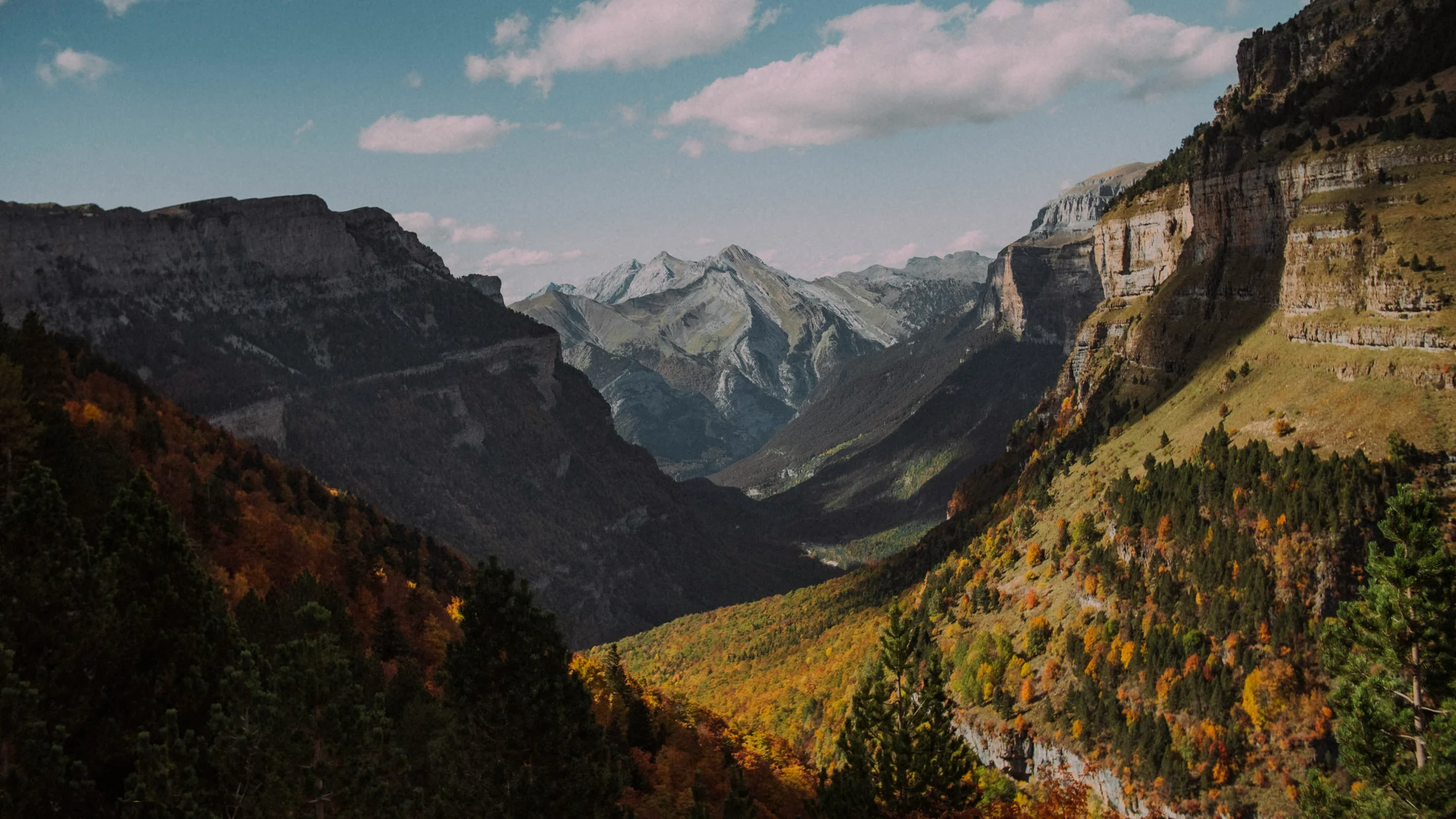
Why visit Spain's national parks
Spain brings together 16 national parks, spaces where nature sets the pace of the visit. There are mountains, wetlands, volcanoes and islands, and each one calls for a different plan.
This guide brings together for each park what to see, what to do and when to go, so that you can compare landscapes, access and activities before choosing a destination. Each profile is organised with practical criteria: accessibility by road and public transport, natural values, viable activities such as hiking, birdwatching, astronomy or snorkelling, and interest for families, couples and groups.
The smell of damp pine at dawn or the petrified lava under your boots are part of the journey. You will also find the essential regulations for each space: permits, capacities and safety.
In many areas there are access limits or prior bookings, so it is advisable to check them before going to avoid surprises. The article indicates marked and essential routes and the best time for each landscape.
Picuco te puede ayudar
Does something here catch your eye?
Tell us.
Write to us on WhatsApp or email: we answer questions, find the best options and help you sort out the booking.
Where they are and how to read the map
The map of Spain's national parks distributes each space in points by region and islands, so that you can see at a glance what you have nearby.
Each point brings basic layers: location and boundaries, main access points, visitor centres and quick notes on capacities, transport and recommended time. With that, you can decide before leaving how much time you need and how to get there.
A filter lets you see the parks by typology (islands, mountain, wetland or volcanic) and combine destinations according to the trip you have in mind. The filters also serve to trace routes by proximity, such as Guadarrama and Monfragüe from Madrid, or by theme: birds, volcanoes, forests.
When you have your list, save your selection of parks and return to it to finalise your plan.
What you will find in each profile
Each profile brings together the essentials to decide on your visit without wasting time. It starts with the location and an orientation map, and continues with how to get there by car and, when available, by bus or train.
You will also see if there are tickets or permits and what the best time to visit is. Each park indicates who it suits best: families, hiking or birdwatching, with the activities and the points that should not be missed.
The profile closes with practical advice on weather, equipment and regulations, and with the place to confirm capacities, internal transport bookings or parking spaces. Within each park, it is indicated where to find information about specific permits, such as summits, parking or guided routes: at the visitor centres or on the official websites of the park and the OAPN.
National parks of Spain (1–8)
1. Picos de Europa National Park
The Picos de Europa National Park is a limestone massif spread across Asturias, Cantabria and Castilla y León. In the Garganta del Cares, the cold wind smells of damp rock and forest, and the gorges roar after the snowmelt. Shepherds and cheesemakers continue to work in their valleys.
The main access points are Cangas de Onís (Asturias), Fuente Dé (Cantabria) and Caín (León). If you travel without a car, there are regional buses to Cangas de Onís and Potes and seasonal shuttles in some valleys; it is advisable to confirm local schedules. Entry to the park is free, but the Fuente Dé cable car is paid separately: 18,00 € return (March-November) and it rises 753 m in 4 minutes.
In summer (July-August) car access to the Lagos de Covadonga is restricted and it is mandatory to use the shuttle bus. Public transport access is regulated during Holy Week, summer and national holiday long weekends. Parking at the Lakes costs 5,00 € in summer (April-October) and requires online reservation.
The best time is from June to September, and allow 2-4 days to combine valleys. It is an ideal destination for hikers, for high mountain photography and for active families with short routes. Do not miss the Ruta del Cares (12 km through a gorge, between Poncebos and Caín, linear), the viewpoints of Fuente Dé and the Mirador del Tombo.
The weather is changeable: bring warm clothing, water and a headtorch, do not leave litter, keep dogs on leads where permitted and do not leave the paths. Get up early to avoid traffic towards Covadonga and stay until sunset, when the light turns the walls golden.
2. Ordesa y Monte Perdido National Park
By the Arazas river, you can hear the murmur of the waterfalls, among beech forests and great walls of the Aragonese Pyrenees. The Ordesa y Monte Perdido National Park occupies the province of Huesca and has four gates: Torla-Ordesa (Ordesa Valley), Escuaín, Añisclo and Pineta.
In summer and during long weekends, you go up to the Ordesa Valley by shuttle bus and it is advisable to book. Bus access is temporarily suspended if more than 1,800 people are in the valley simultaneously.
In La Pradera de Ordesa there are 410 parking spaces. If they are full, access from the Puente de Los Navarros is closed.
May and June are the best months to see the waterfalls and the flowering, and October for the ochre beech forests. In winter you go up with snowshoes and guides. The park suits demanding hiking as well as families who traverse the valleys via marked routes.
The Faja de las Flores is only for experienced mountaineers; the Circo de Pineta and the Ordesa viewpoint reach more people. Before leaving, check the status of the paths and the snow, do not leave the itineraries, do not use drones and respect the rock-dwelling fauna. Dogs cannot be off their leads and pets travel in the hold of the bus, except for accredited assistance dogs.
Book your parking or bus seat in advance during the season and bring layers: the microclimate changes quickly at altitude.
3. Aigüestortes i Estany de Sant Maurici National Park
More than 200 lakes of glacial origin form the high mountain landscape of the park. Los Encantats is its symbol mountain, and the high mountain meanders that give it its name, the aigüestortes, are traversed on foot.
Three plans summarise the visit: Estany de Sant Maurici with Los Encantats in the background, the Aigüestortes plain, and sections of the Carros de Foc circuit linking refuges, which requires 5 to 7 days. The main entrances are in Boí (Vall de Boí) and Espot (Sant Maurici), with Boí, Taüll, and Espot as nearby hubs.
Access is free, but the circulation of private vehicles is restricted on the tracks and you must use authorised taxis. From the Prat de Pierró car park, you can only go up to the lake on foot or by bicycle, and the la Molina lever car park (via L-500 towards Caldes de Boí) marks the final point for private cars.
The Bus del Parc operates from 21 June to 30 September and the Vall Fosca cable car between July and September. Summer leaves the lakes accessible, autumn brings colours and fewer people, and spring arrives with the thaw. The park is suitable for trekking, photography, and families with short marked routes.
Respect the regulations: no drones, no swimming in the lakes, do not stray from the paths, and pick up your waste. Camping, collecting plants, flowers or mushrooms, hunting, and fishing are prohibited. In summer, book accommodation in the valleys in advance and check the high mountain weather on AEMET. Taüll adds nearby Romanesque heritage to combine culture and mountains in a single day.
4. Teide National Park
At 2,000 m, sunrise on the volcanic plateau of Tenerife smells of broom and new stone.
The cable car leaves from the base station, at 2,356 m above sea level on the slopes of Teide, and reaches the Mirador de La Rambleta (3,555 m). It is a 2,482-metre journey in eight or ten minutes.
In winter there may be snow and occasional closures, and the skies are clearer in autumn-winter. The park is a good destination for astronomy, volcanic hiking, and photography.
Acclimatise, hydrate, and bring intense sun protection and warm clothing. Do not leave the paths or step on fragile gullies.
If you want to contrast in one day, combine the visit with historical towns such as La Orotava and La Laguna and with the southern beaches.
You arrive via the TF-21 from La Orotava to Portillo de la Villa (31 km) and from Granadilla, passing through Vilaflor, to Boca de Tauce (57.5 km). The TF-24 goes from La Laguna to Portillo de la Villa (30 km) and the TF-38 covers the 8.3 km between Chío and Boca de Tauce. By public transport, you have line 348 from Puerto de la Cruz.
5. Timanfaya National Park
In the southwest of Lanzarote, black basalt covers everything: seas of lava, cinder cones and volcanic tubes. At the Islote de Hilario, the air smells of sulphur.
Volcanic activity remains active. There are surface heat points of 100-120 °C and at 13 metres depth of 600 °C.
The Route of the Volcanoes is done in the park's official bus from the Islote de Hilario, with a paid ticket, on a circular itinerary of approximately 14 km. Access by private vehicles or on foot is not permitted. There are several guided walking routes with limited capacity and prior booking, and the free ones (Tremesana and Litoral from El Golfo) require booking at least 1 month in advance.
Don't miss the artificial geyser for thermal demonstration, the natural ovens of the volcanic restaurant and the Montaña Rajada Viewpoint. The main entrance is at the Islote de Hilario, via the LZ-67.
Go in winter or spring, due to the mild temperatures and lower crowds; in summer, it is advisable to avoid the central hours. Arrive early for the first bus departure and take advantage of the low light, which accentuates the textures.
Inside the park, do not leave the itineraries, do not collect rocks and do not use drones. Restricted use areas can only be visited with an authorised guide. Timanfaya is perfect for those looking for geology, volcanic landscape photography or a plan for curious families.
6. Caldera de Taburiente National Park
A basin 6.5 km in diameter with ochre walls and Canary pine forests occupies the centre of La Palma. It is the Caldera de Taburiente National Park, and it is explored on foot.
The viewpoints of La Cumbrecita offer the most comfortable view, and the Roque de los Muchachos, on the edge of the caldera, functions as a great viewpoint for the whole area. The park is perfect for those looking for mountain hiking, Canary pine botany and ravine photography.
It is advisable to be mindful of autumn storms and the flow of the ravines.
To drive up to La Cumbrecita in a private car, prior booking is required due to parking limitations. You can book a month in advance or on the same day if there is availability. Access is regulated from 08:30 to 16:00 (extendable to 18:00 in high season) and is free from 18:00 onwards.
From Santa Cruz or Los Llanos de Aridane, you reach La Cumbrecita via the LP-3 to the Visitor Centre and then via the LP-302; the viewpoint is 7 km from the Visitor Centre. To enter the interior of the caldera, you access it from Los Llanos de Aridane following the signs towards the Los Barros road.
The terrain is stony, water is essential and mobile coverage is irregular. Check the weather and the state of the ravine at the Visitor Centre: after rainfall, it can be impracticable. You cannot camp freely and you must take all your rubbish back with you.
7. Garajonay National Park
In La Gomera, the mist lingers among the evergreen trees: it is the laurisilva that protects Garajonay National Park. This humid and temperate forest covers a large part of the island and can be explored through a network of marked trails.
The usual starting point is the Juego de Bolas Visitor Centre, open from Monday to Sunday, including holidays, from 09:30 to 16:30.
You can come all year round. Cloudy days enhance the greenness of the forest, and spring brings flowers and less heat. The park is perfect for botanical tourism, gentle family hiking, and cloud forest photography.
Don't miss Alto de Garajonay (1,487 m) or the circular trails that depart from Laguna Grande. The Mirador del Monumento a los muertos del incendio de 1984 commemorates the forest fire with the highest number of victims in Spain.
Inside the park, stay on the trails, do not pick plants or moss, do not use drones, and moderate your pace through fragile areas. Wear footwear with good grip: the forest mud can be slippery after horizontal rain.
8. Doñana National Park
Doñana distributes marshes, dunes, and hunting grounds between Huelva, Sevilla, and Cádiz, with large concentrations of birds. At sunrise, flamingos are silhouetted against the horizon.
The core zones can only be visited with guided tours in 4x4s or by boat, with variable rates. It is advisable to book throughout the year, even outside the high season.
Autumn and spring bring migratory birds and large concentrations of birds; summer is the season for protected beaches. Doñana works well for birdwatching, marsh photography, and families with short routes. The guided trips to the marsh are the visit you cannot miss.
You can walk freely along the 33 km of beach between Sanlúcar de Barrameda and Matalascañas. In the beach area, the dead trees that emerge due to the movement of the dunes are characteristic.
The Palacio del Acebrón and El Acebuche centres are only accessible by private vehicle, and the José Antonio Valverde Visitor Centre is reached via unpaved tracks. There is public transport from Sevilla and Cádiz to the Fábrica de Hielo Visitor Centre.
Bring binoculars and check the tides, because water changes alter the presence of birds. The use of drones is prohibited, do not step off the walkways, keep silent in the observatories, and keep in mind that dogs are restricted in sensitive areas.
National parks of Spain (9–16)
9. Cabañeros National Park
Between Ciudad Real and Toledo, Cabañeros protects Mediterranean scrubland and dehesa, with deer among holm oaks at sunrise. It was declared a National Park in 1995.
In autumn, the roar of the rutting season echoes through the park. The best time to visit is spring, because of the blooms and the birds, and September-October, for the rutting season.
Enter via Horcajo de los Montes, Alcoba or Retuerta del Bullaque, and use the Casa Palillos Visitor Centre as a reference. There are buses from Ciudad Real towards Alcoba, Horcajo de los Montes, Pueblonuevo del Bullaque, Retuerta del Bullaque and Navas de Estena, and from Madrid towards Los Navalucillos. The Horcajo de los Montes Visitor Centre has a museum, 3D cinema and displays of flora and fauna.
The trails are free to access. On rutting season weekends, book in advance: demand exceeds supply.
Don't miss the viewpoints of the Raña de Santiago. Cabañeros is great for wildlife watching, dehesa landscape photography and families. Keep your distance from the wildlife, do not use drones and do not travel outside of the authorised tracks.
10. Sierra de Guadarrama National Park
Granite, pine forests and scree slopes less than an hour from Madrid: the Sierra de Guadarrama is the mountain park for an escape from the city. It is suitable for mid-mountain hiking and for going out with children.
The park is divided between the Madrid and Segovia slopes. The most used entrances are Puerto de Cotos, Navacerrada and La Pedriza, in Manzanares El Real.
From spring to autumn, the plan is to walk. In winter there is snow and snowshoes, and you can ski in authorised areas near the station; most of the lifts are located outside the park. Above 2000 metres, the winter trails are of high-mountain difficulty due to ravines, ice and sudden weather changes.
The C9 commuter line (Cercedilla - Puerto de Navacerrada - Puerto de Los Cotos) is closed for works and there is an alternative road plan. From Segovia, the "By bus to the Guadarrama National Park" service connects with the Puerto de Navacerrada with stops in La Granja, Valsaín, Boca del Asno and el Puente de los Mosquitos.
No camping or fires are allowed, and dogs must be kept on a lead. High mountain lagoons have special protection. On weekends, arrive early or use public transport: car parks have a capacity limit and close during peak hours.
11. Sierra Nevada National Park
Sierra Nevada is the peninsula's high mountain range: peaks above 3,000 m and unique flora, with endemics. The air is thin and cold, smelling of high-altitude thyme and hot stone in the sun.
The park is spread across the provinces of Granada and Almería. You enter via Hoya de la Mora (Granada), via Capileira (Alpujarra) or via Güéjar Sierra. Motorised access is restricted on high mountain tracks; in summer there is a shuttle bus from Capileira to Hoya del Portillo and Alto del Chorrillo.
From June to October, the high-altitude trekking season arrives. In winter, you can do winter activities and ski in the adjacent authorised areas. The park is open from Holy Week until the beginning of December, subject to weather conditions.
Sierra Nevada is high mountain terrain, endemic botany and summit photography. You have two clear appointments: the ascent of Mulhacén (3,479 m) via the south face, which is demanding, and Veleta peak from Hoya de la Mora.
Safety comes first. Acclimatise, protect yourself from the sun with high-factor cream and expect electrical storms in the afternoon during summer; consult AEMET before heading out. Do not leave the paths in fragile areas and do not camp freely in the heart of the park.
For Mulhacén, plan 2 days with an overnight stay in a nearby staffed refuge, outside the strict zone, and get up early to avoid the heat. The interpretation service for the northern slope only operates in summer; the one for the southern slope opens during the summer-autumn season, with hours from 10:00 to 14:00 and from 17:00 to 20:00 h.
12. Tablas de Daimiel National Park
Las Tablas de Daimiel are a Manchegan wetland of reed beds and boardwalks, in the province of Ciudad Real. The air smells of sweet salt marshes and fertile mud.
Access is free. The Information Centre is 11 km from Daimiel via an asphalt road.
The Isla del Pan trail is 2.5 km long and takes 2 hours, and it is accessible for people with reduced mobility. Do not miss the boardwalk itineraries through islets, the bird observatories and Isla del Pan.
Go in autumn-winter or in spring to see water birds; in summer there is less water depth in dry years. The early morning hours and the late afternoon are the best for observing wildlife. The park works well for ornithology, families and environmental education.
Keep silent in the observatories, do not leave the boardwalks and do not bring pets. It is also not permitted to make fires, camp, collect natural elements, disturb animals, ride bicycles, make loud noises, litter, hunt or fish.
Before going, check the water status: during droughts, the itineraries and sightings change significantly.
13. Monfragüe National Park
In Monfragüe, vultures fly at eye level. The park, in the province of Cáceres, is a destination for observing cliff-dwelling birds: griffon vulture, black vulture and imperial eagle.
Spring is the best time for courtship and breeding; autumn and winter, for large bird concentrations. Access to the park is free and open to everyone.
The North Visitor Centre opens in summer from 09:30 to 18:30 and in winter from 09:30 to 17:30 (closed on 24, 25 and 31 December and 1 January). From there, a 1 km interpretive trail with information panels departs.
Keep your distance from the nesting cliffs, do not use drones and do not feed the wildlife. Bring a spotting scope, check the observation points at the centre and take advantage of the afternoon light for photos.
14. Cabrera Archipelago National Park
South of Mallorca, the Cabrera Archipelago National Park protects turquoise water coves, posidonia meadows and clear skies.
You can only reach it by authorised boat and with daily quotas.
Going ashore and anchoring outside of established places is prohibited. Navigation is only permitted during the day and with express authorisation; anchoring zones are regulated and you cannot fish or extract anything.
From late spring to autumn, you have the best time for sailing and snorkelling; in summer there are more frequencies. The park is perfect for scuba diving, snorkelling, island nature and gentle hiking.
The Cova Blava Route is a self-guided trail and cannot be done with a guide.
Respect the posidonia, do not take species or shells, do not use drones and bring your waste back to the mainland. Bring water shoes and sun and marine protection: the water is crystal clear but cool in spring.
15. Atlantic Islands of Galicia Maritime-Terrestrial National Park
Fine sand beaches, cliffs and Atlantic forests are shared between lighthouses and cormorants.
The park is perfect for those looking for beaches, coastal hiking and seabirds. From late spring to early autumn is the best time; if you want to swim, avoid days with persistent fog.
Boats depart from the ports of Vigo, Cangas and Baiona. In high season (Semana Santa and from 15 May to 15 September) you need prior authorisation from the Xunta de Galicia for Cíes and Ons, and you must obtain it before buying the ferry ticket. You can only camp on Cíes and Ons, with a reservation, and the campsite itself processes the administrative authorisation. For Sálvora and Cortegada, the ferry company processes the authorisation for group visits.
Respect the regulations: no fires, no wild camping and no drones, and leave the nesting bird colonies in peace. Stay on the mainland (Vigo, Cangas, Bueu) and go on day trips; bring warm clothing even in summer.
16. Sierra de las Nieves National Park
Between Málaga and Ronda, the Spanish fir occupies about 2,000 hectares: more than half of this species' surface area on the peninsula. Sierra de las Nieves National Park protects that fir forest and a landscape of karst modelling on the surface and underground, with the Sima GESM (1,101 m depth) and low altitudes of red colour due to peridotites.
Torrecilla peak (1,919 m) is the highest point in the province of Málaga. It is climbed via a 14 km route (round trip) with about 900 m of elevation gain. If you are looking for something shorter, the Sendero de los Quejigales is a circular route of a few hours at medium altitude, suitable for a half-day trip.
The park is perfect for mid-mountain hiking, the botany of Spanish fir forests, and photography. Go from April to June or in September and October; in winter there are snow episodes at high altitudes. In summer, start early and bring water: the sunny slopes heat up more than they appear.
Do not collect flora and keep dogs on leads. Take extreme precautions with fire and cigarette butts. Tracks and summits have specific regulations depending on the season and conservation needs.
Access points are in Yunquera, El Burgo, Tolox, and Parauta, with local visitor centres.
Tips for choosing your Park
Choose according to your time, your preferences, and the time of year.
n. m. and valleys such as those of the San Nicolás and Escrita rivers. Adjust the activity to your physical level: Cola de Caballo requires endurance. Keep the season in mind: spring for migratory birds and blooms.
Plan key reservations before leaving: summit permits in Teide, the Ordesa bus, parking at La Cumbrecita in La Palma, boats to Cabrera or Cíes. In Cabrera, access is mandatory by boat from the ports of Colonia Sant Jordi, La Rápita, or S'Estanyol, and you must request a prior reservation for collective transport from Colonia de Sant Jordi or Porto Colom.
Frequently asked questions
Do I need a permit to enter or stay overnight in the parks?
Entering national parks is usually free and without a permit, but some services and areas require authorisation. It is advisable to check this before leaving, because each park has its own rules.
Places are made available every Monday at 07:00 (Canary Islands time) for the following 56 days. The trail is not accessible for people with reduced mobility (PMR).
You also cannot access non-accessible areas nor disturb or capture wild animals.
Wild camping is prohibited in all parks: it is only possible in authorised campsites and marked areas outside or in enabled areas. Before travelling, confirm the conditions at the park's visitor centre and at the OAPN.
How do I book in parks with limited capacity?
Reservations are made online on the official websites of the park or the regional administration. There you manage the Ordesa shuttle, Teide permits, or boats to Cabrera and the Cíes.
In high season, book weeks in advance and carry the receipt on your mobile. If places are sold out, look for alternative times, such as the first or last departures, or visit outside of peak periods.
What regulations apply to dogs, drones and camping?
In most national parks, your dog must be on a lead and may be restricted in sensitive areas or on walkways. Drones are prohibited unless express authorisation is granted for conservation or research reasons.
Camping and fires are prohibited: only use authorised areas and campsites. Cooking with a flame is also restricted, so bring food that does not require fire.
Before setting off, consult the specific regulations at the visitor centre. Penalties for non-compliance are substantial.
How to get there: car, train or bus?
Almost all national parks can be reached by car, but several have public transport that saves you from parking. It is advisable to check schedules before leaving: in some places, the connection changes according to the season.
From Madrid, intercity buses depart from the Moncloa or Plaza de Castilla interchanges towards the Madrid side.
In Ordesa, during the season, a shuttle bus leaves from Torla next to the Torla-Ordesa Visitor Centre and has its final stop at La Pradera de Ordesa. In island parks, such as Cabrera and las Atlánticas, you arrive by authorised boats with quotas.
To calculate travel times, combine train and regional bus and check updated schedules before leaving.
Are there fees or discounts?
Entering national parks is free. You only pay for certain services: cable cars, shuttle buses, boats, 4x4 tours or guided visits.
Discounts change depending on the service, so check the rate for the specific service before going. There are reductions for minors, residents and families, but they are not applied the same way in all cases.
Bring cash and a card: not all services accept the same form of payment. And book in advance, especially if your plan depends on a bus, a boat or a guided visit.
Where can I find reliable and up-to-date information?
Before setting off, consult the OAPN (Organismo Autónomo Parques Nacionales): it brings together the general regulations and maps of the national parks. The visitor centres of each park publish last-minute notices, so check the one for your destination a few days before.
For the weather, the AEMET offers mountain and coastal weather reports. If your plan includes staying overnight or moving by public transport, first check who manages the permits and bookings: the island or regional authorities are in charge of this.
Book your experience — discover active tourism activities in Spain with providers verified by Picuco.
Conclusion
Spain brings together limestone mountains, marshes, laurisilva forests and volcanoes in its national parks. Exploring them helps you understand the territory through its most valuable landscapes.
With good planning, you can link several parks in a single trip. Before setting off, consult the files for each park, choose according to your time of year and your level, and verify permits and transport. In peak seasons, book in advance.
Practise responsible tourism and support the communities that look after the parks. Leave the place a little better than you found it.