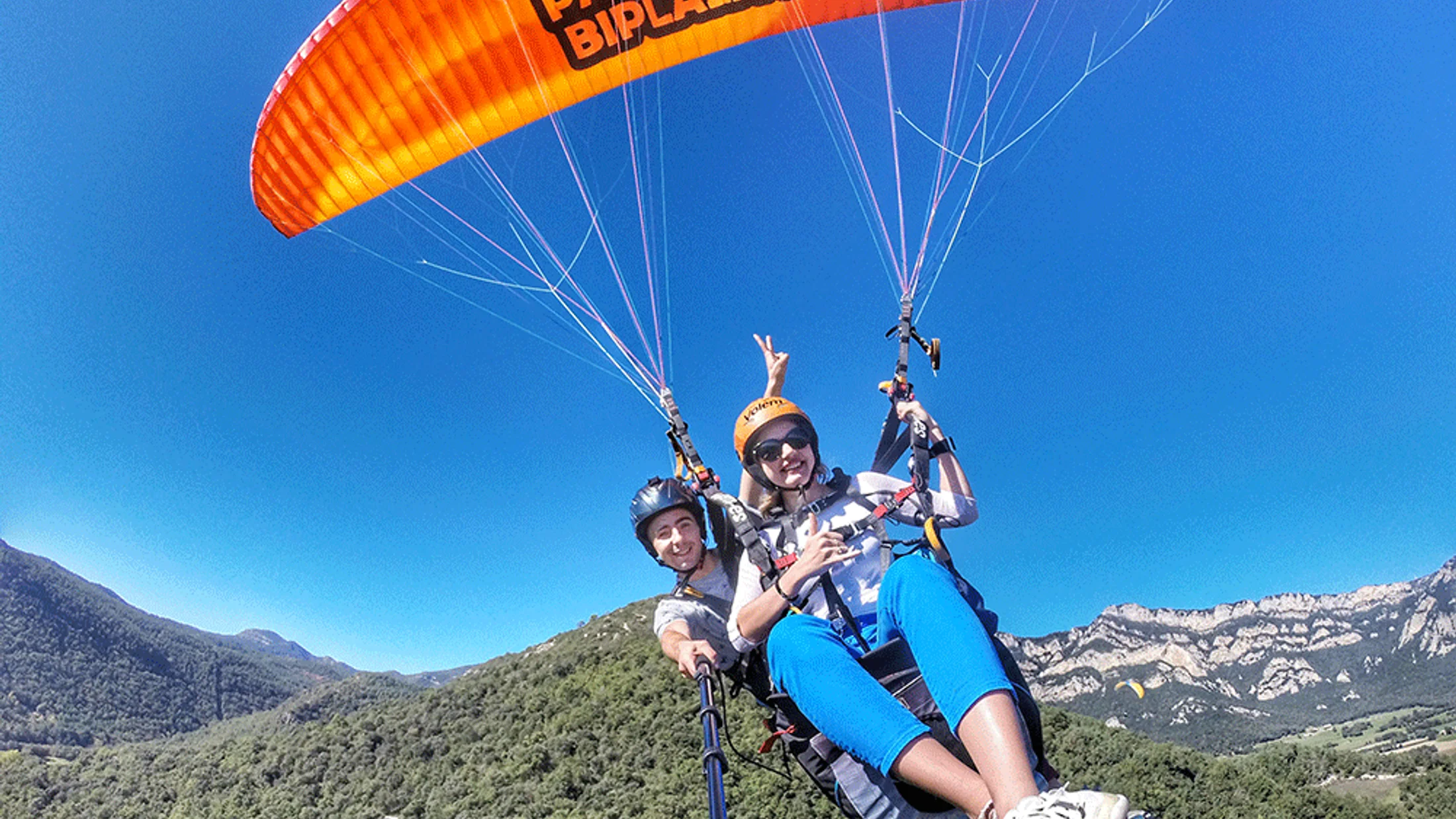
Tandem paragliding: accessible, thrilling and closer than you think
You fly sitting in front, attached to a professional pilot, and glide with the wind over mountains and the coast. Tandem paragliding is a safe and accessible experience, even for those who have never flown before.
Spain has take-offs for all tastes: powerful thermals in Andalusian mountain ranges, coastal flights supported by the breeze, and long descents from volcanic peaks down to the seashore. Here you will find destinations with good accessibility, pilots with specific training and consistent reviews, as well as indicative price ranges and the best time of year for each location.
The article is organised into three parts: how centres are chosen, how a tandem flight unfolds, and seven iconic locations. Being well-informed before your flight saves you nerves and allows you to book in advance and make the most of your trip with complementary plans.
What we value when choosing a centre
Choosing a tandem paragliding centre requires looking at technique, judgement and personal service, just like when choosing a mountain guide. Before booking, check these points and ask anything that is not clear.
Safety starts with the equipment: paraglider, harness and emergency parachute that are EN/LTF certified and undergo periodic inspections. Also ask for clear protocols, including pre-flight checks, wind assessment and a plan B for landing.
Two things matter regarding the pilot. That they have a valid tandem licence and verified flight hours at that specific take-off site. And that they know how to explain the manoeuvres and make you part of the flight plan.
Check the location: take-offs and landings that are accessible by vehicle, with runways in good condition or transport included. It helps if the prevailing winds are well known and the flight zones are wide.
Reviews with real photos tell you a lot if they mention punctuality, clear briefings and a sense of safety. Regarding the price, check what is included: transport to the take-off, photos or video, insurance and duration. Book in advance.
Each person's profile changes the choice. If you are looking for adventure, prioritise the pilot's experience in manoeuvres and thermals and the best local time of year. If it is your first flight, prioritise safety and communication, with stable ridge or coastal flights. If you are going with family, prioritise easy access, wide schedules and a clear policy for minors.
Some reference examples: Algodonales for thermals, Santa Pola for gentle ridge flying and Teide for a great altitude drop. The best centre is the one that fits your plan and your pace.
What happens during your first flight step by step
The first tandem flight starts at the meeting point and continues with a short transfer to the takeoff site. There, the pilot gives a briefing: they explain the sequence, adjust your helmet and harness, and check the lines, wing, and radio.
To take off, you must be able to jog about 10 metres on sloping ground. Takeoff is usually with a short run or with assistance on a coastal slope.
A coastal flight lasts 15–25 minutes; on days with thermal lift, 25–45 minutes. In large elevation changes like Teide, the glide can be extended further if the conditions allow.
The sensation during flight is stable, more like looking out from a balcony than a roller coaster. If you feel like it, you can ask for more dynamic turns.
Before booking, check these details with the centre:
-
Minors can fly from 6–8 years old, with parental authorisation and a harness adjusted to their size.
-
No medical certificate is required, except in cases of cardiac history or epilepsy. If you have severe vertigo or have had recent surgery, consult beforehand.
The landing is gentle: you lift your legs slightly and sit down or walk a few steps, guided by the pilot. Wear closed trainers and a light jacket, because the air at altitude is cool.
Picuco te puede ayudar
Does something here catch your eye?
Tell us.
Write to us on WhatsApp or email: we answer questions, find the best options and help you sort out the booking.
Seven unforgettable places to fly tandem in Spain
Algodonales (Cádiz): reliable thermals between Sierra de Líjar and the countryside
In Algodonales, the air rises in warm columns almost every day, which explains why it is a reference point for paragliding in Spain. The takeoffs are in Sierra de Líjar and work with east and west winds, so the flight and training windows are wide.
Thermals allow you to gain altitude and extend the flight. If you are lucky, you will share a thermal with vultures and stay in the air until sunset.
In summer, if you are a beginner, avoid flying before 18:00 due to the strength of the thermals. If it is your first tandem flight with thermals, ask for a mid-morning or afternoon flight, when the cycle is usually more docile.
Watch out for the approach: there are power lines parallel to the landing zone and you must always perform the approach after passing the lines. Access has tracks that facilitate vehicle ascent, but it is advisable to book in advance.
Around the village, there are plans to complete the day: Zahara de la Sierra and Grazalema.
Conil and Vejer (Cádiz): coastal at sunset over infinite beaches
In Conil and Vejer, you fly in a tandem glider over long beaches, with take-offs from low cliffs and stabilised dunes. The landings are spacious, on the beach or on large flat areas.
Take-off takes place at Playa de la Fontanilla or at El Roqueo, depending on the wind. You can also fly from the Los Caños de Meca cliff, facing southwest. You get there from the centre of Conil de la Frontera towards the beaches, via Calle del Roqueo and the access track to La Fontanilla.
The slope works with a westerly breeze, and the best times are the afternoon and sunset. Spring and autumn provide the most stable conditions; in summer, aim for the afternoons with sea thermals. Bring sunglasses with a strap and a light sweatshirt: the breeze feels cool at sunset.
The flight costs 70 € in the basic modality or 85 € in the standard modality per person, and it is advisable to confirm extras for photos and video. The duration ranges from 10 minutes (basic) to 20 minutes (standard), depending on conditions and the passenger, with an average flight altitude between 100 and 150 metres.
It is a plan that suits couples, beginners looking for a smooth flight, and sunset photographers. The minimum age is 15 years. It respects the tides, bathers, and protected dune areas, and you must follow the pilot's instructions.
Around you, you have El Palmar beach, Atlantic bluefin tuna in Barbate, and the historic centre of Vejer.
Montellano (Sevilla): docile thermals and accessible take-offs
Montellano is located in the surroundings of the Sierra de San Pablo. It is a comfortable area to experience the thermal sensation without feeling overwhelmed.
The thermal cycles are regular, and from below, the fields and the flight of common kestrels set the rhythm.
The average price is around 173 €, with offers from 90 € per person. It fits well with beginners who want to feel the thermals and with families coming from Sevilla with limited time.
There are active schools and infrastructure nearby. If you have extra time, the Vía Verde de la Sierra, the countryside towns, and the mountain gastronomy complete the plan.
You arrive from Sevilla in 66 km. If you come on a weekend, book the morning slot in advance: the air is calmer and the heat is less intense.
Teide / Izaña (Tenerife): from the volcano to the ocean in a single glide
From Izaña, on the Teide ridge, tandem paragliding takes off at about 2,200–2,300 m altitude: it is the highest glide in Spain.
Black lava, pine groves, and the Atlantic in the background form a contrast that is hard to forget. During the middle section of the descent, you are accompanied by the scent of Canary island pine.
The price is around 150 € per person with one operator and 180 € per person with another. The best time is from September to June, when conditions are more stable. It is a great option for those seeking volcanic landscapes, for photographers, and for those who want a large altitude drop.
Bring a jacket and high-mountain sun protection.
Before flying, confirm the planned landing point: Playa Jardín, Playa de Martiánez, or the pier expanse of Puerto de la Cruz. This way, you can coordinate your return transport and adjust your itinerary on the island. The Izaña area is within the Teide National Park.
Berga (Barcelona): Pre-Pyrenean balconies and mountain flight
In Berga, you fly over wooded hills and reservoirs, with the Catalan Pre-Pyrenees opening up beneath the glider. Take-offs are about 9 km from the town, and the paragliding atmosphere is noticeable in the sky.
Spring and autumn thermals allow you to gain altitude and make calm transitions. These are moderate thermals, so the flight is suitable for those not looking for extreme manoeuvres. The silence is broken by distant cowbells and the whisper of the glider.
Berga works well for photographers and for those who enjoy mountain landscapes. If you want sharp photos, ask about morning flights, when the air is most transparent.
Book your tandem in advance and ask the centre for the meeting time: from Berga, you must travel to the take-off area, about 9 km away.
Villar del Arzobispo (Valencia): school, stability and proximity
Villar del Arzobispo is a tandem paragliding base with stable conditions and well-reputed schools, 52 km from the city of Valencia. The village is in the La Serranía region, at 520 m altitude, and can be reached via the CV-35.
It is a practical option for beginners, for gifting a surprise flight, or for an express getaway from Valencia. If the forecast holds, you can book at the last minute.
During flights, you can take off and land in the same place, so you can leave your car parked nearby. The thyme on the slopes scents the air at the take-offs.
Centres adjust schedules to real wind windows, so it is advisable to keep your mobile phone active.
If you have time left, Valencia's historic centre, Malvarrosa beach, and an horchata in l'Horta will complete the day.
Santa Pola / Alicante: lighthouse, cliffs and turquoise views
Santa Pola is a ridge flight destination with a sea breeze, where the air does almost all the work.
With a moderate easterly component, the air clings to the relief and smooth glides emerge, providing a great sense of control. From the cape, you can see Tabarca, the bay of Alicante, Cape Cervera, Grosa Island, and the Peñón de Ifach.
Tandem flights cost between 70 and 110 € per person. There are options from 80 € per person for 2 people or 70 € per person for 3 or more, with free video; check the options on Picuco.
You can fly all year round, including holidays and weekends. The best days are with a laminar breeze from the E–SE, in the afternoon and at sunset. It is a good choice for beginners, coastal photographers, and those seeking a stable flight.
Respect sensitive areas and hikers on the cape, keep children and dogs behind the cliff barriers, and pay attention to recreational air traffic. The lighthouse building is not open to visitors as it is active infrastructure, and access may change due to fire restrictions: check the municipal notices.
To complete the day, cross to Tabarca by boat, stroll through the Santa Pola salt marshes, and eat an arroz a banda in the bay. Bring a phone case with a strap and wear layers: the breeze is refreshing even on sunny days.
Map to plan take-offs, landings and seasons
An interactive map with markers for the take-off points, the usual landing site and the meeting point or parking for each area helps you coordinate schedules with the actual wind. It adds links to the booking pages and local weather reports, and notes the best time of year for each place.
The most used layers are the prevailing wind and the orientation of the terrain (N, S, E, W), the access points and the type of surface (road, track, 4x4 transfer), the protected or restricted areas and the recommended maximum altitudes. It is also useful to mark the difficulty of the take-off and the landing (easy, intermediate), the obstacle-free space, the optimal season and the suggested time slots (morning, midday, afternoon).
To use it, filter by travel date and type of flight (coast, thermal, high altitude change). Then open the centre's file to see the price range, what is included and the cancellation policy, and check the access points and the transfer time from your accommodation.
Always save two plans, a main one and an alternative one depending on the wind. This way you have an option ready when conditions change.
How to choose a centre and type of flight without getting lost in the fine print
Choosing a tandem paragliding centre well gives you peace of mind from the very first contact. Look for clear questions, complete information and simple rules: if something doesn't add up before flying, it won't add up during take-off either.
Before booking, pay attention to the pilot's training and the insurance and permits the centre holds. Take a moment to read the reviews and compare prices calmly, because that is where you see how each school operates.
The right feeling when closing the booking is a click of confidence, like when the harness embraces you and everything fits.
Certifications and pilot training
Before taking off, ask the pilot for their current tandem licence and their federative accreditation. These are the two documents that separate a safe flight from a commercial promise.
The centre must mention approved training with recognised schools, a sports licence and tandem authorisation. Also ask about their accumulated flight hours and how many they have done at that specific take-off site. If the advertisement says "tandem paragliding flight" without detailing licences, request the credentials and do not hesitate to postpone the flight.
Check that the tandem authorisation is valid and that there is associated insurance. Check that the equipment is up to date: wing, harness and emergency parachute with the latest recorded inspection. Also value their continuous training in meteorology, active safety and SIV (Simulation of In-flight Incidents).
Ask for the licence number and the federation to cross-check them with the regional federation, and see if the pilot appears on local club or school lists. A good pilot explains the jargon in simple steps. If they also detail the take-off plan, the alternatives and the cancellation conditions, you have a clear sign of professionalism.
Insurance, responsibilities and permits
Before taking off, ask the operator for a written summary of their insurance. It must cover civil liability and assistance for tandem passengers during the activity, including coverage limits, excess, and whether it includes medical transport.
In natural spaces, such as the areas near Teide National Park, confirm that regulations and restricted areas are respected. Here, "permit" means complying with the rules of the space and conservation, not paperwork that the passenger must manage.
The administrative checklist is summarised in two documents: the specific civil liability policy for tandem flights, with a copy or certificate, and accident insurance for the passenger, at least basic. Additionally, demand a cancellation policy due to weather at no cost or with priority rescheduling.
Ask for clarity on extras: photos and video, transfer to the takeoff point, and minimum guaranteed duration. Clarify if the "from" price includes taxes and full equipment, and confirm the planned landing point and whether there are return costs.
Ask about weight and age limits and about mandatory clothing. Some takeoffs require coordination with local clubs or have time limitations; good centres already operate under these rules and explain them naturally.
Reviews, ratings and bookings
A useful review talks about safety, punctuality, service, and cancellations, not just how much the customer enjoyed it. When reading reviews of a tandem paragliding centre, pay attention to how they describe the briefing and the landing.
Look for photos from real users. A repeated opinion about the feeling of safety tells you more than many stars without context.
To find out the real cost of the flight, compare price ranges by duration and include extras: photos, video, and transport. Also check the cancellation policy, with flexibility for weather and the possibility of rescheduling.
The time slot changes the flight. In the morning, the air is usually calmer and the light is sharper; in the afternoon, the colours are warmer.
Book in advance: 3–7 days in high season and 24–48 h if you depend on a specific window. Be wary of promises of "we always fly" without meteorological nuances, the lack of information about insurance and licences, and slow or evasive communication when faced with specific questions. If the price on the web is the same as by phone, book online and keep written record of the conditions.
Before taking off: clothing, health, photos and weather
In tandem paragliding, half the preparation is done at home. Dress as if for a gentle walk in the breeze: closed-toe shoes with good grip, comfortable long trousers and a windbreaker jacket, because it is cooler at altitude than it looks. Add sunglasses and, on the coast, high-protection sunscreen.
Eat lightly and drink water before heading out. Avoid very heavy meals just before the flight and stay well hydrated. If you get car sick, consider a mild antiemetic after consulting with a pharmacist.
Tell the pilot how you are feeling. Declare any recent injuries or heart conditions: they will adjust manoeuvres and flight duration accordingly.
Photos are sorted on the ground. Many centres offer video and photos using the pilot's camera: ask about the cost and format before flying. If you bring your mobile phone, use a strap and a secure case, because loose objects are a risk. Action cameras are only allowed with an approved attachment to the harness and with the pilot's approval.
The wind rules: it is normal to reschedule a tandem flight if it is blowing hard or if there is wind shear. Check the cancellation policy when booking, including free rescheduling or a refund if you cannot change the date. Have a nearby alternative plan (a stroll on the beach, a short route or coffee with a view) and keep your phone active.
With minors, coordinate turns: one flies and the other waits with the person who is not flying. If you arrive without a car, ask about transfers from an easy meeting point. Arrive 15–20 minutes early to park, use the toilet and complete the briefing without rushing.
Frequently asked questions
What is the minimum age to fly in tandem paragliding?
Most centres accept minors from 6–8 years old, always with consent and a fitted harness. Before booking, check the specific policy of the centre and the minimum weight allowed to guarantee fit and safety.
The priority is that the minor understands simple instructions. If they understand them, age ceases to be the deciding factor and the centre will assess the rest with you.
Are there weight limits for the passenger?
Yes, there are weight limits for the passenger: the usual range is from 35 to 110 kg, and it can reach 120 kg with specific equipment and conditions. Wind and temperature have an influence, because with heat, air density drops and some limits are adjusted.
When booking, confirm your weight including clothing and footwear. This way, the centre chooses the right equipment for your flight.
How long does a tandem paragliding flight last?
A tandem flight usually lasts between 15 and 25 minutes on a coastal slope and between 25 and 45 minutes in thermal inland. The figure changes depending on the location and the day, so ask about the minimum guaranteed duration before booking.
Is it safe to go paragliding in Spain?
Tandem paragliding in Spain is safe if three conditions are met: a qualified pilot, approved equipment and suitable weather. Those three pieces carry more weight than anything else when choosing a centre.
Good centres use checklists before the flight, carry a checked emergency parachute and have alternative plans if the weather changes. Ask about these points when booking and you will know who you are flying with.
Your role as a passenger also counts: follow the pilot's instructions and tell them how you are feeling during the flight. With that, the flight is enjoyed much more.
Can I get motion sickness during the flight?
Motion sickness in tandem paragliding is uncommon if the flight is stable, but it can occur with intense turns or if you arrive dehydrated. Ask for a calm flight profile and look at the horizon during the trip.
Avoid sudden movements with your head. If you tend to get motion sickness, mention it to the pilot before taking off and consider a mild antiemetic.
What happens if there is bad weather or the wind changes?
Paragliding depends on the wind, so the flight may change date. If there is no safe window, the centre will reschedule or cancel at no cost, according to its policy.
The wind changes quickly in the mountains. Keep your mobile phone operational on the day of the flight and have a plan B ready in case the takeoff is delayed or suspended.
Can I gift a flight or receive a voucher?
Yes, many centres offer gift vouchers with validity for several months. It is a common option for birthdays and celebrations, and you can also receive one if someone gifts it to you.
Before buying, check whether the voucher is transferable or not, its date extension policy, and if it includes photos. This way, you will know if it is suitable for the intended person and what the flight covers.
Save the digital receipt to manage the booking quickly. With it, you can finalise the date and centre in a few minutes when the time to fly arrives.
Do I need fitness or previous experience?
No previous experience or special fitness is required: it is enough to be able to walk a few steps when taking off and landing. The pilot manages the glider; you just enjoy, breathe, and let them know if you want more or less dynamism.
Wear footwear with good grip and comfortable clothing. With that, the flight depends on the wind and the pilot, not on your training.
Book your experience — discover active tourism activities in Spain with providers verified by Picuco.
Conclusion
Choosing the right tandem paragliding centre makes the difference: clear information, well-maintained equipment, and pilots who inspire confidence. Before booking, compare locations and read the reviews carefully.
A map helps you coordinate wind, access, and season in each area. Book in advance and have an alternative plan in case the wind does not allow flying.
Safety comes first: that way, you enjoy the flight without rushing. When the harness embraces you and the glider rises, all that remains is to look down and keep that silence with an infinite view.