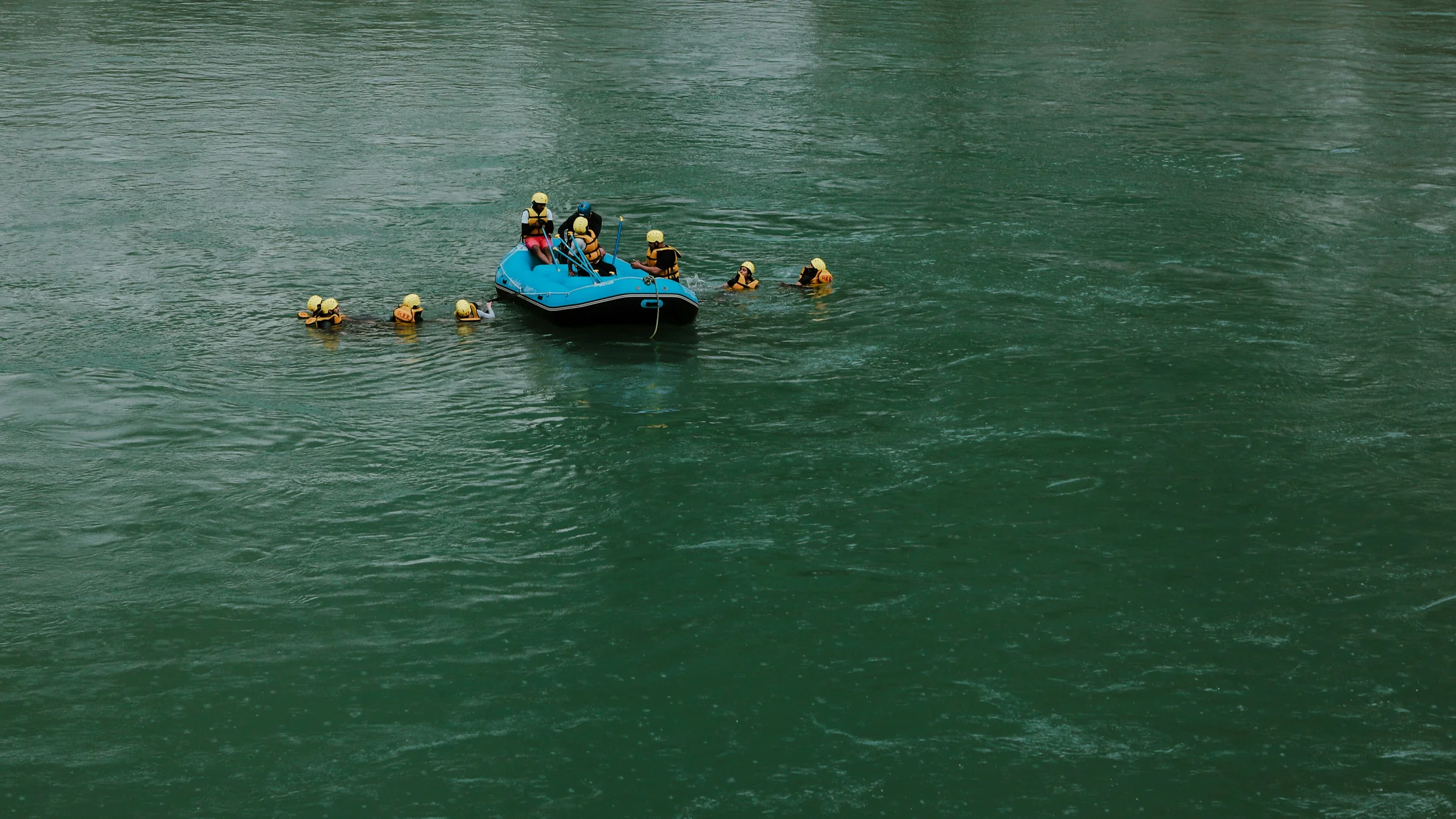
When the rivers awaken: the brief window of the thaw
In April, the Pyrenees riverbeds flow with more water due to the thaw, and spring rafting is only possible for a few weeks. This short window changes the river map: flow rates rise, ephemeral rapids appear, and sections become available that cannot be done in summer.
The cold mist over the water and the afternoon sun lighting up the snowy peaks accompany the raft as it glides. The trade-off is greater demand: you must look after safety, choose the section well, and plan with precision.
In the following pages, you will see why spring changes the game, which rivers work and when, how to reach the key valleys, and what equipment and guides to choose. You will also find references to flow rates, roads, basic regulations, and useful signs to decide whether to go out or wait, and a route to book well and paddle with confidence.
Thaw in the Pyrenees: from snow to rapids
Every spring, the snow stored in the Pyrenees turns into the water that moves the rapids. In winter, the mountain range accumulates snow at medium and high altitudes; as temperatures rise between late March and May, that solid reserve becomes runoff and feeds the thaw rivers.
The flow rate has daily and weekly peaks that depend on altitude, the orientation of the slopes, and rain episodes. The valleys to the north and in the shade release water later, while the sunny slopes and medium altitudes activate earlier.
That is why the same section might be navigable in April and another only in May: choose the river and the date according to its orientation and altitude. The window can move forward or backward by several days due to a warm front or a late snowfall, so the activity date is confirmed with little notice.
Operators consult the Automatic Hydrological Information Systems (SAIH) —CHE for the Ebro basin and ACA for the Segre/Noguera— and AEMET warnings to adjust schedules. Depending on the flow rate, the outing is scheduled during the thaw afternoons, when the river carries more water, or at safer hours if the peaks are high.
Who this guide is for and what you are going to find
If you have already rafted through class II–III and want to make the leap to III–IV sections, this guide is for you: in spring, those sections only exist for three months. Families can do initiation sections with guides and reinforced safety, and intermediate level groups find technical lines.
The smell of damp pine and warm neoprene marks the river mornings. Here you have files by river —Ara, Noguera Pallaresa, Ésera, Gállego, and Cinca—, with the best dates, access, typical duration, levels, basic rules, and what to check before booking.
Book in advance if you are looking for a III–IV section in spring: the flow rate rules and guided spots fill up. Check your river's file, check the level and the material before heading out.
Picuco te puede ayudar
Does something here catch your eye?
Tell us.
Write to us on WhatsApp or email: we answer questions, find the best options and help you sort out the booking.
The essentials before booking
In spring, typical flow rates rise significantly: rivers that drop to 10–30 m³/s in summer can multiply up to 40–120 m³/s for weeks, with daily peaks after midday; confirm values in SAIH Ebro (CHE) and ACA, not on guesswork. The murmur of floodgates and the roar of the rapids will tell you that the snowmelt is already in command.
Basic rules and permits: in Aragón and Catalunya, registered active tourism companies coordinate quotas, access, and insurance; if you go with an operator, the paperwork is covered. Sections in parks and reserves have access and parking limitations, and respect for riverbanks, fauna, and fishing zones is strict; ask about local restrictions (Ayuntamientos, CHE, ACA). The International Scale of River Difficulty (I–VI) classifies the rapids: in spring, the same section can rise half a class due to flow, navigable but more continuous and cold; interpreting that jump correctly avoids scares.
The weather is in command: water between 6–10 °C, changing air, afternoon storms, and rapid snowmelt during heatwaves. This impacts boarding schedules (sometimes safe mornings, other times more fluid afternoons) and section selection (avoiding narrow passages with drifting wood). Your helmet visor will get wet with icy droplets in the first wave train.
Differences by province: in Huesca, free rivers like the Ara and the Ésera depend on pure snowmelt, more unpredictable and explosive; in Lleida, the Noguera Pallaresa combines snowmelt with reservoir regulation, which prolongs navigability and facilitates the scheduling of descents. Signage: the usual put-ins and take-outs are near bridges, recreational areas, or side tracks; many companies install temporary signs and shuttle vans, but do not expect official panels at every point.
Before booking, create your "mental checklist":
- Current flow and trend (SAIH/ACA) and water temperature.
- Group level and minimum age required by the operator for that section.
- Logistics:
N-260open, roadworks, and travel time between boarding and disembarking. - Cancellation policy due to flow/storms and included insurance.
- Equipment: available sizes, thick neoprene (5 mm) and closed boots.
- Environment: fishing zones, nesting areas, or livestock movement on riverbanks.
Reference sources: SAIH Ebro (CHE), ACA (Xarxa SAIH), AEMET bulletins, and the International Scale of River Difficulty (American Whitewater). Take notes on your mobile and compare them with your guide's judgement.
Spring rivers: where to paddle when the Pyrenees melt
In spring, discreet riverbeds turn into foam highways or compact technical lines. Each valley has its own character, and these practical river guides help you choose the section, date, access, and level.
| River | Zone | Spring level | Duration | Highlighted section |
|---|---|---|---|---|
| Ara | Huesca | III–IV depending on flow | 2–3 h | Torla/Broto–Fiscal |
| Noguera Pallaresa | Lleida | Flow regulated by the La Torrassa Reservoir | 2–3 h | Llavorsí–Sort |
| Ésera | Huesca | III–IV | 1.5–2.5 h | — |
| Gállego | Huesca | — | — | Carcavilla–Murillo de Gállego |
| Cinca | Huesca | — | 4 h | Laspuña–Aínsa |
The Ara flows with level III–IV depending on the flow and is paddled in 2–3 hours. Its best-known section goes from Torla/Broto to Fiscal, and you reach it via the N-260 in the Broto Valley.
It costs €49 for adults and €35 for children under 12, and the recommended season goes from spring to mid-October. You must know how to swim and, if you are under 18, you need parental authorisation.
The Ésera has level III–IV in spring and is paddled in 1.5–2.5 hours. In the Gállego, the reference section is Carcavilla–Murillo de Gállego.
It is also necessary to know how to swim here.
Before booking, check the flow for the week and choose the section according to your experience. Spring outings fill up on weekends, so it is advisable to book in advance.
1. Ara: the wild classic of Huesca
The deep rumble reaching from the stone bridges at dawn warns that the Ara has awakened. It is the last great Pyrenean river without dams in its main course, and in spring, this is evident in its free flow.
The classic rafting section runs between Torla and Broto, through a limestone canyon with continuous rapids. During the descent, you can see the Mallos de Broto.
The difficulty in spring is III–IV, with continuous passages and wave trains; during strong peaks, it can border on technical IV+ for large rafts.
The equipment is 5 mm neoprene, windbreaker jacket, CE EN 12402 life jacket, and EN 1385 helmet. After floods, logs may appear, known as "river trees": the guide decides whether to portage if there is wood in the line.
As it is a free river, the flow depends on the snowmelt and the sun from the previous day, with milder mornings and afternoons with more water. Consult the SAIH Ebro (Broto/Fiscal station) and confirm the safest window with your guide; those data are informative and do not constitute official alerts.
The season goes from April to June, during the snowmelt period, and the full activity lasts 2–3 hours. You must know how to swim and have adequate physical fitness, and it is recommended not to be afraid of the water; the maximum is 6 people per boat with a guide.
2. Noguera Pallaresa: the heart of Pallars Sobirà
The Noguera Pallaresa combines snowmelt, reservoir regulation and simple logistics, and that is why it is the epicentre of this sport in the province.
In spring the water is continuous and fast, but you navigate with guides.
It features a typical descent of 2–3 hours, with half-day options and combinations with hydrospeed or kayak. The classic Llavorsí–Rialp section lasts 2 h 30; there are short introductory descents between Llavorsí and Moleta and long descents up to Collegats for a full day.
The upper reservoirs extend the season, normally until summer, and stabilise the flow schedules. In April and May, snowmelt rules: check the flows at the ACA (Xarxa SAIH Segre–Noguera) before booking.
The itineraries have good evacuation, qualified staff and visible rescue protocols, something useful to secure dates during the spring peak.
3. Ésera: pure technique and mountain
The Ésera is born in the Maladeta massif and gathers the snowmelt from high peaks before narrowing its way towards Campo and Graus. In spring it offers fast lines, clean water movements and rapid response to temperatures, making it a very beloved technical gem. The scent of resin and wet rock accompanies the runs.
-
Recommended sections:
-
Duration: 1.5–2.5 hours depending on section and level.
-
Safety: the Ésera reacts quickly to thermal rises; if there is a strong peak, go early or choose a lower section. Control of “hydraulics” (stationary eddies) in low dams or ledges.
-
Context: it is a key part of rafting in the province of Huesca; many bases are in Campo and Benasque due to their centrality and services.
The echo of joyful shouts is lost among limestone walls while the raft cuts through a perfect train of waves.
4. Gállego: variety and good access
The Gállego allows you to choose the difficulty level and have villages with services nearby.
The Murillo de Gállego–Embalse de La Peña section has difficulty II–III and is suitable for beginners, with gentle waves and space to manoeuvre. In the upper sections, depending on the flow, the movements are more powerful and III–IV passages appear when the snowmelt pushes. The rapids have names like "El Embudo" or "La S".
The activity lasts between 1.5 and 2.5 hours, so it suits families and mixed groups. There are shifts at 10:00, 13:00 and 16:00. To confirm your spot, you need an online deposit of 10€ per person; you pay the rest on the day of the activity.
The minimum age is 14 years for the full section and 8 years for specific sections, avoiding the El Embudo rapid. You must know how to swim, and it is not suitable for pregnant women or people with heart conditions or serious medical problems.
Evacuation is good and there are viewpoints next to the road. Watch out for occasional water releases and wood after storms. The water is cold in April: add a thin thermal layer under the wetsuit.
There are services in Murillo de Gállego. The sound of the river competes with that of the swifts cutting through the sky above the Mallos.
5. Cinca and tributaries: charming alternatives
The Cinca, in Huesca, is suitable for rafting in spring. Between Laspuña and Aínsa lies the most navigable stretch of the Cinca.
The Laspuña–Aínsa rafting stretch costs €60 for adults and €50 for those under 14 years old. It has difficulty II–III in mid-seasons: it is great for families with a guide and for groups wanting to add kilometres without any scares. It is a good place to polish paddling technique, falls, and re-entries.
For rafting, you have to know how to swim and bring a swimsuit, towel, sunscreen, and footwear that can get wet. Navigation depends on the snowmelt: stretches open and close quickly depending on snow and rain. Be flexible with dates, check flow rates, and adjust expectations with the guide.
The glacier-origin valley is trough-shaped, with a beech forest at its head. It is a habitat for trout and the Pyrenean desman, and birds such as the bearded vulture, the golden eagle, and the dipper live there. At sunset, the sheet of water reflects the snowy peaks while the river flows down with a constant murmur.
You arrive via the A-138 (Bielsa–Aínsa) and the N-260, with parking near bridges and recreational areas. From Barbastro, take the N-123, divert via the A-138 towards Aínsa and continue until Bielsa and the bottom of the Pineta valley.
When to go: the three-month season that changes everything
Rafting in the Pyrenees depends on the snowmelt: the season is concentrated between April and June and the snow dictates the calendar. When the daily thermal gradient dissolves the snow, flow rates rise, and spring rains amplify them.
May and June are the months of highest flow, ideal for mid-high level kayaking and rafting. Orientation matters: the shaded slopes retain snow and stagger the peak flow, while the sunny slopes concentrate early snowmelt. The smell of wet earth after a light rain is the best "report" for a river Sunday.
Southwesterly storms spike flow rates within 24–72 hours, and afternoon convective storms add brief pulses. In the SAIH, regular rises in flow every afternoon indicate a good fusion rhythm; sharp peaks with abrupt drops warn of risk and floating wood. If the water is below 8 °C, prioritise wide stretches and avoid prolonged technical manoeuvres with novice groups. And if snow still covers 1,800–2,000 m at medium altitude, expect a second rising wave of flow in the following weeks.
Every river has its window. In the Gállego, April until mid-May offers variety, and Saturday mornings have less crowding than the afternoons.
If your schedule is fixed, book with a buffer of 2–3 weeks between late April and mid-May. If you can move around, monitor flow rates and choose your window 48–72 hours beforehand.
How to get there and where to sleep near the water
In spring, moving through the Pyrenean valleys requires combining main roads with mountain stretches. Calculate extra time: roadworks and late snow on high passes can lengthen the journey.
The approach via the N-260 at dawn takes place among curves, with the river appearing every little while. Leave early if you want to reach the rafting starting point with margin.
Sleep near the water in the valley villages, a short distance from the embarkation points. Book in advance for spring weekends, when the best flow conditions coincide with more people heading up to the mountains.
Access, transport and parking
Reaching the meltwater rivers requires a car and some prior planning. Access points change depending on the valley, and the travel times from reference cities will help you decide when to set off.
From Zaragoza, it takes you 1 h 50 min to the Ara (Fiscal) and 2 h 4 min to Torla-Ordesa. You reach the Ésera (Campo/Benasque) in 2 h 30–3 h. From Huesca, the A-132 leaves you at the Gállego (Murillo) in approx. 41 min.
If you are coming from Catalonia, the Noguera Pallaresa (Llavorsí–Sort) is reached via the A-2 and the C-13: 2 h–2 h 15 min from Lleida and 2 h 45–3 h 30 min from Barcelona.
In the Huesca valleys, provincial buses are limited, so the most practical option is using your own or a shared car. Park in designated areas near bridges and recreational areas and avoid private tracks.
Operators usually manage shuttles between take-out and put-in: ask about the schedules to coordinate your return. On peak meltwater weekends, arrive 20–30 minutes early to gear up calmly and avoid blocking access. The smell of thermos coffee and sunscreen will remind you that the day starts before you enter the water.
Accommodation: rural houses, campsites and bases by the river
Sleeping near the river decides how early you have to wake up the next day. In the base villages of the Pyrenees, there are rural houses and small hotels, riverside campsites with bungalows and space for wet equipment, and mountain refuges at high altitudes to combine with hiking or spring skiing.
Look for accommodation 15–20 minutes by car from the river or the activity base: you will save yourself early mornings. If you are travelling in a group, ask about early breakfasts, space to dry wetsuits and bike storage if you are combining activities. Also consider parking and nighttime silence if you are heading out for the first shift.
Spring is changeable, so check for flexible cancellation policies due to conditions. Weekends in April–May fill up fast: book 2–4 weeks in advance. During the week, there are better prices and less traffic on the rivers.
The crackle of a stove and the dripping of suits hanging on the porch give off that expedition camp vibe.
Safety, levels and tips for success in spring
In spring, rivers run with more water and the decision on how to descend carries more weight than in summer. Before booking, choose your difficulty level, equipment and guide with care.
Check the difficulty scale of the section and the predicted water level for your date before booking. With those two pieces of data, you will know if the descent fits your experience and with whom you are going.
The water remains cold in spring and that is an added risk. Consider a wetsuit and thermal protection before your first dip.
The company or the guide taking you is what makes the difference in safety. Ask about their experience on the section and about the equipment they make available to you.
Difficulty levels and participant profiles
The International Scale of River Difficulty classifies rivers from I (very easy) to VI (extreme, non-commercial). Before booking, check which class your section falls into: it indicates the type of water, the audience, and the equipment you will need.
Class I–II: moving water, small waves and rare capsizes; ideal for families and first experiences. Class III: sustained waves, clear manoeuvres and possible controlled falls; suitable for sports initiation and active groups. Class IV: strong movements, precise lines and probable rescues if there is a capsize; reserved for fit participants with an experienced guide. Class V: very high risk and complex manoeuvres; usually not offered commercially in spring for standard groups.
In the Pyrenees, you have examples of every level. The middle Gállego, in the Mallos de Riglos canyon, presents class III and IV rapids. The Llavorsí–Rialp section, in the Noguera Pallaresa, includes class IV rapids such as "La Lavadora". The lower Ésera is an option for medium days, of class III. The lower Cinca is navigated between the Laspuña bridge and Ainsa, with classes II and III, and the landing is at the Ainsa market car park, east of the Cinca bridge. For class IV, the middle Ara in May, under the peaks of the Ordesa y Monte Perdido National Park, has a meeting point at the base of Broto.
Regarding physical condition, it is advisable to know how to swim 25 m, endure a brief immersion in cold water and climb into the raft with assistance.
The rhythmic tapping of paddles in the air synchronises the team before entering the rapid.
Read the season carefully: if the section is "III with water", treat it as "III+". Ask about optional portages for tough passages before closing your booking.
Safety and equipment: what to bring and what the company provides
In spring, the water is cold and equipment makes the difference. The company usually provides you with a 4/3–5 mm full wetsuit (or 5/4 in April), a jacket and booties, as well as a CE EN 12402 approved life jacket (50–70 N depending on size) and an EN 1385 whitewater helmet.
The raft, paddles, safety rope, first aid kit, river knife and the guide's whistle are provided by the company. You bring a thermal swimsuit or a thin merino layer under the wetsuit, a towel and a full change of clothes for afterwards, sunscreen, water and a salty snack.
Test the fit before boarding: the life jacket must fit snugly without riding up when pulling on the shoulders and the helmet must be firm without pressing. If you feel limited in your shoulders, ask for a larger wetsuit size: you will paddle better and retain heat.
The cold is the real risk. Immersions are short, thermal layers are used and the guide rotates the crew if someone is shivering. In sections with wood and debris, the guides do scouting and portages; follow their instructions to paddle hard or duck down. In powerful hydraulics at the drops, enter at an angle with a marked line and paddle with everyone.
If you fall, float on your back, with your feet downstream and protecting your head. Listen to the commands and swim towards the raft via the outside of the rapid. If someone else falls, throw the rope only if you are stable and trained; the guide coordinates.
The rough feel of the rescue rope on wet hands reminds you that safety is teamwork.
Guides, permits and how to choose well
In whitewater, the difference between a good day and a scare lies in who is leading you. Before booking, look at the team's training and their experience in meltwater rivers.
Choose guides with specific whitewater training (IRF or national certifications) and up-to-date first aid. Also value the operator's local experience: knowing seasonal rivers and how they behave during meltwater peaks changes the way the descent is planned.
In class III–IV waters, the usual guide/participant ratio is 1/6–1/8. With more water in class IV, lower ratios add safety. Ask for confirmation of the insurance, including civil liability and accidents and their coverages, and check the equipment: inspected rafts, helmets and life jackets in good condition and in a wide range of sizes.
Companies must be registered in Turismo Activo de Aragón/Catalunya and coordinated with the Confederación Hidrográfica del Ebro (CHE) or the ACA. Respect fishing bans, nesting fauna and the limited zones of the parks, and follow the instructions of town halls and Protection Agents.
Read reviews, but prioritise technical information: flow rates, protocols and cancellation criteria for safety. Contact them beforehand and explain your experience, age and expectations so they can place you in the appropriate section and time slot.
Reference prices are around 45–75 € p. p. for a half day, depending on the river and the season. It is necessary to book in advance.
Upon entering the base, the smell of clean rubber and neoprene is a sign that they are up to date with maintenance.
Frequently asked questions
How long does a typical descent in spring last?
A half day of rafting involves 1.5–3 hours in the water, depending on the river and the flow rate. To that time, add 30–45 minutes to equip yourself and for transfers.
During meltwater peaks, some sections are done faster. Guides adjust the start and end of the descent to take advantage of the waves and guarantee safety.
The clock runs faster when the spray splashes your face. Calculate a full half day including preparations, water and the return to the starting point.
What is the recommended minimum age?
The minimum age depends on the river class and the flow rate of the day. In class II, they usually accept children from 8–10 years old if the child knows how to swim and the flow is moderate. In class III, the usual minimum age is 12–14 years.
The exact age varies by operator and by the flow rate of the day, so it is advisable to confirm it when booking.
Always ask for a well-fitted helmet and a life jacket in your size.
What happens if the flow is too high or there is a storm?
Operators follow the SAIH/ACA and the AEMET forecast, and they may change sections, move the time or cancel without cost according to their policy. Ask about the "safe window" of the day and agree on a plan B before leaving.
Often, the day can be fixed with a small adjustment: moving to the morning or going down to a section with less water. Ask for that change as soon as you see the report, because the good spots fill up quickly.
Do I need previous experience?
For a class II–III descent, no previous experience is needed: a good attitude, knowing how to swim and following the guide's commands is enough. It is the level with which most people usually start in spring.
In class IV, it is advisable to have done rafting before or to have practised in whitewater. If you have doubts, start in class III and increase your level according to the guide's criteria.
How does snowmelt affect the price and the schedules?
Snowmelt moves the water, but demand moves the price of rafting. Rates do not usually vary due to the flow, but rather due to weekend influxes and the logistics of the shuttles.
Schedules do follow the rhythm of the snowmelt: in the morning you set off with less water and in the afternoon with more. The guide decides the schedule and the section according to the safety of the group, so it is advisable to plan with a margin for last-minute changes.
What to bring for after the activity?
Bring a complete change of dry clothes, comfortable footwear, a towel and something to eat for after the activity. You will appreciate it as soon as you get out of the water.
At the bases with showers, ask if you need flip-flops. A light fleece comforts you when the valley wind blows.
Book your experience — discover active tourism activities in Spain with providers verified by Picuco.
Conclusion: three months of foam and mountain
Spring in the Pyrenees offers brief opportunities: free rivers like the Ara and the Ésera flow strongly, the Noguera Pallaresa offers reliability and variety, and the Gállego opens doors to all levels. If you choose the dates and section well, spring rafting gives you descents with safety and high mountain landscapes.
Before setting off, monitor the flows at SAIH Ebro/ACA and the AEMET reports. Define the group level and the minimum age, and choose the section accordingly. Verify equipment, insurance and the company's cancellation policy.
Plan your access via the N-260, the C-13 and the A-132, and allow for shuttle times. With this list and a good guide, you will sit in the raft with calm and energy to paddle every wave.