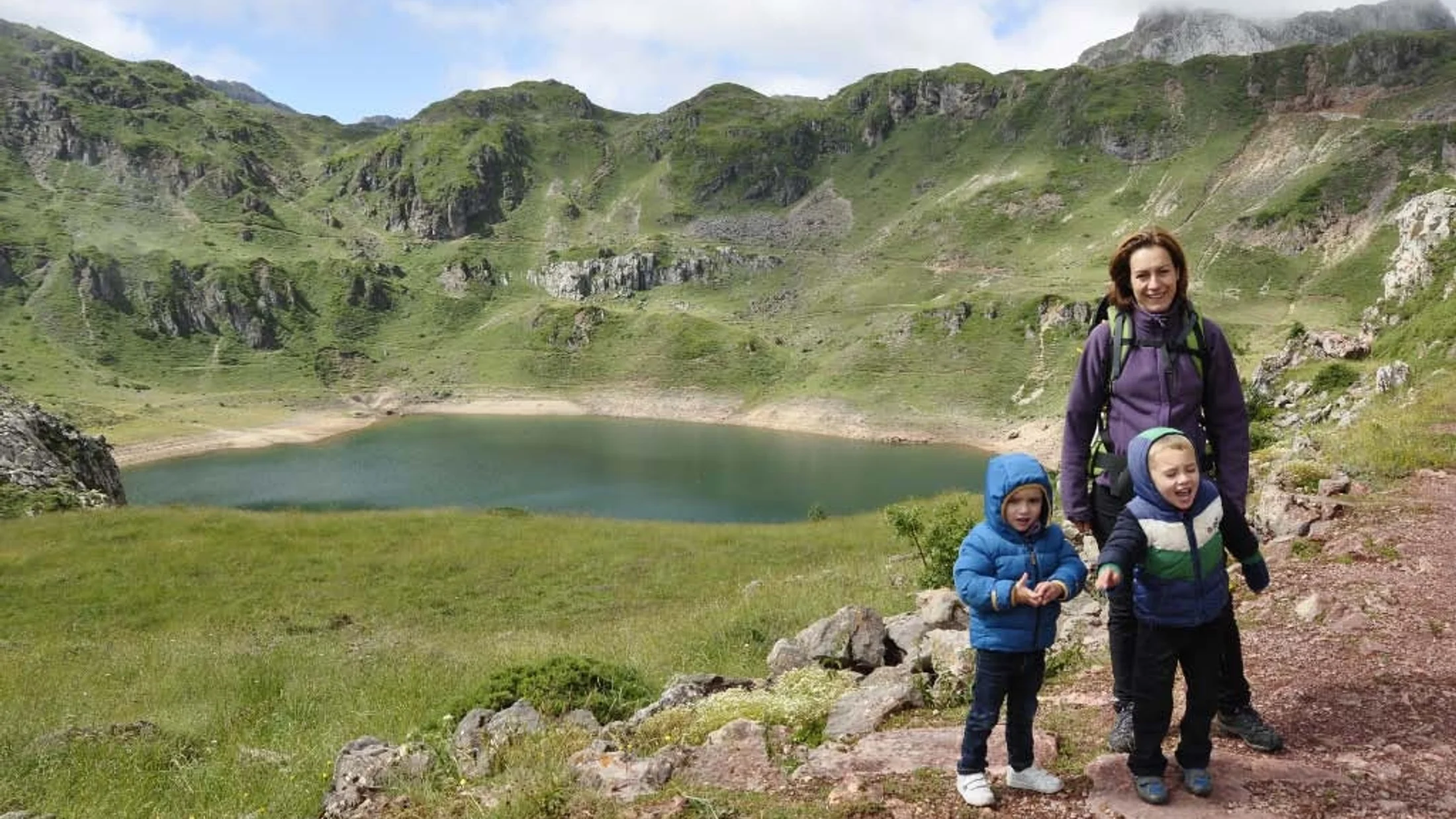
Somiedo with family: nature that sparks curiosity
Somiedo works well with children: fresh air, simple routes and authentic rural life in the southwest of Asturias. The Somiedo Natural Park was declared in 1988 and has been a UNESCO Biosphere Reserve since 2000.
Inside the park there are glacial lakes, forests and mountain pastures where transhumant livestock farming is still alive. It is organised into four large valleys (Pigüeña, Somiedo, Valle and Saliencia), with altitudes ranging from 400 m to over 2,000 m on peaks such as Cornón, the highest point in the municipality at 2,194 metres. Lago del Valle is the largest in Asturias.
The park has marked hiking routes and well-signposted viewpoints, with reasonable access and villages with basic services. The emblematic fauna (brown bears, western capercaillies, red deer) and the possibility of spotting Pyrenean chamois and birds of prey such as golden eagles or griffon vultures make every walk an opportunity to observe and learn. The sound of cowbells blends with the flight of vultures over green valleys.
The following plan is a realistic and flexible three-day itinerary, with short routes, educational ideas and breaks calculated for different ages. You will also find directions on how to get there, where to sleep and what equipment to bring. If you want to refine the wildlife watching part, book the guided outings in advance.
What you will learn and how to make the most of it
Planning Somiedo with children is solved with concrete data: times, elevation gains and alternatives by age. This section gathers the steps to organise the family visit without any surprises.
Inside you will find a 3-day itinerary and family routes with distance, duration and level. There are also educational activities by age groups, from 3 to 12+ years, and criteria for choosing rural accommodation in Somiedo, with recommended areas and price ranges.
The practical part includes where to park, how to coordinate the bus and what to expect with the weather. Key rules regarding fauna, dogs and mountain pastures are added, along with official resources to check schedules and weather reports.
If you travel with family, start by choosing dates and adjust the plan with the comparative tables and equipment lists.
Picuco te puede ayudar
Does something here catch your eye?
Tell us.
Write to us on WhatsApp or email: we answer questions, find the best options and help you sort out the booking.
Where it is, when to go and how to move around with little ones
Somiedo is best explored with generous timeframes: leave margins for a nap or for the little ones to play for a while. Planning the trip before leaving saves energy during the stay.
This section helps you locate the park, understand its microclimate and organise your arrival, by car or by public transport. On the shaded paths, you can hear the murmur of streams by the side of the way.
With this data, you can decide when to go and how to move around the park with children.
Where it is and the best time to visit
Somiedo occupies the southwest of Asturias, adjacent to León, and the AS-227 crosses it from Belmonte de Miranda to Puerto de Somiedo. Pola de Somiedo is the reference village for services and Valle del Lago is the access point to Lago del Valle.
Altitude rules the plan: La Farrapona is at about 1,708 m and Puerto de Somiedo is around 1,486 m, so temperatures drop and snow appears in winter. La Farrapona is reached via the SD-1 road from the AS-227, passing through Veigas, Arbellales and Saliencia; there are hairpin bends at the altitude of Arbellales and a short, wide tunnel without lighting. The surroundings are high mountain, with peaks exceeding 2,000 m.
You can go up to the Lagos de Saliencia from Saliencia via an asphalted road or from Torrestío (León), leaving the car and walking 4 km along a track.
Each season changes the trip with children:
- Spring (April-June): flowers and young animals, lush meadows and trails with some mud; bring a windbreaker and boots.
- Summer (July-August): long and dry days at altitude, with more people at the iconic spots; get up early to park and walk during the cooler hours.
- Autumn (September-October): intense colours in the beech forests and mild temperatures, a good time for mid-morning routes and picnics.
- Winter: access may be affected by snow or ice; only recommended with experience and by checking the daily reports.
For families, May-June and September are the months of greatest comfort; in summer, getting up early and booking in advance works well.
Permits, rules and basic safety
Somiedo has 13 marked hiking routes, several of them starting in Pola de Somiedo. The park rules protect the fauna, the livestock and the brañas that you are going to see with the children.
Wild camping is prohibited by the regional regulations for protected spaces. Dogs must always be on a lead to protect the fauna and the livestock. Do not enter fenced meadows or tamper with the brañas' enclosures.
A teito is a traditional vegetation roof and can be damaged by friction: it is enough to just look and take photos. The use of drones is restricted or prohibited without authorisation.
A close encounter with bears is very unlikely, although there is a stable population. Keep a long distance, ideally more than 200 m, and do not leave food or scraps. Never approach with children to observe bears off the paths.
The morning is a good time to see fauna from a distance; the air smells of cold earth. Leave early, bring water and mountain footwear and calculate the return time before it gets dark.
How to arrive and move around: car and public transport
The AS-227 road connects Belmonte de Miranda with Puerto de Somiedo. The final bends invite you to stop at viewpoints; the low light paints the heath in gold at sunset. With little ones, plan a break every 60-90 minutes and bring anti-nausea bags if they get motion sickness.
-
Parking:
- Valle del Lago: parking in the village; respect signage and resident zones.
- Pola de Somiedo: surface parking, a convenient base for moving around.
Check with the Consorcio de Transportes de Asturias for updated schedules and connections. From Pola, local taxis or arranged transfers can take you near the start of the route; coordinate the return to avoid waiting with children. Always have a short plan B if a bus is delayed, such as visiting the Centro de Interpretación de la Naturaleza.
Where to sleep well with little ones: areas and accommodation
In Somiedo, there are rural houses, small hotels and campsites scattered across valleys with character. Sleeping near the next day's route changes the plan: with children, arriving rested at the start weighs more than anything else.
Choose your base village according to your children's age and the services you need. A village with a shop and bar close by simplifies dinners and mornings; if the little ones are small, look for accommodation with spacious rooms and parking nearby.
Here is which villages to choose, which services to value and which type of accommodation fits best with each age. Book in advance during bank holidays and summer: the supply is limited and fills up quickly.
Villages and recommended areas to stay
With children, the area you choose decides a large part of the logistics for each day: it is worth balancing nature and services.
Pola de Somiedo has supermarkets, a pharmacy, restaurants, a playground and a nearby interpretation centre. It is the option for a first visit, with babies or if you are looking for simple logistics.
Valle del Lago leaves you at the doorstep of the Lago del Valle route, in a serene environment. There are fewer services, so buy supplies and refuel in Pola before heading up.
Saliencia and La Peral are close to La Farrapona and the Saliencia Lakes, although dining options are limited out of season.
The morning mist descends between cabins like a light sheet.
If it is your first time and you are travelling with small children, choose Pola; if you prioritise silence and walking out from your door, opt for Valle del Lago.
Types of accommodation and what to look for with a family in mind
In Somiedo, most families sleep in rural houses, small hotels or campsites, and each option changes daily life with children quite a bit. Choose according to what you need: your own kitchen, breakfast sorted or a tight budget.
Rural houses and apartments usually have equipped kitchens, washing machines, cots and highchairs upon request, and space for play. Many include a garden or an outdoor meadow where the little ones can burn off energy after the route. After a hike, the warmth of the wood and the fireplace is appreciated on cool nights.
Small rural hotels include breakfast, offer family or interconnecting rooms and close personal service. Ask if they prepare picnic lunches for excursions.
Campsites and motorhome areas have shaded pitches, bungalows, play areas and laundry facilities. It is the simplest and most budget-friendly option, and it is usually very popular with little ones.
As a guide per night in mid-season: apartments and rural houses 80-140 €, rural hotels 70-130 € and bungalows 60-110 €. Before booking, ask about extra beds, stair barriers and if they allow pets. Confirm prices and details on Picuco or on the official websites of each accommodation.
Bookings and peak demand
Somiedo fills up in July and August, during bank holidays, and in autumn, when the forests turn red. If you travel with children, accommodation makes the difference between a relaxing plan and a rushed one.
Book 6-8 weeks in advance during high season and 3-4 weeks in spring and autumn. Choose accommodation with flexible cancellation: the weather in the mountains changes, and it is advisable to be able to change dates at no cost.
Communicate what you need in advance: a cot, early breakfast times, or recommendations for guided wildlife routes. When asking, confirm if the accommodation has cots, high chairs and baby baths, and if they provide printed information on family routes. On days when you need to head out early, ask if they offer breakfast to take away.
In October, the aroma of roasted chestnut accompanies short walks that are perfect with children.
3-day itinerary: play, trails and attentive looks
Three days in Somiedo allow you to walk slowly, stop to look, and eat without rushing. The plan combines gentle walks, learning moments, and stops to eat, with a pace adapted to children.
Each day has its own objectives, timings and difficulty level. You will also find alternatives depending on the children's age and dining options, so you can adjust the plan to your family.
Day 1: Brañas de Somiedo and gentle walks
The first day is for getting to know the brañas of Somiedo and their teito architecture with a gentle walk, suitable for families. The brañas are high-altitude settlements that shepherds used in summer, with stone huts and vegetable roofs.
It is linear and measures 6.5 km, with 170 m of elevation gain: calculate 2-2 h 30 min with children. The difficulty is easy-moderate due to the terrain and the gentle slope.
Access begins in Llamardal, after passing Caunedo from Pola de Somiedo and taking a diversion to the left. The braña has 25 very well-preserved teito huts, with restored enclosures and cabins, and retains ancient olleras to keep milk with running water. Light filters through in patches between mountain avens and pastures, and it smells of dry grass.
To make the walk engaging, suggest a scavenger hunt: have the children look for "braña signs" such as watering holes, a stone enclosure or an intact teito. With toddlers aged 3-5, bring a baby carrier and make two 10-minute stops. With 6-9 year olds, add a mini-mission to draw a hut. With 10-12 year olds, explain why the teito insulates against the cold: the straw traps air, which is a poor conductor.
There may be local cattle: keep your distance and avoid touching the fences. If it rains, the plan B is the Park Interpretation Centre in Pola de Somiedo, with an audiovisual and interactive exhibition on relief, geology, vegetation, fauna and ethnographic heritage, and a short urban walk with hot chocolate.
To eat, a picnic in a nearby meadow, making sure not to leave a trace, or a menu in Pola asking for hearty spoon dishes for children. Return early for a nap or for free play in a playground.
Day 2: Saliencia Lakes and landscape readings
The Saliencia Lakes read like a geology notebook: each cirque tells the story of how the ice passed through. Today it is time to discover them and learn how to look at a glacial landscape as a family.
The circuit starts from La Farrapona and passes by Lago de la Cueva and Lago Cerveriz. It is 6-9 km depending on the variant, with +250-350 m of elevation gain, taking between 3 and 5 hours with children and having an easy-moderate difficulty: the path is obvious, with stony sections.
Access is from the car park following the PR-AS 15 route towards the south. The recommended season is spring, summer and autumn. Arrive early to secure a parking space and walk clockwise: the first lake, La Cueva, has a wide shore to explain how the ice shaped the cirques.
Adapt the activity to the age. For 3-5 year olds, suggest "Find three colours" (green, blue, slate grey) and name animals that could live there. For 6-9 year olds, identify striking plants like heath and bilberry and explain why the mountains store water. For 10-12 year olds or more, locate moraines (rock accumulations) and note the altitude of La Farrapona (1,708 m) to compare temperature.
In the area, there is a presence of brown bears, Eurasian otters, Egyptian vultures and golden eagles. Wear closed footwear with gripped soles and avoid sandals. A windbreaker doesn't hurt even in summer: the breeze cuts like a soft razor on the mountain passes. Carry water and snacks, because there is limited shade.
With a baby stroller, limit the visit to the viewpoints near La Farrapona or walk only the first wide section to the views of Lago de la Cueva. On the stony sections, switch to a baby carrier.
Day 3: Watching without disturbing: wildlife at dawn and farewell
On the last day, it is time to watch more than to walk: an early outing to a viewpoint or mountain pass with good visibility to see roe deer, birds of prey or signs of bears. The difficulty is easy and the priority is silent logistics.
Choose a viewpoint with a wide view in the Pigüeña valley or in Somiedo and arrive 30-45 minutes before sunrise. Bring binoculars (8x or 10x) and, if you have one, a telescope; teach the children to scan the landscape by quadrants.
The golden rules are simple: do not call out, do not approach off the paths and do not leave a trace. Do not abandon the marked itinerary so as not to interfere with the conservation of the ecosystems. If it is your first time, consider an outing with an authorised guide who knows the slopes and winds: responsible bear watching maximises options and minimises impact.
In the Pigüeña valley, the starting point is the village of Villar de Vildas, where you can leave your vehicle, and the return is made via the same way back. Along the way, Braña de la Pornacal gathers 34 huts with vegetation covers (piornos or broom). From Braña Viella, you have a perspective of the Valle de los Cereizales and the Leonese valleys of Laciana.
End the day with a picnic in a designated area and a purchase at a local shop of regional cheese, honey and wood crafts—purchases that support those who care for the landscape. If there is fog or wind, move the observation to late afternoon or switch to the Prehistory Park in Teverga (30-40 min) as an alternative indoor plan. The Prehistory Park is at the entrance of San Salvador de Alesga and features a building that houses a gallery.
Activities for all ages: routes, centres and wildlife
Somiedo has plans designed for every age: short routes, interpretation centres and clear guidelines for observing wildlife. With young children, it is advisable to choose one activity per morning and leave the rest of the day free.
An early breakfast helps to face the day with young children, with the smell of toasted bread and butter on the table. Afterwards, it is time to walk little, stop often and look at the landscape calmly.
Somiedo family routes: 4 walks to enjoy without rushing
Four walks in Somiedo are perfect for walking with children without exhausting anyone: two mountain routes and two short and flat ones. Choose according to age and how you feel that day, and alternate long days with shorter ones.
During these walks, the teitos, the views of the valley and livestock farming are of interest. With children, a scavenger hunt and a story about pastoral life help to maintain interest.
Lago del Valle is the largest in Asturias, also known as Lago del Ajo: 24 hectares and a wide river plain at the final part. With young children, it is enough to reach the first majada and have a snack there. Leave the car in the village car park, before reaching L’Auteiro, and in summer and during bank holidays, arrive early. Respect private property and do not cross meadows with tall grass; it is easy to spot Pyrenean chamois, roe deer and birds of prey.
To set the pace of the hike, count "giant steps" between milestones.
The accessible route cutting through Pola and the Auteiro surroundings is a very easy walk along the riverbank and nearby meadows, ideal for transfers or the baby's nap. It begins in Pola de Somiedo, next to the stone bridge that crosses the Sousas river, and ends at the Mirador del río Aguino, with views of the Somiedo river valley and possible sightings of griffon vultures. Try the sensations circuit (stone, wood, grass) with your eyes closed.
Beech forests smell of sweet leaves when the sun warms up after the rain. Finish the hiking plan with an ice cream as motivation.
Interpretation centres and workshops that add value
In Pola de Somiedo, the Natural Park Interpretation Centre explains the geology, wildlife and traditional uses of the area. The exhibition features interactive and audiovisual elements regarding the relief, vegetation and the ethnographic heritage of the park.
If it rains or if you want to understand the environment before the routes, the Interpretation Centre is a good stop. Dedicate a morning to it and you will leave with clear ideas for the rest of the trip.
On special dates, a teitado workshop is organised. Ask at the ticket office for children's leaflets or downloadable colouring materials.
Before going, check the seasonal opening hours: they usually open in the morning and afternoon, closing at midday. Arrive with a 10-15 minute margin and ask about family discounts, combined tickets and card payments.
Bear watching in Somiedo: expectations and best practices
Seeing a bear in Somiedo is possible, but no one can guarantee it. The odds increase with a guide, patience, and outings at sunrise and sunset.
Responsible observation is based on three things: keeping your distance, staying silent, and using appropriate optics. Keep more than 200 m distance and bring binoculars and, if you can, a spotting scope with a tripod. Do not leave the paths or approach the cubs, and do not carry food in sight: keep scraps tucked away and avoid attracting wildlife. Always follow the instructions of guides and environmental agents.
With children, the educational goal can be recognising signs: tracks, droppings with fruit remains, and scratches on trunks. It is a way for the outing to be meaningful even if the bear does not appear.
Guided visits are carried out by authorised companies and guides, with small groups during the season. They cost 50 € per adult and 25 € per child (VAT included), last about 4 hours, and the meeting point is in Pola de Somiedo. There are daily outings at sunrise and sunset from 1 April to 31 October, and the activity is for those over 8 years old. The guide looks for the ideal spot with the highest probability of sighting.
If there is no sighting, celebrate the process: note down the birds observed (northern goshawk, griffon vulture, common kestrel), the weather, and the anecdotes. Book the visit in advance if you are travelling during high season.
Practical tips: equipment, safety and changing weather
In Somiedo the weather changes quickly and the mountain with children requires a method. With a clear list and simple habits, routes can be enjoyed without scares.
Equipment depends on age. From 3 to 5 years: technical t-shirt, thin fleece, waterproof windbreaker, thin hat, and an extra change of clothes. From 6 to 9: technical t-shirt, fleece, waterproof jacket, buff, and spare socks. From 10 to 12 years or more: base layer, light insulation and hard-shell, with thin gloves between October and May.
Wear hiking boots or trainers with gripped soles, no Crocs or smooth soles, and use high socks to avoid grass chafing. The backpack: 15-20 L per adult and 8-10 L for older children, with water and a snack, accessible raincoat, and a waterproof cover. Calculate 1-1.5 L of water per adult per day and 0.5-1 L per child, plus salty and sweet snacks such as nuts, bars, and small sandwiches.
Check AEMET the evening before and 2 h before leaving. If it thunders, descend from ridges, avoid isolated trees, and put away your poles; in fog, follow marked paths and turn back if you are in doubt: a "not today" is also a success. With cows and calves, maintain a calm distance, give them a very wide berth, or wait; dogs must always be on a lead and with a muzzle if they get excited by the livestock.
Carry a basic first aid kit: plasters, disinfectant, gauze, medical tape, children's pain relief, prescribed antihistamine, sunscreen, and after-bite. Add bags for waste and return with nappies and wipes. To orient yourself, use a waxed printed topographic map and a loaded offline app, and tell a third party your plan and estimated return time.
The family pace works with the 1-3 rule: for every 45 min of walking, 10-15 min of play. Rotate the role of "compass captain" among the little ones to maintain motivation. Do not pick flowers, photograph rather than collect, and, in damp areas, step on rock and marked paths.
Frequently asked questions
Are the Saliencia Lakes accessible for strollers or small children?
The classic route to the Saliencia Lakes from La Farrapona has stony and undulating sections, not suitable for conventional strollers. From Alto de La Farrapona, the trek to the first two lakes is manageable for children aged 6-7 with minimal preparation. In the mountain passes, the breeze is biting, so bring warm clothing even in summer.
Another option is to do the first section of the path to Lago del Valle and return. If you are looking for a plan without physical exertion, you have the interpretation centres and the ecomuseum.
For the excursion, pack an ergonomic baby carrier with a windproof hood, a hat, sunscreen and water: shade is scarce. Get an early start to avoid the heat and have a margin for the return.
What are the chances of seeing bears and how to act if there is a sighting?
Seeing a bear with the naked eye on a short solo outing is unlikely. The chances increase with authorised guides, who follow crossing zones and natural feeding areas.
Observation works best at sunrise or sunset, in spring and autumn, from viewpoints with wide visibility. With children, it is common to see silhouettes or brief movements at a distance, and many days only traces are detected.
If there is a sighting, keep silent and maintain a distance of more than 200 m. Do not approach or leave the path, and do not run or try to follow the animal. Explain to the children that watching from afar is part of the game.
Keep food in closed backpacks and do not leave scraps. If a bear crosses the path nearby, back away slowly without blocking its exit, keep the group together and speak in a low tone.
Consult official sources (Natural Park, Brown Bear Foundation) for updated guidelines and consider booking a guided outing adapted for families.
How long do the recommended routes for families last and what is their level?
La Braña de Mumián is a linear route of 6.5 km, taking between 2 and 2 h 30. The Saliencia Lakes, on their medium loop, require between 6 and 9 km at an easy-moderate level and have sections of loose stone. Lago del Valle is the largest lake in Asturias and the route has a duration of 2-3 h.
The children's age sets the pace. From 3 to 5 years old, expect 2-4 km in total and partial carrying: the goal is La Braña de Mumián with many stops. From 6 to 9 years old, you can do 5-8 km at a constant pace and with games, with the Saliencia Lakes as a medium variant. From 10-12 years old, if they sleep and eat well, they can reach 8-10 km and you can include variants and viewpoints.
To rest, you have watering holes and mountain passes with views and moderate wind, lake shores with flat stones for snacking and huts and shepherd shelters, without invading enclosures. Start walking no later than 10:00 and reserve 30-45 extra minutes for childhood unforeseen events.
Do I need to book guided tours or permits in advance?
Marked routes and interpretation centres do not require permits: simply arriving during opening hours is enough. Guided wildlife tours, however, should be booked in advance.
To see bears and birds with a guide, book with 1-2 weeks' notice. They fill up during high season and on weekends. Workshops and children's activities at the ecomuseums have limited capacity, so check the calendar with the Somiedo Town Hall.
Accommodation also moves quickly. For July-August and long weekends, book family accommodation or the bungalow 6-8 weeks in advance. If the forecast looks bad, ask about flexible cancellation policies and date change vouchers.
Bus schedules change, so check the Asturias Transport Consortium the day before and on the day of your trip.
Are there medical services, pharmacies and mobile coverage in Somiedo?
In Pola de Somiedo, there is a health centre and a pharmacy, with variable hours depending on the season and the day. In the smaller villages, services are limited, so bring your usual medication and a basic first-aid kit.
Before heading out on the route, download offline maps and share your plan with someone at your starting point. Keep your health cards and the accommodation contact numbers close at hand.
In emergencies, dial 112 and provide your approximate location: route name, last crossing or reference altitude. If you travel with allergies, identify the pharmacies in Pola and their holiday hours in advance.
Bring a power bank for your mobile and use airplane mode on the route to save battery. On clear days, in Somiedo you only hear the wind and the cowbells, without notifications.
Book your experience — discover active tourism activities in Spain with providers verified by Picuco.
Conclusion
Three days in Somiedo with children allows for gentle walks, the Saliencia Lakes, interpretation centres and a responsible wildlife watching outing. Bring layers, patience and the desire to listen to the territory and its people, who keep the teitos, paths and traditions alive.
Book in advance during high season and get up early to park in La Farrapona. Alternate long and short days so that the children's spirits stay high.
To adjust activities or add a guided wildlife outing, check updated options on Picuco and in the official resources of the Somiedo Natural Park. Upon your return, share your experience and your tips: you will help other families discover this valley with respect, calm and joy.