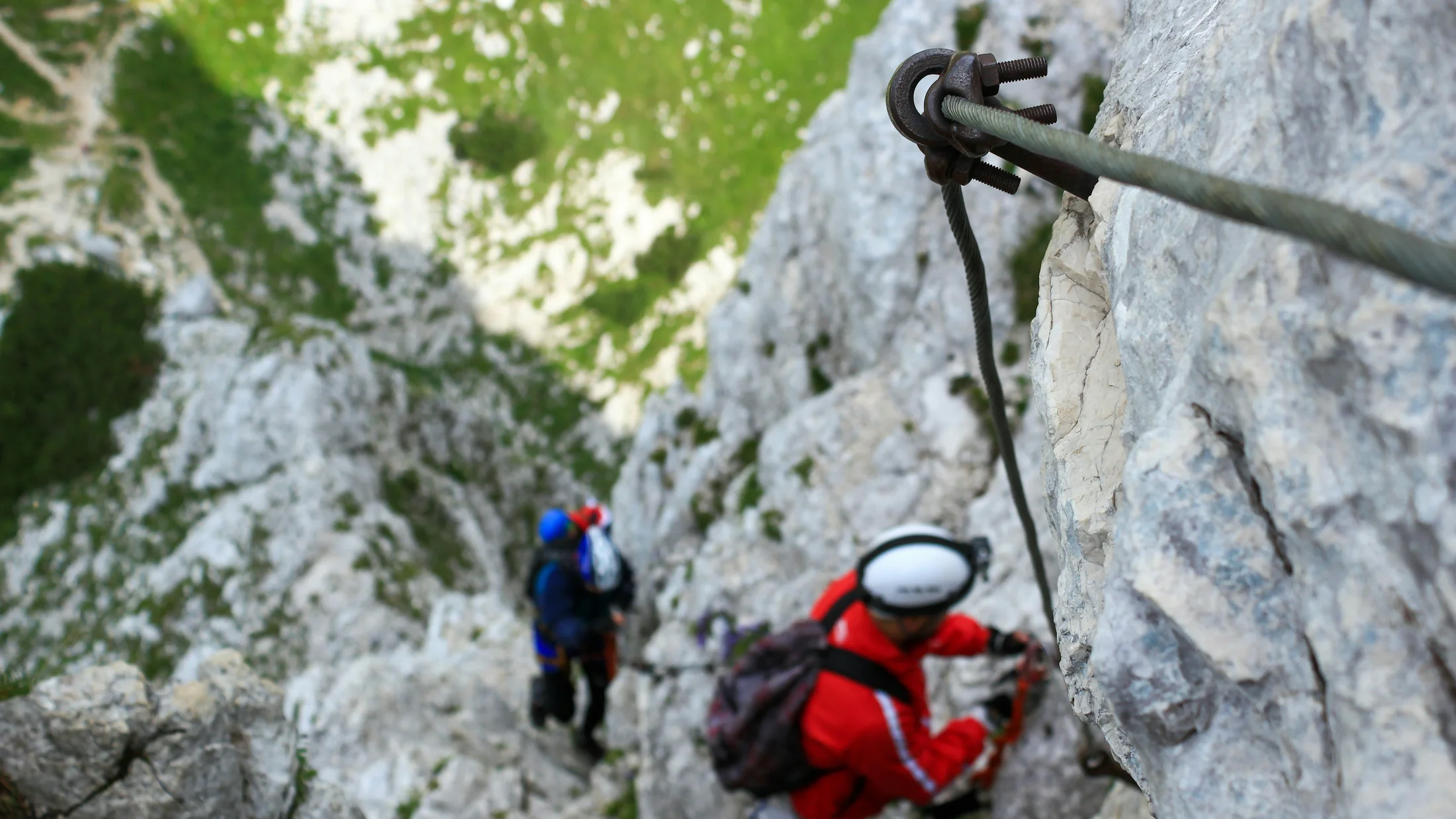
Why look for shaded via ferratas when summer heat intensifies
In July and August, a grip in the sun can burn your hand and fatigue arrives sooner than expected. The risk of heatstroke rises with every metre, so shade stops being a detail and becomes part of safety.
In Spanish mountain ranges and valleys, the thermometer often exceeds 30 °C at midday. North-facing aspects, forests, and canyons maintain 5–8 °C less and a more humid atmosphere, and that is the difference between enjoying and suffering.
At dawn, the rock still gives off the freshness of the night and smells of pine.
This selection brings together 6 routes with shade or a cool microclimate in Picos de Europa, the Pyrenees, and coastal mountain ranges. Each fact sheet indicates level, duration, sun orientation, why it stays cool, access points, and what to do nearby.
The selection criteria are safety (equipment in good condition, clear escape routes), accessibility (reasonable approaches), variety of levels, and the actual presence of shade or proximity to water.
If you are in doubt, start with an introductory route first thing in the morning and finish with a dip in a river or lake.
Heat changes via ferrata climbing
With 34 °C on the thermometer, choosing a north-facing slope or a canyon decides if the day goes well. On a via ferrata, high heat accelerates dehydration and reduces concentration, and that is noticeable during clipping and on exposed sections.
Rock in the sun can exceed 45 °C, heating up gloves and making every hold uncomfortable. Shade cuts that effect and stabilises body temperature. Valleys with rivers and waterfalls lower the thermal sensation and create local breezes, a microclimate that is noticeable when entering a canyon or a shady forest.
Upon entering a gorge, the murmur of the water dampens the summer buzz.
Shade, altitude (every 1,000 m usually drops 6–7 °C) and nearby water work in favour of the climber. Look for via ferratas with shade or near water between June and September, and avoid west-facing slopes, which accumulate heat in the afternoon.
Heatstroke gives no warning: dizziness, hot skin, and an accelerated heart rate are signs to stop.
What we have valued to choose them
In summer, shade rules: a via ferrata in full sun can go from a fun plan to a sweltering one in just a few metres. That is why we first look at the orientation of each route and how enclosed it is.
North faces and routes tucked into ravines receive less radiation and overheat less. Forests and narrow walls filter the sun and leave the air cooler, and altitude plays in your favour: the higher the elevation, the lower the average summer temperature, so Picos and the Pyrenees score points.
Proximity to waterfalls, rivers, or mountain lakes moderates the temperature and improves comfort. We also include routes of 1.5–3 hours, which combine effort and heat control without extending exposure for too long.
For logistics, we value shaded approaches, nearby fountains, and reasonable parking. With these criteria, you can choose a shaded via ferrata in summer and decide the best time for the group.
Before heading out, check local weather information (AEMET, MeteoPirineu, regional services) and warnings from town halls or federations.
Picuco te puede ayudar
Does something here catch your eye?
Tell us.
Write to us on WhatsApp or email: we answer questions, find the best options and help you sort out the booking.
How to read these sheets and choose well
Each sheet gives you just enough to decide: technical level on a K scale (from K1 easy to K6 extreme), physical demand, duration, sun exposure, why it is cool, and summer tips. With that, you can compare routes without getting lost in data.
If it is your first via ferrata, look for K1–K2: large steps, short sections, and clear escapes. If you already handle the energy absorber well (the system with an energy absorber that protects you in a fall), the K3 routes with shade and water can be ideal at dawn. During the approach, the cool breeze of the valley can be felt when passing through a damp pine forest.
Before heading out, check the weather by time slots and the orientation of the route (north or west). Also, check the status of the route via municipal notices, autonomous federations, and parks, and check schedules and possible fees, such as regulated waterfalls or summer parking lots. Have escape alternatives and estimated time in the shade planned.
Duration is the total time of the activity, including the approach and the return. In summer, add 20–30 extra minutes of pauses in the shade to drink (300–500 ml every 30–45 minutes) and refresh your arms.
Mandatory equipment is a helmet (EN 12492), harness, energy absorber (EN 958:2017), and gloves. Add enough water (2–3 l in a hydration bladder), a mesh cap under the helmet, sunscreen, and a UV breathable t-shirt.
If you doubt your level or the group is heterogeneous, hire a guide: companies with TD2/TD3 climbing qualifications operate in these areas and adjust pace and safety. Book in advance in summer, confirm temporary closures due to wildlife, and park only in designated areas.
Top 6 via ferratas with shade for the summer
1) Fuente Dé surroundings (Picos de Europa): gorges, shady slopes and forest freshness
The Fuente Dé surroundings bring together gorges, shady slopes, and forest, and the Los Llanos via ferrata is on the road towards Fuente Dé.
The area is cool due to the shady slopes of the gorge, the shade of beech forests, and north-facing orientations. Upon entering the path between limestone walls, the forest smells of damp leaves.
There are sections ranging from beginner to intermediate (K2–K3) and more technical options in specific sectors. If you are starting out, go with a guide and choose K2–K3 routes; if you already have experience, try the more athletic sections.
Go early in the morning or at sunset and avoid 12:30–17:00 on days of extreme heat. Park early, because in August the valleys fill up by mid-morning, and check local notices for possible specific sector closures.
Bring thin breathable gloves: the steps in the shade can be damp. You can combine the activity with a swim in the Deva pools, only in permitted areas and with caution regarding the flow.
The Fuente Dé cable car goes up in 3 min 40 s to an altitude of 1847 m and connects the town with the El Cable viewpoint; book in advance.
2) Sorrosal (Broto, Ordesa): shade by the waterfall and water breeze
-
Where: Broto (Huesca), gateway to the Ordesa Valley; the via ferrata skirts the Sorrosal waterfall.
-
Management and price: access regulated by the Broto Town Hall; during the season it may require authorisation and a symbolic fee (check updated information on official channels).
-
Level and duration: K3 with airy sections and bridges; 2–3 h depending on the flow of people and experience.
-
Why it is cool: it is a via ferrata near water; the spray from the waterfall, the shade of the canyon and the orientation reduce direct radiation for much of the route.
-
Best time: 8:00–11:00 in the height of summer; at that time the canyon is in the shade and the flow refreshes the atmosphere.
-
For whom: practitioners with some experience or beginners accompanied by a guide; not suitable if you have severe vertigo.
The white roar of the waterfall cools the air and soaks the atmosphere with micro-droplets. It is one of the most pleasant shaded ferratas on hot days, but it demands attention: the wet sections require a steady foot and good use of the anchor line. Grip gloves and, in summer, a second t-shirt for the return are essential. Carry 2 l of water per person; the breeze is deceptive and dehydrates you just the same. Complete the day with a stroll through Torla-Ordesa or a controlled swim in the recreational areas of the Ara, and remember that in the National Park swimming and leaving marked paths is not permitted. If there are afternoon storms in the Pyrenees, move the activity forward and avoid passing under waterfalls during flood episodes.
3) Montserrat (Barcelona): equipped channels and shaded sections under pines
In the shaded areas of Montserrat, there are channels and equipped paths that allow you to climb in summer without spending the day in the sun on the north slopes. The massif features handrails, staples and chains on itineraries of very different levels.
The Canal de les Dames has athletic sections and minimal equipment. La Teresina is long and demanding, and was the first via ferrata of this type in Spain, installed in 1993 by Antonio García Picazo. There are short K2–K3 channels and long, technical routes: choose according to your experience.
The north slopes and the narrow channels with stone pines provide shade early in the morning and late in the afternoon. The best time is sunrise; avoid the afternoons due to the sun exposure on the ridges. If the garbí, a southwest wind, blows, the thermal sensation rises, and the shaded areas maintain a margin of comfort.
Short channels with a guide are great for beginners; long itineraries are for those already accustomed to the void. Not all itineraries are open all year round and some are considered equipped paths rather than classic ferratas, so check the regulations regarding nesting and temporary closures. In summer, prioritise the north channels, get up early and carry 2–3 l of water: there are no reliable fountains at altitude.
You can complete the day with a visit to the monastery, at 720 m altitude, or by walking to Sant Jeroni, the highest point of the massif at 1236 m. You arrive via the BP-1121 from Monistrol de Montserrat, connected to the C-55, or via the BP-1103, which links with the N-II and the A-2 in San Pablo de la Guardia. You can also go up by cable car (Aeri de Montserrat) from a few kilometres before the monastery, or by FGC train from Monistrol, with a train every half hour towards the centre of Barcelona.
4) Mallos de Riglos: base of giant walls and shade due to altitude
In Riglos, reddish walls full of vulture nests rise above the village and cast shade over their bases for much of the morning. The mallos have names such as El Cuchillo, El Puro or La Magdalena, and one of the largest colonies of griffon vultures in Europe lives here.
The equipped route, with handrails and sections of staples and chains (for example, Cubilillo–Os Fils), gives you an aerial experience without continuous cables in all its sections. The level is K2–K3 on the most common equipped paths: it is suitable for hikers used to moderate vertigo and for via ferrata enthusiasts looking for views without extreme heat.
The shade of the Mallos covers the bases early on and the valley wind softens the morning heat. In summer, the best slot is from 7:30 to 10:30; in the afternoon the sun hits directly and the rock radiates heat.
Bring gloves and shoes with grippy soles, because some polished sections are slippery with sand. Avoid sitting under overhangs in summer: the day/night thermal cycle releases stone fragments. Calculate a minimum of 2 l of water per person, as there is no shade on the return if you leave late.
Complete the getaway with vulture watching at the mirador de los Buitres; the Riglos interpretation centre is closed until further notice. Riglos is 1 h 3 min (44.8 km) from Huesca by road.
5) Àger and La Noguera (Lleida, Prepirineo): shaded ravines and reservoir microclimates
In the Prepirineo of Lleida, there are equipped via ferratas around the Pertusa (Corçà) and in Sant Llorenç and Camarasa, with grades from K1 to K5+. Among them are the Sant Jordi or de la Llum (K1), the Topi Cresta del Conill (K2) and the Cágate Lorito (K5+). To start, the Teletubbies + Olmo Soler route works well due to its progressive character and ease.
The area is cool in summer: the shady sides of the ravines and the north-facing slopes provide shade early on. Go early in the morning, or at sunset if the orientation allows. If the tramontana blows, the thermal sensation drops and progress is comfortable, but keep hydrated.
It is suitable for mixed groups and beginners with a guide, and for anyone who wants to add a swim and a picnic at the end. Bring a swimsuit and sandals for a controlled dip in the designated areas of the reservoirs. Check local regulations: in summer some access points are organised by high attendance and fire prevention.
You can combine the day with the collegiate church of Àger.
You arrive by car at the marked car parks next to the reservoirs and the walls.
6) Panticosa / Valle de Tena (Huesca, Pirineo): Santa Elena via ferrata, forest and nearby water
The Santa Elena via ferrata is in Biescas, next to the hermitage and the waterfall of the same name. It is one of the most rewarding options in the central Pirineo during summer: shade, short approach, and water nearby.
The level is K2–K3 with escapes. It is suitable for beginners with a guide, active families, and groups looking for a via ferrata near water without excessive technicality. It runs through alpine forest with generous shade, the nearby waterfall refreshes the atmosphere, and the altitude of the valley moderates the heat.
Go from 8:00 to 11:00. On hot days, get up early and take breaks in the shade. Climb with a helmet, breathable gloves, and sunscreen on your neck and forearms: even if you are in the shade, the sun appears in the clearings. Always carry a light layer, because afternoon storms are frequent in the Pirineo and descending on wet rock requires double attention.
When you finish, you can swim in the high-altitude ibones (Brazatos, Bachimaña) after a morning hike, or relax in the Panticosa spa, located in the Valle de Tena at 1600 m altitude (check access times).
To get there, from Biescas take the detour towards the Santa Elena hermitage in the direction of Formigal, cross a bridge and continue to a barrier to park. The car park has capacity for about six cars, with a larger clearing next to the road before the Puente de Santa Elena. There is a municipal access fee of 3,50 €. From Huesca, it takes 1 h 35 min (105 km) via the A-23/N-330 and the A-136.
Location and access map
Before setting off, locate the start of each route by its official name on reliable apps: IGN Mapas (Instituto Geográfico Nacional), regional maps (ICC/ICGC in Catalunya), or municipal tourist viewers. If it exists, download the GPX track from federative sources or local clubs and validate the route on a topographic map.
In Broto, the "Vía Ferrata del Sorrosal" is approached on foot in 5-10 minutes from the village centre to the base of the waterfall. The access is clear and municipal regulations appear on signs.
For the "Vía Ferrata de Santa Elena", in Biescas (Alto Gállego, Huesca), park in the Santa Elena car park and follow the marked path. Avoid leaving your car on the verges.
The equipped gullies in northern Montserrat start from Monistrol; you can go up by rack railway, but check the times in summer. They are only recommended for experts: they require arm traction in two airy steps and a technical step through a hole that requires flexibility and the use of a foothold.
In Liébana, the via ferratas of the valley have entrances marked at the foot of the gorge and designated parking areas. Access is on the N-621 road, opposite the La Hermida spa, with parking in the village centre or in designated areas before the spa. The route measures about 700 m with a vertical drop of over 300 m: the activity lasts a little over 3 hours, plus 30 min for the return via a poorly marked path.
Public transport is limited in mountain valleys. In Picos and the Pirineo, consider combining bus and local taxi.
When planning your approach, account for sections without shade: often the last 500 m on the return are the most exposed. Also check local tourist offices and official town hall websites for closures, fees, and equipment improvements; many publish updated notices daily during the season.
How to choose in summer without failing
In summer, the shade of a via ferrata depends on three things: orientation, time, and altitude. Choose north-facing slopes and canyons, start at sunrise, and avoid open ridges during the middle hours.
If the forecast marks 36 °C in the valley, increase your altitude: between 1,500 and 1,800 m you have a useful thermal cushion. On scorching days, gain 600–1,000 m relative to your base.
North and northeast-facing slopes receive less direct sun in the morning. The golden window goes from 7:30 to 10:30; at sunset, the shade varies depending on the orientation. Dense woodland and gorges reduce radiation and hot wind.
Adjust the duration to 1.5–3 h to limit exposure and be able to take breaks in the shade. If there are rivers, waterfalls, or reservoirs nearby, they cool down and make refreshing easier.
To choose according to your level, keep this in mind:
- Active families: better short K2–K3 routes, forests, and escapes, such as Santa Elena (Biescas, Alto Gállego, Huesca) or the shaded slopes of Àger.
- Beginners with a guide: look for continuous shade and short approaches, such as Sorrosal (Broto, early) or Liébana, with K2–K3 sectors and a 200 m route of K2, K3, or K4 difficulty.
- Fit technicians: north channels of Montserrat early on. In Montserrat, the route starts from the Degotalls car park, it is one way only, 17.42 km long with 3,099 m of positive elevation gain and 3,252 m of negative elevation loss, very difficult difficulty and about 9 hours and 23 minutes.
In Montserrat, in the Canal del Cavall Bernat, a harness, anchor sling, and helmet are recommended. At the end of the Canal del Moro, there is an 8-metre wall with a fixed rope that requires arm strength, and in the Ecos area, the descent is done with a 10-metre rappel.
Check the AEMET hourly report for the exact locality, not for the provincial capital, and watch out for afternoon convective phenomena in the Pyrenees. If the thermal sensation rises due to warm wind, cut the activity short or switch to a nearby aquatic plan.
Recommended equipment and safety when the heat is intense
Essential equipment and adaptations for summer
On a summer via ferrata, the heat weighs as much as the iron. With approved equipment and everything at hand, clipping in flows better and hydration doesn't break your rhythm.
A well-fitted climbing helmet (EN 12492) is the foundation, and its shade is a relief, although it does not replace a lightweight mesh cap. You need a comfortable harness with adjustable leg loops and an updated via ferrata lanyard (EN 958:2017), with elasticated lanyards and central anchor. Add two specific automatic carabiners for via ferrata, breathable gloves with a grippy palm and no closed leather that sweats too much, and trainers or boots with approach-type grippy soles.
For the heat, carry 2–3 l of water in a camelbak or distributed bottles and add salts if you sweat a lot. Under the helmet, wear a mesh cap and a thin sweatband. A UPF50+ technical t-shirt and a lightweight long sleeve protect your forearms during sunny sections, and SPF 50 sunscreen on the nape, ears, and hands must be reapplied every 2–3 h. During breaks, a small microfibre towel and a cold gel for the nape are appreciated.
Also pack a lightweight headlamp in case you extend the activity and a thin waterproof jacket: afternoon storms are frequent in the mountains.
Safety measures against the heat
Drink before, during and after the activity, between 300 and 500 ml every 30–45 minutes, alternating water and salts.
Walk in the shade whenever you can and stop for 5 minutes every 30–40 minutes to cool down. Before starting, have salty snacks and dried fruit, and leave heavy meals for afterwards.
Headaches, hot or dry skin, dizziness or confusion force you to stop, hydrate and evacuate via the nearest escape route. If at 10:30 the sun is already unbearable, shorten the objective or switch to a shadier route.
In the Pyrenees, move the activity forward to avoid afternoon electrical storms: wet rock multiplies the risks.
Best times and microclimates playing in your favour
The best air arrives between the first light and mid-morning: radiation is still low and the rock releases the night's cold. In canyons and in north-facing aspects, that window is extended; on ridges and west-facing aspects, it is shortened. The breeze from a waterfall or a reservoir adds a comfort that is noticeable even in the shade.
Each route has its own distribution of light. In Santa Elena, the lower section goes through forest and then there are isolated clearings where the sun enters.
Riglos has a K4 (difficult) via ferrata, at about 900 m altitude and with an approximate duration of 4-5 h, between vertical and overhanging walls of up to 350 metres in height. Park at the entrance of the village and expect 15–30 min of approach depending on the equipped itinerary.
Approaches are mostly brief and their cool climate makes it ideal for climbing during the hot season.
Plan to arrive at the car park with enough margin to equip yourself without rushing and to walk the approach in the twilight. Bring a simple schedule: start time, planned rest points in the shade and a cutoff time to abort if the heat rises more than expected.
Frequently asked questions
Is it recommended for people with vertigo?
With pronounced vertigo, start with short, shaded, equipped paths of K2 difficulty, and consider hiring a guide. Shade reduces thermal stress, but it does not eliminate the sensation of emptiness.
Choose routes with short escapes and bridges. This way you can exit the route at any point without walking a long section over the void.
What physical level do I need in summer?
With heat, the same effort feels 10–20% harder. Keep this in mind when choosing the route and when calculating how long you will take.
For a K2–K3 level via ferrata, it is advisable to be able to walk 2–3 h with moderate elevation gain without stops. If that effort is difficult for you, train beforehand and prioritise short and cool routes.
Is it better to hire a guide?
Hiring a guide is recommended if it is your first via ferrata, if the group is mixed or if the route has airy sections. Qualified guides adjust the pace, manage safety and know the best hours for shade.
How do I book or check the status of a route?
Before heading out, check the websites and social media of the town halls, the autonomous federations and the parks: that is where notices, fees and closures for each route appear.
At the Sorrosal via ferrata, in Broto, access may be regulated during the season. Check the status on the same day, especially if you are going in summer.
What do I do if the weather changes or the heat rises?
When the heat intensifies, get up earlier, shorten the objective or switch to a shadier via ferrata or one at a higher altitude. This way you avoid the central hours and reduce the effort.
If a storm is forecast, do not enter canyons or ridges: reschedule the activity. Check the forecast the day before and decide before leaving home.
Can I go with children?
Yes, as long as you choose K2 level and short via ferratas. The child needs a helmet, harness and a lanyard suitable for their weight, respecting the lanyard's minimum activation requirements.
Avoid the central hours of the day and take breaks in the shade with frequent hydration.
Book your experience — discover active tourism activities in Spain with providers verified by Picuco.
Conclusion
Choosing ferratas with shade, water nearby and a good time is the key to enjoying summer without suffering through it. With that resolved, the route depends on your level.
In Picos, the gorges of Liébana provide shade and an authentic mountain atmosphere.
Get up early, hydrate, check the condition of the route and listen to your body: the best day is the one you finish wanting to come back. Tell us how it went and share your photos and tips on Picuco to help others plan their next cool getaway.