Naturism on the coast: freedom, landscape and calm
Fifteen naturist sandy beaches spread from north to south of Spain, with different degrees of isolation and accessibility. Choose according to the plan and the rhythm of your trip: there are wild beaches to disconnect and others with a consolidated tradition and amenities, useful for starting out or travelling with family.
Naturism is understood here as a social practice of nudity with respect and without sexual connotation, linked to protected landscapes and to local communities that preserve paths and seasonal chiringuitos. Each entry indicates where the beach is, how to get there, whether nudism is official or tolerated, the best time, the level of services and a tip on where to sleep nearby.
The planned access points are car, path, bus, bike or boat, with accommodation options in campsites, hotels and rural houses. To complete the day, there are gentle activities: snorkelling, photography and coastal walks.
Coexistence is based on consent: do not photograph without permission, respect the separation of spaces and manage your waste. Enjoy by leaving the place better than you found it.
Picuco te puede ayudar
Does something here catch your eye?
Tell us.
Write to us on WhatsApp or email: we answer questions, find the best options and help you sort out the booking.
Where the 15 selected naturist beaches are
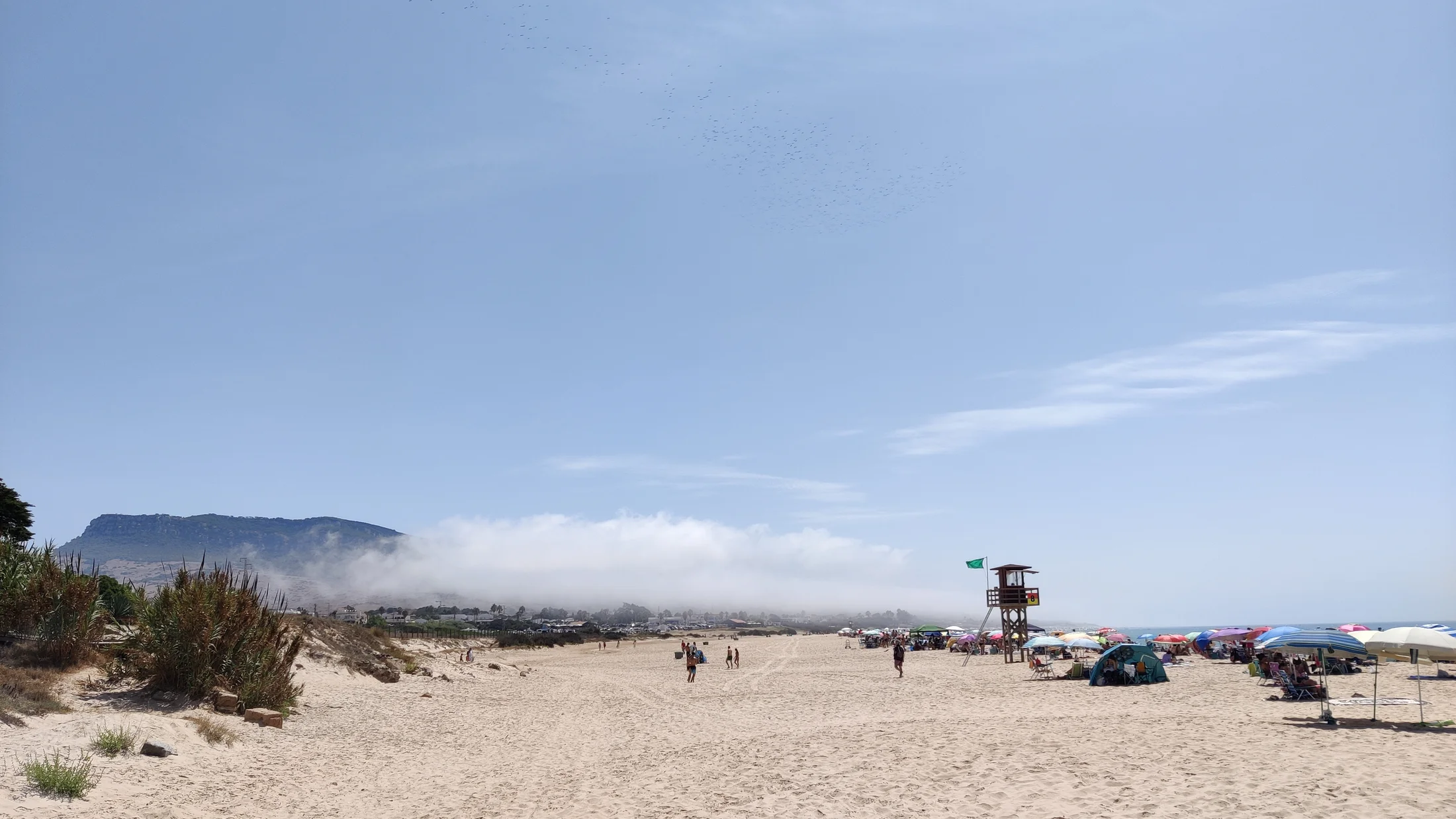
Playa de Bolonia (Tarifa, Cádiz): dune and open horizon
Playa de Bolonia is an arc of light sand 3.8 km long and 70 m wide in the Strait of Gibraltar, in Tarifa (Cádiz). It is a classic for those seeking freedom with landscape.
The great mobile dune measures 30 m in height and advances 3 m per year. It is protected and can only be traversed via the boardwalks.
Next to the beach is the Baelo Claudia archaeological site, the best preserved in Roman Hispania. Its visitor centre and museum can be visited for free every day except Mondays. If you are looking for a beach with history alongside, this one delivers.
There is a signalled nudist area at the southern end of the beach, on the left looking towards the sea. The breadth of the sandy area leaves quiet spaces outside of August and on weekends. The best time is spring and autumn, to avoid overcrowding and extreme winds.
It is reached via the CA-8202 road from the N-340. In season, there is paid or regulated parking, and there is frequent bus service (30 min) from Algeciras to Tarifa.
To sleep, there are rural houses and small hotels in El Lentiscal and Zahara de los Atunes. In summer, it is advisable to book in advance.
Playa de los Muertos (Carboneras, Almería): pebbles and glass-like water
In Carboneras, within the Cabo de Gata environment, there is a sandy area of pebbles with remarkably transparent waters. The descent on foot filters the influx and leaves the beach quite tranquil.
The seabed has a slope and unevenness, and that is why the intense blue turns to cobalt. The swell and the undertow require attention, especially if you go with children.
Naturism is common towards the ends of the beach: it is tolerated, but it is not exclusive. The isolation is high due to the descent on foot and because there are no services on the sand. Bring water, shade and a bag for your waste.
In summer, it is advisable to avoid peak hours and strong levante winds.
To arrive, from Carboneras take the AL-5107 road in a southerly direction and, after about 5 km, you will find a signalled diversion towards the beach. The descent is on foot via a path with a steep slope, so wear good footwear.
To sleep, Carboneras and Agua Amarga concentrate the supply, with rural options in the interior.
Playa de Vera (Vera, Almería): established naturist tradition
Vera Playa is the largest naturist area in Spain and one of the most long-standing in Europe: the country's first naturist hotel opened here. Naturism is official in signalled stretches and the tradition is well-established, with a respectful and convivial atmosphere.
The beach is wide, with fine sand, urbanised areas, promenades and comfortable access. Isolation is low: you are in an urban-tourist environment, albeit with spacious areas. At sunset, the sun tints the apartment blocks in copper and the sea turns to silver.
For those starting out, there are clear rules and services at hand. You will find chiringuitos, showers and summer surveillance in certain sectors. Respect the signage for textile and naturist zones and avoid taking photographs.
The climate is mild almost all year round, with temperate water in summer and cool water in winter.
Arrive via the A-7 to Vera and then via the AL-5104 to the coast; the ALSA Almería–Vera line takes about 1 h 30 min and, from Vera pueblo, you need a taxi or your own vehicle to reach the coast. There is nearby parking. The approximate coordinates of the naturist area are 37.2152703, -1.8327178.
Playa de los Genoveses (Cabo de Gata, Almería): perfect curve and silence
The environment is pristine: fine sand, fossil dunes and nearby posidonia meadows, and the scent of thyme and pita arrives with the breeze.
Spring and autumn are the best time to visit; in summer it is advisable to arrive early. The parking costs 6 €/vehicle from 20 June to 27 September and is free for the rest of the year.
There are no chiringuitos: bring water and sun protection. Use the walkways, do not step on the dune vegetation and pick up all your waste.
Playa de Es Trenc (Mallorca, Balearic Islands): Balearic crystal and dunes
Es Trenc has several kilometres of white sand and shallow waters, with stretches where nudism is common, especially between Ses Covetes and Ses Salines. The environment is a protected dune system with turquoise water, and the management of parking and walkways seeks to balance high demand with conservation.
Naturism is tolerated in the intermediate stretches and is not exclusive to the entire beach. From the sand, you can see pink flamingos in the protected wetland of the Salines de Llevant. The salt in the air mixes with juniper notes from the dunes.
May, June and September are the best time. In July and August it is advisable to avoid peak hours: arrive before 9:30 or go on weekdays. In summer there is a shuttle bus from Campos, which is mandatory in August; you can also arrive by taxi or by bicycle (5-10 km).
By car, access is from km 8,8 of the road from Campos to Colonia Sant Jordi, following a road to the paid parking: the one at Ses Covetes costs ~7€/day and the official Es Trenc one is between 7€ and 10€ depending on the season. There are occasional chiringuitos, loud music is not permitted and waste is monitored; do not pull up or move the posidonia.
Es Cavallet (Ibiza, Balearic Islands): historical flag of naturism
Es Cavallet was the first nudist beach in Ibiza and today naturism remains official and is signposted. It is located in the Ses Salines Natural Park, with a long tradition and a free atmosphere that has also made it an international reference for the gay public.
The beach combines dining areas with quieter stretches further away from the access points, so you can choose according to your plan. It preserves a stone defensive tower and the surroundings consist of a strip of sand with dunes, salt pans inland and views of Formentera; the wind draws small crests in the sand.
May, June, September and October are the best months; in summer it is advisable to go early. At the northern end there is a free and very small car park, which is insufficient in high season. The southern end can be reached from the paid parking at Las Salinas with a 20-minute walk through pine trees.
It is a non-smoking beach and you are asked not to leave the dune walkways or touch shorebirds. In the remote stretches there are no services, so please respect the music and the volume. For sleeping there is a wide range of offers in Ibiza town and Sant Josep, and it is advisable to confirm availability in advance.
Ses Illetes (Formentera, Balearic Islands): azure water and light sand
Ses Illetes is a beach in Formentera with sandbanks that advance towards the north of the island. It is within the Ses Salines Natural Park, with turquoise water and a Posidonia oceanica seabed, and the whole area is a UNESCO World Heritage site.
Naturism is tolerated in certain stretches, and there is more tranquillity if you walk towards the ends of the beach. The daily capacity of the park regulates the pressure on the sand: access control limits entry to 384 cars and 1,132 motorcycles.
The best time is May-June and September; it is advisable to avoid mid-days in July and August. During the season, you pay an entrance fee to the park and anchoring over Posidonia without buoys is prohibited. You must also not walk on the dunes outside of the walkways and signalled paths. Hybrid vehicles pay 50% of the access fee.
You arrive by ferry from Ibiza to La Savina (about 30 minutes with Baleària) and then continue via the Camí de Ses Illetes and the Carretera de San Ferran a la Savina. Parking for cars and motorcycles is regulated and expensive.
Playa de Maspalomas (Gran Canaria, Canary Islands): living dunes and nudist sectors
Maspalomas is a wide and open sandy area within a field of dunes, with the La Charca lagoon next to it. This combination makes this beach a unique landscape in the Canary Islands.
Nudism is authorised in signalled sectors, between numbered kiosks and with informative signage. The isolation is medium-low: walking 10-20 min you will find more calm.
You can come all year round, with temperate temperatures, although it is advisable to take the trade winds into account.
Park in the public car parks 200 m from the lighthouse and near the bus station. The beach is connected to the whole island via the guagua network.
Camping or setting up camps is prohibited all year round and at any time. Respect the signage, the fauna of La Charca and the closure of sensitive paths.
Coordinates: 27.7356, -15.5825 (WGS84).
Playa de Sotavento (Fuerteventura, Canary Islands): infinite sand and free wind
Sotavento consists of several very long beaches on the Jandía peninsula, in Pájara, Fuerteventura. In these open spaces, naturism is common, and by walking a little, you find very quiet corners.
The wind brings those who do kitesurfing and windsurfing, who spread out across sectors: respect the designated corridors. Around it, there are sand plains, intertidal lagoons and transparent waters, with moderate isolation.
The lagoon measures between 30 and 50 cm in depth and has no waves, so it is good for going with children. Watch the currents and the tides and consult the local panels before entering the water.
To sleep, Costa Calma and Morro Jable have villas and apartments nearby.
The easiest access is via Risco El Paso, with an asphalted and signposted road from the FV-2. There are sand parking areas and stretches on foot across the beach. The beach is in Pájara (Costa Calma), Fuerteventura, at the coordinates 28.1006, -14.2714, and access is free as it is a public beach.
If you are looking for more Coast options on the island, this area of Jandía concentrates open and sparsely built sandy areas.
Platja del Torn (L’Hospitalet de l’Infant, Tarragona): Catalan naturist landmark
Platja del Torn is a sandy area with a consolidated naturist tradition, bordered by the Camping Naturista El Templo del Sol.
The environment mixes golden sand, pines and coastal scrub, with the Torn islet as a landmark. When you step, the sand crunches lightly and smells of resin from the nearby pine forest. The beach is part of the La Rojala - Platja del Torn natural park, and several paths through the pines allow you to explore the area.
May, June and September are the best months to come: July and August concentrate the highest influx. Arrive from the N-340 and the Jonquet area, where there are signposted parking lots.
Bring extra water and use the enabled walkways so as not to tread on dunes or vegetation. To sleep, you have a nearby naturist campsite, a general offering in L'Hospitalet and Mont-roig, and rural houses in the interior.
Cala Varques (Manacor, Mallorca, Balearic Islands): path and silence
At Cala Varques, the entrance gate already warns you: the car stays about 150 metres away and the rest is done on foot. The cove is in Manacor, Mallorca, and is accessed via a path of about 20 minutes that crosses the pine forest.
The path between pines and karst lasts 20-30 min and acts as a natural filter: that is why the cove maintains its wild character. Signage is scarce, so it is advisable to wear comfortable footwear and pay attention to the path. The coordinates are 39.499°N, 3.296°E.
It is common to see naturists, especially outside the central hours of summer. Naturism is tolerated and is frequent, but not exclusive.
You can explore small pools and sea caves; the smell of pine and salt sticks to your skin. Watch out for jumps from the rocks and respect the caves: the tides and the swell are moderate. Bring water, food and a waste bag.
Spring and autumn are the best time. In summer, go early or at sunset.
Playa de Covachos (Santa Cruz de Bezana, Cantabria): cliff and sandbar
In Covachos, a sandbar connects the shore with an islet when the tide goes out. The beach is in Soto de la Marina, in Santa Cruz de Bezana (Cantabria), between sand and rock cliffs.
Nudism is tolerated and common, especially on mild summer days and outside of peak hours. The sandbar disappears with high tide, so check the tide before crossing it and watch the currents and the rising water.
You arrive on foot via a path with steep stairs, not suitable for strollers. The upper car park is small and free, and the descent ends in a section without stairs where you go down with the help of a rope. There is no mobile coverage on the beach and you cannot enter with dogs.
Summer and sunny days are the best time; avoid storms. You can combine the visit on the same day with Liencres, Suances or Santander, and sleep in rural inns and hotels in Bezana, Piélagos and the surrounding areas. The coordinates are 43.47233333, -3.91155556.
Playa de A Lanzada (O Grove/Sanxenxo, Galicia): Atlantic expanse with corners
A Lanzada is a long and windy Atlantic strip between O Grove and Sanxenxo, one of the most famous beaches in Galicia. It has protected dunes, rough sea and wooden walkways.
Nudism is practised mainly in the less crowded sections and in the adjacent coves. A Lanzada is not an exclusive naturist beach, so it coexists with bathers of all kinds.
The beach is protected as a Natural Space and is part of the Natura 2000 Network, within the Complexo Intermareal Umia-O Grove, A Lanzada, Punta Carreirón e Lagoa Bodeira. The air brings iodine and the lapping of the waves sounds constant like a metronome.
Go in summer or in September; in spring a fresh breeze blows. There is lifeguarding from June to September, from 12:00 to 20:00, as well as beach bars and toilets in some sectors.
With strong swell and wind, swimming can be dangerous: pay attention to the flags and panels, and keep in mind that sometimes the beach becomes impracticable due to the swell. To sleep, look for accommodation in O Grove, Sanxenxo and rural houses in Salnés.
Playa de Torimbia (Llanes, Asturias): natural amphitheatre
Torimbia is a shell of fine sand under high meadows and cliffs, in Niembro (Llanes, Asturias). Above, there is a viewpoint with views and the entire beach is part of the Paisaje Protegido de la Costa Oriental de Asturias.
Naturism has a very deep-rooted tradition here for decades: it is common and respected, although the beach is shared with all types of visitors. The walk down limits the influx and maintains a serene atmosphere; the meadow smells of damp grass when the morning mist rises.
You reach it via a 10-15 minute path, and at the top, there is a free parking area available in high season. In high season, there is free parking at the top of the cliff, and a second route leaves from the lower part of the village. The path takes about 10-15 minutes via both routes, with a descent down the cliff; it is not suitable for strollers or for people with reduced mobility.
Services at the beach are scarce or non-existent, so it is advisable to bring what you need; there are bars in Niembro and Nueva. The sea has occasional undertow, so you must pay attention to the flags.
Go in summer and September, or in spring if the weather permits. To sleep, Niembro, Barro and Llanes have manor houses and apartments, a good base for exploring the eastern coast.
El Playón de Bayas (Castrillón, Asturias) and Cala Presili/platja del Tortuga (Menorca): remote options
El Playón de Bayas measures between 2,800 and 3,000 metres and reaches 90 m in width in its central area. It is a wild sandy area of dark sand, with dunes and open sea, a Natural Monument with a dune system and the Isla de la Deva.
The nudist sections are far from the access points: you have to walk to find solitude. It is forbidden to step on the protected dune areas, so respect the environmental signage. Arrive via the marked car parks and walkways, and watch the wind and the tides. Services are limited and there are no beach bars in the remote sections, so bring everything you need.
Cala Presili (Platja d'en Tortuga), in Maó, Menorca, is next to the Favàritx lighthouse. It is an intimate cove of sand and rock, with clear waters, low pines and scrubland. It is protected from the tramontana and from the sand you can see the Favàritx lighthouse, with a white silhouette and a black spiral band.
In summer, access to the Favàritx lighthouse is restricted for private vehicles: leave your car in a car park 2 km away and use the bus from Maó. The cove has no services; respect the posidonia and the fauna.
Naturism is tolerated on both beaches, with discretion and respect for other users. To sleep, there are rural houses in Castrillón and Avilés, and varied offers in Maó and Es Grau; in Menorca, it is advisable to book transport in summer.
How to arrive without leaving a trace
Not all beaches allow cars right by the sand, nor are all paths obvious. Before setting off, plan your access in advance and check if there are quotas, paid car parks, or seasonal closures in protected areas such as Ses Salines (Ibiza/Formentera) or Cabo de Gata.
In summer, arrive early and do not park in ditches, agricultural transit zones, or on dune vegetation. There are fences or nocturnal barriers and fines for bad parking in coastal municipalities. Many accesses are 10-30 minutes on foot through stony terrain: verify distance and altitude before leaving.
Bring closed footwear, water (minimum 1,5 l per person in summer) and a cap. Follow the signage and boardwalks, and take shortcuts only via established tracks to avoid erosion.
Cycling is ideal in the Balearic Islands and stretches of coast with flat routes. Bring a lock and tie it up outside the boardwalks, and combine bus + bike where there are bike racks or internal services (Formentera, Ibiza).
For coves without easy land access, a rental kayak or a boat with local operators allows you to arrive without stepping on dunes. Inform yourself about regulated anchorages and Posidonia meadows and use authorised buoys. When in a kayak or boat, bring a waterproof bag with water, protection and a cap: the sun reflects strongly off the sea.
Natural parks may require access fees or restrict traffic: respect the daily quotas and do not cross private properties or gate closures if you enter via livestock tracks or rights of way. Plan with offline maps and coordinates (lat, lon) in case coverage fails, and allow a safety margin for the return before sunset.
Where to sleep: campsites, rural houses and naturist hotels
Sleeping near the beach allows you to arrive early, avoid the heat and see the sunset by the sea. The offer changes depending on the area: campsites among pines, established naturist accommodation and rural houses in the nearby interior.
On the coasts of Tarragona, Cádiz and Asturias, there are campsites near pine forest areas from which you can reach the beach on foot or by bike. Some are naturist and manage respectful access, so consult their internal rules and schedules. Wild camping is prohibited in most communities: look for legal areas to avoid sanctions.
They usually include convenient access, information about nearby beaches and quiet environments for families. Check the policies for using common spaces and choose more relaxed seasons if you are looking for calm.
5-20 km from the sea, in the nearby interior, there are farms and rural houses that reduce the pressure on the coast. Look for environmental certifications, waste management and energy efficiency; on islands with water stress, ask about well water. They work well for groups and families who combine the beach with hiking, wineries or local markets.
Choose according to your plan:
- With low mobility or with children, prioritise flat access and nearby services, such as in Vera, which has adapted access for reduced mobility.
In the Balearic Islands and the Canary Islands, book weeks in advance in summer; in spring-autumn there are better prices. Verify cancellation policies and check-in times if you depend on a ferry or bus. On islands, consider moving by bike and public transport to avoid the lack of rental cars. Staying far from dunes and Posidonia meadows helps to look after the environment.
What to do besides swimming: nature at your own pace
A wild beach offers much more than just a swim: water, shade, walks and a bit of gentle exploration. Lengthen your day without rushing, leaving a small footprint and making little noise.
Use "reef-safe" sunscreens and do not touch or collect organisms. Avoid splashing over the posidonia and keep away from swimmers if you are wearing long fins.
To walk, link coves via coastal paths in Cabo de Gata and Menorca. The Camí de Cavalls (GR-223) circumvents Menorca along the coastline for about 185 km, divided into 20 stages with accessible starting and finishing points. It crosses private farms: close the gates as you pass and do not disturb the livestock. Leave early and bring water and a map.
In dunes and salt pans, observe wading birds and herons with binoculars and from a distance. Do not step on fragile vegetation or leave the walkways: the spring flowering is delicate. If you take photos, avoid taking recognisable people without permission and refrain from using drones where there are people or in protected spaces, as many parks prohibit them. Take advantage of the golden hours and frames without a human footprint.
In the Canary Islands, in Sotavento, kitesurfing and windsurfing are practised in designated areas. Before entering the water, check wind and swell reports and your level.
For yoga, reading and a nap, a towel, a light mat and natural shade are enough; music with headphones or, better yet, no music. A long break at midday reduces the risks of sunstroke and brings you closer to the local rhythm. End the day with a short walk picking up any micro-litter you see.
Respect and rules: coexistence and environmental care
Naturism is sustained by two pillars: freedom and respect. These two principles organise coexistence, privacy and environmental care in every sandy area.
In Spain, nudism is not a crime at a state level: there is no general prohibition. Some municipalities regulate usage on specific beaches, so pay attention to local signs and instructions from the beach police. In parks and reserves, environmental rules regarding paths, quotas, waste and fauna take precedence.
Consent is practised: do not stare or invade personal space, and always ask permission to take photos. Even better, avoid any shot with people in the background and stick to the pure landscape. Respect the indicated separations between textile and naturist zones and choose less crowded corners.
Avoid wipes, glitter and single-use plastics, and bring sturdy bags and a portable ashtray. Do not step on dunes or break vegetation: use walkways and official access points. On islands, respect the posidonia: do not anchor outside the buoys or remove it from the shore.
Check the flags and inform yourself about currents, because the Atlantic and the Cantabrian Sea change quickly. Bring your own shade and water: sunstroke is frequent on beaches without services. In isolated nudist beaches, communicate your plan and your return time to someone.
Before leaving, check this list:
- Sufficient water and light food for the whole day.
- Sun protection, cap and your own shade.
- Footwear for trails and pebbles.
- Waste bag and portable ashtray.
- Offline map and charged battery.
- Respect for signage and other people.
The local community sustains these places: being grateful, consuming locally and following the rules is your way of giving back.
Frequently asked questions
Is nudism legal in Spain and are there differences by Community?
Nudism is not classified as a crime at a state level and is protected by individual freedoms. Therefore, you can practice it on many beaches in the country without any legal problems.
Differences appear at the local level. Some town halls regulate usage on specific beaches through ordinances, so it is advisable to check local signs and municipal websites before going.
How to know if a beach allows nudism?
The first thing is to look for specific signage on the beach itself and cross-reference it with updated maps and guides. Before settling in, observe how the section you have chosen is being used: the actual use of the beach tells you a lot.
If there are no signs, act with prudence. Stay away from the main access points and ask users or lifeguards respectfully.
What to take to a wild nudist beach?
In a wild sandy area, there are no services or guaranteed natural shade, so you should prepare your backpack before leaving. Bring plenty of water, sun protection, a cap, and portable shade.
Include light food and hiking footwear, because access is usually on foot via paths. Add a bag for waste and take your rubbish with you: there are no bins in the area.
A minimal first-aid kit with plasters and disinfectant will cover small mishaps. If you are going to coves that are accessed by water, keep your mobile in a waterproof case.
Is it safe to visit isolated nudist beaches alone?
Yes, it is safe to visit isolated nudist beaches alone if you plan your visit. Before leaving, inform someone of your plan and your return time.
Carry an offline map and check the coverage in the area. Avoid cliffs and currents: do not risk it in them.
If something makes you uncomfortable, change areas or return. Your safety comes first.
How to act if there is conflict with other users?
In the event of a conflict with other users, stay calm and keep your distance. Respectfully explain what is bothering you, such as noise or photos, and avoid direct confrontation.
If the situation is not resolved, turn to the lifeguards or the beach police. When appropriate, change sections of the beach to preserve your well-being.
Can I use drones or loud music?
Do not use drones: many protected spaces prohibit them. Before taking it out of your backpack, check the local regulations.
Avoid loud music because it disturbs others. If you want to listen to something, use headphones. Prioritise the sound of the environment: the sea and the birds already provide the soundtrack.
Book your experience — discover active tourism activities in Spain with providers verified by Picuco.
Conclusion
Choosing a nudist beach in Spain is choosing a slow and conscious way to be on the coast, with freedom and respect at the forefront. In these sandy areas, the naturist community and the local people have achieved a fragile balance, and looking after it is the responsibility of whoever arrives.
The last swim, when the light fades and the air smells of juniper and salt, is worth more if you leave the place intact. Before going, plan your access and choose responsible accommodation. On the sand, practice kind naturism: consent, silence, and a small footprint.
Save this selection of 15 beaches for your next trip and share it with anyone seeking calm.