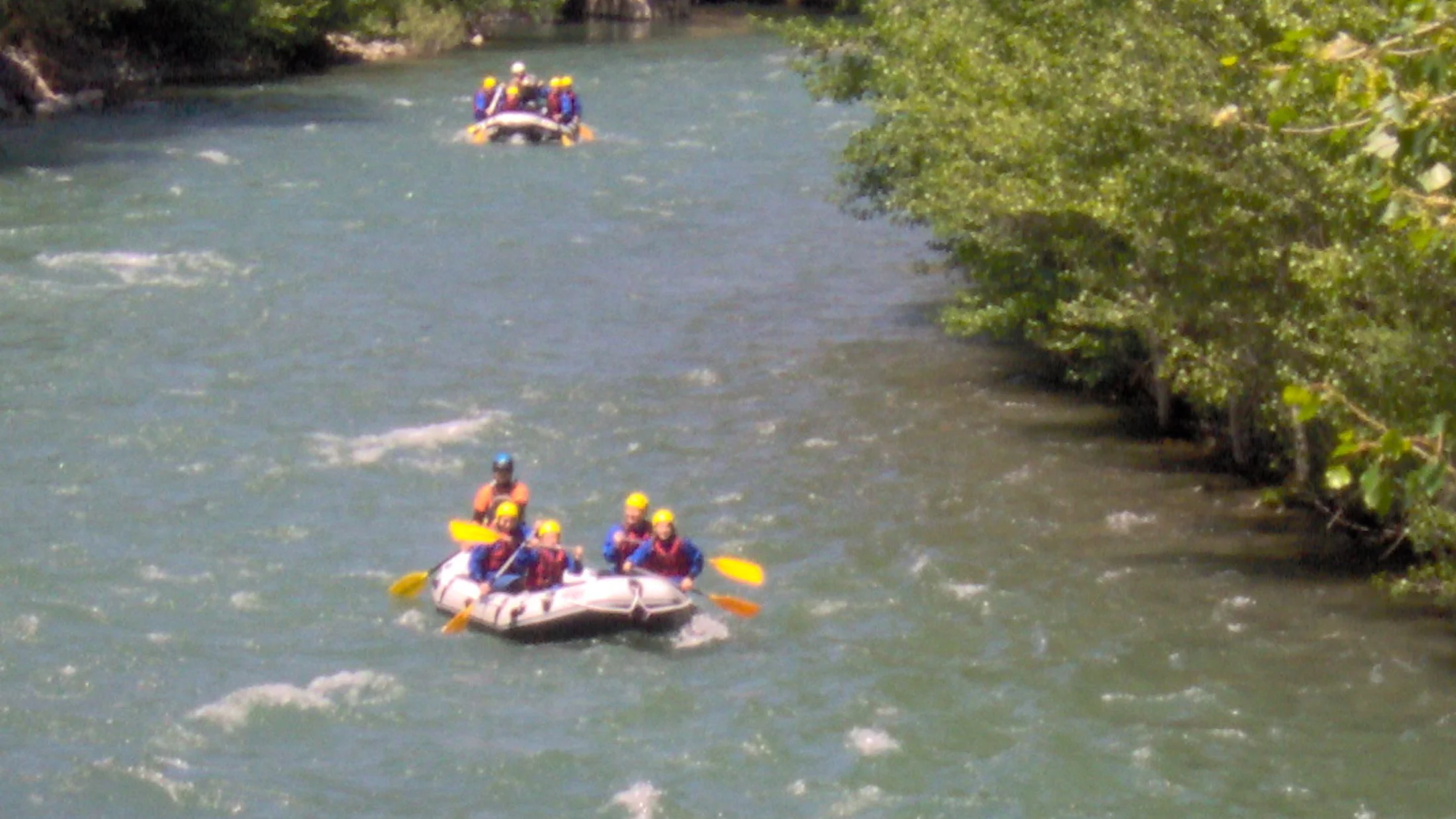
Why the Noguera Pallaresa is the king river of rafting in Spain
The Noguera Pallaresa flows down 154 km from the high lakes of the Vall d'Àneu to the Segre, with sustained rapids and a regulated flow. Before you see it, you already hear it: a low murmur, like a drum marking the rhythm of the day.
It is a benchmark destination for rafting in Spain. Here, top-level guides are trained and compete, and thousands of people discover the river every year. The flow remains stable in summer thanks to reservoirs and scheduled releases.
In Pallars Sobirà, in the heart of the Pyrenees of Lleida, the Noguera Pallaresa river is the king of rafting in Spain. The local network allows for early check-in, coordinated transfers, dry equipment, and photos ready after the river.
This guide gathers the essentials to plan your descent of the Pallaresa: when to go depending on snowmelt or releases, how to get there and where to sleep, which stretches to choose by level, what other activities are available (kayak, hydrospeed, scenic), and how to book safely. If you are coming to the Pirineu, here is your starting point.
Picuco te puede ayudar
Does something here catch your eye?
Tell us.
Write to us on WhatsApp or email: we answer questions, find the best options and help you sort out the booking.
When to go and how the flow works on the Noguera Pallaresa
The Noguera Pallaresa rises at 1860 m altitude and is dammed at La Torrassa (La Guingueta d'Àneu), Sant Antoni/Talarn, and Terradets. Releases are coordinated to produce hydroelectricity and for recreational uses, so the river changes depending on the day.
Leave a day of margin upstream or downstream in case the river rises too much after sudden heat.
Summer (July–August and part of September) brings scheduled releases with a stable flow at planned times. The difficulty is medium (II–III+, with occasional IV passages in specific stretches) and the temperature is milder: it is the best window for a first descent and for going out with children. Book in advance for weekends and August, because the best slots run out.
It works well for families, beginner kayaking, and photography, although the supply of outings decreases with the season: it offers weekend outings and a plan B of hiking or thermal baths if the flow drops.
Depending on your level, these are the dates that fit best:
- Beginners and families: July–September, on release days and during mild mornings.
- Intermediate level: Llavorsí–Sort or parts of Collegats, depending on what the guide indicates.
- Beginner level: stretches such as Arboló–Figuereta, class II-III.
The river includes rapids known as "La Lavadora", "El Paso del Ángel", and "Gulliver". Ask your operator for the release times during the week of your trip and adjust your slot to the peak flow if you want more intensity.
You bring a swimsuit, towel, and footwear that can get wet. The pattern of snowmelt and releases can vary due to accumulated snow and hydroelectric management: check local reports the day before.
How to get there and where to sleep near the river
From Barcelona, you reach the Noguera Pallaresa in 245 km and 3 h 21 min. From Lleida, it is 125.5 km and 2 h 1 min to Sort. From Andorra la Vella, it is about 71 km to Sort, in approximately 1 h 10 min–1 h 18 min by car.
By train, the FGC Lleida–La Pobla de Segur line (single track of 89.35 km) connects with the local bus to Sort and Llavorsí. From Barcelona, you can take the AVE/AVLO to Lleida and connect with FGC and Rodalies. The local bus costs 1 or 2 euros and on-demand transport requires prior booking until 19:00 the day before; bring a ticket to use the ALSA service.
To sleep, you have riverside campsites with bungalows and pitches, rural houses and apartments for groups, and 2–4 star hotels with early breakfast. When choosing a base, look at the proximity to the embarkation or pick-up point of the section, easy parking for changing clothes and subsequent logistics, and nearby services (last-minute shopping, restaurants, pharmacy). If you combine activities such as canyoning, hiking or cycling, prioritise quick access to the C-13 and the N-260.
In high season, book two nights: the afternoon of arrival (gear check and briefing) and the morning of the descent. As evening falls, the river tones down and the birds fill the riverbank with a soft chorus.
Sections and levels to choose your descent
The Noguera Pallaresa has descents for every profile. Before booking, check the section scheme and choose the one that fits your experience and your group.
Fits experienced advanced paddlers and compact teams: you embark near Arboló and disembark in La Figuereta.
Llavorsí–Sort is the most flexible option: 14–18 km, 2–3 h and difficulty II+–III+ with occasional IV. There are multiple bases and ramps with easy transfer, and it works well for mixed groups, eager beginners and families with teenagers.
Collegats (La Pobla–Gerri or variants) covers 12–20 km in 3–4 h, with difficulty II–III and III+ depending on flow. It has a scenic profile and is great for intermediates, scenic trips and photographers.
In Collegats the price is 50€ for adults and 35€ for under 12s. It is essential to know how to swim and parental authorisation is required for under 18s.
Arboló–Figuereta: short and technical for strong emotions
Fourteen kilometres and more than two hours in the water is what the Arboló–Figuereta descent offers, adapted for the whole family.
The technique is demanding: entries into small eddies, narrow passages, quick reaction and occasional siphons that the local guides know well.
The transfer is short, but before entering the water you need a specific briefing on lines and guide signals.
It works well for groups of friends with previous experience and for paddlers who want to step up a level: mid-morning allows for a lot of condensed adrenaline.
Llavorsí–Sort: the classic that balances excitement and landscape
It has a constant rhythm, playful waves and open landscapes, and you can adapt the distance between 14 and 18 km.
In summer, the Llavorsí–Sort section has a difficulty level of II+–III+, with occasional grade IV passages. In spring, some passages rise to IV.
It works well for mixed groups, for first-timers with an active attitude and for families with teenagers: there is fun without extreme technicality and room to learn.
Before booking, keep these details in mind:
- The price is 49€ for adults and 35€ for children under 12.
- It is essential to know how to swim.
- The minimum age is 8 years old in spring and 6 years old with 1.20 m in height in summer.
In your summer run, book a morning slot for a fresher flow and less heat.
Collegats: long and spectacular for advanced users and scenic trips
The cool gloom of the gorge smells of damp rock and common box.
The technical character depends on the flow: with medium water it delivers a very navigable and panoramic II–III; with more level it requires attention in narrow channels and standing waves. The duration is 3–4 hours, with variations between La Pobla de Segur, Gerri de la Sal and intermediate points.
In the water, you have to read the fine current, avoid eddies under ledges and maintain the boat's traction in the eddies. The ideal conditions are summer with consistent runs from Sant Antoni/Talarn for scenic trips, and late spring for experienced teams.
The landscape has walls of conglomerate and limestone rocks in reddish tones.
Collegats fits intermediate users who want a long and photogenic day, with groups of friends based in La Pobla/Sort and with photographers who want grazing light on the walls. The access leaves from the C-13, in the Font de la Figuereta rest area, between La Pobla de Segur and Gerri de la Sal; there are viewpoints and the transport logistics are slightly greater.
Main activities in the Noguera Pallaresa
The Noguera Pallaresa is not just about rafting: the river can also be navigated in whitewater kayak and hydrospeed, and adds panoramic and combined routes. That variety lets you choose how much intensity you want for the day.
You can start with a calm section and finish by trying a new activity. The variety serves to adjust the pace of the day and to learn new skills safely, always with the appropriate material and accompaniment.
At the base, the smell of freshly rinsed neoprene announces that everything is ready for a new round of adventures.
Rafting: guided boat descents for groups
In the Noguera Pallaresa, rafting is the gateway to the river: self-bailing boats with 6–8 seats and a qualified guide at the stern. You will feel the boat vibrate under your feet as you enter the first wave.
Then comes the dry briefing and the practice of commands —forward, back, stop— before going down into the water. At the end of the descent, there is a return transfer and a review of photos.
Sections are chosen according to the level. In summer there are family descents of difficulty II; the classic is Rialp–Sort, with difficulty III–IV. Safety is supported by a guide with official training and by a support kayak when the flow is high.
If it is your first time, choose the summer descent. If you have already done one or two outings, try a higher section with medium flow. And remember the phrase of the day: "Head down, row hard, trust the guide".
Kayak: technical and versatile for individual paddlers
In river kayaking, you go alone, in a closed boat with a spray deck and a double-bladed paddle. Every movement counts and progression is noticeable river by river.
The bases of the valle offer introductory courses (bracing, reading currents, controlled capsizes) and advanced courses (eskimo roll, surfing waves, lines in III–IV). The splashing against the hull sounds intimate, like a personal metronome.
You need to know how to swim and be comfortable underwater; for the roll, patience and practice are required. Choose the kayak if you are looking for total control, want to improve your technique, or have already paddled in II/III and feel like moving from rafting to paddler mode.
Hydrospeed: sled descent for the brave
In hydrospeed, you lie on a floating rigid foam sled and descend the river with fins and thick 5–7 mm neoprene with reinforcements. You propel yourself with your legs and surf the waves.
The activity is more physical and intimate than rafting: it requires good physical fitness and comfort in currents. Equipment is included: sled with handles, helmet, life jacket, full wetsuit with elbow and knee pads, gloves, and fins.
It is advisable to avoid sections with siphons or complex hydraulics. The average and stable flow is the best time: too low penalises the descent and too high is very demanding.
The activity is suitable for athletes looking for intensity who are familiar with swimming in a river. Ask your guide about the rapids of the day and the safe lines.
Knowing how to swim is essential. The minimum recommended age is 16 years and minors under 18 need parental authorisation. The price is 64€, and you can cancel with a full refund or change the date or time without charges with more than 24 h notice.
Scenic and combined tours: photos, routes and multi-activity packs
These are the way for those who prefer landscape over adrenaline.
There are also river photography sessions with accessible banks, designed to capture the surroundings without getting too wet.
In combined days, water and mountain are alternated, and the day ends with a dinner in Pallars. Families have their own option: short schedules, simple logistics and adapted rhythms, so that the whole group finds their place without giving up on sharing.
When booking, first define the intensity for each participant. Then book packages with transfers included and a margin for schedules: that way, your day won't be wasted on cars and rushing.
Companies, bookings, safety and equipment: how to choose well
Before paying, check three things: licence, insurance and the guides' qualifications. Choose operators with an autonomous licence for active tourism in Catalunya, civil liability and accident insurance, and guides with official qualifications, for example, White Water Sports Technicians.
Check recent reviews and ask about the guide/client ratio, safety protocols and the condition of the season's equipment. Ask for transparency: they must inform you about the expected flow, the target section and the plan B.
A standard booking usually includes a certified helmet, buoyancy aid, full wetsuit and water shoes; for hydrospeed, fins and reinforcements. It also usually includes a qualified guide by boat, a safety kayaker depending on the flow, internal transfers between the base, embarkation and disembarkation points, civil liability and accident insurance, and a safety briefing with prior practice on the shore.
The photo package is not always included: confirm before paying if it is included or extra, its cost and its format. Also clarify the cancellation policy due to flow or weather: if the planned section cannot be descended, what alternative they offer.
Ask about available sizes for wetsuits and water shoes, cold-weather gear, the guide's languages and age and fitness requirements per section. Companies manage the usage permits and comply with quotas where they exist.
In environmental protection areas such as the Parc Natural de l’Alt Pirineu, which extends through Pallars Sobirà and Alto Urgel with 79,317.21 ha and the highest altitudes of the Pirineo de Lérida, and in the surroundings of Congost de Collegats, strictly respect the banks and wildlife.
Always use CE certified equipment and follow the guide's commands; boats operate with rescue protocols using throwbags (throwing ropes) and signalling. You must know how to swim and feel comfortable in the water.
It is not advisable to participate with recent shoulder or back injuries or during pregnancy.
Check that your travel insurance covers adventure sports; many include rafting up to a certain degree. If you carry a camera or goggles, use a leash or cord: the company does not cover personal losses.
Practical tips and frequently asked questions
Arrive with time to spare, eat a light breakfast, hydrate and leave loose objects at the base. Typical departures are at 9:30 and 15:30, so check in 30–45 minutes beforehand. Allow between 3 and 4 hours in total, including transfers and briefing.
For the river, bring a swimsuit, towel, sunscreen, tie your hair back and footwear that ties firmly if water shoes are not included. Pack dry clothes in a bag for the end, a bag for wet items, an elastic or cord for your goggles and waterproof sunscreen. If it is cool, a thin thermal layer under the wetsuit will change your day.
Ask about the photo collection point. For scenic trips, give notice if you are carrying an action camera and secure it with a leash.
How is the river cared for during the descent?
Do not step on fragile banks or leave litter, and use the official embarkation areas. Silence your music and avoid excessive shouting: there is wildlife and fishermen sharing the river. During stops, keep boats and sleds tucked away so as not to block the way.
What do I do if something goes wrong in the water?
Follow the guide's instructions 100% and report any physical discomfort before embarking.
Is the Noguera Pallaresa suitable for beginners?
Yes, if you choose the right stretch and go with a qualified guide. The Llavorsí–Sort descent is adapted with safe lines and stops.
Before setting off, the guide explains the commands, the safety position —floating on your back, feet downstream— and how to get back into the boat.
Start with a half-day and add intensity if you want more. Declare your weight, height and any medical limitations to adjust equipment and pace.
In spring, with high flow, they may suggest a gentler stretch or change the date.
What equipment is mandatory and what can I rent?
In the Noguera Pallaresa, you don't go into the water in what you are wearing: rafting companies provide you with a helmet, buoyancy aid, full wetsuit and booties, all certified.
You bring a swimsuit and a towel, and if you are sensitive to the cold, a thin long-sleeved thermal layer.
The equipment provided by the company is neoprene, booties, helmet, life jacket and paddle. Before entering the water, you will notice the dense feel of the warm neoprene.
It is advisable to bring your own gear: strap for goggles, sunscreen, hair ties and personal medication (for example, for asthma), informing the guide. If you use contact lenses, close your eyes during heavy splashes or consider using swimming goggles.
Leave jewellery, loose watches and mobile phones without a waterproof case and leash at home.
How are bookings and cancellations managed?
Book online or by phone in advance, especially on summer weekends. When booking, they will ask for the date, number of people, ages and level, and they will assign you a stretch and a slot according to the expected flow and releases.
The confirmation must include the check-in point and time, the included material and the cancellation policy. Ask for an invoice and keep the receipt.
If the flow prevents a safe descent, they must offer a change of stretch or date, or a refund according to the conditions. If you change the booking yourself, check the deadlines (24–72 h) and if there is a penalty.
Ask about the scheduled release times during the week of your activity: a change can move your slot to the morning or the afternoon. If it rains, the activity usually continues unless there is an unexpected rise in water levels; follow the technical criteria of the guide.
What sustainability and environmental respect measures should I follow?
The Noguera Pallaresa is both a wildlife habitat and a cultural landscape. Walk and navigate with good practices to leave no trace, respect wildlife and fishing, and use only authorised access points.
Before going down to the river, avoid creams with harmful filters and use mineral protector if possible. Do not pick plants or enter private property. In gorges and breeding areas, lower your voice and minimise noise.
When choosing a company, ask about waste management and the cleaning of stretches. It is better if they limit group sizes, train their team in Leave No Trace and collaborate with Parks. If you see a spill or damage, report it to the local authorities or the Parc Natural de l'Alt Pirineu.
Shop at local businesses, respect opening hours and park in designated areas.
Book your experience — discover active tourism activities in Spain with providers verified by Picuco.
Conclusion: prepare and book your descent
The Noguera Pallaresa has a reliable flow, stretches for all levels and simple logistics in a valley that lives sport with authenticity. The season changes the river: in spring the snowmelt takes over, with more power and technique; in summer the releases provide consistency for groups and families; in autumn the calm and the colours round off the descents and courses.
To get it right, choose your base between Llavorsí, Sort or Rialp, define the group level and adjust the dates to the flow. If it is your first time, start with Llavorsí–Sort in summer; if you already feel comfortable, try Arboló or a long Collegats with medium flow.
A good operator adds safety, suitable equipment and qualified guides. Ask about ratios, insurance and cancellation policy before paying.
These are the final steps to close the booking:
- Choose the date window and check the forecast for releases and snowmelt.
- Review recent reviews and confirm the operator's credentials.
- Select the stretch according to the level and the conditions of the day.
- Verify what the price includes (equipment, photos, transfers) and read the terms.
- Prepare your backpack: swimwear, towel, eyewear strap and dry clothes.
The reflection of the sun on the sheet of water seems like an invitation written in light.