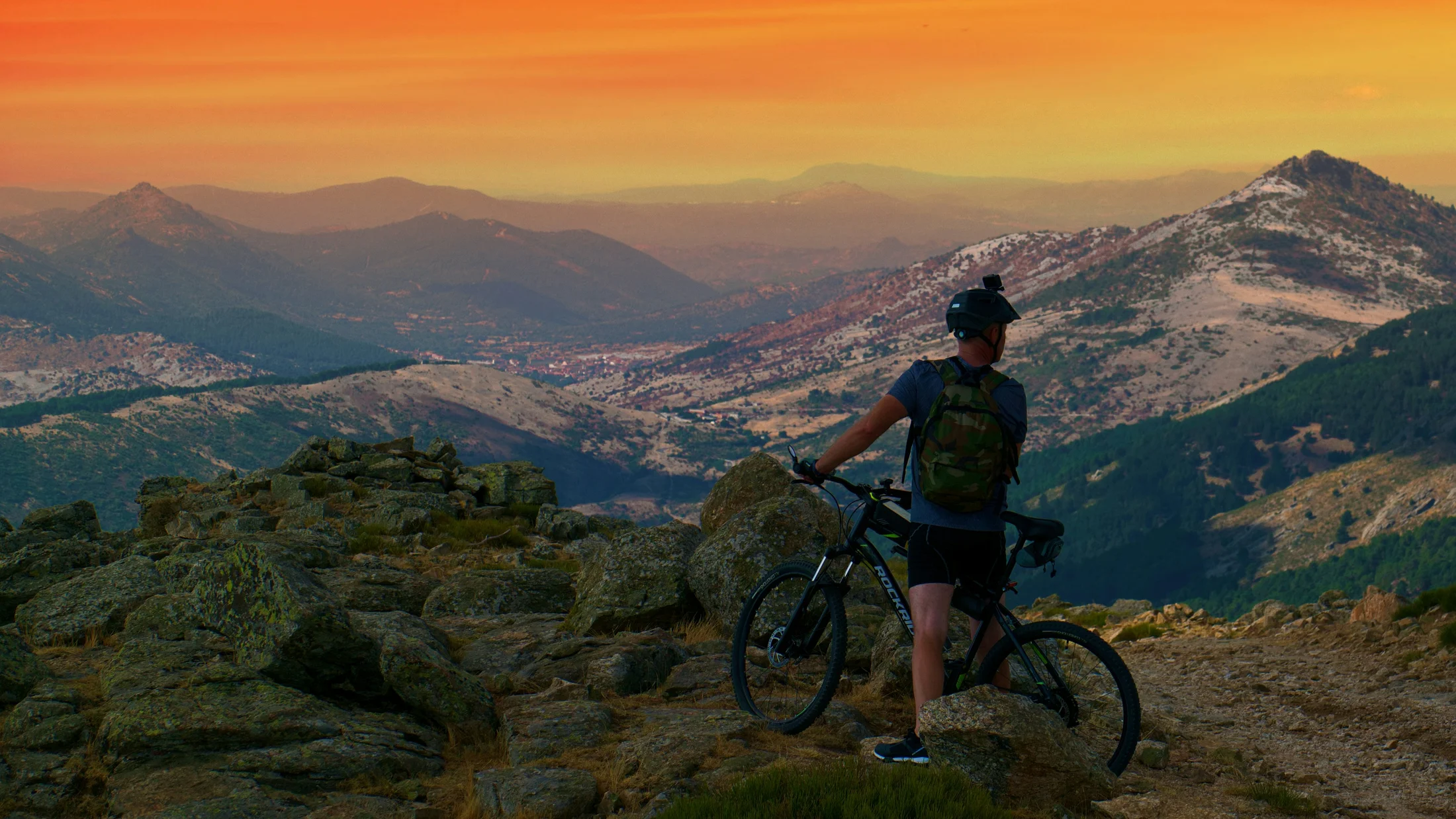
Why these MTB routes in Spain deserve to be on your list
Ten mountain biking circuits in Spain, ordered so you can choose according to your level and the terrain you are looking for. There are fast tracks and technical trails, and each route comes with its data so you know what you are getting into.
The selection considers the required technical level, the type of terrain, and how easy it is to reach the start. It also takes into account what is around: water, workshops, bike-friendly accommodation, and landscape. And, of course, that proven GPS tracks exist.
For each route, you will see the positive elevation gain in m+, the length, the estimated time, and the type of surface: rock, compact earth, or volcanic sand. We also check if a permit is needed or if there are restrictions due to national parks or protected areas, and if the route has variants for XC (cross-country), trail, enduro, and e-bike.
We prioritise destinations with good road or public transport connections nearby, so that a one-day or weekend getaway is feasible. We stick to signalled routes, on public paths or forest tracks, in areas accustomed to receiving cyclists and with clear rules for coexistence.
The list goes in layers: circuits to start, to progress, and to challenge yourself with technical sections. In between, alpine, wooded, arid, and volcanic terrains. The crunch of gravel under your tyres at dawn, with the cold air on the first climb, is the best way to start reading it.
Picuco te puede ayudar
Does something here catch your eye?
Tell us.
Write to us on WhatsApp or email: we answer questions, find the best options and help you sort out the booking.
How to read these files and ride safely
Before choosing a circuit, look at the level: the scale has four grades and tells you what terrain you are going to find. Easy is wide tracks, predictable turns, and little exposure. Intermediate adds trails with roots or loose stones and moderate descents. Advanced enters technical singletracks, steps, tight turns, and exposed sections. Pro requires high technical and physical demand, risk management, and mountain experience.
If you are unsure between two levels, choose the lower one: you will progress more safely and enjoy yourself twice as much.
Each file indicates distance in km and positive elevation gain in m+, which mark the real effort. The estimated duration is calculated with an XC/trail pace and short stops. It also details the terrain (rocky, wooded, arid, volcanic, or mixed) and the recommended profile (XC, trail, enduro, or e-bike). The files include the ideal season, local permits or rules, and the availability of GPX/KML tracks with navigation tips.
The smell of pine and damp earth sets the rhythm when the trail narrows between shadows.
Check the local weather forecast before heading out: in high mountains, the weather changes in minutes. Wear a helmet, gloves, and goggles; on advanced routes, add knee pads and shin guards. Calculate 500–750 ml of water per hour depending on heat and effort, and carry enough salts.
Respect priorities: pedestrians and livestock first; close gates and reduce speed when crossing paths with hikers. Do not ride off the marked paths and avoid sensitive areas such as nesting sites or wet pastures.
The section is completed later with an equipment checklist, basic maintenance, and tricks to choose a route according to your bike (XC, trail, enduro, e-bike).
10 mountain bike circuits for all levels
1. Picos de Europa: limestone alpine and characterful trails
Picos de Europa is high limestone mountain, with sharp rock.
The required level is advanced-pro: rock, limestone and scree, with good technique for enduro and all-mountain. The clinking of the chain against the frame resonates between walls while a red-billed chough draws circles over the valley.
The Áliva viewpoints, the Fuente Dé cirque and the traditional mountain pastures are the stops that justify the route. Cycling transit is regulated and many PR trails are prohibited for bicycles. You can use forest tracks and rural paths, unless signposted otherwise.
During Holy Week, summer and national holiday long weekends, access to Los Lagos and Covadonga is regulated via public transport. You can also arrive with buses and taxis from nearby villages.
Bring windproof and thermal layers: the fog can close in within minutes. Set your tyre pressures slightly higher to avoid rim damage on sharp rock. For GPX tracks, search for "rutas MTB España Picos de Europa GPX" in BTT centres and local clubs, and validate the variants at mountain refuges and park offices.
2. Sierra Nevada (Granada): altitude, sustained slopes and panoramic XC
Sierra Nevada, in the province of Granada, is a high-altitude MTB destination: many routes exceed 2,000 m. There are long tracks for XC with views of the snowfields and more technical options on stony slopes.
The required level is intermediate-advanced, over slate, scree slopes and compact high-mountain tracks. A typical route goes for 30 km and 400 m of elevation gain, and the terrain works for high-altitude XC, trail and e-bike with extra battery. You can hear the dry crunch of the slate under the wheels while the mountain range opens its late snowfields to the horizon.
The points of interest are the Vereda de la Estrella and the historic irrigation channels. Cooking fires are only permitted in designated areas.
It is advisable to bring sun cream and UV glasses, because the sun at 2,000 m burns. The altitude slows you down, so calculate wide margins and have a plan B if strong winds blow.
For GPX tracks, search for “tracks MTB España Sierra Nevada GPX” in Andalusian federations and town halls, and confirm temporary closures before heading out.
3. Bardenas Reales (Navarra): friendly desert, wind and open singletracks
The Bardenas Reales are a semi-desert landscape of clays, sandstones and gypsums shaped by the wind, with undulating badlands and no shade. They are in Navarra, within a Natural Park and Biosphere Reserve, and work well for an easy-intermediate MTB level.
The terrain is arid, with hard tracks and sections of gentle singletrack. It is suitable for XC, for gravel with basic technique and for e-bike. The surface changes with humidity: when dry it is fast and hard, and with mud it becomes clayey and heavy, so carry moderate pressures and tyres with a good volume.
The typical loop measures 69 km and takes about 5:20 h. The points of interest on the route are Castildetierra, Plano and Rincón del Bú. The dust rises like a golden trail as you glide between mounds and gullies.
Go in autumn or spring and avoid mid-summer and days with strong cierzo wind. Get up early to escape the heat and the wind, carry 2–3 litres of water and sun protection, and use GPX: crossings repeat, although the main tracks are obvious.
Respect the nesting closures and the perimeter of the military polygon; transit through the military use zone is prohibited. Visiting hours are from 8:00 until one hour before dusk, and in winter you must leave before 16:30 h. Camping or staying overnight outdoors (tents or motorhomes) is not permitted anywhere in the territory, nor is the use of drones for tourist or recreational purposes.
The usual access is via Arguedas or Carcastillo, via the NA-134 road and local roads. Navarrese MTB centres offer signposted routes and it is advisable to download official maps.
4. Val d’Aran and central Pyrenees: alpine enduro with variants to progress
The Val d'Aran mixes forest slopes with alpine paths: all-mountain and enduro terrain with variants for intermediate levels. The descents link tight turns, roots and fast sections, and in valleys like Naut Aran you can use shuttles or seasonal lifts.
The level depends on the variant you choose: intermediate, advanced or pro. The terrain is alpine woodland, with roots, granite and limestone rock, and the estimated duration is from 4 to 6 h. It is an ideal area for enduro, all-mountain and e-bike with reinforced tyres.
You ride through a network of public paths: respect local signage and forest closures. The best time is from late spring to autumn; avoid the heavy mud from the snowmelt. Before heading out, check your suspensions for wet roots and your brakes for long descents.
Between routes, stone villages like Arties and Salardú, the Garona viewpoints and Aranese culture complete the day. For tracks, search for "Val d'Aran MTB circuits by level GPX": tourist offices and local clubs publish routes, and it is advisable to confirm if lifts or shuttles are operating.
You arrive from Pallars Sobirà via the Bonaigua pass (2072 m) via the C-28 to Vielha, and from Ribagorza via the N-230 through the Vielha tunnel (5173 m long).
5. Girona and Empordà: Mediterranean flow and inexhaustible network of trails
The city and its region function as a bike-friendly destination for those who want to pedal for several days without repeating a route.
The level ranges from easy to advanced depending on the sector, over Mediterranean forested terrain of compact earth, granite and loose slate. It is suitable for XC, trail and e-bike, with short variants for families.
It smells of rosemary and pine when the trail winds between dry stone walls. In the city and on the coast, you will find rentals, guides and workshops to resolve any breakdown.
You ride through public paths and mountains, so respect the local signs and private estates. Check your brake pads and transmission due to the fine dust: after the rain, the grip is excellent.
The BTT centres of Empordà and club websites offer marked routes and GPX tracks. You can arrive by AVE to Girona or via the AP-7 motorway and regional roads.
6. Sierra de Guadarrama (Madrid): mid-mountain, fast tracks and urban escapes
The Sierra de Guadarrama is one hour from the centre of Madrid and has fast tracks, classic passes and trails with roots. Climbs on wide tracks and descents on paths are linked together, with variants for beginners and others that are more technical.
The mountain range is divided between the Community of Madrid and Segovia, within the Sierra de Guadarrama National Park. The level ranges from easy to advanced depending on the itinerary, and the terrain mixes Scots pine, granite, compact earth and roots. Calculate between 5 and 7 hours of route.
Spring and autumn are the best times. In summer you have to get up early and in winter it is advisable to avoid ice. The mountain range works for XC, trail and urban e-bike on day trips, with Puerto de la Fuenfría, Siete Picos and Calzada Romana as points of interest.
There are restrictions for the use of mountain bikes depending on the area and the number of people in the group. Respect the park rules and avoid reserve zones. There are many people on weekends: moderate your speed. Slightly low pressures improve grip on polished granite.
Among the pines, the air smells of resin while the light flickers over the track.
Arrive by Cercanías C-8/C-9 to Cercedilla or by road, via the A-6 or the M-607 depending on the valley. For the route from Cercedilla to Puerto de la Fuenfría, the starting point is the Dehesas car park, in Cercedilla. Search for "rutas ciclismo montaña Guadarrama GPX" in the Madrid federation and in BTT centres: there are marked PR and GR routes such as GR-10 and GR-124, not all of which are cyclable.
7. Sierra de Gredos (Ávila): granite, steps and routes that test your legs
In Gredos, the trails are made of granite, with natural steps and scree slopes that demand technique and strong legs. The mountain range is in Castilla y León, province of Ávila, and its level is advanced.
The terrain mixes granite, scree, Scots pine and heath. It suits all-mountain, technical enduro and e-bike with reinforced tyres. Along the way, you will encounter glacial cirques, gorges and stone bridges.
Mountain villages such as Hoyos del Espino or Navarredonda serve as a base, with rural accommodation accustomed to bikers and tough variants towards the Plataforma de Gredos. The sound of water in the gorges accompanies you as your bike climbs over slabs heated by the sun.
From Hoyos del Espino, you climb 12 km via the AV-931 to the end of the road; you can also do it from Navacepeda de Tormes via a track that links with the road. It is advisable to go by car. At km 7, there is a barrier and a small booth to buy the access ticket up to km 12, and access is free for vehicles arriving before the start of the regulation. At km 1 of the Plataforma road, you will find the Pinos Cimeros Park House for tourist information; the Plataforma de Gredos is situated at 1750 m above sea level.
Go in spring or autumn: in summer it is hot at midday and in winter there is ice. Bring tyres with reinforced sidewalls, short gearing and braking power. These are public mountain tracks, so respect protected areas and livestock paths. To prepare the route, search for "tracks MTB España Gredos GPX" in Ávila clubs and BTT centres, and check the technical variants in local forums.
8. Serra de Tramuntana (Mallorca): cobblestones, mountain passes and balconies over the sea
The Serra de Tramuntana is a World Heritage site and combines cobbled tracks, traditional paths and constant climbs with views of the Mediterranean. The classic routes pass through Esporles, Valldemossa and Deià, with sections of the GR-221 (Ruta de Pedra en Sec) whose cyclability depends on the sector and the signage.
The level is intermediate-advanced, over limestone, cobblestones and Mediterranean holm oak. It works well for XC and trail with short gearing, and for e-bike if you manage the battery and the heat. At sunset, the sea shines like a sheet of silver between olive terraces.
Respect private property and signage: some sections of the GR-221 are not cyclable. Brake in a modulated way on the cobblestones, because with rain the stone becomes very slippery.
The best time is autumn and spring; avoid summer due to heat and crowds. You reach it from Palma via the Ma-1110 and the Ma-10, and there is bike rental on the island. GPX tracks can be consulted at tourist offices and clubs, which publish recommended routes and notices. The mountain range contains the three main reservoirs of Mallorca: Cúber, Gorg Blau and the military one of Puig Mayor.
9. Somiedo and the Natural Park (Asturias): forests, long climbs and silence
Somiedo has tracks and paths between beech woods, brañas and glacial lakes, within a Natural Park declared a Biosphere Reserve. It is an MTB destination in Asturias for anyone looking for constant pedalling and long climbs.
The terrain alternates damp earth, roots and some loose stone, so the level is intermediate. Among the beech woods, the smell of wet leaves accompanies the murmur of the streams. With damp forest and compact tracks, the area is good for XC or trail with a tyre with good grip, or for a well-balanced e-bike.
Brown bears and roe deer live here: get up early, ride with respect and don't leave the paths. Also respect the park's regulations and don't encroach on brañas or restricted paths.
Mild summer and autumn are the best time. In rainy winters the mud weighs heavy and the Saliencia road may close due to snow. Take mixed tyres with good spaced knobs to clear mud and clean the transmission after the route.
Lago del Valle is at 1,580 m altitude and is the largest in Asturias, with 24 hectares. To go up, park in the village: traffic towards the lake is restricted to livestock farmers and park management.
There is also a direct ALSA bus between Oviedo and Pola de Somiedo, with less than 2 hours of travel. For GPX tracks, search for "rutas ciclismo montaña Somiedo GPX" on Asturias tourism and local club sites, and check wildlife and works notices.
10. La Palma (Canary Islands): volcanic sand and descents you won't forget
La Palma has volcanic sand and tracks that approach the Cumbre Vieja from both sides. The loose curves and the forest sections change the grip in seconds.
The circuit is intermediate-advanced level and the terrain is volcanic, with sand, lapilli and basalt rock. It is good for enduro and trail, and for an e-bike with good brake cooling. Along the way you see pine forests, craters and Atlantic viewpoints, and on the slopes you can appreciate the formation of the sea of clouds.
You can start in the recreational area of the Refugio del Pilar, in the centre of the island. The best time is winter-spring, with mild weather and less dust. You arrive via La Palma Airport (SPC).
Lower your pressures to float on the sand, use powerful brakes and control the temperature on the long descents. Respect temporary closures for forestry or volcanic management and the specific rules of the natural parks.
Important
Before riding in protected areas, check the current regulations of the park or municipality and always respect temporary closures and signage on the ground.
Location map and how to make the most of it
The map brings together the 10 circuits with layers by level, terrain and starting point. Activate the "Level" layer to see the colours by difficulty and the "Terrain" layer to distinguish rocky, wooded, arid or volcanic.
The "Start" layer locates car parks and base villages. By zooming in on the map, you can check road access and alternatives if a mountain pass is closed.
From the map, you can download the tracks in GPX and KML formats. Check compatibility with your GPS or app, because some require FIT format.
Before heading out, save an offline version of the track and a paper backup copy. Verify that the track is the most recent one and, if there are two variants, choose the official signalled one.
Also locate water sources, workshops and return routes in case of bad weather on the map. This way, you can resolve a puncture or a change of plan without leaving the planned route.
What to choose according to your level and preferred terrain
If you are looking for altitude, in Sierra Nevada many routes exceed 2,000 m.
In Girona/Empordà there is a 42 km circular gravel route through the Empordà plain, between rice fields, wetlands, medieval villages and traffic-free rural tracks. It starts from L'Estartit, crosses the Aiguamolls de l'Empordà wetlands and passes through Torroella de Montgrí. Another option in the area is a 35 km gravel circuit through the DO Empordà vineyards, passing through Peralada, Espolla and the Serra de Rodes.
Practical tips and equipment for heading out riding
The bike you bring dictates the route you choose. With an XC, prioritise tracks and fluid singletracks; with trail or enduro, look for technical descents and steps. E-bikes extend the range of action, but the battery must be managed: cold, long slopes and high mode consume more than expected.
Before setting off, check brake pads and bleeding, the torque on stems, axles and calipers, and any play. Adjust the suspensions to the SAG of the day, which depends on your weight with equipment and water, and lubricate the transmission after rain or intense dust. On the route, tyre pressure also counts: lower it by 0.1–0.2 bar on loose terrain and increase it on sharp rock.
For your body, wear a helmet, gloves, goggles and knee pads on advanced routes. Drink 1.5–3 L depending on the heat, with salts on routes of more than 3 h. In your backpack, a first aid kit with elastic bandages, gauze, disinfectant and a thermal blanket.
Tools make the difference when something fails far from the car:
- A multi-tool with a chain breaker, 2 tyre levers, 2 tubeless plugs, 1–2 inner tubes, a pump and/or CO2 and a quick link.
- Spares such as a derailleur hanger, brake pads, cable ties and duct tape.
- Navigation with GPS and offline GPX, mobile phone in airplane mode and a paper map.
Let someone know your plan and schedule and use "Live" mode if your app allows it. Evaluate the terrain before launching yourself and walk a step if you are in doubt; control your speed at crossings and when encountering hikers or livestock. While riding, listen to your breathing and the rhythmic click of the cassette: if everything sounds smooth, you are on the right track.
Travel logistics: arriving, sleeping and relying on local services
Almost all the starting points for these MTB routes are reached by car, especially in Gredos, Somiedo and Bardenas. By train, commuter services leave you near Guadarrama. For medium and long distances, confirm Renfe's bicycle policy beforehand: for long distance, the bike usually must be packed with maximum dimensions, while for Medium Distance and Commuter services, acceptance is more flexible depending on available space.
If you fly, pack the bike in a box or hard case and check the airline's fees and rules. Remove the pedals, lower or detach the handlebar and protect the gears and discs.
Renting a bike is practical in destinations such as Girona, Tramuntana or Sierra Nevada: you save on logistics and can choose the range. Bringing your own guarantees a perfect fit, although it adds packing time and checks after the trip.
To sleep, look for bike-friendly accommodation with a secure bike storage area, a washing zone, basic tools and an early breakfast. In Pyrenean valleys and central mountain ranges, rural houses and hotels accustomed to MTB abound. Check availability in high season (long weekends, summer and autumn in the Pyrenees) and, for long stays, consider apartments with a kitchen and washing machine.
Local services will solve your day: workshops for quick checks, bleeding and replacing pads or tyres; guides who optimise routes and improve safety in enduro; and transfers with shuttles or adapted taxis for climbs or linear links. When cleaning the bike upon arriving at your accommodation, the splashing of the water sounds as the sun sets behind the mountain pass.
Book 3–6 weeks in advance in summer and during long weekends; in islands and the Pyrenees, even more. Prepare a plan B for weather, with a low-altitude route if the pass is closed at altitude, and check the accident and civil liability coverage of your federated or private insurance.
Frequently asked questions
Do I need a permit for these routes?
In general, no fees are paid to ride these MTB routes. However, in national and natural parks there are restrictions: ride only on authorised paths.
Respect temporary closures for wildlife or conservation. Before setting out, consult the local regulations of the place where you are going to pedal.
What is the best time for each terrain?
Before setting out, check the calendar: extreme heat, snow and snowmelt condition any MTB route, regardless of the terrain. In high areas like Sierra Nevada, from December to February only low-altitude routes are recommended due to snow or ice in the high mountains.
The Veleta route starts in the Hoya de la Mora (2,510 m), with Mulhacén (3,479 m) as the highest peak in the peninsula in the background. It is best to pedal there in summer and early autumn, when the snowmelt has already left the terrain clear.
If you have little time, there is a short ride of almost 6 km to visit El Fraile, in the Bardena Negra. The ecosystem is fragile: respect the paths and do not collect stones or damage the formations. Access is also not permitted for sports cars or minibuses.
Are they suitable for e-bikes?
Most routes are suitable for e-bikes. With an electric bike, manage the battery and the brake temperature on long descents.
Before setting out, check the local regulations in case there are specific restrictions in protected areas.
Where do I download reliable tracks?
Local MTB centres, tourist offices and regional federations publish official tracks for their routes. Download them there before setting off and you will have the layout exactly as it is maintained by those who mark it.
Afterwards, cross-check the track with the park maps and with the GR/PR signage of the route. If something does not match on the ground, follow the marks and the map.
Discard unknown tracks that do not have reviews or whose last date is old. A file without a recent date may not have been reviewed for years and might pass through closed or diverted paths.
What cycling rules should I follow?
Throughout the entire route, priority is given to pedestrians and livestock. Reduce your speed at crossings and when passing through towns.
Always ride on the marked paths and do not stray from them. Carry your waste with you and close the gates when passing.
On routes with high traffic, choose hours of lower transit so you do not cross paths with other users.
Which insurance is best for me?
Before setting off, check your federative or private insurance and ensure it covers rescue, mountain assistance and civil liability. If any of those three are missing, look for a policy that includes them.
Carry your health card and emergency contacts with you, on your mobile and also on paper in case the battery fails.
How do I manage safety in high mountains?
In high mountains, the weather changes quickly and the local forecast rules. Check it before setting off and adjust your plan to what is announced.
Carry thermal layers and a windbreaker in your backpack, even if you set off in the sun. Plan wide schedules and have alternative routes of lower altitude prepared in case the day goes wrong.
If there is a storm, avoid the ridges and do not delay your return. Descending on time is part of the route.
Book your experience — discover active tourism activities in Spain with providers verified by Picuco.
Conclusion
Choosing the right route makes the difference between a demanding day and an unforgettable adventure. Adjust the circuit to your technique, your fitness and your bike: XC, trail, enduro or e-bike.
Start with a circuit that feels comfortable for you and raise the bar on your next outing. Progressing sensibly is the best way to enjoy yourself.
Before setting off, check the weather, permits and closures, carry the essential equipment and ensure offline navigation with an updated GPX. Always respect paths, fauna and local communities.
In high mountains, plan wide margins and have a plan B at a lower altitude. In arid terrain, prioritise water and early schedules; in humid forests, choose tyres with good tread and brakes in good working order. In Picos de Europa the maximum altitude is 2650 m a.s.l. and the summit is Torre Cerredo.
All of Spain fits into a handful of well-chosen paths: from the sharp limestone of Picos to the volcanic sand of La Palma, there is always a line waiting for you.
Choose one of the 10 circuits, download the verified track and prepare your bike this week. Share which route you rode and what you learned to help others decide their next destination.