Introduction
Choosing the right spot makes the difference between a great day of kitesurfing and frustration with your kite on the sand. In Spain, the variety of winds, coasts and seasons allows you to sail almost all year round if you know where and when.
This guide selects 10 places based on predominant wind, consistency, accessibility, schools, safety and variety by level and season. Inside you will find a quick summary, a detailed list with practical tips and recommendations for choosing by wind and season.
Before heading out, check the forecast reports (AEMET, Puertos del Estado, Windguru, Windy) and learn how to read them to avoid surprises.
Context and popularity of kitesurfing in Spain
Spain has the Atlantic, the Mediterranean and archipelagos with wind: you sail in winter in the Canary Islands and in spring-summer on the Peninsula. That mix of seas explains why kitesurfing has grown so much here.
Each area has its own wind. In Tarifa, the Levante and Poniente rule; in the Strait, strong Levante gusts alternate with a more manageable Poniente; the Mediterranean works with thermals; Girona with tramontana; and the Canary Islands with trade winds in Tenerife, Fuerteventura and Lanzarote. The trade winds blow with greater persistence between May and September.
To choose a spot according to your level, think about the season: summer is useful for progressing in Mediterranean thermals, and the Canary Islands in winter provide constant wind. In the islands, Pozo Izquierdo is the historical home of the PWA World Cup and the Gran Canaria Wind & Waves Festival.
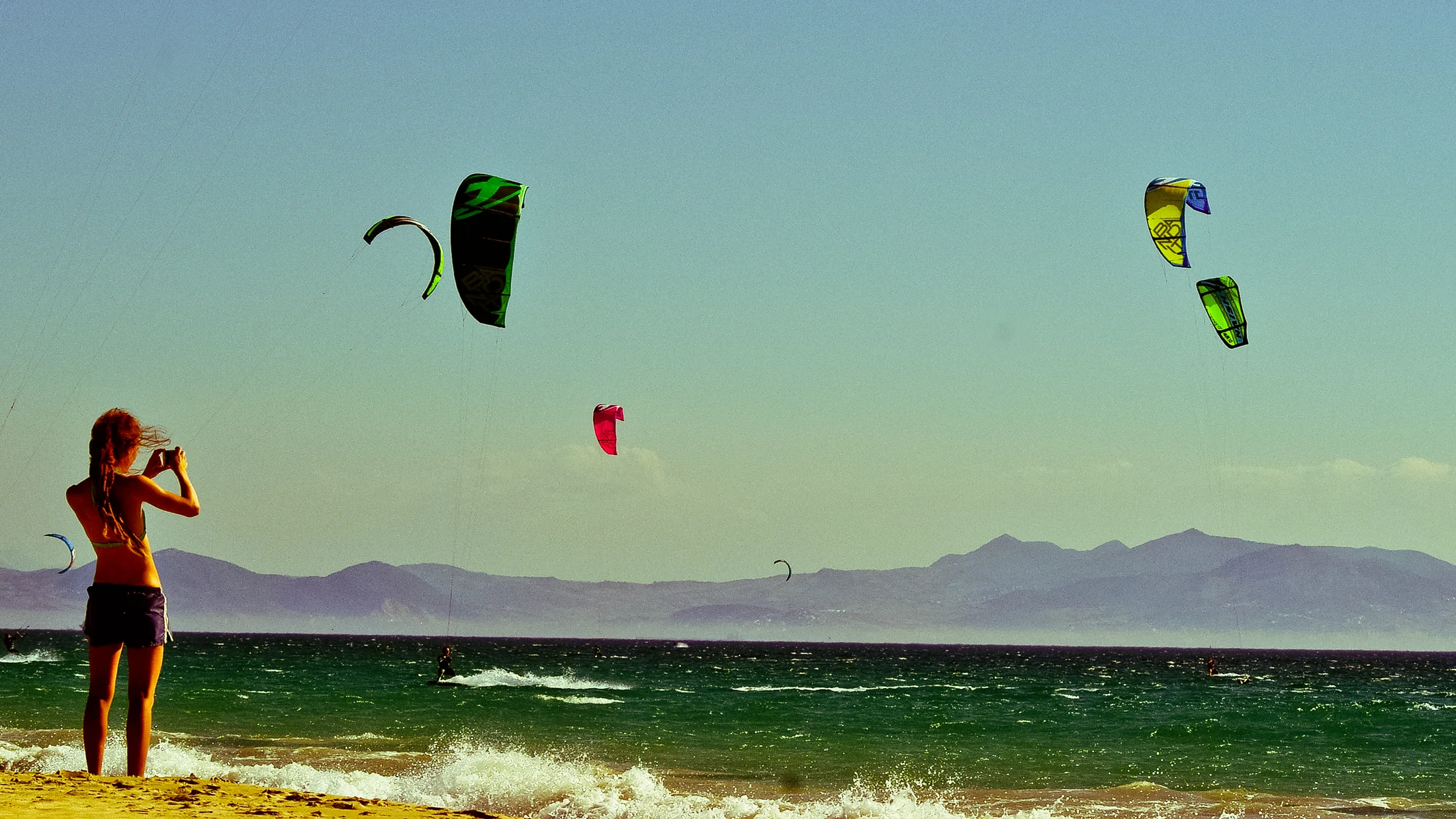
At dawn, the sails dot the horizon like seagulls poised over the foam.
In the Canary Islands, the bottom is rocky, so it is advisable to use booties; you sail with winds of 20 to 22 knots. The water oscillates between 19.5 °C and 24.1 °C all year round: with a 3/2 mm wetsuit you will be fine, and for cooler days, a 4/3 mm one.
Selection criteria used
Each spot on this list passes through six filters before being included: the type and consistency of the wind, access and parking, available schools and rentals, safety (open spaces and currents) and variety for beginners, intermediates and advanced riders.
For each one, you will find the same information, so you can compare at a glance. We indicate location, direction and typical wind strength, approximate prices for classes and rental, the best time by months and ideal level. We add strengths, risks or local restrictions and practical recommendations, including access and nearby alternative spots.
Book classes and rental at picuco.com and do so in advance: spots fill up during the season.
Picuco te puede ayudar
Does something here catch your eye?
Tell us.
Write to us on WhatsApp or email: we answer questions, find the best options and help you sort out the booking.
The 10 spots at a glance
Here you have the ten spots in a mental table: wind, best time and level, to decide in a minute. Each row summarises what you need before booking.
- 1. Tarifa (Cádiz): Levante/Poniente wind, best time from April to October, suitable for all levels with separate zones.
- 2. El Médano, Tenerife: NE trade winds, best time from May to September, intermediate–advanced level, with beaches for beginners.
- 3. Corralejo, Fuerteventura: NE trade winds, best time from May to September, intermediate level and waves for advanced riders.
- 4. Famara, Lanzarote: trade/thermal wind, intermediate–advanced level due to the waves.
- 5. El Ejido/Almerimar (Almería): best time from October to May, beginner–intermediate level; with Levante wind the water stays flat and the sheltered bay also makes it a reference for windsurfing.
- 5. El Ejido/Almerimar: kitesurfing is prohibited from 15 June to 15 September; the buoyage and the nautical channel of the municipal beach can change every year; 45 minutes from Almería Airport (LEI).
- 6. Sant Pere Pescador (Girona): tramontana/thermal wind, beginner–intermediate level.
- 7. Delta del Ebro (Tarragona): intermediate level.
- 8. Oliva/Valencia (València): SE/E thermal wind, best time from May to September, beginner–intermediate level; in summer the main practice area is that of the club, with buoyage, rescue boat and zone controller, and sailing outside authorised zones is prohibited; there is parking near the practice locations.
- 9. Isla de Arousa (Pontevedra): Atlantic N–NW wind, intermediate level and keep the tide in mind.
- 10. Calpe (Alicante): best time in March, April, May, September, October and November, beginner–intermediate level.
The 10 best spots for kitesurfing in Spain
1. Tarifa: capital of the wind in the Strait
Tarifa rules in Spanish kitesurfing due to its wind: Levante (E) strong and gusty, Poniente (W) milder and laminar. From April to October, navigable days accumulate, with peaks in summer, and powerful sessions continue to occur in winter.
There are zones for schools, for practitioners and for swimmers, although the signage is not perfect. Do not enter the protected lagoon or the Los Lances Sur wetland.
El Balneario requires an advanced level due to the waves and the space.
Indicative prices: a group class of 2–3 h costs 60–100 € p.p., equipment hire per day goes from 60–90 € and foil from 80–120 € (confirm updated prices). The best time is April–October; July and August are very crowded. Watch out for the Levante off-shore in some areas, the currents during spring tides and the buoyed swimmer areas in summer: respect flags and school zones.
If you are looking for fewer people, Caños de Meca is a beach with a wild character and a mostly rocky bottom. From Tarifa, head towards Cádiz and take the exit to Caños de Meca after passing Vejer.
2. El Médano (Tenerife): trade winds and island life
El Médano is Tenerife's kitesurfing spot that works with the NE trade winds, which are constant from May to September. On good days, the wind picks up at midday and gains strength until mid-afternoon.
El Muelle and El Cabezo have waves and are for advanced levels. El Cabezo is a small-scale wave spot that requires experience during high tide.
The best time is from May to September; in winter, you sail with occasional northerlies. The water is between 20 and 25 °C from May to October. Arrive at mid or high tide to avoid rocks and combine your session with routes to Teide or snorkelling in the south.
The approximate prices are these:
-
2 h private classes: 130–190 €.
-
Supervision: +20–40 €.
Watch out for the shorebreak with swell, gusty wind with calima, and swimmer areas during high season. The spot has consistent trade winds, a range of schools, a Canarian atmosphere, and surfing options in the north of the island. It is less than 15 minutes from the airport. As the sun sets, it paints the volcanic hillside in red like a motionless candle.
3. Corralejo (Fuerteventura): flats, waves and dunes
Corralejo, in the north of Fuerteventura, combines flat lagoons that depend on the tide with wave peaks open to the NE. Everything is within a small radius and with dunes in the background.
The trade winds blow more strongly in summer, especially from June to August, with chop and wind sea. Flag Beach is the widest area for intermediate levels: it works with mid or high tide and also with chop.
Getting to Flag Beach is easy: it is 4 minutes north of the centre of Corralejo via the FV-1, with free parking right above the beach. By bus, the Tiadhe 8 line drops you at the entrance of the natural park and you walk 10 minutes north; on foot, it takes 35 to 45 minutes through the dunes.
Inside the Parque Natural de las Dunas, only park in authorised areas, use the marked paths, and do not collect sand, stones, or plants. In the distance, the silhouette of Lobos looks like a kite lying in repose.
Equipment hire is reserved for autonomous kiters with a minimum level of 3K IKO. Take into account the currents according to the tide, the reefs in the wave zones, the crowds in summer, and the swimmer areas.
For day-to-day life, hire a car and move between beaches, and book accommodation in advance in July and August. Bring a 3/2 wetsuit in summer and a 4/3 in winter, with water temperatures of 18–23 ºC.
4. Famara (Lanzarote): wave lines and solid wind
Famara is a sandy beach under a cliff that channels the wind and the N–NW swell. The volcanic setting and the local surf and kite culture justify the trip.
The beach is 2800 m (2.8 km) long and has a comfortable entrance. In summer, you sail freeride with chop; the most defined waves arrive from October to April, when the wind alternates between thermals and the trade wind and requires fine reading.
The level that works here is intermediate–advanced for waves. Initiation is possible on calm days, with a school and supervision. Hire is around 60–90 €/day.
It is advisable to watch out for lateral currents and rip currents, mixed bottoms, calima fogs, and gusts with large swell. Check the tides, using the Arrecife tide gauge as a reference, and avoid the banks during large sets. The tidal difference changes visibility and access to rocks, ramps, and pools on the low, volcanic coast.
The deep murmur of the ocean resonates in the cliff like a drum.
5. El Ejido / Almerimar (Almería): reliable thermals and wide spaces
Almerimar has Poniente and Levante beaches. The marina protects the area and leaves space to learn and progress.
Poniente Beach stretches from the marina to the last car park on Avenida del Mar (1990 m). Levante Beach stretches from the marina to the Punta Entinas-Sabinar Natural Park (950 m). Both have plenty of space for beginner–intermediate levels.
Watch out for the calendar: you cannot kitesurf from 15 June to 15 September. March and April are the windiest months, and the Levante appears in manageable episodes.
Access is simple, with parking and services nearby. In summer, it is advisable to watch out for marked zones, loose rocks, and a thermal that drops late; respect the flags.
Arrive at midday to catch the thermal. On mild days, use large kites (12–15 m) and a higher volume twin-tip.
6. Sant Pere Pescador (Girona): bay and lagoon to progress
Sant Pere Pescador has an extensive beach and flatter inland water areas where you can learn and polish your technique. It is located in the Bay of Roses, and in summer the southeast thermal (Garbí/Marinada) is usually reliable from 13:00.
The lagoon and inland areas, when operational, provide smoother water for manoeuvres. The seabed has sandbanks and the depth changes throughout the area, so do not assume a constant depth.
Kitesurfing is practised only in designated areas, which may change depending on the movement of the sand. In the height of summer, there are areas for swimmers, and July and August are busy.
The Tramontana can arrive strong, gusty, and with an offshore or cross-off direction: better to have short sessions or smaller kites.
The available space provides a safety margin, and there are reputable schools and campsites nearby. Indicative prices: private classes 80 €/h and rental 90 €/day.
The air smells of reedbeds and warm sea when the thermal kicks in.
7. Delta del Ebro (Tarragona): freeride and long crossings
The Delta del Ebro (Tarragona) has plains and protected bays where you can chain downwinds and long freeride sessions. Sea thermals and Mistral episodes set the rhythm of the sailing.
Trabucador is the reference for intermediate level: flat sheet and side-on wind. The Mestral (north) affects Riumar, while the Garbí (south) is the wind for Trabucador and the Bay of Alfacs.
Sailing through the inland lagoons of the natural park is prohibited, and there are marked beach areas for bird nesting. In the Fangar area, strictly respect the marked zones for bird breeding on the sand.
The seabed changes after storms, there are temporary environmental restrictions, and the wind shifts. Consult the town hall and local flags before heading out.
Plan your pickup logistics at the downwind, carry a GPS or tracking app, and stay hydrated, because there is little shelter from the sun. With strong Mistral, do short sessions with a small kite.
Private classes cost 70 € per hour per person. Kitesurf rental is 50 €/hour, 100 €/2 hours, and 120 €/3 hours.
The Delta wins with its immense spaces, its downwind logistics, birdwatching, and calm. In the salt marshes and nearby rice fields, you can hear the murmur of birds and green paints the horizon.
8. Oliva / Valencia: nearby lagoons and urban open sea
Oliva and the city of València form a practical combo for quick getaways: summer thermals, flatter water in lagoons and protected beaches, and urban tourism once the session is over. Thermals usually start from midday, so the morning remains free for other things.
The best time for thermal wind is from April/May to mid-September. In summer, the main area features buoy marking, a rescue boat and a zone controller. Adjust your kite to 12–14 m for thermals of 12–18 knots.
In summer, sailing outside of authorised zones is prohibited. Respect the marked zones for swimmers and check the current limits with the school. The water is above 24 °C in summer and between 14 and 15 °C in winter.
The strong points are the accessibility from the city, the variety of accommodation and the gastronomic life. As risks, take into account the marked zones and swimming hours, the thermals that drop late and the occasional swell. There is parking near the access points.
9. Arousa Island (Galicia): Atlantic, tides and sea forest
The atmosphere is natural and maritime, less crowded than the Canary and Mediterranean circuits.
The tides draw banks and channels that are worth reading calmly before entering the water. In the areas most exposed to the NW, there are chop and waves, for advanced level. The smell of coastal pine and gooseneck barnacle permeates the humid air.
The risks are strong currents with spring tides, hidden rocks and cold water. Wear a 4/3–5/4 wetsuit almost all year round, with water of 12–20 ºC.
Before heading out, consult the tide tables for Vilanova de Arousa, avoid low tide if it exposes rocks and respect the shellfish areas and the buoys. The beach is next to the bridge that provides access to the island, about 55 minutes from Vigo airport, and has a width of between 10 and 20 m depending on the tide. It is a blue flag beach with sheltered sand, but the area is not regulated for nautical sports in summer.
10. Calpe (Alicante): thermals facing the Peñón
In Calpe, kitesurfing has a delimited zone on the main beach, with the Peñón de Ifach as a reference facing the sea. The Peñón is a protected natural space categorised as a natural park.
The area is of high difficulty: it does not meet the safety requirements for beginners and is left for intermediate and expert levels. In 2026, classes are prohibited in the kitesurfing zone.
The southwesterly wind is functional, but it arrives very gusty and is dangerous. The best time is from March to May and from September to November.
Sail early or at the end of the afternoon to avoid high season swimmers, and use 12–15 m kites in thermal wind. Also watch for lighter wind due to cloudiness and mixed bottoms. If you are looking for more wind, you have Santa Pola and Guardamar as an alternative.
The environment is urban, with services and catering. As the sun sets, the twilight light turns the Peñón into an orange lighthouse over the smooth sea.
You arrive in about 50 minutes from Alicante-Elche Airport (ALC). From Alicante, take the main motorway towards Calpe/Altea, continue towards Benidorm and take the next exit.
Location map
An interactive map lets you cross-reference wind, season and level of the spots at a glance. Each pin carries the lat,lon coordinates (for example, Tarifa 36.062,-5.645), the best season and the main wind.
The pin also indicates the recommended level and quick risks: currents, buoyage and tides. It adds nearby services, such as parking, showers and schools, so you can decide before heading out.
Three filters cover almost everything you need: season (summer, winter, shoulder seasons), level (beginner, intermediate, advanced) and water type (flat, waves, chop). The legend uses icons by wind type (NE, E, W, etc.) and colour codes by level.
To set it up, use web maps like OpenStreetMap/Leaflet or Google Maps with activatable layers. In the description of each spot, link to the area's forecasts (AEMET, Puertos del Estado) and remember the local regulations.
A "View forecast" button opens the weather app with the lat,lon preloaded.
How to choose your spot according to wind, season and level
Choosing a spot means crossing three variables: wind direction and strength, time of year and your level. Reading the weather report well avoids scares and wasted sessions.
The wind comes in on-shore (from the sea), side-shore (lateral) or off-shore (towards the sea). To learn, prioritise side-on for safety. If the average intensity and the gusts differ greatly, expect gusty wind and adjust your kite size.
Thermals rise at midday, trade winds blow for more hours and the Mistral or Tramontana can be cold and gusty. The swell, due to its altitude and period, marks chop or wave lines: flat water makes progressing easier. In estuaries and lagoons, tides change the depth and the currents.
According to your level
If you are starting, look for space, rescue, flat water and side-on.
With an intermediate level, look for consistency and variety for manoeuvres and jumps; the Delta del Ebro (Trabucador) is an example. If you are already feeling loose, aim for waves, long downwinds and stronger winds: Calpe is intermediate to advanced level and is not suitable for beginners.
Season and wind in each zone
In Tarifa, the best season is from April to October.
In the Delta del Ebro, the dominant wind is the mestral (north/northwest) from October to March, usually with 18-30 knots, and the garbí (south/southwest) blows between April and September with 12-20 knots. Navigating through the interior lagoons is prohibited there and there are beaches buoyed in spring due to bird breeding; the water fluctuates between 13-14 °C in winter and 24-26 °C from July to September. The navigation zones are Riumar (north), Trabucador and bahía dels Alfacs (south), Fangar and playa de la Marquesa (northeast). In Sant Pere Pescador, respect the navigation zones and check the tramuntana forecast.
Checklist before heading out
- Do I want waves or flat?
- Is there free space and rescue?
- Does my kite cover the expected range (9 m or 12-15 m for thermals)?
- Does the wind come in side-on?
- Are there swimmers' zones or restricted hours?
- Does the tide benefit me or complicate the outing?
- What Plan B do I have if the wind shifts or drops?
Decide wisely: if you are looking for kitesurfing by season, move your range between the Canary Islands in winter and the Mediterranean/Strait in summer. For spots by level, mix technical days in flat water with progressive incursions into waves. Sometimes, saying "no" and changing beaches saves equipment and self-esteem.
Safety and equipment according to conditions
An out-of-range gust can drag you away, so the session starts with your equipment and the beach rules. Bring the right gear for the wind, the correct wetsuit, and ask the school about any temporary changes.
The kite is chosen by knots: 7–9 m for strong winds (20–35 knots, like Tarifa with Levante and Canarias), 10–12 m for 15–25 knots (Poniente and thermals) and 13–15 m for 10–18 knots (Mediterranean in summer). If the wind increases, decrease the kite size; if it drops, head back to shore before you run out of upwind ability.
On the board, a standard twin-tip is useful for learning, a larger or more voluminous one works well with gentle thermals, and the surfboard or foil appear with waves or light wind. A waist harness is more manoeuvrable; a seat harness is better for learning and relieving back strain.
The wetsuit changes with the area. In Canarias, 3/2 all year round (4/3 in the north in winter); in the Mediterranean, 3/2 in summer and 4/3 in between seasons; in the North Atlantic, 4/3–5/4 with booties.
In the water, respect the buoyed areas and swimming hours, and use the exit channels. Check the risk flags and local signs before entering.
Before each session, check lines, pigtails, and the safety system. Have a self-rescue plan: roll up the lines and use the board as a float.
Take out specific civil liability and accident insurance for kitesurfing: some beaches require it. Invest in courses, because 2–3 good sessions with an instructor are worth more than ten erratic attempts.
Bringing your own gear gives you control over your quiver and adjustments, but you pay for luggage and need a car. Renting allows you to adapt to the forecast and try different equipment; confirm availability in high season and the deposit conditions.
Frequently asked questions
When is the best time for kitesurfing in Spain?
The best time depends on the destination you choose. In Canarias, the trade winds are more constant from May to September, although there is wind all year round. In the Peninsula, Mediterranean thermals work from May to September. The Strait offers solid months of wind between April and October.
If you are looking for reliable wind, choose Canarias in summer or the Strait between April and October. In the Mediterranean, plan your trip between May and September to take advantage of the thermals.
Which spot is best for learning from scratch?
To learn from scratch, Sant Pere Pescador and El Ejido/Almerimar have space, manageable thermals, and schools. In Tarifa, Los Lances with Poniente and the school zones are viable with an instructor.
The article details levels and risks for each beach, so you can choose the spot according to your level before booking the course.
Do I need insurance to sail?
Yes, and the sooner you sort it out, the better: some beaches and schools ask for it to enter the water. Having sailing insurance is highly recommended and, in those cases, mandatory.
Look for policies with civil liability and accident coverage specific to kitesurfing. Before travelling, confirm the policy coverages to know what covers your equipment and third parties.
Where can I rent equipment?
At all the spots on the list, there are schools that rent equipment and supervise you during the season. Ask about the equipment before booking and confirm which sizes and kites they have available.
In summer, it is advisable to book in advance: this is when most people are looking for gear and sizes run out. You can check options on Picuco or with verified local operators.
How much does a kitesurfing lesson cost?
A group kitesurfing lesson of 2–3 h costs approximately 60–100 € per person, depending on the destination and season. If you prefer individual attention, a 2 h private lesson is around 130–190 €, also depending on where and when you book it.
Daily equipment rental is around 60–90 €, a useful option when you already kite and want to practise on your own. In high season and at the most in-demand spots, book in advance: group spots and private lessons fill up.
Book your experience — discover active tourism activities in Spain with providers verified by Picuco.
Conclusion
Ten spots spread across Tarifa, Canarias, the Mediterranean and the North Atlantic allow you to kite almost all year round if you combine the right time, wind and level. Choose side-on wind to learn, summer thermals to progress and trade winds to kite consistently.
Respect the buoys and the local communities that look after these beaches. Before heading out, check the weather reports (AEMET, Windguru, Windy), the tides and the regulations of each area, and rely on schools and guides to accelerate your learning curve.
If you already have a destination, prepare your quiver, confirm availability and leave a plan B in case the wind doesn't blow. If you are still unsure, choose based on the season and your level.