Introduction
Granada has mountains, river plains and white villages less than an hour away, with routes for all levels. The province goes from the peaks of Sierra Nevada to the almost flat terrain of the Genil river plain.
The Sierra Nevada National and Natural Park includes one of the southernmost ski resorts in Europe. Here you will find ten routes with a practical fact sheet: distance, time, elevation gain, difficulty and the best time of year.
The guide also tells you how to get there by car or by public transport, with safety warnings and regulations, and ideas for families, couples and groups. If you are unsure of your level, start with "How to choose the route", select by area (Sierra Nevada, Genil, Alpujarra) and by time of year, and check the weather 24 h before setting off.
At altitude the weather changes quickly and in summer the heat is intense at low altitudes. Plan your outing according to the season.
Landscapes and seasons near Granada
The calendar rules. In winter the snow closes the high passes; in summer it is advisable to look for shade and water by riverbanks and irrigation channels. Spring and autumn are the most balanced seasons in terms of temperature and light.
If you go above 2,500 m, check the weather report and the snow conditions before setting off. Bring layers, a cap and enough water: dehydration is losing more liquid than you replace, and it arrives sooner at low, sunny altitudes.
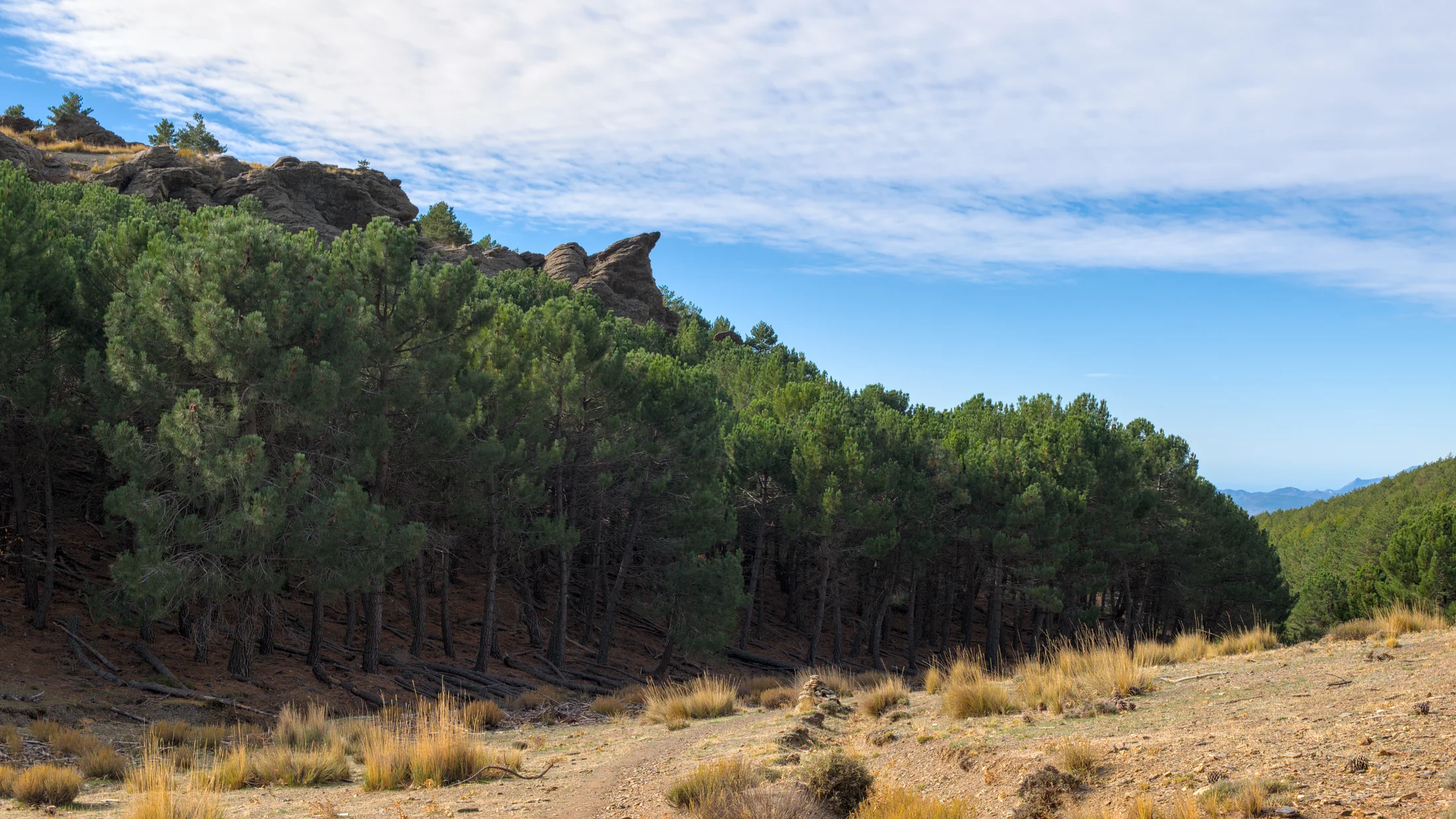
Over the slate ridges, you can see choughs and Spanish ibex.
How we choose these 10 routes
Ten routes 90 minutes or less from Granada, with levels and landscapes ranging from a stroll to a long ascent. The list mixes well-signposted paths, options with public transport and mountain refuges where they are needed.
The levels range from familiar to expert: from 5 km walks to long ascents with 1,300 m of elevation gain. To organise them, we look at distance, elevation gain and the terrain, which can be earth, stone or boardwalks.
Signage also counts: posts and approved markings such as the GR-240 (Sulayr) or others. And cultural interest, with irrigation channels maintained by water communities and mining heritage, alongside historic bridges, river plains and glacial lagoons.
To get there, there are local roads, intercity buses or park shuttles. In summer look for shade and water; the summits and lagoons are best in late summer and early autumn.
Picuco te puede ayudar
Does something here catch your eye?
Tell us.
Write to us on WhatsApp or email: we answer questions, find the best options and help you sort out the booking.
The 10 best hiking routes near Granada
1. Los Cahorros (Monachil): gorge, bridges and bare rock
Los Cahorros, in Monachil, is the closest classic route to Granada: a gorge with walkways and suspension bridges over the Monachil River, 10–20 min from the city.
The route is a short circular or an out-and-back, with 6–8 km and 3–4 h depending on the variant you choose. The accumulated elevation gain is around 300 m and the difficulty is easy-moderate, with narrow sections.
Along the way, you cross suspension bridges, handrails on rock, and small caves where you have to crouch; one of the bridges is 63 metres long. Wear footwear with good grip, because the path can be damp and slippery.
With children, keep a close eye on them on the walkways and by the riverbed, and avoid peak hours. If you want more open views, extend the route towards Cahorros Altos.
The best time is autumn or a dry spring. In summer, it is advisable to set off early and avoid floods after rain.
By car, there is a car park to the right of the "El Puntarrón" restaurant, at the exit of the municipality. On weekends, capacity is limited and during the season there may be access and parking controls.
The walls are equipped for climbing and light via ferratas: do not invade the working areas of local clubs.
2. Vereda de la Estrella (Güéjar Sierra): mining history and panoramas
The Vereda de la Estrella is an old service track to mines and today one of the most photogenic routes in Sierra Nevada.
It was built to facilitate the extraction of minerals from the Minas de la Estrella, de la Probadora, and de la Justicia. The route is linear, out-and-back, and follows the Genil River. Along the way, there are mining remains, old bridges over the Genil, and natural viewpoints of 3,000 m peaks; the side lighting is best first thing in the morning or late in the afternoon.
It covers 16–22 km and 5–7 h depending on the turning point, with moderate difficulty due to the mileage. The route connects with traces of the GR-240 and with variants towards Cueva Secreta or the Loma del Calvario.
Autumn brings the colours and spring brings the water flow; in winter, decide based on the snow at high altitudes. Wear stiff footwear and carry water: there is shade, but few reliable fountains. Avoid high sections with late snow patches if you do not have winter gear and experience.
By car, you arrive via an asphalted track to the Barranco de San Juan, with regulated parking; the final track is narrow, so it is advisable to arrive early.
3. Tramway Path / Tramway Greenways (Granada–Cenes–Genil pines)
The Tramway Path follows the old Sierra tramway platform along the Genil river, on a flat walk that is suitable for families and bicycles. The breeze from the water and the song of common blackbirds accompany almost the entire route.
The route is linear and totals between 8 and 14 km, with 2 to 4 h on foot depending on the section. The accumulated elevation gain is 215 m and the difficulty is easy. It is advisable to plan the outbound journey on foot or by bike and the return by bus.
The surface is compacted for most of the route, so it works well with a child's pram or with a gravel/urban bike. Bridges, short tunnels and old tramway infrastructures dot the path. Maitena station, a former tram stop, now functions as a restaurant and picnic area.
You can go at any time of the year; in summer, the shade by the river is appreciated and May is a recommended time due to the snowmelt. There are rest areas by the river for water and picnics: respect the cleanliness and the fishing areas.
As it is a linear route, check the return schedules and mark the turnaround point by time, not by kilometres. During floods after a storm, the low-lying parts can become muddy and the Greenways may be temporarily closed due to rain and storms: consider postponing your trip.
4. Poqueira Gorge (Pampaneira–Bubión–Capileira): the essence of the Alpujarra
Its villages have medieval origins and preserve the Berber imprint from the Andalusi era.
It is traversed via circular routes and connections between Pampaneira, Bubión and Capileira. The Pampaneira–Bubión–Capileira Triangle shares the route with the GR-7 path up to Bubión and offers views of the Mulhacén summit (3,482 m), the highest altitude on the peninsula. There are variations via irrigation channels and viewpoints over the Poqueira Gorge.
The difficulty is easy-moderate, with narrow paths, sections of loose stone and root steps: it is advisable to wear sturdy footwear. The best time is autumn for the colours and spring for the water flows and flowering; in summer, avoid the middle of the day and with rain, the flat stones become slippery.
Hiking here has a cultural focus: Mudéjar churches, looms and drying rooms. Respect the irrigation channels and private paths, close the gates and do not capture animals, light fires or collect plants.
It is 1 h 30 min from Granada. Pampaneira is accessed via the A-4132 and the path begins in the upper part of the village, from the old road to Bubión, or in the Pampaneira Church Square for the triangle. For public transport, there are buses to Pampaneira from Granada and the rest is connected on foot.
5. Alpujarra villages route: two circular routes with flavour
In winter, with clear days, the air smells of freshly baked bread and firewood.
The short variation takes half a day. It has moderate difficulty due to a sustained slope and passes by viewpoints over the Poqueira, textile workshops and local pastry shops. The Poqueira Gorge and Capileira are Sites of Cultural Interest.
From Granada, there are buses to Pampaneira and Soportújar; check schedules before leaving. If you go by car, leave the vehicle in the perimeter car parks and do not enter the historic centres.
Spring and autumn are the best time. In summer, walk early and carry 1–1.5 l of water per person. Pack a light jacket even if the day is sunny: it gets cool in the shade. When finished, book a table: Alpujarra gastronomy restores salts and spirits.
6. Centenary Olive Route (Órgiva): a family walk among ancient roots
In Órgiva, a well-signposted circular walk winds through centenary olive trees, terraces and traditional irrigation channels. The path features interpretive panels and reaches the ruins of a thousand-year-old olive tree.
The route is easy and suitable for families and active seniors: the elevation gain does not reach 150 m and it can be walked at any time of the year. You can also do it by mountain bike or on horseback.
The departure is in Órgiva, 1 h 15 min from Granada. There are buses from Granada and parking on the outskirts, with the start clearly marked.
During the season, you can visit olive oil mills. Wear comfortable footwear and a hat on clear days, and complete the day with a stroll through the local market and Órgiva's pastries. After the rains, avoid stepping on exposed roots so as not to damage the trees or injure your ankles.
7. Caldera Lagoon (Capileira): gateway to the high lagoons
Caldera Lagoon is one of the best-known glacial lagoons in Sierra Nevada and is located below the Puntal de La Caldera peak. Up there, the air is thin, the sun stings and the water reflects an almost metallic dark blue.
The route is high mountain trekking and requires respect and planning: the altitude and the stony terrain give it a moderate-high difficulty. Bring warm clothing, a windbreaker, thin gloves, hard-soled boots, poles, sunglasses and sun protection, because the weather changes.
Visibility is variable, so carry a track and a physical map as backup. Around you, you will see cushion plants and broom, and a Spanish ibex may appear.
By private car, you can only reach the Hoya del Portillo car park (2143 m). The shuttle minibus (SIAC) departs from Capileira during the summer season, costs 13€ per person and it is advisable to book it in advance; the service may be suspended or modified without prior notice due to weather or safety conditions.
If there is ice, do not skirt the edge of the basin: bank collapses are frequent.
8. Ascent to Mulhacén: the peninsula's roof for experts
Mulhacén reaches 3,479 m. Its normal route does not involve technical climbing, but it requires good physical fitness and experience in long high-altitude routes.
The South itinerary starts from Alto del Chorrillo (2,700 m), which you can reach by shuttle from Capileira. It is a 12–14 km round trip, with +700–800 m of elevation gain and 5–7 h of walking, with moderate-high difficulty. The shuttle shortens the distance and elevation gain, but you must book it in advance and spaces are limited. Another option is to start from the upper part of Pradollano, in the Sierra Nevada ski resort, where there is dedicated parking.
You can climb at any time of the year, although the weather can be severe at any time. In the cold season, check the snow reports and avoid ridges with strong winds. Bring thermal layers, a windbreaker, gloves, a hat, a GPS or track, and a headlamp. Calculate 2–3 l of water per person, as fountains are not guaranteed.
The Poqueira Refuge (2,500 m) is useful for ascents via the southern slope; book in advance. No specific permit is required for the summit, but respect the National Park regulations.
The high summit interpretation service is open from 10:00 to 14:00 and from 17:00 to 20:00 h, from Holy Week until early December (subject to weather conditions). Transport may be suspended or modified due to weather or safety conditions. On clear days, you can see views of the Moroccan Rif from the summit.
9. Water Route (Recommended section in Nigüelas): irrigation channels and springs
In Nigüelas, the water flowing down from Sierra Nevada runs through historic irrigation channels and the murmur guides your way. The Water Route is an easy and educational themed path, also known as the Lovers' Path.
The route follows the Ruta de la Pavilla, which has a circular or almost circular layout, alongside irrigation channels and orchards. It is 2.62 km and approximately 1 h of walking, with easy-moderate difficulty and some narrow sections.
The panels explain water collection, distribution, and riverside biodiversity. It is an ideal outing with children to understand what an irrigation channel is, a traditional canal that carries water by gravity. Nigüelas is known as the "Balcony of the Lecrín Valley".
Respect the irrigation turns and private paths, and do not alter the sluice gates; if there are cleaning works on the irrigation channels, give way. When the ground is wet, avoid the edge of the irrigation channel due to the risk of slipping.
You arrive by car and park on the outskirts, where the start is signposted.
10. Genil river path (Cenes–Quéntar): shade, riverbank and dam
The Genil river path connects the river plains with slopes of sweet chestnut and holm oak up to the Quéntar surroundings. It is a green corridor where the coolness at midday and the constant murmur of the water relieve the summer heat.
The route is circular, 10–14 km and 3–4.5 h depending on the turning point, with easy-moderate difficulty. In summer, shade is king; in autumn, the ochre and yellow colours of the riverbank prevail.
Poplars and willows grow by the water, and on the tranquil banks, you can see water birds and dragonflies. The start is at the Bola de Oro sports centre, with car parks next to the building and in the surrounding streets, suitable for motorhomes. If you go by public transport, the 0395 line leaves Granada and passes through Cenes de la Vega and Dúdar to Quéntar.
The signage is discontinuous: follow the track and pay attention at the crossings. After rain, there is mud and small water crossings. Do not cross the riverbed outside of the designated areas, because the currents can be deceptive.
It serves as a transition route from Sierra Nevada and as good training for greater goals.
Map of locations and useful tracks
Before setting off, open the interactive map and see where each route starts, how much you have to drive and how long it takes to reach the start. The starting points appear with coordinates and approximate altitude, so you know if the car goes uphill or if the elevation change starts at the first step.
The difficulty is colour-coded: green easy, blue moderate, red demanding. Each trace includes distance, estimated times and direction arrows, so you can compare routes at a glance.
Add the service layers and you will have the basics sorted: mountain shelters like the one in Poqueira, nearby bus stops and car parks. Also activate the seasonal layer and you will see alerts for snow at altitude or heat in the valleys.
Download the GPX track of the chosen route and check that your navigation app opens it correctly. Before setting off, note down a plan B: return paths, bus stops and nearby shelters.
The tracks are for guidance and the terrain may change due to forestry works or floods. Cross-reference with the official MTN25 cartography from the IGN and respect the signage on the ground. In summer, mark the water points and the shaded areas on the map to manage your effort.
How to choose the right route: level, season and safety
Choosing the right route means enjoying yourself more and risking less. Start with your real level: in the mountains, the pace slows down and the elevation gain multiplies the effort.
Read distance and elevation gain together. The Vereda de la Estrella is long, with 16.7 km and 800 m of elevation gain, and requires stamina and trained feet.
To calculate times, use 3–4 km/h on easy terrain and add 1 h for every +400–500 m of ascent. Adjust for heat, snow or groups with children.
If you do linear routes like Cenes–Quéntar, public transport is an option: check the return schedules before setting off. On weekends and holidays, get up early to park and avoid saturating the historic centres.
If you are aiming for summits or long routes, sleep nearby to set off early. Capileira is at 1,436 m altitude and in summer there is transport to the Hoya del Portillo to shorten the ascent to Mulhacén.
Before setting off, check the forecast 24–48 h before and on the day; if you have doubts, have a plan B. Carry footwear with grip, layers (windbreaker always at altitude), 1.5–3 l of water depending on the route, a cap and sun protection. Load your track and physical map, and put your mobile on airplane mode to save battery. Leave your route and schedule with someone and let them know if you change them.
Know the opening hours and phone numbers of the mountain huts: the Refugio Poqueira is a reference on the southern slope. With children, choose short routes with water, shade and points of interest (tramway, irrigation channels), with a flexible pace, frequent stops and without exposed sections. If you are an expert, pace yourself according to altitude and prepare plans A/B/C for changing weather; carry a first aid kit, a thermal blanket and a headlamp even on long daytime outings.
Respect for paths and irrigation channels keeps the work of local communities alive: tread carefully and greet those who look after the territory.
Frequently asked questions
Do I need permits to climb Mulhacén or enter Sierra Nevada?
Climbing Mulhacén via the traditional routes does not require a permit, but the National Park regulates access. Respect the reserve zones, traffic on tracks and the shuttles.
In summer, a regulated shuttle operates from Capileira to Alto del Chorrillo. It is advisable to book it in advance, as the service may be suspended or modified without prior notice due to weather or safety conditions.
The northern slope starts from the Hoya de la Mora Stay and Control Area (Albergues Zone), on the old road to Veleta Km. 39.
Choose a slope depending on where you are staying and book the shuttle before fixing the date. On the summits, the weather changes quickly, so check the forecast the day before.
How is the signage on these routes?
On popular routes, such as Cahorros, the Vereda de la Estrella or the Vía Verde, the signage is generally good: there are posts and markers that guide you without any problem.
In high mountains, things change. The tracks can be vague among scree slopes or in fog, so carry a track and a map even if you know the area.
Are there mountain huts and what services do they offer?
The Refugio Poqueira is the base for moving around the southern slope of Mulhacén: it has beds, catering and a weather station. During the season, the hut requires mandatory booking, so secure your spot before leaving Granada.
There are also bivouac sites and unstaffed huts without services. Before relying on them, confirm their current status.
Can I get to the starting points by public transport?
Yes. Several metropolitan lines run from Granada towards the villages where the routes begin. Line 183 connects Granada, Huétor Vega, Cájar, Barrio Monachil and Monachil Pueblo; line 181 connects Granada, Huétor Vega, Barrio Monachil and Bellavista. There are also buses to Cenes and Quéntar.
To the Alpujarra you can go by car, bus or taxi: there are no trains. The buses are Alsa and depart from the Granada Bus Station. The ticket costs between 4 and 8 euros for destinations such as Lanjarón, Órgiva, Pampaneira, Bubión, Capileira or Trevélez.
Between Granada, Lanjarón and Órgiva there are 5 to 6 buses daily: the first one departs around 08:30 and the last one returns around 16:00. For other villages up to Trevélez there are only three buses daily, at 10:00, 12:00 and 16:30. Before setting off, check the return schedules and public holidays.
Where can I download reliable tracks?
Download GPX tracks from platforms such as IGN Rutas, AllTrails or Komoot and cross-check them with official cartography. This way, the route you have on your mobile matches the marked paths in the area.
Test the track on your app before setting off and do not rely solely on mobile coverage. Keep it downloaded on your phone and, if possible, on a backup device.
What rules of conduct should I follow?
The path marks the way: do not leave it and respect private property. The irrigation channels water orchards and farmhouses, so do not touch their gates and close the gates behind you.
Take your waste back with you and avoid loud music, which scares away the wildlife and disturbs those living there. During fire risk periods, inform yourself about current restrictions before setting off.
Are there costs, fees or paid parking?
In high season, some route starting points have regulated or paid parking, such as Güéjar Sierra or Monachil. It is advisable to check the signage before leaving your car.
In Monachil, the blue and red zones operate from 1 December to 30 April, every day from 08:00 to 20:00. The red zone (on the A395 from the Hoya de la Mora junction to GLP Sierra Nevada) is only charged on weekends, public holidays and eves of public holidays from 08:00 to 20:00. There, the price is €0.50 per 30 minutes up to €12 per 12 hours, and exceeding the permitted time results in a €9 fine.
Alto del Chorrillo is a viewpoint over the Poqueira valley with views of the Sierra Nevada peaks and, if the weather permits, the Mediterranean Sea.
Book your experience — discover active tourism activities in Spain with providers verified by Picuco.
Conclusion
Granada brings together in a few kilometres the altitude of Sierra Nevada, the freshness of the Genil and the living culture of the Alpujarra. In a single weekend you can walk between slabs at altitude and follow irrigation channels under sweet chestnut trees.
The Genil is the second longest river in Andalusia and the seventh in the Iberian Peninsula, and it belongs to the Guadalquivir basin. Choose the route according to the season and your level, respect the territory and support the irrigators, shepherds and mountain refuges that make walking safely possible.
To take it a step further, stay in base villages like Capileira, Pampaneira, Órgiva or Güéjar Sierra, and rely on local guides for ascents and technical traverses. Before setting off, complete your preparation with physical maps, a verified track and transport schedules.