Why choose Castilla-La Mancha for your next route
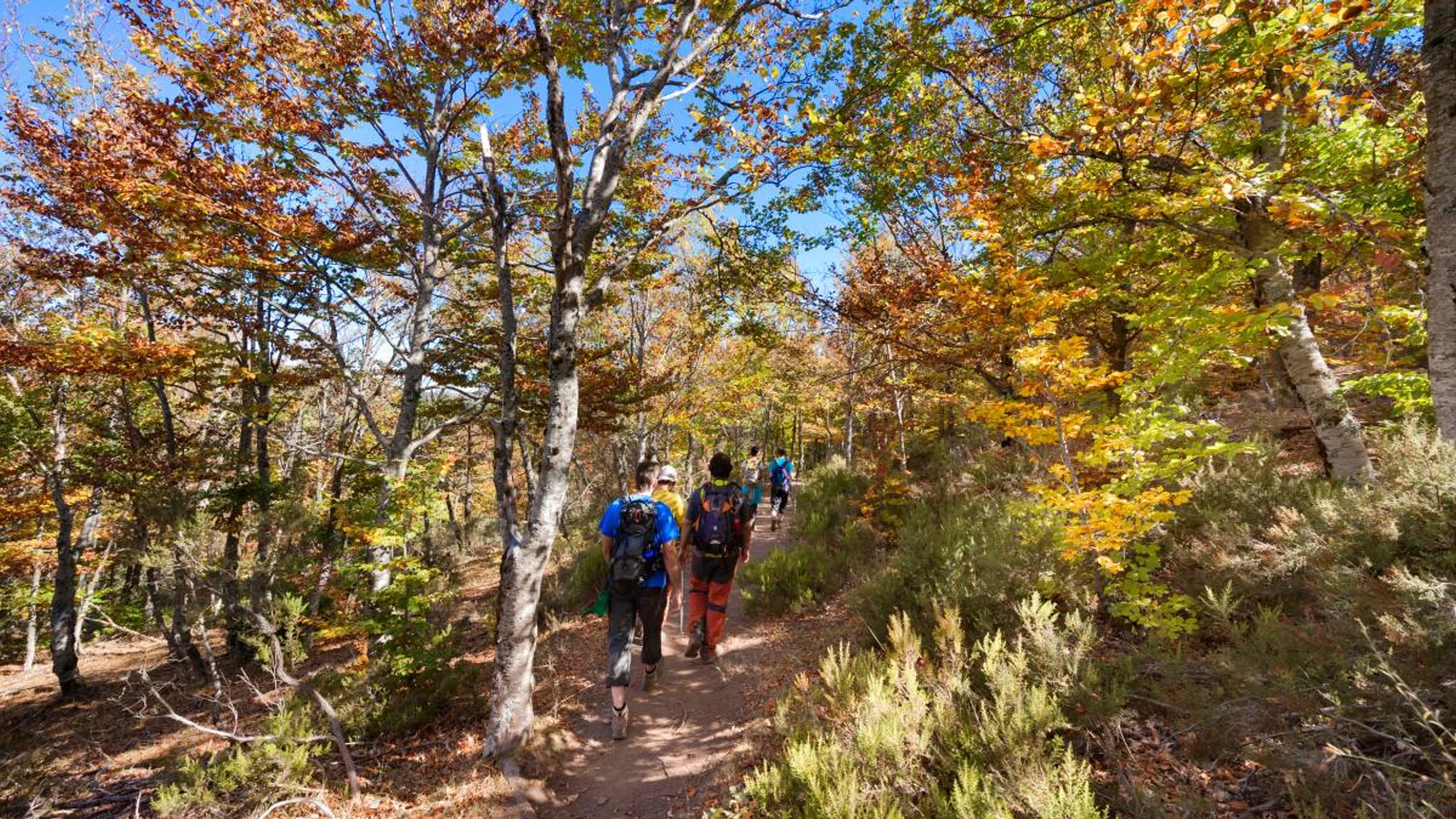
Castilla-La Mancha has limestone gorges, turquoise lagoons and wooded mountain ranges that you can explore at your own pace. That variety means hiking fits here for almost any level and any weekend.
In a canyon of the Júcar, the echo of the water mixes with the flight of a vulture above the cliffs. It is a good way to understand what awaits you on these eight routes.
The selection includes practical data and seasonal tips so that you can plan safe and enjoyable outings. The idea is to choose well, enjoy more and leave the place better than you found it.
Diverse landscapes and ideal season
Castilla-La Mancha has routes for families and for mountain lovers, from the Serranía de Cuenca to the Alto Tajo. Within a reasonable driving distance, canyons such as the Júcar, the Cabriel and the Tajo are combined with lagoons like those of Uña and Ruidera, and mountain ranges such as Cuenca, Alcaraz and Ayllón.
The Alcaraz mountains are part of the Prebética mountain range and are divided between the Sierra del Segura and Sierra de Alcaraz y Campo de Montiel associations. The Ayllón mountains belong to the Central System, are located between the provinces of Guadalajara, Segovia and Madrid and are a protected area of the Natura 2000 network (Site of Community Importance and Special Protection Area for Birds). In them are the pico del Lobo (2269 m), the Concha mountains (1865 m), the pico Ocejón (2048 m) and Alto Rey (1852 m).
The Chorreras del Cabriel form a tobaceous structure 1.5 km long, with a canyon of pools connected by waterfalls and cascades. The air smells of thyme when the sun goes down behind the cliffs.
Summers are hot on the plain but cool in the gorges and on the banks. Spring and autumn concentrate flowering, high water flows and colours, and winter brings snow on summits like the Ocejón and calm to the lagoons. The best general time is spring and autumn; in summer, leave early or at sunset; in winter, bring suitable gear.
These landscapes are cared for by mountain villages made of slate, forestry trades and shepherds. The routes are suitable for families, nature photographers and intermediate and advanced hikers.
How we choose these 10 routes
The ten routes in this guide measure between 4 and 18 km, with the elevation gain indicated and the difficulty explained in simple language. This way you can compare before setting out and choose the one that fits your day.
For each route we look at the access points and marked parking areas, the natural and heritage interest, the presence of water and the viewpoints. We also note nearby services, such as fountains, recreational areas and visitor centres, and permits or regulations where they exist.
Safety and sustainability rule the selection: marked paths, avoiding erosion, respecting wildlife and complying with regulations. The result is 8 varied routes, spread across provinces and with family and medium/high level alternatives.
Picuco te puede ayudar
Does something here catch your eye?
Tell us.
Write to us on WhatsApp or email: we answer questions, find the best options and help you sort out the booking.
The 10 routes, at a glance
Ten routes spread across Cuenca, Albacete, Guadalajara and Ciudad Real, with a clear idea of each one so you can choose quickly.
- Hoces del Júcar (Cuenca, around Cuenca capital and Villalba de la Sierra): limestone gorges, viewpoints and griffon vultures.
- Laguna de Uña (Cuenca, Uña): protected lagoon with walkways and pine forests, ideal for birdwatching.
- Nacimiento del río Mundo (Albacete, Riópar): emblematic waterfall and path to the Chorros, with spectacular flows in spring.
- Salto de Poveda y Laguna de Taravilla (Guadalajara, Alto Tajo): Tajo canyon, clear pools and a photogenic artificial waterfall; the lagoon is of a karst type, with fresh and permanent waters fed by a stream, and an average depth of 11 m.
- Lagunas de Ruidera (Ciudad Real/Albacete, Ossa de Montiel–Argamasilla de Alba): circuit alongside turquoise lagoons and viewpoints.
- Hoces del Cabriel (Cuenca/Valencia, Minglanilla–Villargordo del Cabriel): gorges, river beaches and viewpoints over limestone blades.
- **Sierra Norte de Guadalajara — Pico Ocejón and black villages (Guadalajara, Majaelrayo/Valverde): classic ascent and slate villages.
To start with hiking routes in Cuenca, focus on 1–2; if water calls to you, 4–6 are your range. The murmur of the river accompanies you when you choose the right route and season.
Routes in detail
Each fact sheet in this section tells you when to go, how to get there and who each itinerary is for. You will find access points, distances, safety and local tips for each route.
The scent of pine resin accompanies some of these paths. Choose the one that fits your time and your fitness level, and check the fact sheet before heading out.
1. Hoces del Júcar: gorges and viewpoints
The Júcar river makes its way between limestone and clay rock walls of up to 200 metres in the province of Cuenca. The Hoces del Júcar bring together several gorges with meanders and riparian forest, and you can enter them from Cuenca capital, via the Puente de San Antón, or from Villalba de la Sierra, via the Ventano del Diablo.
The route is between 6 and 12 km depending on the section you choose, with low-medium difficulty via paths with natural balconies. Along the way, it is easy to see golden eagle and griffon vulture, and there are fish in the water.
The route is suitable for photographers, hikers fond of viewpoints and families accustomed to paths with partial railings. Spring and autumn are the best times due to the mild temperatures. In summer, walk during the early or late hours; in winter, wear warm clothes due to the occasional frozen ground.
Avoid the edge of the cliffs, carry water because there are few fountains and protect your binoculars and camera from the wind. Exercise extreme caution on exposed path sections.
Public paths have no fees and parking is free or paid depending on the season and the area; there is parking at Recreo Peral / Playa Artificial.
2. Uña Lagoon: glacial lagoon and forest paths
Uña Lagoon occupies a glacial hollow in the Serranía de Cuenca, next to the village of Uña. It has been a Fauna Refuge since 1988 and features cliffs and bird observatories.
The circular route goes around the lagoon in about 3 km, with low difficulty and a mixed terrain of earth and boardwalks. You will see great herons and typical grebes, and with luck, an Eurasian otter. At sunset, the water surface turns amber.
Autumn and winter are the best times for waterbirds, and spring, because of the flowering. In summer there is more crowds and heat at midday. It is a comfortable plan for families, birdwatchers and landscape photographers seeking tranquility.
Arrive via the CM-2105 and park next to the village; the interpretation centre is nearby. Wear footwear with gripped soles and do not leave the path so as not to erode the reed beds. Swimming is not allowed to protect the ecosystem. At the visitor centre you can ask about sightings and sensitive temporary sections; the itineraries are signposted.
If you want more, it connects with the climb to the Muela de la Madera, in the Serranía de Cuenca: 508 m of positive elevation gain. Its surface of giant lapiaz with pine forest presents a risk of disorientation. You can also combine the visit with the viewpoints of the Serranía de Cuenca.
3. Serranía de Cuenca — Ciudad Encantada and surroundings: rock formations and panoramas
In Valdecabras, about 30 km from Cuenca via the CM-2104, there are rock masses that look like sleeping animals among pines. It is the Ciudad Encantada, in the municipality of Valdecabras (Cuenca).
The interest lies in the rock formations with their own names, the Scots pine forests, the viewpoints and the boardwalks. Tormo Alto is the symbol of the place and is right at the entrance. The stone, speckled with lichens, smells of fresh humidity after a drizzle.
The internal circuit is signposted and requires payment: between 1.5 and 3 km, very easy, ideal for families and for anyone who wants simple geology explained on-site. It costs 5 € for adults; 4 € for children aged 8 to 12, retirees and large families; children under 7 enter for free. You cannot book or buy the ticket online: it is purchased directly at the ticket office.
Outside the site there are paths towards nearby viewpoints and towards Uña. You can combine the visit with Uña or with the Ventano del Diablo viewpoint on the same day. Ventano del Diablo is free access, with no ticket office, and is open 24 hours.
The best time is spring-autumn. In summer it is advisable to enter early to avoid queues and high sun, and in winter you must watch out for ice patches in the shade. Making fires and smoking is prohibited, and do not climb on the formations. The site is not equipped for wheelchairs, people with reduced mobility or baby strollers. There is ample parking and the rest of the Serranía has recreational areas.
4. Birth of the Mundo River: waterfall and high mountain paths
In Riópar (Albacete), a waterfall of more than 300 metres falls down the wall of the Calares del Mundo y de la Sima Natural Park. The Birth of the Mundo River is parked at the Los Chorros area and you walk up to the base.
The path to the base is well marked and has steep sections. The cave can only be entered with caving and authorisation. The mist from the waterfall refreshes your face even in full sun.
Spring and the days following heavy rains are the best time: that is when the "reventón" arrives, a sudden increase in flow. In winter there is ice and snow at high altitudes. Along the way you will see riverside forest and calcicolous flora, and with luck, birds of prey and Spanish ibex.
The route is suitable for active families, waterfall photographers and intermediate hikers who extend the journey towards high viewpoints. There are walkways and railings at key points, but the ground is slippery due to the water spray: bring poles and footwear with good grip.
Pedestrian access is free. On bridges and during Holy Week there may be parking regulations. If it is full, a queue is set up from the Puerto del Arenal.
5. Salto de Poveda: canyons and pools in the Sierra Norte de Guadalajara
A waterfall about 20 metres in height and 10 in width awaits in the Alto Tajo Natural Park, near Poveda de la Sierra. The Salto de Poveda combines the water fall with pools and riverside forest, and the route also passes through the Laguna de Taravilla.
The difficulty is low-medium, with some short climbs. It is a route for families used to walking, for groups looking for responsible swimming in permitted areas and for water photographers. When the wind dies down, the green mirror of the lagoon looks like ancient glass.
In summer there are more people in the pools, so it is advisable to get up early. In July and August it is necessary to book and pay a fee through the canondeltajo.es platform.
You can extend the route towards the cliffs above the Laguna de Taravilla or link it with marked river sections of the Alto Tajo. Bring water (fountains are not guaranteed), a cap and sunscreen, and respect the signage for swimming and currents. After floods, the fishermen's walkway can be crossed with caution.
Park in the Laguna de Taravilla car park, at the end of a track of about 6.5 km (20 min.) from Taravilla, and do so in the designated areas.
6. Lagunas de Ruidera: lagoon circuit and water activities
The water falls over small tufa formations and forms a string of waterfalls and jumps between one lagoon and the next.
The circuits are flexible: you follow shores and viewpoints with low-medium difficulty, marked by the heat and local orientation. The Cañada Real de los Serranos or Conquense used to pass along its shores, used by transhumant flocks for watering.
Families, water photographers and groups that combine walking and kayaking with accredited local companies do well. Spring brings flowering and water flows, summer brings water activities and long afternoons, and autumn brings colours and calm. At sunset, the lagoons turn copper and the murmur of the waterfalls lowers in volume.
In summer there are regulated swimming and parking areas: check the updated restrictions and the visitor centres, which provide maps and recommendations. Avoid the middle of the day in summer, bring footwear for the shore and respect the walkways and the fragile tufa barriers.
7. Alto Tajo Natural Park: canyons, forests and river routes
Alto Tajo combines canyons, pine forests and riverside paths between meanders and cliffs, on horseback between Guadalajara and Cuenca.
There are also marked viewpoints from the road, as well as walkways and wooden bridges at key points. From above, the river draws a dark green thread between limestone walls.
The difficulty is low-medium due to the distance and some slopes. At the viewpoints, watch out for the edges and loose stones. Spring and autumn are the best times; in summer you can take a responsible dip in the permitted areas and winter is cold but bright.
The park is a great fit for active families, wildlife and bird photographers, and medium-level hikers. Before heading out, check with the interpretation centres regarding temporary closures due to nesting or flooding; there are marked car parks.
A full weekend includes reddish stone and wood villages, hermitages on high ground, wood craftsmanship and the Salto de Poveda.
8. Hoces del Cabriel: gorges, crystal clear waters and viewpoints
The Cabriel river makes its way through rock walls on the border between Cuenca and Valencia. The Hoces del Cabriel features limestone blades, river beaches, meanders and cliff-dwelling birds, with great panoramas over the Contreras reservoir.
The Cuchillos de Contreras are vertical strata such as Torre Negra and Torre Cabriel. The escarpments and rocky outcrops reach up to 100 metres of elevation gain. Along the route, you will find the Noria de Casas del Río, from the 18th century and still in operation, and the Puente de Vadocañas, from the 16th century on a Roman base.
The circular route is 5.7 km long with 313 m of elevation gain and requires an equipped descent into the canyon. There are also riverside sections and viewpoints of 5–10 km, with low-medium difficulty, featuring short slopes but stony ground.
Spring and autumn bring temperate weather. In summer, you can swim in the designated areas and should avoid the midday hours. The area is suitable for families who alternate between walking and swimming, medium-level hikers, and kayak enthusiasts who set off with authorised operators.
At dusk, the cliffs turn orange and the river flows silently.
Both communities protect these spaces: respect the signage for sensitive areas and use the designated car parks. Bring water and a hat, be careful with loose ground on the balconies, and check the water flow if you plan on any water activity.
The loop starts at the Puerto de Contreras esplanade. The usual access points are Minglanilla (Cuenca) and Villargordo del Cabriel (Valencia).
9. Sierra de Alcaraz and surroundings: panoramas and gentle summits
The Sierra de Alcaraz, in the province of Albacete, mixes pine forests, traditional lime kilns and mountain streams with open views of the Manchegan plains.
The ascent to Pico Almenara (c. 1,796 m) has medium difficulty and 498 m of positive elevation gain: it is an accessible summit for intermediate hikers. From the ridge, the fields look like a mosaic of ochre and green tones.
If you are looking for something gentler, the Vía Verde de la Sierra de Alcaraz has firm flat sections and easy options for families and cyclists. In Bogarra, the sculpture and waterfall route is a round trip, 15.96 km long with 543 m of positive and negative elevation gain, and moderate difficulty.
The Bogarra path features more than 100 hand-carved sculptures; the Sculpture in the Landscape Workshops are held on the first weekend of May. The surroundings offer waterfalls such as Batán, Cueva or Chorraero, and the Hoz de Bogarra, a canyon more than two kilometres long. The Torre de Haches played an important role in the struggles between Christians and Muslims during the late Middle Ages.
Spring and autumn are the best times due to the temperatures. In winter there may be snow on the summits and in summer it is advisable to start early. Bring enough water, because there are few fountains, an offline map and clothing for the summit due to the wind. Respect livestock crossings and gates.
You can complete the weekend by linking it with the Nacimiento del río Mundo, in Riópar, or with the waterfalls near Bogarra.
10. Sierra Norte de Guadalajara — Pico Ocejón and mountain villages
Pico Ocejón is the classic summit of the Sierra Norte de Guadalajara: at the top, the panoramas are 360° and the path passes through the black architecture of the area. The route from Majaelrayo is the best known and most frequented to reach the summit, and its southern face can be seen from many kilometres away.
It features 13 km round trip from Majaelrayo and 14 km from Valverde de los Arroyos. The positive elevation gain is 864 m from Majaelrayo and 794 m from Valverde de los Arroyos, with medium-high difficulty due to length and slope. If you set off from Valverde de los Arroyos towards Pico Ocejón, the route allows you to pass through the Despeñalagua streams.
At the summit, the wind brings the scent of resin and hot stone. Spring and autumn provide the best temperature and visibility; in winter there is snow and ice, so you need crampons and experience, and in summer it is advisable to start early. There are no drinking water fountains on the path: bring water.
Start early, check the weather and pack thermal layers, a headlamp and poles for the long descents. The route is suitable for experienced hikers and groups looking for a classic summit of the region. The classic access points depart from Majaelrayo and Valverde de los Arroyos, in the Sierra Norte (Ayllón). For the following day, plan a short route through the black villages (Majaelrayo, Campillo de Ranas, Valverde) as active rest.
Location map to chain routes in a single trip
Eight separate plans can become a meaningful trip if you place them on an interactive map. Mark the starting points, calculate travel times, and group routes by proximity so you don't waste energy on travel.
Work with separate layers: car parks, water points and recreational areas, viewpoints, rural accommodation and natural pools. This way, you can see at a glance what you have near each route and what you have yet to cover.
Before setting off, import reliable GPX/KML tracks and validate them with official cartography (ICGC, IGN). Between bases, transfers are short: Cuenca–Uña (~45 min), Riópar–Bogarra (approximately 1 h 3 min, 38.1 km) and Poveda–Peralejos (about 57 minutes by car, 37 km), always subject to traffic.
Plan alternatives: if a section is closed, add another nearby of the same level. Also note the regulations for each area, including permitted bathing zones, trails temporarily closed due to nesting, and visitor centre opening hours.
Carry the map on your mobile and save it offline. With it, you can adjust each day according to the heat, the flow or your energy.
How to get there and where to stay near the routes
Castilla-La Mancha is easily travelled by car, and public transport reaches the regional hubs. The most practical option is to choose a well-located base and organise each day from there.
By car, you have the A-3 (Madrid–Valencia) for the Cabriel, the A-31/A-32 for Alcaraz and Riópar, and the A-40 for Cuenca and the Serranía. By train, the AVE and Avant arrive in Cuenca and Ciudad Real.
Driving times change depending on traffic, so calculate with a margin. From Cuenca, Uña is about 45 min by car.
For sleeping, rural houses and apartments work well for families and groups: they are close to the trails and have a kitchen. Mountain hostels and guesthouses are the economical option, with a hiking atmosphere.
Choose your base according to the block of routes you want to do: Cuenca and Uña for routes 1–3, Riópar–Alcaraz for 4 and 9, Alto Tajo–Poveda for 5 and 7, the Cabriel for 8 and Ruidera for 6. When booking, compare the exact location, the cancellation policy and the walking access to the start of the routes.
How to choose a route according to level and season
Adjusting the distance and the elevation gain to your physical fitness is the best investment of the trip. Heat, river flow, and daylight hours matter more than it seems.
If you are a beginner or travelling with family, the Laguna de Uña (2) is about 3 km and the Ciudad Encantada (3) is another 3 km. For a medium level, you have the Hoces del Júcar (1), with 7.00 km of low difficulty, and the Salto de Poveda–Taravilla (5), which is 5 km.
The season changes the route. In summer, look for water and shade, start early, and practice responsible swimming. In winter, the days are short and there may be ice or snow: limit yourself to low routes or carry winter gear.
From 27 June to 31 August, you must reserve parking to travel the Tajo track in Taravilla, Zaorejas, Poveda, and Peñalén. In Peñalén, Poveda de la Sierra, Taravilla, and Zaorejas, motor vehicle parking is limited from 7:00 to 21:00 h in authorised places.
Before setting off, check three things:
- Carry 1.5–2 l of water per person in summer, because fountains are not guaranteed.
- If you are not used to elevation gain, prioritise routes with less than 400–500 m.
- If you have vertigo, avoid edges and choose paths with railings.
With little ones, choose short circuits with a visual reward: a waterfall, a viewpoint, or birds. If you are going to take photographs, aim for the first and last light in Júcar, Mundo, and Ruidera.
Safety, essential equipment and responsible practices
These mid-mountain routes are enjoyed with planning, good equipment, and respect for the environment. Before setting off, check the weather report and the available light, and let someone know your plan.
In the massif, footwear with grippy soles and trekking poles make the difference on routes with slopes. Wear layers: a light thermal layer, a windbreaker or waterproof jacket, a cap, and sunglasses. Do not forget water and energetic food, with a thermos in winter.
To orient yourself, download an offline map or a reliable GPX and carry your mobile phone charged with a power bank. A minimum first-aid kit (bandages, disinfectant, emergency blanket) and a headlamp complete the basics.
Follow the signage, do not take shortcuts, and avoid overhangs and unstable edges. Respect temporary closures due to nesting or water flow and get information at visitor centres. Swim only in permitted areas: currents and eddies are not always visible.
Take your waste back with you, including organic matter; the wildlife does not need your food. Do not pick plants or disturb the wildlife and keep your dog on a lead where required. Stay on the path: the tufa formations of Ruidera and the reed beds of Uña are fragile. Greet others on the path and respect forestry and livestock work.
Frequently asked questions
Do I need to pay or request permits for these routes?
Most paths are free access, so you can walk without reserving anything. There are exceptions that are worth checking before setting off.
The Ciudad Encantada is a paid enclosure. To enter the Mundo cave, you need speleology authorisation. At some points there may be parking regulations; check the local rules before going.
Are they suitable for strollers or wheelchairs?
It depends on the section. The flat sections of Ruidera and some walks in the Serranía have accessible surfaces, so you can do them with a stroller or wheelchair.
Most routes, however, feature dirt and slopes, so they are not suitable for strollers or wheelchairs. Before setting off, check the current adapted options at the visitor centres.
Can I bring my dog?
Yes, in general, you can bring your dog on these routes, always on a lead and respecting sensitive wildlife areas. In specific enclosures and river beaches, there may be specific restrictions: check the signage on-site before entering.
How do I get there by public transport?
By train, you can reach provincial capitals such as Cuenca and Ciudad Real. From there, regional buses depart for nearby towns like Riópar, Uña and Molina de Aragón.
Train and bus frequencies are limited, so plan your schedules in advance. To complete the final sections to the start of the route, you will have to rely on a local taxi or additional walks.
What do I do if a route is closed for maintenance or nesting?
When a route is closed for maintenance or nesting, look at the map and find a nearby alternative of a similar level. This way, you keep your plan for the day without changing areas.
If Salto de Poveda is crowded, opt for a section of the Alto Tajo upstream or for a designated viewpoint. Check the status of the route before setting off and carry the map downloaded in case the closure forces you to improvise.
Can you swim in lagoons and rivers?
You can only swim where it is permitted and signposted. In the Ruidera lagoons and in the Cabriel river, there are areas enabled for bathing.
In Uña, bathing is not permitted. Avoid jumping from rocks and respect the currents.
Book your experience — discover active tourism activities in Spain with providers verified by Picuco.
Conclusion
Castilla-La Mancha has ten hiking routes for all levels, among gorges, lagoons and mountain ranges, with water, viewpoints and mountain culture at hand. Choose yours according to the season, adjust the distance to your legs and protect yourself from the heat.
Before setting off, confirm local regulations and carry offline maps. To complete your getaway, you can look for kayak experiences or guided routes with accredited companies and check options on Picuco.
Travel light, leave the place better than you found it and share your route to inspire others to walk responsibly.