Introduction
More than 3,200 km of old railway tracks run through Spain by bike, without cars and without hills. Greenways are the simplest way to cycle as a family.
These itineraries recover the layout of old railways: they are flat, have no motorised traffic and pass through landscapes that invite you to stop. In 2025, the network totals about 3,500 km spread across 140 routes. The Greenways brand only applies to itineraries on former railway infrastructures, so every route that carries it meets that condition.
The signage is clear and the route is separated from motorised traffic, which removes the stress of watching every car. The surface is usually compacted or asphalted, comfortable for small wheels and trailers. The scent of pine after a bend and the shade of a viaduct accompany the little ones as they pedal without rushing.
This guide brings together 10 routes with recommended distances, estimated times, surface, levels (very easy, easy and moderate), services such as water, toilets and shade, and advice on child seats, trailers and tandems. You will also find the location of each route, the best time to visit, access points and accommodation, as well as basic safety rules and frequently asked questions. If you are looking for more ideas for going out with children, take a look at our family section and our active tourism proposals.
Picuco te puede ayudar
Does something here catch your eye?
Tell us.
Write to us on WhatsApp or email: we answer questions, find the best options and help you sort out the booking.
Why choose greenways with children?
Greenways are born on old railway tracks: minimal slopes, wide layouts and no cars. That triangle of smoothness, space and absence of traffic translates into relaxed rides, less fatigue for children and better control for the adult.
Compared to a secondary road, with irregular hard shoulders and cars that dictate the pace, here your legs and the desire to stop are in charge. The surface is fine asphalt or compacted gravel, stable for children's bicycles with 16” or 20” wheels and suitable for trailers. The light crunch of gravel under the wheels accompanies the pedalling.
The signage includes kilometre markers, panels with distances and warnings at crossings; at crossings with local roads, there are usually designated crossings and priority signs. Compared to technical trails or forest tracks, greenways reduce risks: fewer unexpected potholes, gentle blind curves and constant width. Short tunnels provide shade and excitement, the railings on viaducts add protection and the proximity of rivers or woodland lowers the temperature in warm months.
You can plan a 6–8 km round trip with children aged 4–6, or extend it to 15–25 km once they have mastered pedalling. Many greenways pass through villages every 5–10 km, making it easy to replenish water, go to the toilet or eat something. Several old stations have been converted into rest areas or rental points, and some offer fountains or picnic areas.
A large part of these layouts connect with train stations or accessible car parks, and the design allows you to adjust the distance and the return point. If you are looking for routes through a valley with shade and water nearby, these greenways fit well. In summer, it is advisable to set off early and prioritise sections with shade or riverside areas.
Ten family-friendly greenways: mind map, levels and key facts
With children, the math changes: calculate an average of 6–10 km/h and include short stops. This way, you will know if the route fits into the morning or if it is better to split it in two.
The ten greenways that follow are flat and traffic-free, but each one has its own length and starting point. Before choosing, look at how many kilometres you will cover in total and how much actual time it will take you.
The murmur of the wind through the trees marks the tempo better than any clock. To ensure no one arrives exhausted, take a long break every 60–90 minutes of pedalling, with water and something to eat.
With these two pieces of data, the average and the pauses, you can plan any family outing without schedule surprises.
1. Carrilet Greenway (Girona–Olot): volcanic landscapes and gentle sections
The Carrilet Greenway is well-suited for first-time families.
The surface is made of compacted crushed stone with paved sections and the gradient stays below 2%: easy level. The route is wide, is signposted and protected, and a village appears every few kilometres.
Along the route, there are rest areas and intermittent shade from agricultural trees. The width and the stable surface make a child tandem comfortable.
You can set off from Parc de Pedra Tosca (Les Preses) or from Olot Station and return via the same path. Combine the route with the Garrotxa Volcanic Zone Natural Park and, in autumn, with a visit to the beech forests. Montsacopa volcano is in the middle of Olot.
2. Sierra Greenway: old railway line with shade
The Sierra Greenway follows an old railway line between Cádiz and Sevilla, with the track protected alongside the Guadalete river. The high-quality compacted crushed stone surface has a slight gradient and an easy level, so it is suitable for families with children.
The tunnels and the riverside vegetation provide partial shade: it is one of the most pleasant greenways when the heat intensifies. Upon entering a tunnel, the sudden coolness contrasts with the smell of thyme on the sunny slopes.
The old stations have catering and toilets, although they usually close one day a week and do not open for dinner. There are closed sections: tunnels nº14 "Zamarra", nº15 "Alberquilla" and the section between the colada del Morón and the Olvera tunnel.
The constant width of the path accommodates trailers comfortably, child seats without problems and tandems. Bring lights or a headlamp for the long tunnels and some light clothing for inside them, even in summer; plan ahead for water and schedules too.
You can start and finish at the Puerto Serrano Station car park or at the Coripe Station car park, and return via the same route.
3. Vía Verde del Aceite (Jaén–Córdoba): olive groves and services for families
Between Luque, Zuheros and Doña Mencía, the Vía Verde del Aceite crosses olive groves without a single car. It is a section suitable for families almost all year round.
The family distance ranges from 12 to 22 km, round trip, depending on where you decide to turn back. The surface is fine asphalt and compacted gravel, with gentle slopes and an easy level. Trailers and child seats roll well, and the child tandem flows smoothly over the asphalt.
You can start or finish at the Doña Mencía Station or in the surroundings of Zuheros, with views of the Subbética. The renovated stations have services and there is shade at specific points along the route, with towns nearby to stop at. The sea of olives forms green waves up to the horizon while cicadas sizzle at midday.
The route crosses the Sierras Subbéticas Natural Park, declared a UNESCO Global Geopark. It is the longest greenway in Andalusia: the full route goes from Jaén, next to the Las Fuentezuelas sports centre, to the Campo Real station.
In summer, start early, schedule a stop in the shade every 45–60 min and carry 1–1.5 l of water per person.
4. Vía Verde de Ojos Negros (Accessible section): landscape and railway layout
The Vía Verde de Ojos Negros is the longest in Spain, with 160 km in length, and this family section adds 10–18 km round trip.
The surface is mostly asphalt in the Comunitat Valenciana, with gentle and sometimes favourable slopes. The level is easy and the generous width leaves room for trailers, tandems and child seats, which are comfortable on asphalt. The viaducts are protected and towns appear every few kilometres, so you can stop to rest whenever you want.
Motor vehicles are prohibited and path crossings are signposted. There is partial shade in the riverside sections and the layout crosses the urban centre of Caudiel through the El Barrio area. On sunny days, wear a cap under your helmet and sunscreen, and avoid the middle hours in summer.
The shimmer of the water in the Palancia strait provides a blue respite to the green of the valley.
5. Vía Verde del Tajuña (Madrid): getaway near the capital
The Vía Verde del Tajuña is a cycling getaway near Madrid, suitable for families: very smooth reddish asphalt surface, minimal slope and a very easy level. The signage is clear, the width is generous and services appear frequently, making it an ideal half-day trip.
The municipalities along the route have rest areas, bars and fountains. The shade is moderate and increases in the riverside sections. The smell of freshly baked bread from the Tajuña towns accompanies the first pedal strokes of the morning.
The smooth surface works well for trailers and child seats, and the child tandem will appreciate it. Arrive by Metro line 9 to Arganda del Rey, by Cercanías from Vicálvaro (C2 and C7) or by car via the A-3 (exit 25) or the R-3 (exit 21).
You can ride it at any time of the year. In summer, it is advisable to get up early due to the heat and, if you set off from Madrid, start early to avoid access traffic. Before setting off, check for any occasional works on the route.
6. Plazaola Greenway (Navarra–Gipuzkoa): tunnels and easy nature
The Plazaola Greenway crosses Navarra and Gipuzkoa on compacted earth, with short tunnels and a very gentle slope. It is an easy and safe route for cycling with children, passing between renovated stations and a valley with abundant shade.
The murmur of the river Leitzaran accompanies you like a soft soundtrack amidst ferns and black alder. It is one of the safest and most playful greenways for little ones who love tunnels.
The river atmosphere and the shade of the valley provide refreshment in summer. In the towns, there are interpretation centres, tables, and fountains to make a stop.
You can attach a trailer, fit a child seat without any problem, or pedal a tandem with lights for the tunnels. Avoid long tunnels that are closed or without light, and carry lights and a thin raincoat: the humidity of the valley is refreshing even in summer.
7. Besaya Greenway (Cantabria): cultural and shaded section
Twenty flat kilometres connect Suances with Barros, in Los Corrales de Buelna, between the river, industrial heritage, and the coast. Shade appears often in the river sections, which is much appreciated when travelling with children.
The route totals about 20 km of flat terrain between the greenway and the cycle-pedestrian path. The asphalt and compacted sections, with low slopes, make it an easy level. The round trip is about 40 km.
Trailers and child seats fit in without any problem, and the tandem handles well on urban surfaces. The nearby sea is the final reward.
Along the way, you will find a park with the most famous discoidal stela in the region, a symbol of the Cantabrian tribes, and a spa where Queen Isabella II used to take her waters. The salt breeze coming from the estuary softens the effort during the final pedal strokes.
It is advisable to adapt the distance to the children's age and turn back when motivation starts to drop. There is a partial closure of the section between Torrelavega and Reocín due to environmental restoration works: check the passage before setting off.
8. Val de Zafán Greenway (Family section): history and landscape
The Val de Zafán Greenway is a perfect option for cycling with children and adding a plus of railway history.
The journey begins at the La Puebla de Híjar Station (Teruel). The slope is gentle and the level is easy: trailers and tandems work well, and child seats roll comfortably on asphalt. The tunnels are short, the stations have services, and the viaducts have railings, so children can pedal with peace of mind.
There are rest and dining areas at the stations. Shade is intermittent and is more abundant in the tunnels and in the riverside areas. The jagged silhouette of the Ports watches over the valley while the light flickers when passing through the tunnels.
Spring and autumn are the best times; in summer, set off early and schedule a swim or an afternoon activity on the Ebro.
9. Vía Verde de la Jara (Extremadura): river, shade and low gradient
The Vía Verde de la Jara crosses dehesa and riverbanks through the province of Toledo, with a wide layout and very little user traffic. It is an easy route, with a slight gradient, which works well with children.
The Vía Verde de la Jara route begins at the Calera y Chozas station. In the surroundings, it is frequent to see red deer, roe deer, white storks, alpine newts and birds of prey.
Services are scarce: carry enough water and snacks. Shade is partial and appears in the river galleries, so it is advisable to account for the heat.
With a trailer, child seat or tandem, you can ride without any problems, although there is some dust on dry sections. In summer, avoid the middle hours and schedule stops every 45 minutes if you are travelling with small children.
The route may be closed to users due to poor conservation status. Check its condition before going. Access is at the Calera y Chozas station.
10. Vía Verde del Río Eresma (Segovia, family section): history and proximity to cities
The Vía Verde del Río Eresma leaves Segovia and reaches Hontanares de Eresma without complicated logistics: you park near the centre and start pedalling. The family section totals 13.6 km one way, about 27 km round trip.
The surface mixes asphalt and compacted gravel, with gentle gradients and an easy level. Trailers and child seats pass through well, and the child tandem rolls smoothly on the asphalted sections. The singing of birds in the poplar groves accompanies the departure from the city towards the open valley.
It starts in the vicinity of the old track north of Segovia and you pedal towards Los Huertos and Hontanares. Along the way, you have bars and fountains in the villages, rest areas and moderate shade next to the river.
The old town of Segovia and its aqueduct are UNESCO World Heritage Sites. Combine the excursion with a stroll by the aqueduct and an ice cream at the end: it works as motivation for the children.
Where they are and when to go: essential information for planning
The ten routes are spread across four zones: the Cantabrian coast, the Ebro valley, the Meseta and Andalusia. This way you can choose the one closest to home or the one that best fits the seasonal weather.
The rural paths of these greenways run between fields and vegetation, with the smell of freshly cut grass in spring. Before setting off, check the forecast for the chosen area and book in advance if you are travelling during a long weekend or in summer.
Location and general description
Greenways with children are spread throughout Spain and almost all of them are within reach of a weekend getaway. Each area has its own character, and the routes are well described on local panels and in tourist offices.
In the northeast, the Vía Verde del Carrilet joins Girona and Olot through Garrotxa and the Girona plain, between beech forests and fields. From Barcelona, the Carrilet is 1.5–2 h from Olot/Girona.
If you are looking for another family route in the north, you have Cantabria.
From Madrid it is 170 km and about a 2 h 9 min journey.
In the south, the Vía Verde del Aceite (Jaén–Córdoba) combines tunnels, viaducts and a sea of olives. The Vía Verde de la Sierra is 1–1.5 h from Sevilla.
With these distances, greenways with children fit into weekends or long weekends without major travel.
Best time and weather
Spring and autumn are the best seasons to cycle with children: average temperatures of 15–25 °C, blooms and sufficient shade on the river sections.
In summer, set off early (8:00–11:00), choose riverside valleys and tunnels, and take a long siesta at midday to resume in the afternoon. In winter, wear layers, gloves and a neck gaiter; the paved paths drain better after the rain.
Adapt your schedule to the light. On hot days, cycle at sunrise and stop at midday; on damp days, carry a light waterproof and a backpack cover.
How to get there and transport (Cars, trains and bicycles)
Almost all greenways have parking in old stations or marked recreational areas. By car, arrive early on weekends: the access points get full.
By train, Cercanías and Media Distancia allow bicycles under certain conditions. RENFE Media Distancia trains allow you to travel with a bicycle, but confirm weekdays and time slots before setting off.
With small children, plan a circular return trip, out and back, to avoid logistical dependencies. If you want to do it linearly, organise a shuttle car or a transfer.
Accommodation and nearby services
Sleeping near the start of the greenway allows you to set off fresh early in the morning and return in time for a siesta. Alongside the route, there are agrotourism sites, hostels and campsites that usually have family rooms and early breakfasts.
Before booking, check which services you need: secure bike storage, basic workshop, microwave for bottles and baby food, laundry and children's menus. With those five points sorted, the day on the bike organises itself.
In spring and during bank holidays, confirm availability in advance. Also ask about picnic packs and flexible check-out times: they give you leeway for the final route without rushing.
Greenways with children: safety, equipment and practical tips
Going cycling with children requires method: clear rules for the group, appropriate equipment and a simple plan for unforeseen events. With those three pieces sorted before starting, the outing is enjoyed much more.
Start with the helmet. It must be well-fitted and put on before setting off, as the first step of the ritual for every outing. Always repeat that gesture in the same order and the children will internalise it without argument.
Before cycling, agree on two or three simple rules with the group: where to stop, how to signal a sudden brake and who goes in front and behind. Carry water, some food and a basic tool for a puncture. If the plan is short and familiar, any unforeseen event can be resolved calmly.
Safety and rules on greenways
On a shared greenway, pedestrians have priority: slow down when you cross paths with walkers and ring your bell in advance. When with children, group organisation is just as important as your helmet.
Place one adult at the front and another at the back, with the children between the two and stops always within everyone's sight. Maintain a "conversation pace" to avoid falls; on descents, brake gently and anticipate wide curves.
Respect the signs, stop at crossings and cross on foot if there is no visibility. Watch out for the agricultural paths that cross the route.
The helmet must always be worn and properly adjusted, including for minors. In tunnels or in low light, add a high-visibility vest or reflective bands, and carry front and rear lights if you can.
Before setting off, repeat the rules out loud. When spirits are high, remind them with humour: it sticks better than a sermon.
Essential equipment for families
Add thin gloves and clear glasses for dust and insects, and you will have your basic protection sorted.
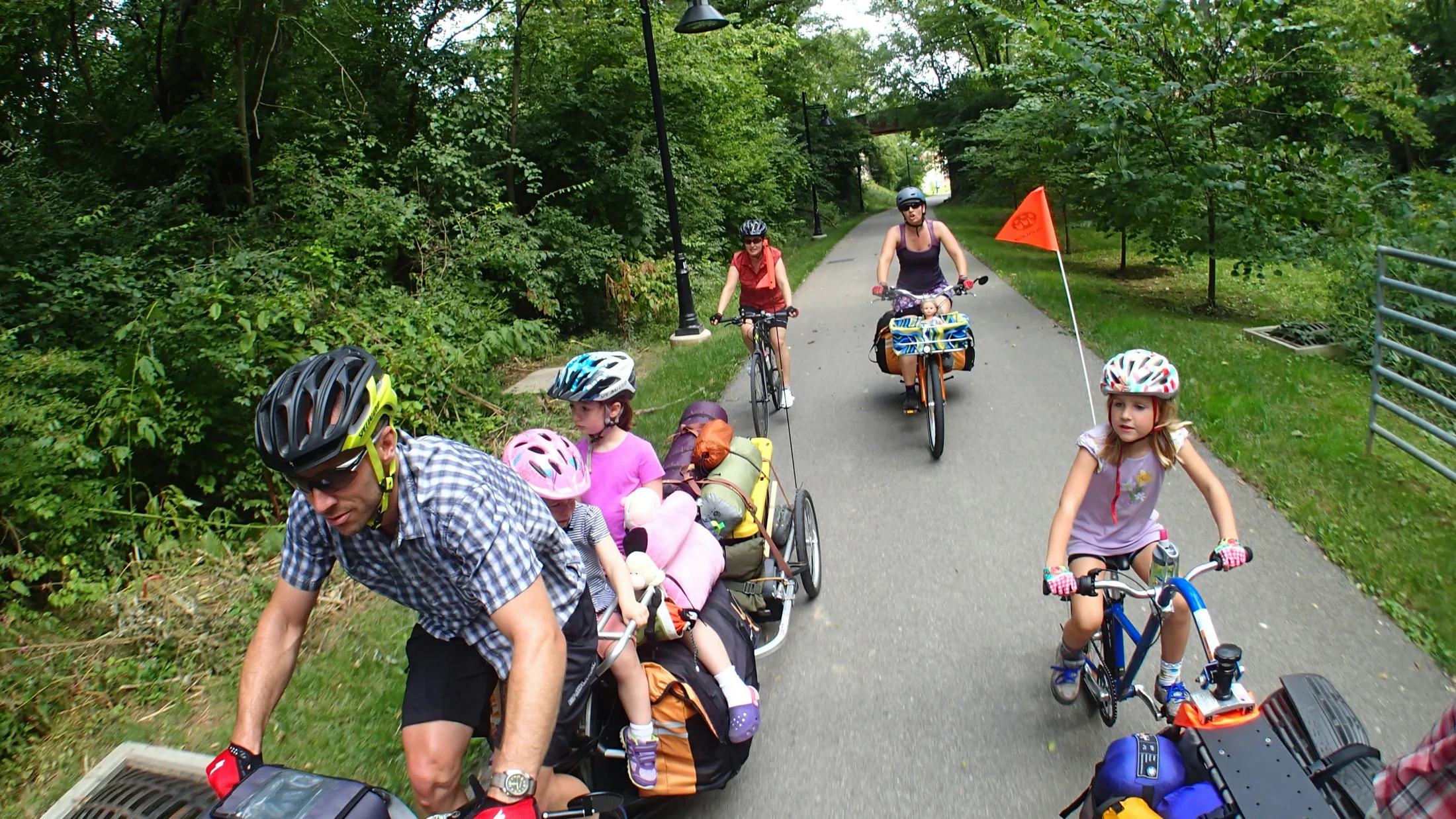
To carry children, choose according to their age. A certified rear seat is suitable up to the indicated maximum weight. Those who do not yet pedal are better off in a trailer with a flag and reflectors. Pre-teens can use a tandem or a tow bar.
Mechanics take up little space: a multi-tool, tyre levers, a spare tube for each size, a mini-pump and a chain quick link. With that, you can resolve a puncture or a dropped chain in the middle of the route.
In temperate weather, calculate 1–1.5 l of water per person, and more if the heat is intense. Bring salty and sweet snacks and soft fruit for the stops.
Clothing should be in light layers, with a compact raincoat and a neck gaiter on cool days. In summer, use sunscreen and a cap under the helmet.
For safety and navigation, pack a basic first aid kit, a mobile phone with an extra battery and an offline map or a screenshot of the information panels. For the little ones, a light change of clothes and wipes are useful; for teenagers, give them responsibility, such as carrying their own water or kit, to reinforce their autonomy.
Tips according to the children's age
With 0–3 year olds, the trailer or the child seat sets the pace: short outings of 6–10 km round trip, with stops every 30–40 min and avoiding heat and loose gravel.
Between 4 and 7 years old, they are already pedalling, so plan distances of 8–16 km with games during stops and visible goals ("up to that bridge"). From 8 years old onwards, calculate 15–30 km depending on their fitness and give them small responsibilities: reading the signs or alerting others at crossings. Maintain steady rhythms and do not rush them.
Photographic "missions" work very well to maintain motivation: bridges, tunnels, unique trees. A small prize at the end also helps. If there is a drop in energy, shorten the route and save strength so they want to repeat it.
Emergencies, insurance and assistance on the route
Before setting off, take a photo of the starting panel with the 0 km mark and the local phone numbers: it saves you doubt if you need help. With that image and a charged mobile, any incident is resolved faster.
If there is a minor fall, check for bruises, clean and disinfect the wound and assess whether to continue. Check the head, hands and knees first, as these are the areas most affected on a child's bike.
With a breakdown, decide quickly: repair in about 10 minutes (a puncture, the chain) or turn back. Having an adult who knows about mechanics changes the day's plan.
To cover yourself, consider insurance with civil liability and accidents for outdoor activities, and carry your health card on you. Keep 112, the approximate address of the section according to the signs and the contact of an external adult at hand.
On your mobile, save offline maps, the weather forecast and your location shared with an adult who is not cycling. This way, someone always knows where the group is.
Frequently asked questions
What distance can children do depending on their age?
As a reference, for 4–6 year olds, aim for 8–12 km round trip; for 7–9 year olds, 12–20 km; and for 10–12 year olds, 18–30 km, always adjusting to the profile of the route, the temperature and the stops. These are indicative figures: adjust the distance to the profile of the route, the temperature and the number of stops.
Flat terrain adds kilometres, and a hot day or many stops subtract them. Watch for signs of fatigue and shorten the route if attention drops or discomfort appears.
Can I carry a child seat or trailer on all greenways?
On most greenways, yes, you can carry a child seat or trailer, especially on the paved sections or those with compacted gravel. Before setting off, check for potholes and specific narrow passages on the route.
On trailers, use a flag and reflectors. Adjust your speed on descents to gain stability.
What is the usual surface and what tyres are suitable?
The usual surface is fine asphalt or compacted gravel. With 35–45 mm (1.35”–1.75”) tyres, you can ride comfortably on most greenways.
On children's bikes, wide tyres with moderate tread improve control on gravel. Check the pressure before setting off and adjust according to the child's weight.
Can I take the bike on the train?
Yes: Cercanías and many Media Distancia trains allow bicycles under certain conditions. Before travelling, check schedules and possible limitations during peak hours.
On long journeys, removing the front wheel or using a cover makes accessing the train easier.
What do I do on hot days?
Set off early and look for valleys with shade and tunnels: these are the best sections to cycle with children when the heat intensifies. Drink every 15–20 minutes and wet caps or scarves to cool down.
At midday, schedule a long nap and resume the route in the afternoon if you feel up to it. Carry sunscreen and light sleeves to cover yourself on sunny sections.
Do you need lighting for tunnels?
Yes. Many short tunnels on the greenways already have light, but it is advisable that you carry front and rear lights, or a headlamp, on your bike or on your helmet.
With artificial light or when exiting a tunnel, adjust your clear glasses and reduce your speed. If you come across other users of the greenway, a friendly greeting helps you pass safely.
Book your experience — discover active tourism activities in Spain with providers verified by Picuco.
Conclusion
Greenways with children combine flat routes, no traffic, gentle slopes, clear signage and services at hand. That is why they work so well for a first family outing.
This selection brings together 10 family-friendly sections throughout Spain, with practical data on distances, times, surface, shade and options for child seats, trailers and tandems. This is completed with safety rules, basic equipment and guidelines by age.
To get started, pick a date soon, choose the section according to your little ones' age and prepare a simple equipment list. If you want to complete the getaway with an activity in the area, book in advance during high season.