Introduction
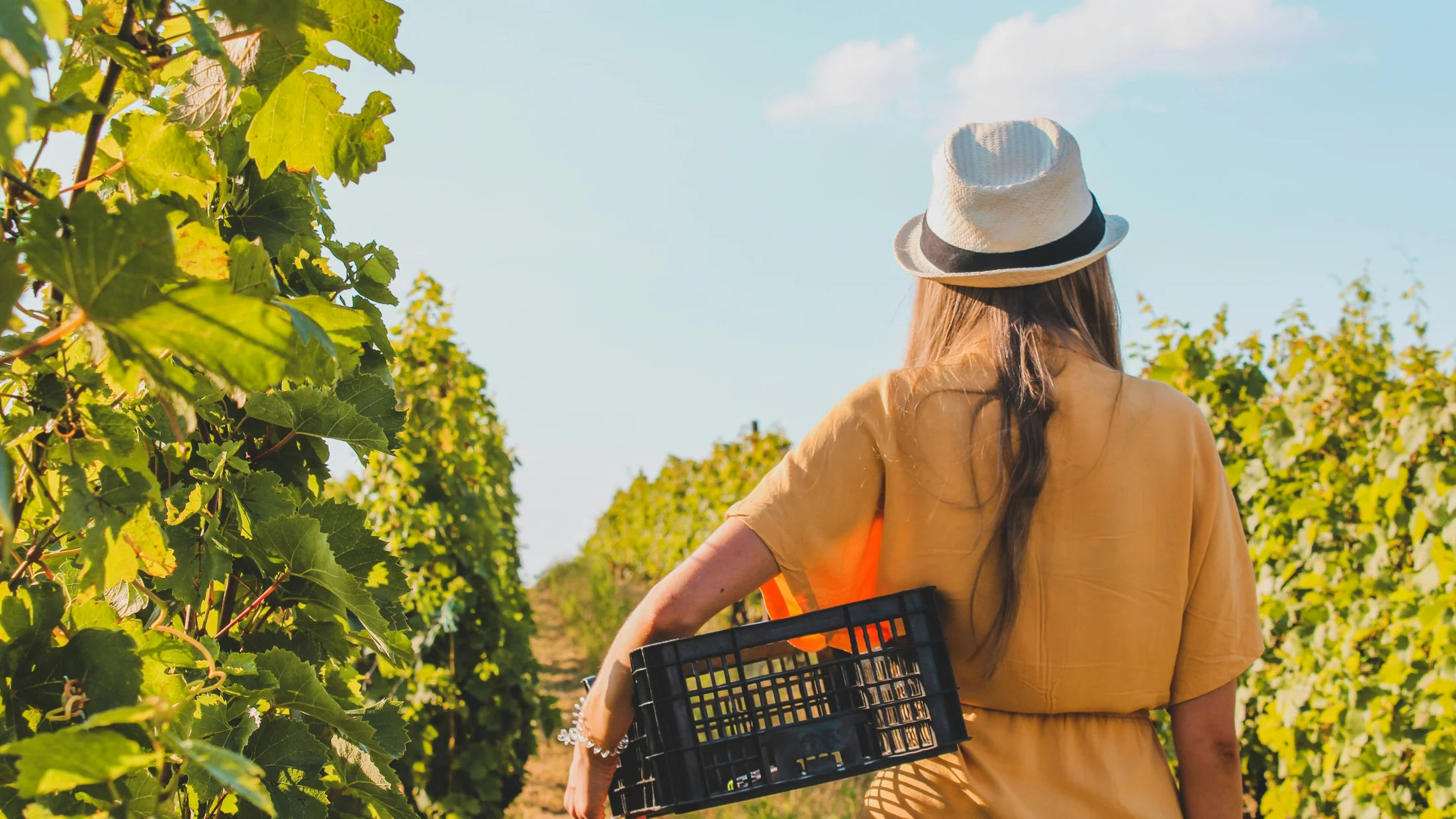
Living the grape harvest in Spain is about sharing landscape, craft, and rural memory, not just cutting clusters. In these experiences, you learn, participate, and savour wine from the vine to the glass.
The aroma of fresh must at dawn lingers on your clothes. That is why many wineries open their doors in September and October to anyone who wants to spend a day among vines, baskets, and tanks.
Roots, culture and the heartbeat of the harvest
In wine-growing villages, the grape harvest has marked the calendar for centuries: neighbours, social clubs, and families organised themselves to collect the grapes to the rhythm of the season. That custom remains alive and today coexists with a way of approaching the craft designed for the traveller.
A grape harvest experience is an activity organised by wineries to participate safely in real tasks and understand the process. It lasts a few hours and includes an explanation, equipment, and a final tasting. It is distinguished from the traditional harvest—the work of professionals subject to rhythms and strict controls—in that it is open to the visitor.
The activity connects tradition, the rural economy, and tourism: it adds income to the territory, promotes the care of the vineyard, and brings the craft closer to those arriving from outside. It attracts people through the connection with the land, practical learning, and the shared memory with the people who sustain these landscapes.
You will feel the crunch of leaf litter under your boots while the first sun gilds the leaves.
Harvests are staggered between late August and October, depending on climate and altitude, so it is advisable to choose dates and book in advance at the winery.
What you will find and how to make the most of it
Twelve wineries in Spain open their doors for you to participate in the grape harvest. This guide brings together those twelve proposals with what each one offers, its duration, and who it is aimed at.
You will also find when to go depending on the region, how to get there, where to sleep, and how to move between wineries. Added to this are practical tips and answers to common questions before booking.
The smell of cut grapes and damp earth accompanies the planning of your getaway. Use the guide to choose the region, compare types of experience, and book in advance the weekend you want.
Picuco te puede ayudar
Does something here catch your eye?
Tell us.
Write to us on WhatsApp or email: we answer questions, find the best options and help you sort out the booking.
When and where: essential map of regions and calendar
Choosing the right date and region is half the experience. Each denomination of origin has its own landscapes, varieties, and its own harvest rhythm, so the decision changes greatly from one area to another.
The harvest is done in the morning, when the fresh breeze from the vineyard helps to start the day. With the map of regions and the calendar in hand, it will be easier for you to get the date and place right.
Key regions and what each one offers
Ribera del Duero occupies a high plateau, between 720 and more than 1,000 metres, with Tempranillo (Tinto Fino) and days of strong thermal contrast. Its experiences are intense and technical: they focus on grape selection and barrel tasting.
Rueda is Castilian plainland with whites of Verdejo and Sauvignon Blanc. Its activities are fresh and educational, suitable if you are starting out in grape harvest wine tourism.
Rías Baixas, in Galicia, is an Atlantic vineyard of Albariño and morning mists. The landscape of estuaries and sea allows you to combine the beach and wineries in the same trip.
Jumilla, in the Region of Murcia (Altiplano region), has Monastrell and a dry climate, with warm and early harvests.
A breath of air between rows of vines brings damp grass and white fruit.
Indicative calendar by denomination
The harvest moves every year: temperature, rainfall, altitude and grape variety change the dates. The calendar by denomination serves as a general guide for you to choose a week and a winery.
Penedès (Xarel·lo, Macabeo, Parellada) has its window in August – September, and Jumilla (Monastrell) between late August and September. Rueda (Verdejo, Sauvignon Blanc) stays in September, as does Priorat (Garnacha, Cariñena), which extends until early October.
Four factors move the calendar. At higher altitude, ripening is slower and the harvest arrives later. White varieties usually precede red ones. A heatwave or some rainfall can move the date by weeks, and the style the winery seeks (more freshness or more maturity) adjusts the harvest.
The snap of the scissors when cutting the peduncle marks a patient rhythm.
To confirm exact dates, check the winery's enotourism calendar, which is updated every summer. Also consult the DO and regulatory councils' social media, and write or call enotourism to find out about availability and schedules.
Manual, mechanical and nocturnal: how your experience changes
In the manual harvest, grapes are cut with scissors, placed in boxes and you participate in the selection. It is the most immersive and social, and it forces you to bend down and walk on irregular terrain. It fits if you are looking for moderate physical activity and close learning.
The mechanical harvest is done by harvesters, which collect in a few hours. Some wineries offer technical visits to see the machinery and then a tasting. It is a more observational option and accessible to all audiences.
In the nocturnal harvest, grapes are cut at night or at dawn to preserve the aromas in warm climates. Temperatures are pleasant and it is advisable to bring light clothing and a head torch. A beam of light opens an intimate circle over clusters silvered by the dew.
To choose, think about what you feel like doing. If field work attracts you, opt for the manual one. If you prefer to understand the process without physical effort, choose the mechanical one or the technical visits.
How to get there and where to sleep for a perfect harvest
Logistics weigh as much as the winery you choose. Move with agility and sleep near the vineyard: the experience changes completely.
A rural house close to the vineyard lets you rest after the early hours of the harvest. In the morning, the smell of coffee and toasted bread accompanies breakfast before returning to the vines.
Before booking, look at the real distance between the accommodation and the estate and confirm what time they expect you at the winery. With the car parked nearby, the early start is easier to manage.
Main access: airports, train and car
Arriving at the winery on time is the first task of the harvest. These are the distances and times from the airports most used by travellers to harvest in Spain.
From Madrid (MAD) to Ribera del Duero there are 160–190 km, 2–2.5 h via A-1 or A-601. To Rueda, 170 km and 2 h 1 min via A-6. To La Mancha, 160–220 km and 2–2.5 h via A-4/A-43; the La Mancha DO covers much of the provinces of Toledo, Albacete, Cuenca and Ciudad Real. To Ciudad Real there are approximately 187 km and 2 h 15 min, and the AVE Madrid-Ciudad Real ticket costs from 9.00 €.
From Barcelona (BCN) to Penedès there are 40–60 km, 45–60 min via AP-7, or the R4 commuter train. The region is located in the provinces of Barcelona and Tarragona. The Penedès Harvest Festival is celebrated from 1 to 30 September 2025, with activities mainly on weekends. To Priorat there are 140–160 km from Barcelona.
From Bilbao (BIO) to Rioja Alavesa there are 100–120 km and 1–1.5 h via AP-68/A-124. To Haro (La Rioja), 95 km and 1 h via AP-68.
By car you have maximum flexibility for early schedules and you park at the winery or estate. If there are tastings, designate a driver or hire a transfer. Train + taxi/transfer works well in Penedès, Rioja and Rueda due to their good connections, and reduces alcohol consumption while driving. Many wineries offer organised transfers (shuttle) from a meeting point: request it when booking.
The open window brings the smell of hay and the murmur of cicadas in the final stretch towards the winery.
Sleeping near the vineyard: rural houses, winery hotels and camping
Sleeping a few kilometres from the vineyard changes the harvest day: you start without rushing and return without a car. Choose accommodation according to your budget and book in advance, because September and October fill the region.
Rural houses offer total immersion, close personal service and early breakfasts. They are usually 5–15 km from the vineyards and let you live the rhythm of the village. Boutique winery hotels offer comfort and schedules adapted to the activity, sometimes with a spa and views of the vineyard, and you can start the experience by walking to the vineyards. Agrotourism and hostels are the economical and social option, good for groups or families.
Camping and glamping work in regions such as Penedès and Rioja, with pitches and safari tents a short distance away: nature and a controlled budget. Rioja has 8 available campsites. A night in the countryside brings silence punctuated by a distant dog and a bright star over the vines.
Book in advance: September and October have high demand. Check minimum stays, because some accommodations require 2 nights on weekends. Ask about agreements with wineries, with adapted breakfast times or harvest packs, and confirm the type of track or terrain if you are travelling with a low car.
Getting around your destination: distances and local options
Between winery and winery there are 20–40 minutes of driving, and you should add extra time for cleaning and tastings. With that clear, choose how to move around depending on how many you want to link together and whether you plan to drink.
Renting a car gives you flexibility to visit several wineries in the same day. If there are tracks, choose one with high ground clearance.
Private transfers or rural taxis are the option if you want to drink during a tasting without driving. In high season, book them in advance, especially during harvest weekends.
Cycling is feasible in Penedès and Rueda due to their gentle profiles. Respect agricultural traffic. The rattling between vineyards leaves a soft hum and the smell of thyme when brushing against the edges.
12 wineries where you can participate in the harvest
Twelve wineries of different styles and territories so you can choose where to harvest. The sun tilts its light over the clusters like an amber lamp.
The list brings together proposals spread across Spain, with formats ranging from a single day to several days at the estate. Choose according to the territory you want to travel to and the time you have.
1. Marqués de Riscal: emblematic harvest
In Elciego (Álava), Marqués de Riscal mixes historical heritage and contemporary architecture with classic Tempranillo vineyards.
It lasts 90 minutes (1.5 hours) and requires moderate effort: walking, bending down, and carrying light boxes accompanied by the team. The work is manual and has a didactic focus, with possible symbolic treading depending on the season. At dawn, the leaves are tinged with copper while one pair of shears sounds after another.
The activity is designed for couples and wine enthusiasts looking for an iconic harvest in Spain with high-level services. Prices are €30 for adults, €14 for children aged 11 to 17, €4 for children aged 3 to 10, and free for children aged 0 to 2.
Pets are not allowed (except guide dogs) as it is a food industry. Contact the enotourism department in advance and confirm the morning schedules. If you stay in the area, you wake up less early and make better use of the subsequent tasting.
2. Bodegas Muga: traditional harvest in Haro (La Rioja)
In the Barrio de la Estación of Haro, Bodegas Muga continues working with artisanal techniques and a classic spirit. They work with a master cooper and three coopers to manufacture their own tanks and barrels.
The visit lasts approximately 90 minutes and goes through the wooden vats, the ageing rooms, and the cooperage. It ends with a tasting of 2 wines.
The experience is manual and mixed, with a focus on tradition and technical detail: light manual and observational activity. It suits those looking for traditional methods who want to see the complete process in a historical setting.
Book by appointment, because it is essential. September weekends sell out quickly, so ask about groups and early schedules.
Entry is not permitted for children under 12, nor is access with pets allowed. The winery has parking and adapted access at the access roundabout.
Combine the visit with a walk through the Barrio de la Estación to understand the railway history of Rioja wine.
3. López de Heredia: historic harvest in Haro
In Haro, López de Heredia works with living heritage and patience: the visit focuses on the origin of the vineyard, the detailed selection of the grape, and long ageing. The tasting can be of barrel or selected vintages, depending on availability.
The experience lasts approximately 2 hours, with little physical load and lots of observation and historical storytelling. It is a selective manual harvest with a technical tasting, designed for travellers seeking sober authenticity and time to listen to vineyard stories.
It opens from Monday to Saturday and closes on Sundays and holidays. You need an appointment in advance: book with weeks of margin and confirm languages and photography policies. The price is 10 euros per person (over 18 years old), deductible from wine purchases in the boutique on the same day.
Capacities are limited due to the age of the facilities, and there is no dining service available. Dress in dark clothing if you visit cellar areas with humidity and noble rust.
4. Bodegas Protos: harvest in Ribera del Duero
Bodegas Protos is in Peñafiel, Valladolid, and belongs to the D.O. Ribera del Duero. During the tour, they explain the pump-overs to you and you finish with a tasting.
It is a manual and observational activity focused on fermentation, with moderate physical activity if there is manual cutting. It suits groups of friends and couples who want to combine landscape and a large-scale winery.
It opens from Monday to Saturday from 10:00 to 18:00 and Sundays from 10:00 to 17:00, with adapted facilities and free parking.
Before booking, confirm if there are internal transfers and choose morning times because of the heat.
5. Emilio Moro: family experience in Ribera del Duero
In Pesquera de Duero, Emilio Moro proposes a harvest closely tied to Ribera family tradition, with the vineyard as the centre. The winery has 200 hectares of its own Tinta del País grape vineyards.
The activity is manual and focuses on the soils, the clones, and the plots. It lasts around 2 hours, with moderate effort, and fits well for families and small groups eager to learn in a dynamic way. At the end of the day, they usually offer simple and educational pairings.
The harvest experience is offered from Monday to Sunday at 10:30 h. The prices, including VAT, are 200€ for Journey to the origin, 72€ for In Malleolus veritas and 55€ for Yin Yoga among the vineyards. When booking, ask about options for children and about availability on less busy weekdays.
If you go during the early harvest, bring a light layer for dawn and a cap for mid-morning. The winery is in Pesquera de Duero.
6. Pago de Carraovejas: premium harvest
In Peñafiel, Pago de Carraovejas proposes a harvest with technical detail in the vineyard and a tour through state-of-the-art production areas. The winery visit lasts 2 h 15 min (Landscapes with Soul).
The proposal is selective: extended tasting and possible gastronomic pairing, with moderate activity and walking routes. It suits couples and travellers seeking a high standard and a slow pace. The winery also has the Ambivium restaurant, with a Michelin star.
It opens from Thursday to Sunday and the facilities are adapted for people with reduced mobility. Book well in advance, especially if you want to add the restaurant or a pairing menu. To enjoy the tasting without worrying about driving, consider a taxi or a transfer.
7. Codorníu: grape harvest and cava in Penedès
In Sant Sadurní d'Anoia, Codorníu harvests base cava grapes and stores cavas in underground cellars declared a Historical-Artistic Monument since 1976. The visit usually starts with the early harvest and continues with an explanation of the gentle pressing, the galleries, and a tasting of sparkling wines.
The activity is early and involves underground observation, with a symbolic grape treading. It lasts 75 minutes (1.25 h) or 105 minutes (1.75 h), depending on the visit.
Prices range from the €25 Heritage Tour for adults to the €54 Ars Collecta Tour. The Heritage Tour costs €20 for those over 65, students, large or single-parent families, and people with disabilities, and €18.75 for those aged 8 to 17; children under 8 enter for free. The Iconic Tour costs €30 and La Memoria de la Burbuja, €38.
Book in advance and confirm the dawn departure and the availability of symbolic grape treading for families. Bring a light jacket for the galleries, where it is usually 12–14 °C: the coolness of the cellar rises against your skin like a summer shadow.
8. Torres: grape harvest with a sustainable focus in Penedès
In Penedès, Torres works on sustainability within the vineyard: vegetable cover crops and water efficiency.
The visit passes through the Mas La Plana vineyard and tours the Waltraud winery, featuring sustainable architecture. During the walk, the buzzing of honey bees over the flowers of the cover crop marks a serene pulse.
When booking, ask about specific soil and biodiversity workshops and family options.
9. José Pariente: Verdejo grape harvest in Rueda
In La Seca (Valladolid), José Pariente focuses his grape harvest on the aromatic freshness of Verdejo and a precise picking.
The activity is manual and light, with a lot of observation, and is perfect for those who enjoy fragrant whites and gastronomic routes through the area. Visits depart from Monday to Saturday at 11:00, 13:00 and 16:00 h, and on Sundays at 11:00 h. It costs €30 for adults and €9 for minors aged 6 to 17, with groups of a maximum of 15 people.
You arrive via Ctra. de Rueda, Km 2.5, in La Seca. Confirm the morning schedules and possible combinations with local cheese or bread producers. To complete the day, combine the visit with a meal in a nearby winery or grill house.
10. Martín Códax: Albariño and the sea
At Martín Códax, facing the Arousa estuary, the grape harvest is carried out among Atlantic trellises and salty breezes. The activity includes manual cutting, a visit to the winery, and a tasting of different Albariño creations.
It lasts 3 hours, with a gentle walk between trellises and a final tasting. Upon arrival, you are given a harvest pack with the necessary material. The group is limited to 40 people and the price is €35 per person.
It is a manual experience in an Atlantic climate, designed for travelling in September, in the middle of the grape harvest in Galicia. It is ideal for couples and groups wanting to combine beach, seafood, and wine. The winery has an outdoor terrace with a panoramic view of the Arousa estuary.
It is advisable to bring a light raincoat in case a quick cloud arrives from the Atlantic.
11. Clos Mogador: Priorat and mountain viticulture
In Gratallops, Tarragona, the grape harvest is done by hand on llicorella slopes, with manual and precise work. Clos Mogador offers a demanding day in the heart of the Priorat mountains.
The experience lasts 2.5 hours and costs 50 € per person, all included. You travel to the estates in your own vehicle, visit the winery with a guide and taste Clos Mogador, Manyetes, Nelin, Gratallops Vi de Vila Rosat and another wine from the DO Montsant, with organic oil and bread.
It is a manual mountain activity, requiring notable effort due to the slopes and the irregular ground. Views of terraces and micro-plots accompany the work, so it suits active travellers.
Bring mountain footwear, water and sun protection, and confirm access and parking beforehand. It is better in the early morning, avoiding the central hours of heat.
12. Félix Solís Wineries: Accessible and collaborative La Mancha
In Valdepeñas, the harvest is measured in hectares: Félix Solís Wineries has 400 hectares of its own vineyards and is one of the largest family wineries in the world. Here you see the Manchegan scale of the harvest, with large expanses of vineyard and precise logistics.
The open experiences are for technical observation, with the possibility of a symbolic cutting and a wide tasting. In front of you, there is a horizon of vineyard that seems never-ending. The activity is light and accessible for large groups, and focuses on processes and quality control.
The grape harvest occurs between the second half of August and the beginning of October. It suits groups of friends, teams and visitors looking for wineries for grape harvesting with a good effort/learning ratio.
Book in advance: ask about extended hours and budget options, and confirm the meeting point and internal transfers. The winery is next to the motorway that connects Madrid with Andalusia, so arriving by car is easy. If you have extra time, combine the visit with Quixote towns to add literature and landscape.
What you will do: harvest, treading and step-by-step tastings
The day begins early, with the vineyard fresh and the grapes firm. After a brief safety talk, you are given shears, gloves and a box, and the good part begins.
During the manual harvest, you learn to identify healthy bunches, to avoid damaged berries and to cut by the peduncle, the little stem that holds the bunch. You walk through the vineyard on foot, bending down with a gentle rhythm, and leave the boxes at the designated points for transport, in the shade if possible.
The shears are used closed next to the bunch: you turn slightly and cut without pulling, so as not to tear the grape. The fruit is not trodden. If the winery allows it, you participate in the selection table by removing leaves or bunches with rot.
Grape treading is not offered by all wineries. When it exists, it is usually symbolic and lasts a few minutes, under supervision. Beforehand, you are asked to disinfect your feet or use sanitary boots, because hygiene is part of the process.
In the subsequent tasting, you visit tanks, barrels and the tasting room. You learn to appreciate the appearance (colour and brightness), the nose (primary aromas of fruit and flower, secondary aromas of fermentation) and the mouth (acidity, body, tannin). A practical trick: write down three words per wine to concentrate impressions and remember them better.
It is advisable to spit part of the wine into the spittoons to maintain freshness and attention. Keep your distance from other users due to the sharp tools, drink water frequently and use sun protection. Do not enter restricted areas or climb on machinery, and take photographs with permission without blocking aisles.
Many wineries close with an aperitif or a pairing of local cheese, sourdough bread, cured meats or olive oil. It is the way to understand the territory and its cuisine.
Experiences that add value: pairings, workshops and celebrations
Harvesting grapes takes up the morning, but the day at the winery can continue with activities that delve deeper into wine or celebrate it. Many are booked separately from the harvest and combine well with it.
Gastronomic pairings range from tapas with local products to full menus with pairing. They vary in duration (45 min to 2 h), in the number of wines (3–6) and in whether they include a blind tasting.
Winemaking workshops cover yeasts, temperatures and pump-overs. Some allow you to measure densities or taste musts at different stages; they last 60–90 min and suit technical profiles.
For those who prefer the camera, there are photography sessions in the vineyard at sunrise or sunset, in small groups with a guide. Concerts and harvest festivals bring music to wineries or squares, with popular treading and collective toasts: they last 2–3 hours and it is advisable to book a ticket.
If you travel with children, look for aroma scavenger hunts, symbolic harvesting or painting with must, lasting 45–60 min. Ask about recommended ages and whether accompaniment is required.
To book, first choose the morning harvest slot and add activities for the afternoon. Check if there are combined packs or discounts for adding workshops.
Before booking, confirm the language, group size and accessibility (stairs, terrain, strollers). Also check the cancellation policy due to rain: many activities adapt to indoor settings.
The difference between proposals lies in the approach: educational, sensory, festive or family-oriented. Choose based on whether you want to learn, celebrate or disconnect.
Key tips, common doubts and smart bookings
Going prepared to the grape harvest multiplies the enjoyment and reduces unforeseen events. Before booking, it is worth knowing what to bring, how long the day lasts and what is expected of you in the vineyard.
Gloves prevent rough friction with the cluster and give you security and rhythm when harvesting. With them, the morning is more productive and you finish with your hands intact.
Check the weather forecast and confirm the booking with the winery before leaving. Many days start early and are cancelled if it rains.
Practical tips for a happy grape harvest
The day ends with the sun high, so clothes are chosen for two climates. Bring long, durable trousers and a short-sleeved or long-sleeved t-shirt depending on the day. Add a light layer for dawn and a cap for midday.
The vineyard terrain is irregular, so use boots or trainers with a gripped sole and avoid flat soles. Put sunscreen, glasses and reusable water in your backpack. If the winery does not provide gloves, bring your own: ask when booking.
Listen to your body. If you have allergies or back or knee injuries, communicate this and regulate your effort. In the field, keep your distance from other shears and boxes and cut with the edge facing the cluster. Do not climb onto trailers or machinery and always follow the staff's instructions.
If you are coming with children, check minimum ages and specific activities: many wineries offer a symbolic grape harvest for little ones. Bring spare clothes and snacks. And if you are going to taste afterwards, designate a driver, use spittoons or hire a transfer or taxi.
Confirm what the package includes: tools, insurance, tasting, aperitif and internal transfers. Check the cancellation policy and if rain moves the activity to the winery.
Respect the vineyard: do not step on the irrigation lines or break shoots and close the gates. Ask permission to photograph the staff and share photos with respect for their work. Following these guidelines will make your grape harvest experience smooth, safe and memorable.
Do I need previous experience to participate in the grape harvest?
No previous experience is necessary. The wineries explain the technique and safety at the start of the day and assign you simple tasks.
If you have medical or mobility doubts, mention it when booking so they can adapt the tour.
How long does a tourist grape harvest day last?
A tourist grape harvest day lasts between 2.5 and 4 hours, normally in the morning. Plan for mid-morning to do it calmly and without rushing.
The day usually includes the harvest, the visit to the winery and the tasting. Some wineries add an aperitif or food pairing, so ask when booking how much time you need in total.
Is it suitable for children?
It depends on the winery. Many offer a symbolic grape harvest and aroma workshops for little ones, designed so they can participate without stepping in the wine press.
Before booking, confirm the minimum age and if an accompanying adult is required. This avoids surprises on the day of the visit.
Can you drink during the day?
During the grape harvest day, you do not drink: the wine arrives during the final tasting and is consumed responsibly. If you are going to drive afterwards, use the spittoons at the tasting.
To drink without risks, choose a transfer or a taxi for the return journey.
How do I book and when is the best time to do it?
Book directly with the winery or through specialised platforms. September and October are the months with the highest demand, so the ideal thing to do is to book in advance.
If you decide with little notice, check availability on weekdays: there is more space than on the weekend.
What happens if it rains?
If it rains, many wineries adjust the plan: time in the vineyard is reduced, the indoor visit is extended, and the tasting is maintained. Ask the winery how they resolve it before going.
Before booking, check the winery's refund or date change policy. This way you know what happens if the day breaks with rain.
Book your experience — discover active tourism activities in Spain with providers verified by Picuco.
Conclusion: take the leap and live the harvest
The harvest in Spain brings you closer to the origin of wine, to the pulse of the villages, and to the work of those who care for the land. A plan that smells of the countryside and tastes of the future: if you are excited, set the date and toast to it.
Before booking, choose a region and date and compare formats: manual, technical, family, or premium. Verify what the package includes and book in advance.
Check recent reviews and confirm the rain policies. If you are going to taste, organise your transport before leaving.