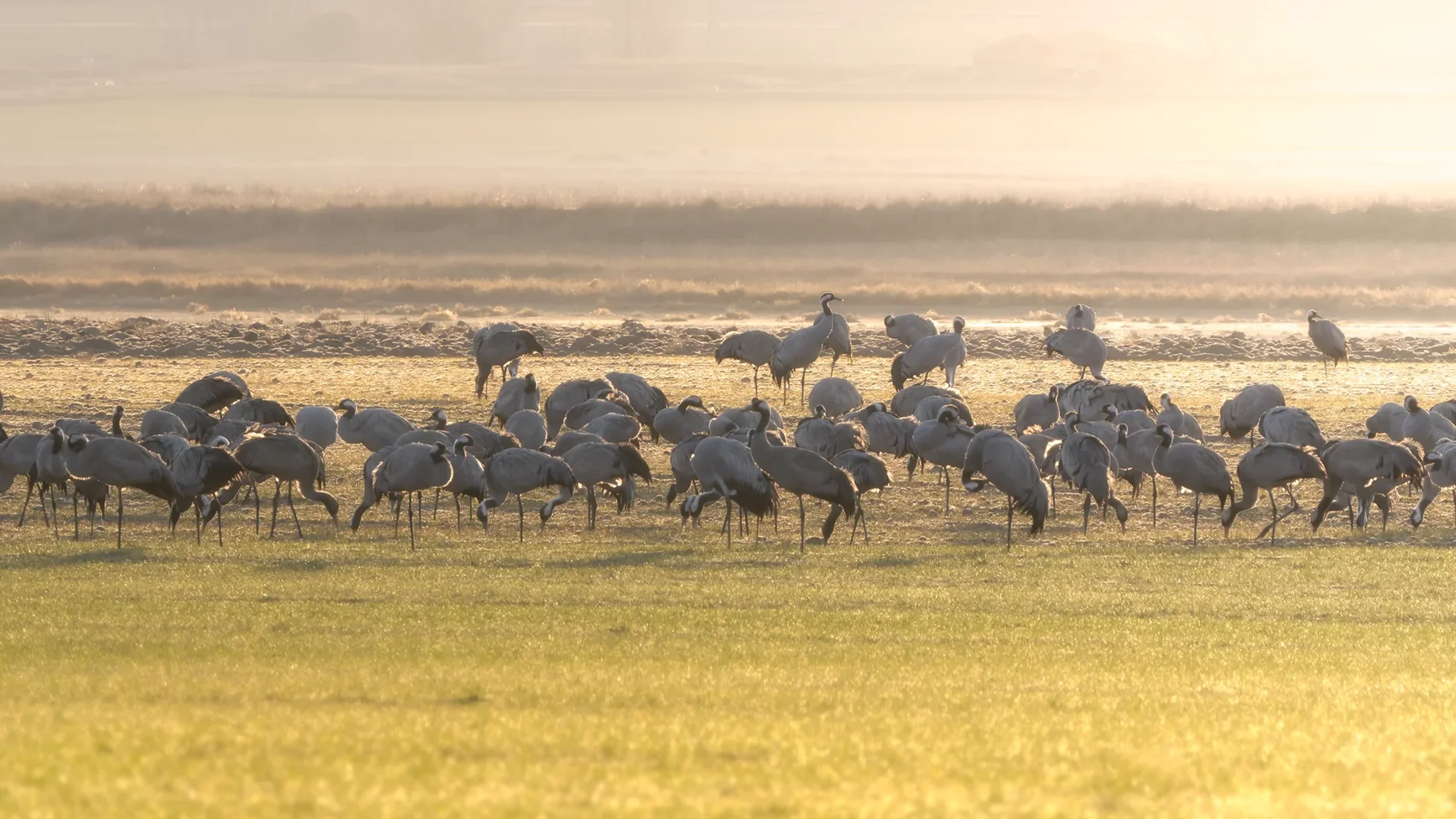
Why the common crane migration in Gallocanta and Extremadura amazes Europe
Tens of thousands of common cranes cross Spain every autumn and stay until February.
Common cranes (Grus grus) rest, feed, and regroup in these two key nodes of the route between Scandinavia and the Iberian Peninsula. Spain hosts 65% of the wintering birds of the European population, with between 260,000 and 270,000 specimens wintering, mainly in Extremadura, Castilla-La Mancha, Aragón and Andalucía.
Gallocanta is the location with the highest concentration of common cranes in Spain. It functions as a large service station during the passages of November and late February, when the flocks gather to sleep in the shallow water. Extremadura (Vegas Altas, La Serena and large reservoirs) hosts the largest wintering population on the peninsula between December and January, with flocks spread across dehesas and irrigated lands.
The migration arrives between October and November and the cranes remain until February or early March. November and February are the best months for observation. The plan combines massive take-offs at dawn and peaceful observations in holm oak groves, always near towns that have been living with this natural cycle for generations. At sunrise, the deep roar of their trumpeting seems to vibrate in your chest like a distant drum.
It is worth knowing that, during the rainy season, the access roads to the observatories at the edge of the lagoon are impassable by vehicle. There are photographic hides managed by the Government of Aragón.
This guide explains what common cranes are and how they move, where the key points are in Gallocanta and Extremadura, when to go and how to get there, and which accommodation and viewpoints are suitable depending on your plan. It includes observation and photography tips, a selection of activities and a conservation section with frequently asked questions for a responsible visit.
Picuco te puede ayudar
Does something here catch your eye?
Tell us.
Write to us on WhatsApp or email: we answer questions, find the best options and help you sort out the booking.
Common crane migration: species, behaviour and the great Iberian route
The common crane (Grus grus) measures up to 1.2 m in height, with long legs and a black mask with a red spot on the crown. It is the protagonist in Spain; sightings of other species, such as the demoiselle crane (Grus virgo), are exceptional and accidental.
The common crane is gregarious: it forms flocks that can exceed a thousand and flies in a "V" shape to save energy, taking advantage of thermals (columns of rising warm air) and favourable winds. Its constant trumpeting is social communication: it maintains group cohesion and coordinates changes in direction during flight.
They migrate to search for food and a mild climate to spend the winter, and return to breed in the north in spring. In autumn, they leave the breeding areas of Scandinavia, the Baltic countries, Poland and Germany, cross France (with famous stops like Lac du Der) and enter the Peninsula through the Pyrenees. The wintering population in the peninsula is the most important in the western Palearctic, with more than 60,000 birds.
The driver of migration is a flexible diet: acorns in dehesas, grains in cereal and maize stubble, invertebrates and tubers in wetlands and rice fields.
The massive arrival takes place in autumn, from mid-October to early November, and the migration towards the north goes from mid-February to mid-March. The common crane is listed as "Least Concern" by the IUCN on a global scale, with an increasing population trend in central Europe, attributed to the protection of wetlands and agricultural changes that increase grain availability. Among its threats are habitat loss, disturbances in roosting sites, collisions with poorly located power lines and wind farms, and prolonged droughts due to climate change that reduce water levels.
If you are looking for the peak of crowds, aim for Gallocanta during the November and late February passages. If you prefer peaceful days with constant flocks, the heart of winter in Extremadura offers daily observations among holm oaks.
The smell of damp earth and stubble accompanies their stops.
Where it is and how to orient yourself: basic map and access
In Extremadura, the epicentres are La Serena, Orellana and the Vegas Altas of the Guadiana. It is advisable to choose one of the three as a base and move from there.
A detailed map is as useful as binoculars for anticipating where the flocks will enter. From a high viewpoint, the reflection of the water at sunset helps to intuit the arrival of the cranes.
Before heading out, check the distance between your base and the observation points: in Gallocanta, it can be travelled in a short time, and in Extremadura, the wetlands are further apart from each other.
Location and map of Gallocanta and Extremadura
The Gallocanta Lagoon is spread between Zaragoza and Teruel, at about 990 m above sea level. It is a shallow endorheic saltwater lagoon, and its surface area changes depending on the year: in wet years it can reach about 14 km².
A perimeter track links towns such as Gallocanta, Tornos, Bello and Las Cuerlas. Around it, there are several birdwatching spots: the Tornos birdwatching viewpoint, the Los Aguanares observatory, the Ermita del Buen Acuerdo, the Ermita observatory, the Los Ojos observatory and the La Reguera observatory.
Getting there is easy. Gallocanta is about 120 km from Zaragoza (1 h 47 min).
The Sierra Brava reservoir is in the municipality of Zorita (Cáceres), on the course of the Pizarroso river, and its route includes the Cordel de Madrigalejo, an ancient livestock drovers' road. The Moheda Alta visitor centre is located on the Ex-116 road, km 4.8, in Navalvillar de Pela. It is about 151 km to Moheda Alta (1 h 49 min).
To read the map in the field, locate the roosts in shallow water sheets or flooded rice fields and trace the paths towards the nearby pastures and stubble fields. Mark elevated viewpoints and points with safe parking, and carry a GPS on your mobile with offline maps, saving waypoints for observatories and access points. When looking for information, prioritise official maps of natural spaces and regional cartography: they usually include car parks and paths.
Best time: calendar, peaks and times of day
Common cranes move in predictable windows, although the weather is in charge. Autumn and winter concentrate the best observations on the peninsula, with nuances between Gallocanta and Extremadura.
In Gallocanta, the first arrivals occur in late October and November. The autumn peak arrives in mid or late November, with variations depending on the year. The wintering period lasts from December until mid-February, and the spring return happens in late February and during the first weeks of March, with a second major peak.
On cloudy days, movements may be earlier or later.
The winter maximum goes from December to January, with stable flocks in pastures and irrigated lands and a wintering population of approximately 139,000 birds. The return migration takes place in February and March, with movements visible at dawn towards the north.
In Moheda Alta, there is a free interpretation centre and three observatories. The common crane is listed in the Regional Catalogue of Threatened Species of Extremadura as being "of special interest".
To plan, in November bet on Gallocanta at its peak and observe the arrivals at sunset. In late February and early March, Gallocanta experiences the great return with electric sunrises.
How to get there: routes from Zaragoza, Teruel and access points in Extremadura
Moving with plenty of time to spare is as important as choosing the right place: the flocks do not wait. Most points are reached via conventional roads in good condition, with final stretches on tracks.
Gallocanta is the largest natural saltwater lagoon in the Iberian Peninsula and is home to more than 220 bird species. From Zaragoza, you arrive in 1 h 47 min (about 120 km). From Teruel, it takes you 2 h 5 min (about 88 km), via the A-23 towards the N-234, exit 181, and then via the A-1507.
The perimeter track can get muddy after rain, so walking is recommended.
In Extremadura, from Badajoz to Mohedosa Alta there is 1 h 49 min (about 151 km). Mohedosa Alta is reached via the EX-116 road from Villanueva de la Serena to Guadalupe, at kilometre 4.8. The final approaches to the roosts are via agricultural tracks: drive slowly, avoid mud after heavy rain, and park in designated areas.
In the cold silence of the early morning, the crunching of gravel under your boots sets the rhythm of the wait.
Where to sleep and from where to watch: essential bases and viewpoints
Sleeping near the viewpoint gives you minutes of light when the common cranes start to move. In Gallocanta and in Extremadura, there is accommodation just a few kilometres from the observation points, so you can be in position before dawn.
Options range from rural village houses to simple hostels and small hotels with charm. Choose your base considering the distance to the viewpoint and the time you want to set off.
The smell of early coffee and the creak of a wooden staircase accompany the departure before there is light.
Recommended rural accommodation near Gallocanta
Sleeping a step away from the lagoon changes your morning: you leave before dawn and arrive at the viewpoint with the first flight of common cranes. A perimeter track links Gallocanta, Tornos, Bello, and Las Cuerlas. If you prefer more services, you can reach the Gallocanta lagoon from Daroca by local taxi (15–25 km).
When booking, look for four things: early breakfast or a picnic to take away, space to store binoculars, telescope, and tripod, efficient heating and hot water for after cold sunrises, and proximity to the viewpoints and the perimeter tracks. Also ask about the house's sustainability policies: renewable energy, waste management, and support for local producers.
Leave room for changes: if the weather holds and the spectacle intensifies, you might feel like extending your stay. And ask the host about the flocks and the day's access points, because many follow the counts and know the terrain well.
Bases and local guides: sustainable observation and knowledge of the terrain
A local guide saves you kilometres and multiplies the number of common cranes you see. Around Gallocanta and in Extremaduran regions such as La Serena and Vegas Altas, companies and guides specialising in observation outings for birds, photography, and environmental education operate.
In Extremadura, the visitor centres at the roosts indicate routes and car parks.
When choosing an operator, ask about insurance, training, and accreditations.
To compare options, use specialised platforms and ask for the itinerary and schedules before booking.
Gallocanta Lagoon: the heart of the migratory route
Walking along the perimeter on dry days, the salt crunches like sugar under your boots.
There is a practicable perimeter ring, with caution after the rains. The observation points include the Tornos bird lookout, the Los Aguanares observatory, the Del Buen Acuerdo hermitage, the Ermita observatory, the Los Ojos observatory and the La Reguera observatory.
At dawn, the "take-off" towards the feeding grounds occurs: position yourself with the wind at your back and avoid ridges that might give you away. At sunset, they regroup and enter the roost, with side lighting and backlighting to photograph silhouettes. With the cierzo (N–NW) wind, position yourself to the S–SE of the roost to have better light and optimal approaches.
Respect closures and signs, and do not invade sensitive banks or private tracks. Access is via the perimeter track and the marked lookouts.
La Serena and large reservoirs: the Extremaduran winter of common cranes
In Extremadura, common cranes spend the winter among holm oak pastures and reservoirs. They sleep in shallow water and feed on acorns and stubble, in a daily cycle that dictates your observation schedule.
The area includes the La Serena reservoir, the largest in Spain, with large expanses of water and adjacent pastures. Orellana and Sierra Brava are in Extremadura. In the Vegas Altas, among rice fields and irrigated lands, the movements at dawn and dusk are very photogenic.
The Moheda Alta visitor centre, in Navalvillar de Pela, provides routes and parking.
In the pastures, the pecking of woodpeckers on dry acorns sounds like fine rain on the leaf litter.
Regional towns such as Villanueva de la Serena, Orellana and Zorita are in Extremadura.
Activities and tips to enjoy without disturbing
Common crane watching benefits from preparation: knowing what to do and how to behave at the observation points changes the experience. Spend some time before your trip reviewing the rules for each lookout and choosing the hours with the least movement of people.
The getaway is completed with guided sightings, photography, interpretation centres and themed festivals. Choose one or two activities per day and leave the rest of the time to observe calmly from the designated points.
To photograph, prepare your equipment in advance: the tripod is set up in the dark before dawn. Arrive at your spot early, maintain your distance from the birds and avoid noise and sudden movements when the flock takes off.
Birdwatching: techniques and best practices
Common cranes are heard before they are seen: their trumpeting announces the arrival of the flock, so listen to the sky while you walk. With binoculars, sweep the low horizon and the corridors that connect roosts and feeding grounds.
Common crane photography: equipment and light keys
A 300–600 mm lens and moderate burst mode are enough to bring the flight of the common cranes home with you. With that and a bit of patience, the morning light does the rest.
On APS-C, the useful range is greater and you can add a 1.4x teleconverter if the light allows. To follow the flight smoothly, mount the camera on a stable tripod or monopod with a fluid head. If the budget is tight, a bridge camera with long zoom and good stabilisation works well, and a phone with binoculars and an adapter serves as an improvised telephoto.
To freeze the flight, shoot at 1/1250–1/2000 s and increase the ISO without fear at dawn. Work in AF-C with moderate burst and centre-weighted or spot metering for backlit shots. With bright skies and dark birds, compensate the exposure between +0.3 and +1.
Anticipate the flight lines and leave space in the direction of the bird's movement. Sunset backlighting gives you silhouettes and fan-shaped formations. Do not approach the feeders: use focal length and wait.
Clean the lens often: the salt mist of Gallocanta and the dust from the pastures adhere quickly.
Guided events and outings: when and what to expect
In November and late February, Gallocanta acts as a service station for the migration of common cranes. In Extremadura, the appointments are spread throughout the season, with notable dates in December in areas such as Moheda Alta.
Guided outings combine expert talks, demonstration ringings, dawn routes, photography workshops and family activities.
Programmes can be consulted at local facilities and on ornithological tourism platforms.
Expect early starts and short but intense treks. You will learn about the behaviour, identification and conservation of common cranes.
Practical tips: equipment, schedules and responsible conduct
For the cold of the lagoon, dress in layers, with a hat, gloves, windbreaker and waterproof footwear. To observe, bring binoculars, a telescope, a tripod, a headlamp with red light and a blanket or folding seat. Add water, an energy snack and a waterproof cover for your equipment.
Keep silent, do not use drones, put your phone on flight mode and do not use calls.
If you go alone, communicate your plan and carry offline maps.
The best approach is the one that goes unnoticed: if the common cranes ignore your presence, you are doing things right.
Conservation, key questions and next steps
The common cranes choose a landscape maintained by farmers, livestock breeders, forest agents and natural space technicians. That daily work is what makes it possible for thousands of birds to find food and rest here every winter.
Gallocanta and Extremadura are communities that coexist with the arrival of the common cranes. The phenomenon brings visitors and opportunities, and in return asks for care from those who come to see them: respect the paths, do not approach the roosts and follow the instructions of the rangers.
At sunrise, the crunching of frost under the footsteps of a ranger accompanies the first outings of the common cranes.
When is the best time to see common cranes?: recommended months and hours
During those dates, it is advisable to get up early: take-offs are seen at sunrise and the entry to the roost in the last hour of the afternoon.
In Extremadura, December and January are stable wintering months. February adds visible return movements at dawn.
Do I need a permit or are there restrictions for approaching the lagoons?: regulations and best practices
In most viewpoints and public tracks, you do not need a permit. However, many shores of lagoons and reservoirs are protected spaces, with restricted access areas to avoid disturbing the roosting sites.
Field signs and visitor centre panels mark the exclusion areas, the designated paths and the authorised car parks. If there are barriers, respect them.
Drones and sound decoys are prohibited, and it is advisable to turn off lights and engines in the waiting areas.
If you have doubts or are approaching sensitive areas, hire a local guide: they will guide you and minimise the impact.
During events and workshops, follow the instructions of the staff, who rely on updated tracking data.
What photographic and optical equipment is recommended?: options according to budget
If you want to photograph them, the equipment depends on your budget and whether you are going to Gallocanta or to the Extremaduran pastures.
With a limited budget, a bridge camera with a 600–1200 mm equivalent zoom covers most situations. Add a lightweight monopod or a beanbag to shoot from the car or the observatory.
With a medium budget, a DSLR or mirrorless with 100–400 mm or 150–600 mm, a robust tripod and a simple gimbal head give you more reach. A 60–80 mm telescope with a digiscoping adapter is useful for attaching the camera or the mobile phone.
In the high-end range, a 500–600 mm f/4 super-telephoto, a body with good AF and burst rate, a gimbal head and a carbon tripod. Also, carry a waterproof cover, extra batteries, fast cards and a microfibre cloth.
A red light headlamp avoids dazzling the birds and some thin gloves allow you to handle the dials in the cold. A backpack with a lumbar belt distributes the weight during the waits.
Protect the equipment according to the location: in Gallocanta, against salt spray; in the Extremaduran pastures, against fine dust.
How can tourism help conservation?: volunteering and donations
Book your experience — discover active tourism activities in Spain with providers verified by Picuco.
Conclusion and call to action: bookings, tours and how to participate
November and late February offer the migration sunrises in Gallocanta. The wintering in Extremadura, among pastures, irrigated lands and large reservoirs, lets you live alongside the common cranes and follow their day-to-day life with more calm and variety.