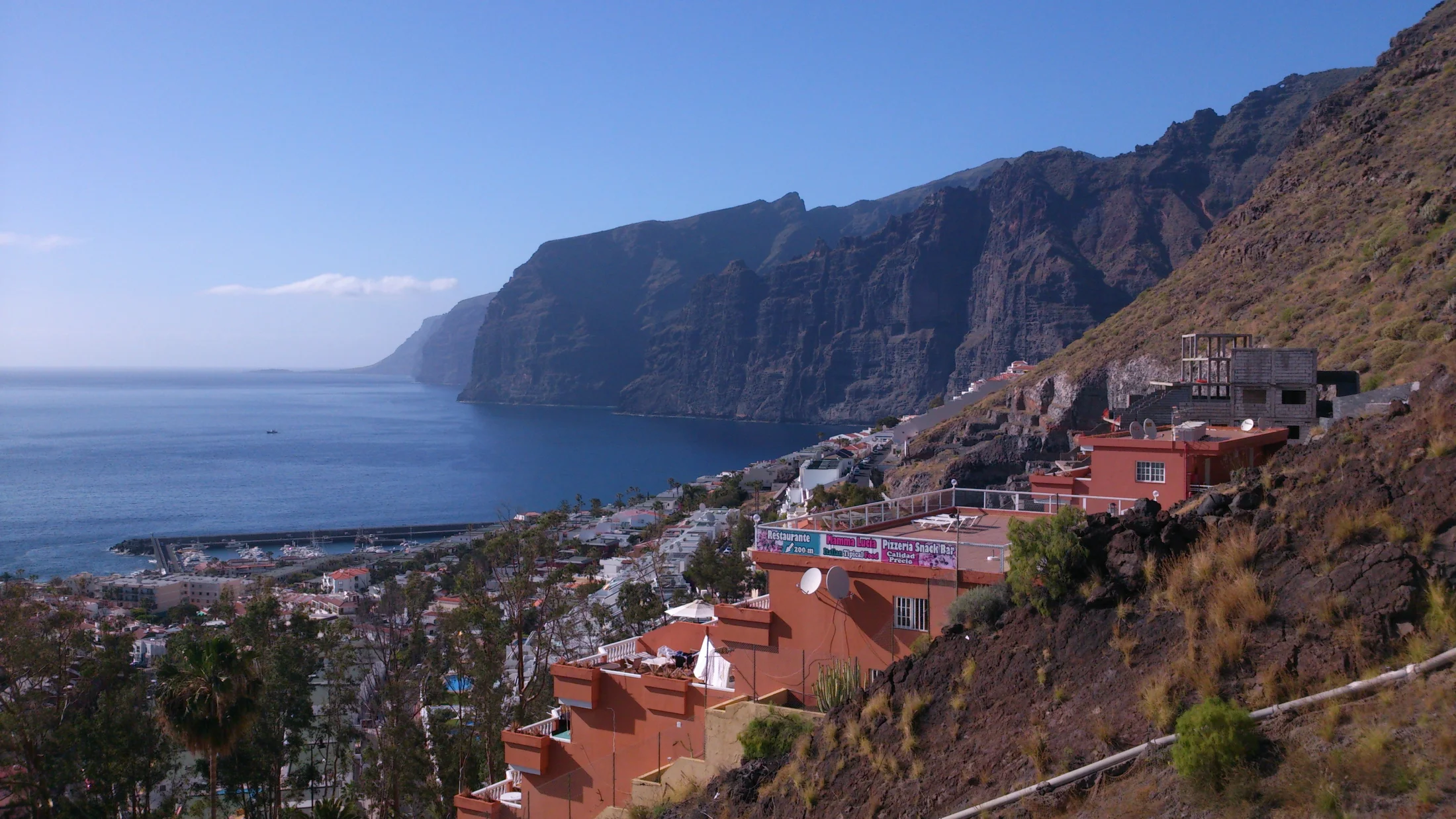
The first edge of the world
Twelve cliff routes between the Atlantic and the Mediterranean, recounted and explained so that you can do them. The guide combines narrative and practice, with stages adaptable to your level and your timing.
Before setting off, consult the AEMET weather warnings, the tides from Puertos del Estado or Meteogalicia, and the regulations of each park. The guide gathers safety advice, tide schedules, and ways to arrive by car and by public transport.
To sleep, you can choose between fishing villages and eco-lodgings depending on the stage you are on.
Picuco te puede ayudar
Does something here catch your eye?
Tell us.
Write to us on WhatsApp or email: we answer questions, find the best options and help you sort out the booking.
When to go, what to bring and what permits to consider
Spring and autumn provide the best light and mild temperatures. In summer, start very early and avoid the central hours. In winter, check the swell and wind warnings from AEMET and Salvamento Marítimo before setting off.
You will hear the sea before you see it, a heavy rumble that grows with every step towards the edge.
Equipment makes the difference. Wear footwear with an adherent sole and mid-cut height, even on sections that pass through the beach, and layered clothing with a windbreaker: on exposed summits, the wind lowers the real temperature. Add sun protection, a cap, and 1–1.5 l of water per person every 2–3 h. Charge your mobile and download an offline map, because it is not advisable to rely solely on coverage. If the route ends near sunset, pack a head torch.
Some access points are reserved or paid for. At Playa de las Catedrales (Ribadeo), access at low tide during high season requires a free reservation managed by the Xunta de Galicia, and you must verify updated dates and capacities. In Cabo de Gata-Níjar, the shuttle bus stops at the beaches of Mónsul, Genoveses, Barronal, Media Luna, and Cala Carbón, with a frequency of one hour starting from 10:30 and service until 7 September. Parking costs six euros per vehicle and has 399 spaces, and vehicle access restrictions are in effect until 28 September 2025. In Calblanque, the bus costs 2 € per trip or 3 € return, with a 10-trip return pass for 20 €; inside the park, there are no points of sale for water or food.
For photography, the golden and blue hours soften contrasts, and a polarising filter and an ND allow for silky water. With children, choose sections with fences or margins, avoid the ledges, and maintain a "safe line" 2–3 m from the edge when the wind blows hard.
Twelve horizons of rock: from the Atlantic to the Strait
Costa da Morte: lighthouses, foam and maritime culture
Faro Vilán watches over a stretch of sharp rocks, Fisterra looks to the west, and Touriñán offers clean sunsets on clear days.
Maritime culture remains alive in sanctuaries such as A Virxe da Barca, in Muxía, and in the coastal ports. To traverse it, the Camiño dos Faros joins Malpica de Bergantiños with Fisterra in about 200 km of hiking between beaches, dunes, cliffs, forests, estuaries, and fishing ports.
You can do sections on foot and jump by car via local roads; there are signposted viewpoints in Vilán, Fisterra, and Touriñán. The best time is from March to June and from September to November, and it is advisable to avoid storms with orange warnings.
If you bring a camera, look for the sunset in Touriñán and clear mornings in Vilán for the textures of the granitic flysch. Do not cross the barriers and walk slowly on the polished rocks.
Cabo Ortegal and Loiba: the Aguillóns and the bench at the end of the world
At Cabo Ortegal, a dark rock colossus overlooks the Aguillóns, needles that split the sea like saws.
The Loiba viewpoints are signposted and have parking, although it can be insufficient during high season.
If you go with a camera, look for the sunsets and use ND filters: the skies after Atlantic fronts clear the atmosphere. Do not go down to the wet grassy cornices, because the grass is more slippery than it looks, and do not approach the edge on windy days.
You reach it via a local road from Cariño. Reserve the whole morning or afternoon and calculate the time for each stop on foot.
Vixía Herbeira (Cedeira): dizzying altitude in the Serra da Capelada
Vixía Herbeira reaches 613 m above the sea and is among the highest cliffs in continental Europe. It is in the Serra da Capelada, on the coast of Cedeira, and is visited on a short excursion from the car park.
From its viewpoints, the coast folds into successive arches and the void falls cleanly to the sea. Up there, the wind blows and smells of heather and salt.
La Garita de Herbeira is a stone construction of about 15 m² from the 19th century that was part of a coastal surveillance network. The walks are brief but exposed, so wear rigid footwear. On days of strong wind, maintain extra distance from the edge and avoid sitting on cornices.
Arrive by car via the DP-2205, a mountain road with a narrow surface and curves. If you are coming from San Andrés de Teixido, the main car park is a small stopping point to the right of the road, which you must cross.
Playa de las Catedrales (Ribadeo): architecture in rock and spring tides
In Ribadeo, the Playa de las Catedrales reveals its rock arches and buttresses only when the water goes down. Known as Aguas Santas, it is a sandy area that at low tide shows the real scale of the cliffs.
The tide dictates the visit. Consult the tide tables at Puertos del Estado or Meteogalicia and arrive 60–90 min before low tide. In high season you need a free reservation, so make it in advance.
Respect the signage and the walkways, and do not climb onto the arches or jump over the fences: erosion is real and visible. If you are going to photograph, sunrise with partial low tide and a soft background sea favours reflections.
If you are looking for fewer people, you have less iconic alternatives nearby: Illas, Esteiro and Os Castros.
Flysch de Zumaia (Basque Country): time written on the coast
In Zumaia, marine and tectonic erosion has laid bare layers of sedimentary rock millions of years old. In Itzurun and Sakoneta, those layers look like open pages of a geological book.
The Zumaia–Deba coastal path goes along the cliff, with detours to viewpoints, and forms part of the GR-121 and the GR-E9.
The flysch platform is visited at low tide and with an authorised guide, and conditions are variable.
For photography, look for the blue hour in Itzurun and the oblique textures with medium tide. Respect closures and the tides, and do not trap yourself between headlands if the water rises.
Costa Quebrada (Cantabria): urros, coves and dunes tied to the wind
From the Península de la Magdalena, in Santander, to the Playa de Cuchía, in Miengo, the coast breaks into cliffs, urros, bufones and sand dunes. Costa Quebrada is a geological park with beaches framed by stone and viewpoints at different altitude.
The limestone and the meadows leave clean lines for composing, and the wind brings the scent of resinous pine from the dunes of Liencres. The full walking route totals 22 km between Liencres and Santander; if you go as a family, you can combine it with stops by car.
Choose the time: sunrise in Arnía and sunset in Portio with mid-tide, when the rock pools can be seen.
In high season, there is a direct summer bus from Santander to the dunes of Valdearenas and Canallave.
Bufones de Pría (Asturias): sea vents on the Cantabrian cornice
In Pría, the sea blows through the land: the bufones are natural chimneys that connect sea caves with the surface. With high tide and heavy swell, they expel jets of water and air under pressure.
The ground vibrates under your boots as if the earth were breathing. On foot, you can do the Llames de Pría – cliffs – Guadamía beach circuit, with part of the GR-E9 nearby.
Do not lean over the active mouths: the pressure can knock you down. Respect the marked distances. The visit combines well with the Cuevas del Mar and with the viewpoints towards Villanueva.
Autumn and winter bring swells and more active bufones; in summer, days of high tide offer great photographic opportunities. With families, choose days of calm sea and stay at the high viewpoints with natural fencing.
Cabo de Gata (Almería): sleeping volcanoes and mineral water coves
In Cabo de Gata, fossilised volcanic flows fall into the Mediterranean and form dark cliffs and pristine coves. Arrecife de las Sirenas, Vela Blanca and San Pedro have unmistakable profiles.
The Vela Blanca – Cala Carbón – Monsul route covers 7.7 km round trip, with 320 m of accumulated elevation gain and about 3 h of medium-low difficulty. It is linear along the same path and starts at the Cala de Mónsul car park.
Halfway through the route, the Torre de la Vela Blanca appears, an 18th-century construction at 212 metres of altitude. You can also climb via the path to the lighthouse and look out from the nearby viewpoints. The air smells of dry esparto and salt.
By car, you can reach Genoveses and Monsul via a regulated track. Inside the park, do not leave the path, do not take rocks and respect nesting and posidonia.
For photos, winter and spring provide softer light, and an ND filter allows you to create silky effects at sunrise. Walk in early time slots, with water and a cap: the levante wind can be strong.
Cabo de Palos and Calblanque (Murcia): golden coves under black cliffs
The Cabo de Palos lighthouse overlooks a coast of tucked-away coves and protected seabeds, with posidonia meadows and coral colonies of great biodiversity. It is one of the coastal stops in Murcia where the sea and black rock meet without urbanisations in between.
Signposted paths connect Cala Magre and Cala Arturo, and the hills offer 360º views over the coastline. Walk early in summer: shade is scarce and the heat intensifies at midday.
In summer, motorised access to the Calblanque beaches is only via shuttle bus with a ticket: 2 € per journey, 3 € return, or a 10-trip return pass for 20 €. From 5 July to 31 August, access by private vehicle to the beaches is prohibited from 9:00 to 20:30 h, so park in the official car parks.
Inside the park, there are no food or water outlets: bring provisions. Pets are also not allowed on the beaches from 1 March to 30 September, nor is bivouacking permitted on the beaches between 1 June and 30 September.
Do not step on the embryonic dunes or leave the walkways, and bring a bag for your waste. To sleep, the most comfortable base is in Cabo de Palos, Los Belones or Cartagena, with varied and nearby options.
Sierra Helada (Alicante): limestone wall over the Costa Blanca
The Sierra Helada drops into the sea between Benidorm, Albir and Altea like a limestone wall, and its Alt del Governador exceeds 400 m. When the sun rises, the air smells of hot pine forest and salt.
The Albir lighthouse route is the simplest: 5 km, 2 h duration, 130 m elevation gain, out and back, and low difficulty. If you want to cross the park, the linear traverse connects the l'Albir Information Point with the Cruz de Benidorm in about 8.5 km and 4:30 h, following the yellow route of the natural park.
Dogs may enter on a lead. Bicycles only circulate on the asphalt road to the lighthouse until 10:00 and from 20:00, and the interior paths are exclusively for pedestrians.
In exposed areas and scree slopes, poles help during descents.
You can go up to the lighthouse at sunrise and afterwards have a swim or snorkel in accessible coves.
Cabo Trafalgar and Barbate (Cádiz): pines, history and cliffs over the Atlantic
Between Caños de Meca and Barbate, the cliffs of the Parque Natural de La Breña y Marismas del Barbate reach almost 100 m at the Tajo de Barbate. The air brings resin from the stone pine and fruity salt.
The Trafalgar lighthouse recalls the battle of 1805 and is a good spot to watch the sunset. At the highest point of the cliff is the Torre del Tajo, an ancient 16th-century watchtower.
The Barbate–Caños cliffs path covers 6–7 km one way and connects Los Caños de Meca with the beach of la Yerbabuena. You can combine the visit with Vejer de la Frontera, Zahara and Conil on a driving route along the coast.
For photography, sunsets are sharp with west winds, and east wind days clear the haze. The paths are sandy and it is advisable to be careful with the ledges after storms.
Strait of Gibraltar (Tarifa – Los Caños): two seas, one single wind
The Estrecho Natural Park is a balcony with cliffs near Bolonia and Punta Camorro and open views.
Go up to the Mirador del Estrecho, at 300 m altitude and with access via the N-340 road. On clear days, you can distinguish Jebel Musa in Africa, and towards the east you see Ceuta (Monte Hacho) and the port of Tanger-Med. Within the park is the Duna de Bolonia Natural Monument.
The levante hums like a tight string in your ears. With strong wind, avoid exposed ridges and hold onto your caps and cameras. For photos, look for the sunrise with Africa in the background and bring a telephoto lens to compress the planes.
From Tarifa, you can go out to spot cetaceans with authorised operators, and on the nearby beaches there is windsurfing and kitesurfing. Arrive via the N-340, with signalled access to the viewpoints. Book your sea excursion in advance and choose a poniente day if you want calm seas.
Planning stages: times, transfers and where to sleep
Divide the coast into modules of 1–3 h of walking plus short transfers. This way, each day has a clear end and you can change your plan without redoing the trip.
Calculate a pace of 3–4 km/h on cliffs with stops for photos. If there is a height difference, add 30–45 extra min for every 300 m of ascent.
In the Cantabrian Sea, FEVE (narrow-gauge train) links towns with stops near the coast, and regional buses connect viewpoints. In Andalusia, Murcia and Valencia, intercity buses reach parks and lighthouses; check schedules outside of the season.
By car, design loops with 2–3 viewpoints and one section on foot per stage, using official car parks. By bike, choose secondary roads with a hard shoulder and perimeter tracks: the wind can decide the direction of the stage.
To sleep, look for proximity to trails and transport, environmental commitment (eco-lodgings, zero km consumption) and an early breakfast with a picnic on demand.
In Cedeira, the promenade reaches the tip of Sarridal with views of the ría, and its local gastronomy focuses on turbot and empanada de xoubas. In Barbate, the speciality is Almadraba tuna and the best time to visit is summer or spring.
For families, alternate intense days and gentle days; for photographers, adjust the stages to sunrises, sunsets and tides. If the weather turns, move the plan towards inland valleys or maritime museums and return to the edge when conditions improve.
A replicable itinerary in 6 days
Six days are enough to travel the cliffs of northern Spain calmly. The plan can be expanded or compressed according to the time you have, and each day is adjusted to the tide and weather warnings.
The fresh morning air will clear your head before the first viewpoint. With that light and your body awake, the day goes further on the coast.
Before leaving, consult the tide table and the daily report. If the wind tightens or there is a warning, change the day for another more sheltered one and leave the coast for when it dies down.
1. Day 1 – Deep Costa da Morte: Fisterra – Faro Vilán – Touriñán
It is a day of open coast, with short stops at the viewpoints and the car as a base to move between points.
End the day in Touriñán, watching how the sun sets over the Atlantic. At the viewpoints, be careful with wind gusts: hold the car door and do not approach the edge when it blows hard.
2. Day 2 – Ortegal – Loiba – Vixía Herbeira
The second day is all about cliffs between the Atlantic and the coast of Ortegal. You will travel by car along mountain roads, with photographic stops at the viewpoints.
The wind blows on the ridges, so bring layers of warm clothing. Plan your day with enough time to get out of the car at each stop and enjoy the views.
3. Day 3 – Ribadeo and Playa de las Catedrales
Playa de las Catedrales must be visited with a reservation for access, so it is advisable to have it sorted before heading towards Ribadeo. If the capacity is full, Os Castros is the alternative for that day.
Book access to the beach if necessary and check the quota the day before. If capacity is full, change the plan to Os Castros and keep the rest of the day as it is.
4. Day 4 – Bufones de Pría and the eastern Asturian coast
The bufones de Pría blast water and air through the cracks in the cliff when the sea pushes from below.
It is best to go when there is a heavy swell to see the bufones in action. Maintain a safe distance from the active mouths and pay attention to spring tides.
5. Day 5 – Costa Quebrada (Cantabria)
The route traverses the Costa Quebrada, in Cantabria, between the municipalities of Miengo, Piélagos and Santa Cruz de Bezana. It is a day of open coast, with rock and moving water, designed for walking without haste.
Sunrise in Arnía marks the key moment of the day: it is worth waking up early to arrive with low light and see how the colour of the stone changes. The sea spray leaves the ground slippery, so wear shoes with good grip and watch every step on the rock.
Allow half a day for the route and bring water and some warm clothing, because the coastal wind bites even on clear days.
6. Day 6 – Flysch de Zumaia
On the last day, you walk upon the flysch: 14 km of cliff between Zumaia and Deba. It is one of the longest days of the itinerary and the one that depends most on the tide.
The walking route joins Zumaia and Deba along the edge of the cliff. If you are short on time or strength, you have a short version between Itzurun and Elorriaga. To see the flysch platform, consult the guides for the platform and do the route at low tide. The train will serve you for the return journey.
With small children, shorten Days 2 and 5 to nearby viewpoints and beaches with a lifeguard. If there is a storm, change Days 3–4 for visits to lighthouses and interpretation centres.
Document the experience with a tide notebook, photos with notes on light and orientation, and GPX tracks saved offline. On the driving routes along the coast, note down the actual times and valid parkings for future repetitions.
Safety, respect and sustainability: what I learned on the ledge
Safety on a cliff starts before you set off: check tides, wind and swell, set return times and tell someone your plan. Consult AEMET and Puertos del Estado; if there are orange or red warnings, postpone your outing.
At the edge, maintain 2–3 m of distance and avoid wet grassy ledges. Do not cross barriers or take shortcuts that cause erosion: step on rock and marked paths. During storms, the swell can sweep across dry platforms without warning, so observe for 10–15 min before moving forward. In enclosed beaches and platforms, plan time windows and do not move towards the tips if the tide is rising.
The smell of tar from an old lighthouse, mixed with salt, reminds you that people work here every day in a demanding environment.
Take your waste back with you, including cigarette butts and wipes, and do not leave objects in the lighthouses. Respect the fauna and flora: nesting season, posidonia in the Mediterranean and Atlantic scrubland. Support the local community by buying at fish markets, markets and small restaurants, and ask about seasonal produce. If you need a guide, especially in flysch or caves, look for certified companies and small groups.
Book your experience — discover active tourism activities in Spain with providers verified by Picuco.
Conclusion: share your journey and return to the edge
Ten cliffs offer a lot, so design your own route by combining the sections that call to you most. Alternate between car and path and leave room for surprises.
Upon your return, note down the coordinates of the viewpoints, the actual times and the conditions of the route. Accompany them with photos of sunrises and sunsets.
If you feel like it, draw a map with your stops and your tips and share it with your travel community. Respect the rules of each place and thank those who maintain lighthouses and paths.
When the wind calls you to the edge again, return calmly.