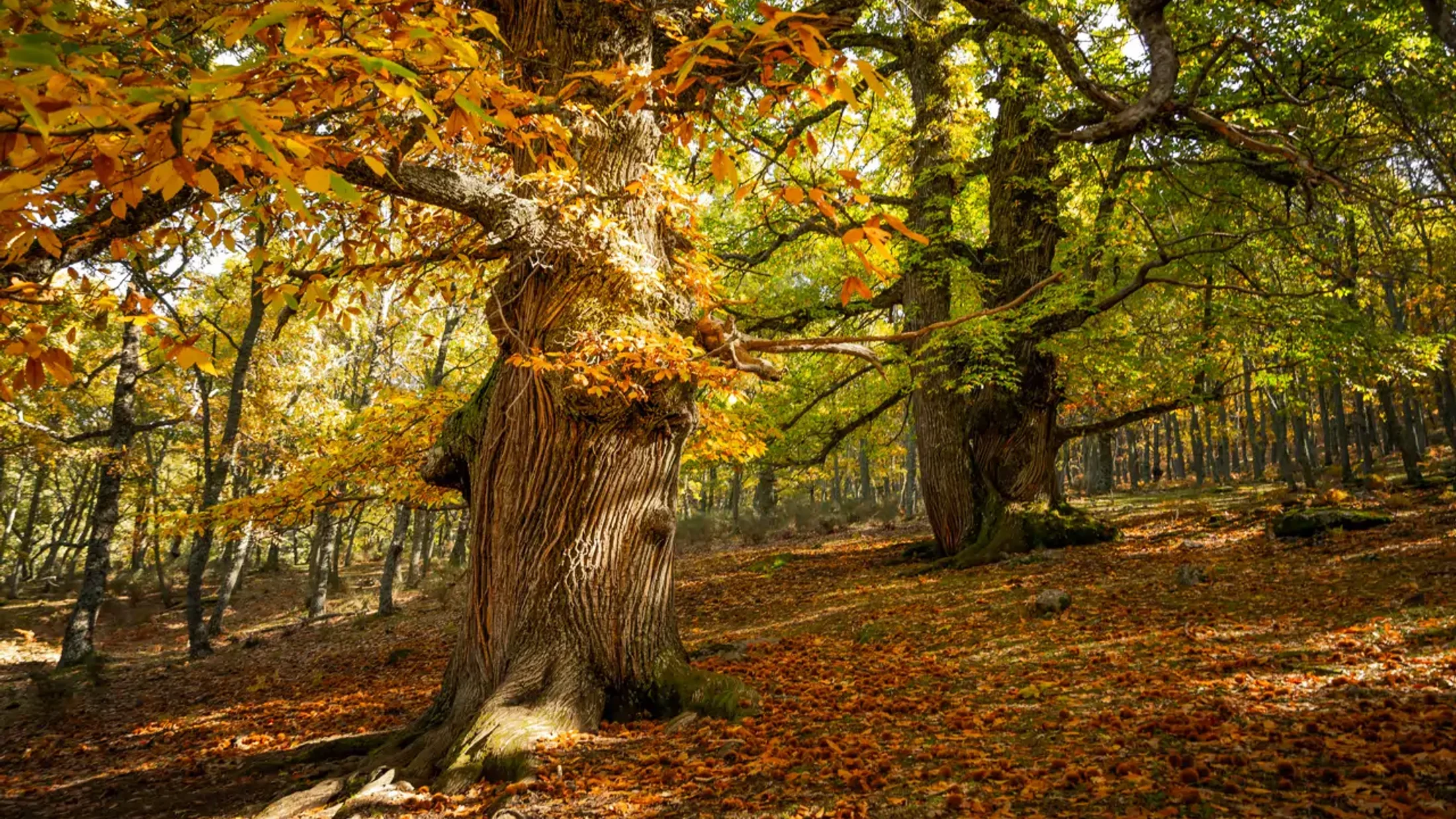
When the copper forest finds you
Ten autumn routes traverse Spain's sweet chestnut groves with history, well-maintained paths and villages that celebrate the traditional chestnut festival. Autumn doesn't last long, so this guide tells you when to go, where to start and how to move with respect through these forests.
There are alternatives for families and half-day hikes, designed for day trips, weekends and slow travel. An October day, among sweet chestnuts, amber light and the crunch of dry leaves and open purple sea urchins explain why it is worth it.
The proposal is simple: walk, observe and thank those who care for these landscapes.
Picuco te puede ayudar
Does something here catch your eye?
Tell us.
Write to us on WhatsApp or email: we answer questions, find the best options and help you sort out the booking.
Why autumn changes everything in the sweet chestnut grove
In autumn the sun goes lower and the sweet chestnut grove turns from green to ochre, from amber to red. The low light emphasises twisted trunks, stone walls and old terraces.
Walking in this season is a sensory experience: leaf litter crunches under your feet, Eurasian jays call and an occasional purple sea urchin falls with a dry thud. The temperature invites you to walk, the humidity revives mosses and mushrooms and the forest shows itself in calm, with copper sunsets and walks without heat.
Centenary sweet chestnuts are a refuge for biodiversity: hollows for birds, shade for ferns and food for wildlife. According to the National Forest Inventory 4 (MITECO, 2021), Castanea sativa maintains notable surfaces in the northwest and the west of the peninsula and sustains rural economies.
The calendar marks the magosto or chestnut festival, with different names depending on the valley but a common gesture: gathering and roasting chestnuts. Autumn hiking routes through these forests are more than exercise: they are a rite of passage between seasons.
Ten routes among sweet chestnuts by region
Castañar de El Tiemblo: the veteran of the Valle de Iruelas
Between Ávila and the Embalse del Burguillo, a millenary sweet chestnut grove grows with monumental specimens. One of them is "El Abuelo", a sweet chestnut with centuries behind it.
The classic path runs gently between walls, streams and clearings. It has low difficulty, with wide paths and some short slopes, and adapts to families. A gust moves the leaves and the forest responds like a chord; next to "El Abuelo" you can hear the constant rustle of leaves.
The best time is from mid-October to early November, when the forest takes on copper tones. In late autumn there is access regulation and a municipal fee: get up early and consult the Ayuntamiento de El Tiemblo. There is a high influx on weekends, so it is enjoyed more during the week.
Arrive from El Tiemblo via the signalled forest road and park your car in the designated areas of the sweet chestnut grove; in late autumn there is access regulation and a municipal fee. Upon finishing, the local gastronomy includes caldereta, migas and roasted chestnuts in season. In the area, calbotadas are celebrated, local variants of the chestnut festival. The nearby towns are El Tiemblo and Cebreros.
Sweet chestnut forest of Hervás: the golden heart of Ambroz
In Hervás, the sweet chestnut forest is explored on foot from the bullring, where you leave your car. You can visit both the forest and the town in the same morning.
The circular sweet chestnut forest route covers 8 km with 300 m of elevation gain. The difficulty is medium, with a marked path and stone sections. Along the way, you will see the sweet chestnut forest and Pyrenean oak formations in the high areas.
Light filters through mossy trunks and frames wooden bridges, with the sound of water nearby. Make time for the fragrant rockrose on the lower slopes.
If you go on a weekend, arrive early or at sunset to photograph with side lighting: the late-hour light enhances the yellows without blowing out the highlights. To take photos, bring a short focal length for forest interiors and a medium one to capture textures.
Arrive in Hervás on foot and leave your car in the outskirts' car parks. Nearby towns are Hervás and Baños de Montemayor.
O Courel: old mosaics under new mountains
O Courel, in Lugo, is synonymous with humid mountains and diversity. Mixed forest, limestone slopes, and centennial sweet chestnuts alternate with slate villages and old riverside groves on terraces. Tracks and paths lead to emblematic devesas, with the relief opening up into natural amphitheatres. The early morning mist settles like a cold handkerchief over the valley.
Here, autumn is Atlantic: fine rain, vibrant greens, changing skies; bring a raincoat and footwear with good grip. O Courel has been part of the UNESCO Montañas do Courel Global Geopark since 2019 (UNESCO, 2019), a recognition that highlights its geology and living heritage. Travel slowly: one afternoon at the Pico do Polín viewpoint compensates for any rush.
- Why special: devesas with old sweet chestnuts and a mosaic of habitats
- Difficulty: medium; moderate elevation gains and damp ground
- Best time: second half of October to mid-November
- Access: local roads LU-651 and tracks; check status after storms
- Nearby towns: Seoane do Courel, Ferrería Vella
- Sensory recommendation: inhale the smell of chestnut and smoke from the first village magosto
- Slow suggestion: combine autumn hiking routes with afternoons of reading in a rural house
Fragas do Eume: deep riverbank with ancient sweet chestnuts
In A Coruña, the Fragas do Eume Natural Park preserves one of the best-preserved Atlantic forests in Western Europe. Oaks, birch, and sweet chestnuts grow on a humid soil that remains green almost all year round.
The river path runs through the river valley between bridges, walkways, and banks covered in ferns up to the Caaveiro monastery. The forest brings together oaks, birch, and sweet chestnuts, in addition to more than 20 species of ferns and 200 of lichens.
The route has low to medium difficulty, with stairs on the river path near Caaveiro.
It is advisable to avoid the middle hours to enjoy the silence and the fauna, and to bring a light layer because the humidity is constant.
The most visited entrance is the one leading to the Caaveiro monastery, following the course of the river through the Ombre fishing estate, 10 km from Pontedeume.
On certain dates, access through the bottom of the valley is regulated: during high season, you must park in the designated areas and use the shuttle. Do not pick flora or leave waste, and always walk on the path. For photos, the walkway over the Eume and the views of the monastery are the most sought-after stops.
Sierra de Gata: sweet chestnut groves and squares that smell of firewood
In the north of Cáceres, the sweet chestnut groves of the Sierra de Gata remain tied to village life: here you walk among forests, fountains and wine presses. The region has chestnuts and honey in its recipes, and olive oil mills that process the local oil.
The GR-10 crosses the region and connects with local tracks; the Sierra de Gata section is linear, 104 km long and consisting of 14 stages, between Robledillo de Gata and Cilleros. It is advisable to avoid 13.4 km of the route through the municipalities of Perales del Puerto, Hoyos and Acebo due to a 2015 fire.
If you go with little ones, choose gentle sections: the difficulty is low to medium, with stone tracks and paths between walls. At sunset, touch a slate wall and feel the stored heat of the day.
The best time is from mid-October to early November. Ask about the chestnut festivals in nearby villages: there are communal roasts and music around All Saints' Day. Try the DOP Gata-Hurdes oil, a monovarietal extra virgin Manzanilla Cacereña, with bread and roasted chestnuts on the side.
Nearby villages are San Martín de Trevejo, Gata and Acebo. You can reach them via good local roads and there are signposted car parks at the entrances to the villages.
Ribeira Sacra: sweet chestnuts among hanging vineyards
Between Lugo and Ourense, the Sil and the Miño have excavated a escarpment where terraced vineyards coexist with groves of old sweet chestnut trees. In autumn, the yellows of the sweet chestnut mix with the vermillions of the vines.
The viewpoints of Pena do Castelo and Cabezoás are in the Ribeira Sacra. The vineyards of the DO Ribeira Sacra are distributed between the provinces of Lugo and Ourense, in Galicia.
Walk along short paths between vineyards and groves, always via public paths, and respect late harvests if they coincide. The difficulty ranges from low to medium, with sections of steep slope and stone surfaces: bring poles, because they help on descents over polished stone.
The second half of October is the best time. Alternate a morning of trekking with an afternoon in an ageing winery, and ask for seasonal menus with chestnut cream or bica. The local pairing is chestnut cake with young Mencía.
From Lugo, you reach the northern municipalities via the N-120 and LU-533 roads; from Ourense, the OU-0508 and OU-0605 roads lead to the starting points of the viewpoints route. Doade, Castro Caldelas and Parada de Sil are the nearby villages where to stop.
Bring your nose close to a red vine leaf and notice the earthy sweetness.
El Bierzo: generous groves and magosto squares
In El Bierzo, in León, autumn is prolonged: the valley's microclimate stretches the colours of sweet chestnut groves, vineyards and market towns. In squares and paths, the magostos fill the ground with purple sea urchins.
The difficulty ranges from low to medium, with wide paths and some climbs. Try a freshly opened roasted chestnut and feel the sweet steam on your fingers.
The Berciana chestnut has had a Guarantee Mark since 2001, which ensures that the fruit is harvested at its exact point of ripeness and meets legal and technical requirements. If you plan to pick chestnuts where permitted, bring thin gloves and always respect signs and property.
Park in the villages to ease the narrow tracks.
Montes de León and Babia: copper altitude on cold afternoons
On the lower slopes of the Montes de León and in the valleys near Babia, sweet chestnuts grow isolated and in groves that illuminate shaded areas and riverbanks. Above remain the high meadows, now without trees.
The thin, cold air and the frost that crunches under your boot at the start of the descent set the tone for the visit.
Choose half-day routes that combine low sweet chestnut groves with high panoramas. If you go with little ones, adjust the elevation changes. The difficulty is medium, with moderate elevation gain and irregular terrain.
Check the weather report before leaving: there are rapid changes, short days and slippery paths after frosts. Bring thermal layers, a hat, gloves, a headtorch and an offline map.
The nearest villages are Sena de Luna and Riolago. You arrive via mountain roads and it is advisable to park in the village to avoid tracks.
La Vera and Garganta la Olla: water, wood and old sweet chestnuts
In Garganta la Olla, the sweet chestnuts grow just steps away from the porticoed squares, among clear water gorges.
Garganta la Olla is surrounded by the Sierra de Tormantos, a foothills of the Sierra de Gredos, from which its name originates.
The freshness of the gorges perfumes the air and the murmur of the water accompanies your walk.
The difficulty is low and ideal for families, with stops by the water. The best time is from late October to November, when around All Saints' Day many towns celebrate their chestnut festival —magosto, calbotá or calbote depending on the valley— with roasts and stories. If it rains, the ground becomes slippery: bring poles and boots with deep tread for the descents.
Arrive via the EX-203 and local roads, with parking at the entrance of the villages. From Madrid, take the A-5 to Navalmoral de la Mata and then the EX-119 towards Jarandilla de la Vera.
Castañar del Paular (Rascafría): autumnal showcase near Madrid
The Castañar del Paular is in Rascafría, a stone's throw from Madrid, and in autumn the groves and poplar groves of the valley turn golden. Sweet chestnuts dot the edges near the Monasterio de Santa María del Paular and the nearby paths, between meadows, riverbanks and mixed woodland.
Autumn hiking routes through the valley, such as the walks towards El Paular and las Presillas, are gentle and family-friendly: low difficulty via tracks and wide paths. Park in designated areas and walk from the monastery.
To avoid crowds, arrive early in the morning or on weekdays and avoid bank holidays. Bring light clothing, because mountain shade cools down in the late afternoon. When you finish, enjoy chocolate and roasted chestnuts in the village when they are available.
You can arrive by bus 194 from Plaza de Castilla to Rascafría (check schedules). The nearby villages are Rascafría and Oteruelo del Valle.
The essentials for planning: seasons, rules and accommodation
The calendar is in charge: in the interior mountain ranges of Ávila, Madrid and Gata, the best time is usually from mid-October to early November. In high-altitude areas, the colours may arrive as early as the beginning of October, and in more southern regions at lower altitudes, the season extends until late November. Choose a two-week window and adjust it according to local reports.
Many chestnut groves regulate access in autumn with capacity limits, fees and traffic restrictions, and some prohibit gathering chestnuts. Others allow limited collection in communal lands for self-consumption. Ask at the town hall or the tourist office and pay attention to signs on-site. In protected areas such as natural parks and SCI sites of the Natura 2000 Network, specific regulations for paths, waste and fauna apply.
Before heading out, check municipal bulletins, park social media and provincial road notices following storms. On days of persistent rain, some paths close for safety. If the chestnut festival coincides with your trip, find out about closures and schedules.
In autumn, advance booking is required for Fridays, Saturdays, Sundays and public holidays. Between October and December, the fee is 6 € per car and 2 € per person. You can avoid the car fee by parking in the village and using the municipal bus, paying only 2 € per person.
Book rural accommodation in advance during peak weekends and confirm the cancellation and rain policy. Consider nearby alternatives in case the colours have not yet arrived or have already passed. Public transport operates in specific destinations, such as Rascafría or Ribeira Sacra with a pre-booked taxi or boat, but a car makes it easier to link viewpoints and villages.
Walk along the paths, close the gates, avoid loud music and bring a bag for your waste. Do not enter private estates without permission. If you participate in a magosto, ask about reusable cups and plates and, if you buy from stalls, prioritise the local producer.
A day, a weekend or a slow trip: easy templates
A chestnut grove is best enjoyed with a simple plan and some breathing room. These three templates are useful for a one-day getaway, a weekend or a slow trip of several days.
One-day getaway (6-9 h). Leave early and arrive at the first car park between 9:00-9:30. Take a main walk of 2-3 h, with a light picnic and a short nap in the sun. In the afternoon, a short walk to a viewpoint or the historic centre and a warm afternoon snack. Return before nightfall, with light on the mountain roads.
Weekend (36-48 h). On Saturday, an 8-12 km route through the chestnut grove, local food and a brief nap; in the afternoon, a market or museum, a magosto or a festival if it coincides, and an urban stroll. On Sunday, a short riverside route, a winery or a cheesery and an early meal. Keep your check-out flexible and return via a scenic secondary road.
Slow trip (3-5 days). Travel through two nearby regions, alternating days of hiking and heritage, with long post-meal conversations. Integrate partial public transport and local taxis, and book artisan visits (olive oil mill, chestnut grower, winery) to understand the craft.
For your autumn gear, bring waterproof footwear with a gripped sole and poles, a thermal layer, a lightweight raincoat and a hat. Add an offline map or track, a power bank and a headlamp, water, a flask with a hot drink and a salty snack, as well as a waste bag and a minimal first-aid kit.
Start with daylight and reserve 30-45 minutes of margin for unforeseen events. Watch out for wet leaves, slippery bridges and hunting on working days; use a high-visibility vest if there are nearby drives. Follow the markers and avoid shortcuts that erode slopes. Buy bread, cheese and fruit in the area to support the local economy.
In the middle of the grove, listen in silence for 60 seconds. After a brief shower, smell the damp bark.
Book your experience — discover active tourism activities in Spain with providers verified by Picuco.
Conclusion
Walking through a chestnut grove in autumn invites you to go slower: to look closely at the leaf, the trunk and the purple sea urchin, and from afar at the valley, the mosaic and the village. The colour of the forest is a living process that someone looks after with pruning, clearing and harvesting.
Count on two key weeks depending on latitude and altitude, and leave margin for rain. Choose marked routes, respect the regulations and bring basic equipment.
Connect with a territory that sustains biodiversity and culture and that welcomes those who give back care: a smile and a purchase at a local stall are also conservation. Before leaving, reread the ten proposed routes and confirm the access points; if it coincides, visit a chestnut festival. Upon your return, share your experience and your photos with respect for the privacy of the people and the places.