Why canyoning fits so well into a stag or hen party
A stag or hen party in the river mixes play, challenge and nature in a single day, and you don't need your own equipment. You jump into pools, slide down natural slides and descend with ropes, always with a guide and certified equipment.
In a group that is celebrating, the river levels the playing field: each person chooses the jumps according to their comfort and everyone moves forward together. The freshness of entering the first pool changes everything: goosebumps, the echo of voices and the green shimmer of the water under the sun.
To get it right, choose a canyon that fits the physical and technical level of the group, the season and the logistics. Difficulty is measured by the mandatory steps: rappels (controlled descent by rope), water flows and possible escapes.
If the group is beginner, look for itineraries with optional jumps and short rappels. If there is experience, aim for sections with verticals and finer manoeuvres. At a logistical level, value short access, proximity of accommodation and companies with daily departures in season.
Always check the AEMET forecast and, if there are rises in water levels, reschedule with the operator: safety comes before the plan.
The selection brings together seven canyons in Spain with good accessibility, capacity for groups, clear seasons and landscapes that work for any stag or hen party. The criteria are technical difficulty, accessibility (approaches and returns under 60–90 minutes), capacity for groups of 8–12 people, panoramic appeal, available operators and typical price range per person.
Each canyon includes location, best time, what to expect (jumps, slides, rappels), indicative prices and safety tips. It is necessary to book in advance.
The road references for "how to get there" are A-23, AP-2, A-92 and AP-9, with approximate times from key cities. Reliable cartography is at the Instituto Geográfico Nacional, and regulations and water flows depend on the Confederaciones Hidrográficas and natural parks.
Picuco te puede ayudar
Does something here catch your eye?
Tell us.
Write to us on WhatsApp or email: we answer questions, find the best options and help you sort out the booking.
7 canyons for an unforgettable canyoning stag or hen party
Sierra de Guara (Huesca): variety, service and unique landscapes
The Sierra de Guara is in Huesca, with Alquézar, Rodellar or Bierge as the usual base. Formiga is the dynamic initiation, Peonera the aquatic and playful one, Mascún the long and scenic one, Oscuros de Balced the sinuous and aesthetic one, and to these, the medium Alcanadre is added.
Formiga is a conglomerate canyon in the Panzano area. It has a section of aerial path with a safety cable until the first rappel, and the return to the vehicle takes only a few minutes. It accepts an approximate age from 7 years, depending on the child's conditions and profile, and costs from 65 € per person, with guide, technical equipment and insurance included.
Mascún asks for more: medium-high level, a long day of 7–9 h and an approach of 2h 45 min. You need good physical fitness and it starts in Rodellar. Peonera is of easy-medium level and about ~6 h total, counting approach and return.
If there are more of you, you are divided into subgroups with several guides. The best time is from May to September, depending on water flows and regulations of the Parque de la Sierra y los Cañones de Guara.
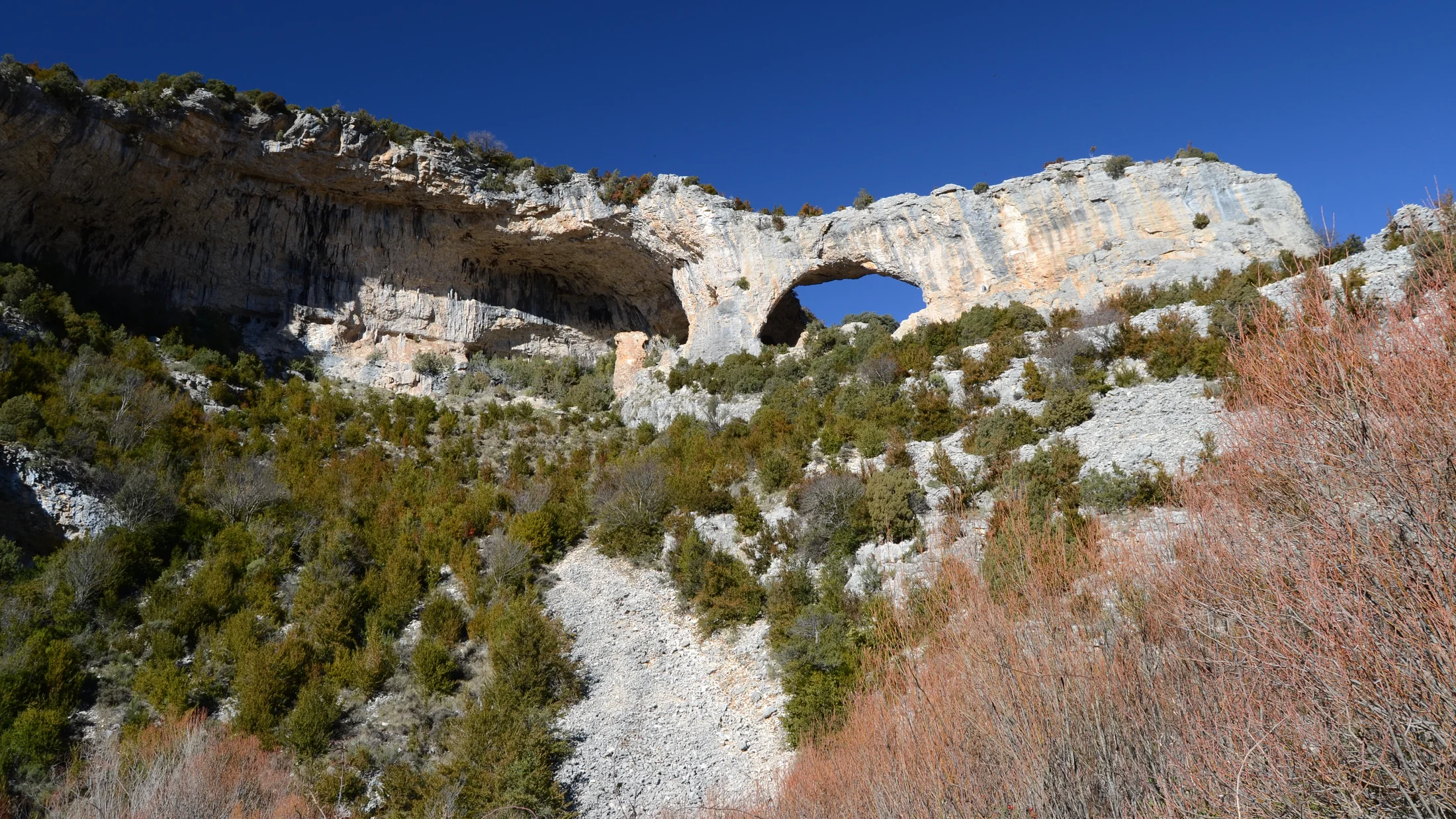
A moment is enough for the light to filter into a narrow corridor and paint the limestone wall amber.
During the season, local companies with TD2/TD3 guides and federative qualifications operate daily; ask about insurance and approved equipment (EN12492 helmets, 5 mm wetsuits). If the stag or hen party is mixed, Formiga or Peonera combine play and landscape without excessive technique.
The usual base is Alquézar, Rodellar or Bierge. Book in advance if you are going on a weekend. More information about the Canyons.
Río Verde (Granada) and base in El Chorro (Málaga): sun, clear water and Andalusian rhythm
Río Verde, in Otívar (Granada), is one of the star descents in Andalusia: emerald pools, polished slides and chained jumps in the Parque Natural de Sierra de Tejeda, Almijara y Alhama. The sun makes its way through oleander and the green surface of the river sparkles like molten glass.
The classic section has medium difficulty and a total duration of 4–6 h. There are optional jumps, natural slides and rappels, with clear water and deep pools. If you are looking for more adventure, the integral section extends the descent.
The approximate prices are 45 € per person for the family section and 85 € per person for the integral one. The minimum age is 9 years for the classic section and 11 years for the integral one.
Each guide takes between 8 and 10 people, and larger groups are staggered. We work with specialised companies and approved equipment, and it is advisable to confirm permits and capacities in high season. Book in advance.
El Chorro, in the municipality of Álora, has a train station that connects with Málaga and Sevilla. In the Málaga surroundings, there are also easy-medium level descents for initiation. To sleep, look at coastal apartments in Almuñécar/La Herradura or rural houses in the Valle Tropical; in El Chorro, adventure houses and hostels abound.
If you want a quiet party after the activity, dine on the coast and sleep in the interior: you will have silence and better temperature.
Marc Canyon (Catalan Pyrenees): Pyrenean, technical and very photogenic
The Marc Canyon is in Auzat (Ariège, French Pyrenees), at the foot of the Montacalm massif. It is a technical descent with bursts of rappelling, cold corridors and clean pools, and it is perfect for daring stag or hen parties or for experienced groups accompanied by a guide.
The difficulty is medium-high and the descent lasts from 2:30 to 3:00 h. Due to its technical character, it is recommended to go in groups of 6–8 people per guide.
The indicative price is around 60–95 € per person. Check availability and the required level with the operator before closing the date.
The best time is summer and late spring, when the snowmelt subsides; check the flow rates after storms. Expect enclosed waterfalls, some unblocking and occasional jumps, with fresh water even in August. The cold roar of a waterfall envelops the conversation and the rock exhales a damp scent of moss.
The minimum age is 12 years and the activity starts at 10:30 h. Prioritise qualified guides and a tight ratio, and bring extra warm equipment (5/7 mm neoprene). It is not a canyon for beginners, but it motivates fit groups with technical curiosity.
To sleep nearby, there are rural houses and mountain hotels in Pyrenean valleys (Ripollès, Cerdanya, Alt Empordà interior).
Melón Pools (Ourense, border with Pontevedra): aquatic, fresh and for everyone
The Melón Pools are a natural aquatic circuit with a granitic aesthetic, famous in Galicia for its jumps and slides. It is perfect for stag or hen parties that prioritise water, play and accessibility.
The route lasts between 1.5 and 2.5 h.
The circuit links pools, with optional jumps, small slides and short rappels if the operator includes them. The water smells of wet stone and gum, and the air brings a freshness that clears any hangover.
Wear a thin thermal layer under the neoprene if you are sensitive to the cold: in Galicia, it is appreciated even in August.
There are companies with regular departures in summer. Stay attentive to the flow rate after the rains and check the regional warnings. The indicative price is 45–70 € p.p., so it is advisable to confirm the season and flow rates with the operator.
Access is not suitable for people with mobility problems and baby seats cannot be taken. The parking area fills up quickly in summer, so arrive early.
The pools are in the municipality of Melón, Ourense, on the border with Pontevedra and next to the A-52: about 40–50 min from Ourense and around 1 h 15 min from Vigo. To sleep, there are rural houses in Ribeiro and on the Rías Baixas coast less than 1 h away, and you can combine wine tourism and the sea.
Pedroso Canyon (La Rioja): less crowded and with a mountain flavour
The Pedroso canyon, in La Rioja, is a less crowded option for a canyoning stag or hen party: the descent takes place through the interior of a beech forest. It combines rappels, drops, some short slides and clear pools, with pleasant walking sections through the forest. The difficulty is easy-medium.
The meeting point is in Baños de Río Tobía and the approach to the starting point is made by van. There are two requirements: knowing how to swim and being at least 10 years old. The scent of pine and rockrose envelops the approach path while the water laps against the pebbles.
It is advisable to monitor the flow rates after snowmelt or rain (Confederación Hidrográfica del Ebro). Local guides know the escapes and volumes, so ask about the cancellation policy due to weather before booking.
To sleep, there are rural houses in the Iregua and Najerilla valleys, and you can combine the descent with a visit to DOCa Rioja wineries. The perfect plan: descent in the morning, lunch in a Riojan grill and an afternoon in a winery without rushing. From Logroño, it can be reached in 45–60 min via the LR-250.
Navarrés (Valencia): mild climate and simple logistics from the city
The Navarrés region, in the interior of Valencia, brings together accessible ravines and a pleasant climate. It is an option for mixed stag or hen parties looking for moderate adrenaline and, if desired, an urban night.
The descents are of easy-medium difficulty, with jumps, short slides and playful water passages. A warm perfume of thyme and hot slate accompanies the murmur of the irrigation channel under the poplars.
To get down to Al Gorgo de la Escalera, you go down a steep staircase of 136 steps from the parking lot, and the maximum capacity is 350 people. Entry costs €2.00 (from 4 years old) and is paid at the entrance, preferably by card; swimming is at your own responsibility and the area has no lifeguard.
To sleep, you have rural houses in the Canal de Navarrés and hotels in Valencia, a good combination for a mixed beach and city plan. Before booking, confirm with the company if specific footwear is included or if you need to bring trainers with grippy soles.
The Navarrés, Anna and Quesa environment is 60–80 min from Valencia via the A-7 and the CV-580.
Cazorla Natural Park (Jaén): vast landscapes and multi-adventure
The Cazorla, Segura y Las Villas Natural Park is an immense massif where water has opened gorges between limestone rock walls. For a large group looking for nature and good infrastructure, it is a safe bet.
There are more technical sections depending on the flow and the guide. In summer, avoid the middle hours of the day.
Operators work with several guides for groups of 12–18 people divided by levels. The indicative price ranges from 30 to 65 € per person, and it is advisable to verify the permits and capacities of the Natural Park.
During the descent, short and medium rappels, green pools and narrow sections await you, with a return path between pine forest and cliffs. The scent of resin and the song of Eurasian chaffinches accompany the green course of the water between the clear slabs.
Choose guides with experience in variable flows and ask if they include a photo report and an extended first aid kit. To sleep, there are rural hotels and houses with capacity for groups, with mountain gastronomy to regain strength. Complete the stag or hen party with via ferrata, kayaking in a reservoir or a 4x4 route through the park's viewpoints.
Location map and how to make the most of it
Seven canyons spread across the peninsula and the Pyrenees fit into a single map. Save it before you leave: mobile coverage fails at the bottom of a canyon.
To give you an idea of travel times, Barcelona is 3 h 15 min from Guara, Valencia is 1–1.5 h from Navarrés, Vigo is 1 h from Melón and Granada is 2–2.5 h from Cazorla.
El Chorro (Álora) has a rail connection with Málaga and Sevilla via the El Chorro-Caminito del Rey station. Pedroso is located 27 km from Logroño and 224 km from Madrid.
To prepare for the day, Google Maps gives you times and tracks for access to the parking lot, IGN Maps provide topographic cartography and contour lines, and the custom SVG maps are useful for printing a pocket version with the day's plan. Design a base with central accommodation and short transfers to the starting point. Print a sheet with the road codes (for example A-22, A-7, AP-9) and the guide's contact numbers.
How to choose the perfect canyon for your stag or hen party
Before looking at photos of jumps, look at your group's real level. If there are people who have never worn a harness, look for an itinerary with optional jumps, short rappels and a clear return. If several people already have experience, increase the difficulty by one point.
Spring and summer bring milder flows and temperatures. Check the AEMET forecast and the warnings for the corresponding park before closing the date. If there is marked vertigo in the group, avoid long verticals; if you all do sport weekly, you can include medium rappels.
With 10–14 people, choose wide and playful canyons to flow without bottlenecks. The typical budget is around 45–95 € p.p. depending on the area, duration and guide/group ratio, so ask about group discounts. Prioritise access via local roads in good condition and signposted parking lots, and look for accommodation <30 min from the meeting point to reduce delays.
After heavy rains, it is better to reschedule: canyons rise quickly. Book with guides with official qualifications, civil liability and accident insurance, and approved equipment (harness, descender, helmet, wetsuit). Some canyons require a quota or prior communication: confirm this with the operator.
Before booking, confirm the date, the meeting point and the time window with the guide. Also validate the level, the minimum age and if there are mandatory jumps. Ask for the list of included equipment and what you must provide: trainers with grippy soles, swimwear, water and a snack. Check the cancellation policy for weather and flow changes.
Group logistics are organised before leaving. Share an offline map and contact numbers in a common chat. Appoint one person as the contact point with the operator and divide the group into sub-teams with people responsible for pace, photos and the sweep car.
Define a nearby plan B, such as a gentle route or a long meal, in case the flow rises. Carry a basic first aid kit in the car and spare clothes for everyone. Park without blocking farms, pick up waste and consume in local businesses: the valley's economy sustains the paths you enjoy.
Frequently asked questions
Is it cold in the canyon water?
The water in the canyons is cold, but with a suitable wetsuit and short breaks, the body warms up.
What level does the group need for canyoning on a stag or hen party?
With an initial level, you can choose easy-medium canyons, with optional jumps and short rappels of 8–12 m. This way, the group moves forward without anyone being left behind.
If several people in the group have experience, ask for a medium section and a tight ratio. The pace will be more agile and the guide will be able to better attend to whoever needs it.
Sincerely declare any injuries or vertigo of the participants. That information helps to choose the canyon and to prepare alternatives in the most exposed steps.
Can minors participate?
It depends on the canyon and the operator. It is usual that they can join from 12–14 years old, with a minimum height of ~1.45 m and parental authorisation.
Before booking, confirm the age, height, and wetsuit size of each minor in the group with the company.
What does the activity include and what should I bring?
The company usually provides the technical equipment and the guide; you only have to bring your clothes and your desire to get wet. The activity includes a qualified guide, helmet, harness, descender, wetsuit, neoprene boots, and insurance.
For the day of the descent, bring trainers with good soles, a swimsuit, water (0.5–1 l), an energy snack, and a towel or dry clothes for afterwards. Ask beforehand if the activity includes photos: that way you will know if you can leave your mobile in the car or not.
What is the cancellation and safety policy?
With high water flow or a storm, the guide may cancel the activity or change the canyon: safety comes first. Before booking, check the refund deadlines and the planned alternatives in case of cancellation.
Follow the guide's briefing: jumps are never done headfirst, you must check the depth and wait for the order to jump.
How much does it cost and how do I book?
The typical price for group canyoning ranges from 30 to 95 € per person. The figure changes depending on the area, the duration of the activity, and the size of the group.
Book in advance, especially in high season. The sooner you close the date, the easier it will be to adjust the canyon and the schedule to your group.
Can it be combined with other activities?
Yes. Canyoning fits into a day with via ferrata, kayaking, gentle rafting, or a short hike. In areas such as Cazorla or El Chorro, there is multiaventure and catering adapted to groups.
To make everything fit, plan the transfer times and meals before booking. This way, the activities fit into the day without rushing and the group arrives at each one with margin.
What happens if someone does not want to jump?
In most descents, jumps are optional and there are rope or bypass variants. The guide indicates the safe line and the alternative for those who prefer not to jump.
Book your experience — discover active tourism activities in Spain with providers verified by Picuco.
Conclusion
A canyoning stag or hen party works because it is shared, adaptable and alive: water, rock and a group in motion. Each canyon has its own character, and that is the charm of choosing well.
The Sierra de Guara offers variety and service; the Río Verde, colour and climate; the Cañón de Marc, technique and Pyrenean drama. Melón provides Atlantic freshness, Pedroso mountain calm, Navarrés easy logistics and Cazorla vastness and multi-adventure.
Choose by level, season and budget, and let a qualified guide set the pace. If you are torn between two options, prioritise safety and accessibility.
Before going, confirm dates, check the forecast, book with a verified operator and share the checklist and the map with your group. Bring suitable equipment, respect capacity limits and the environment, and support the local communities that look after these landscapes.