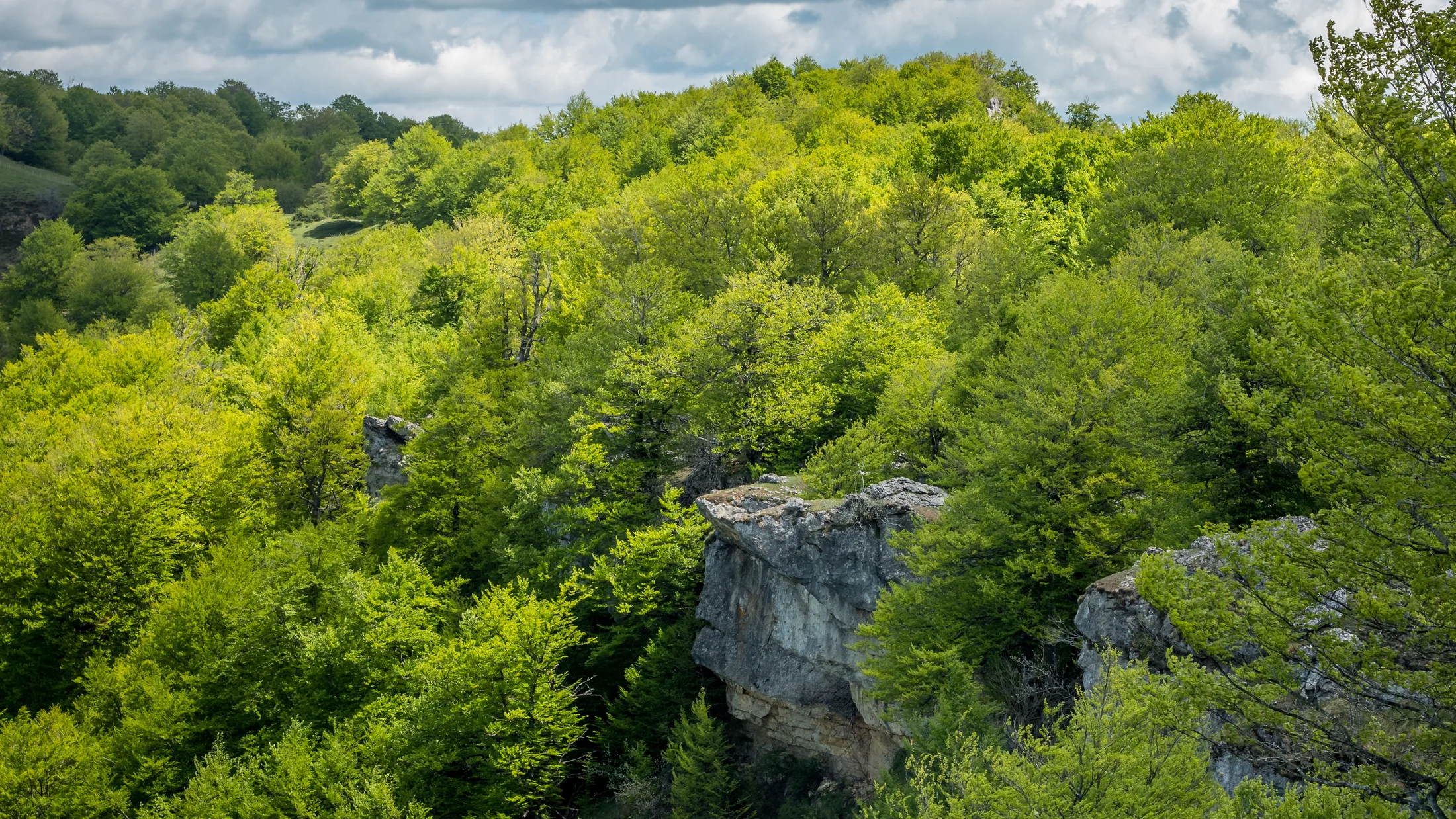
Sunrise among beech forests: the moment that changed my map
I arrived at the beech forest before sunrise, with low mist, after a few days of coastline and waves. A gust of cold air smelled of wet leaves and freshly cut wood.
This first walk opens this section on the Basque Country interior. Here I combine storytelling and concrete data so that you can plan rural routes through Euskadi: times, elevation gains, access points and alternatives if it rains.
The idea is for you to head out the next day, at your own pace and with respect for the environment. Depending on what you are looking for, the interior offers you one thing or another.
If you seek calm, you have shaded walks and long post-meal conversations. If you want to learn, there are small museums, sanctuaries, cheesemakers and wineries with centuries of history. If you enjoy detail, notice the frontons, the bilingual place names and how people are greeted when arriving at the bar.
Picuco te puede ayudar
Does something here catch your eye?
Tell us.
Write to us on WhatsApp or email: we answer questions, find the best options and help you sort out the booking.
Why choose the interior when everyone looks to the coast?
The Basque interior has U-shaped valleys, humid beech forests and clear summits with fewer people than the coast. The relief distributes the climate: rainy and cool Atlantic basins in the north, and to the south the Rioja Alavesa, with Mediterranean influence and more hours of sunshine. A large part of the northern interior exceeds 1,000 mm of annual precipitation, and that is where the exuberance of its forests comes from.
For adventure on the Cantabrian coast, the adventure tourism guide in northern Spain covers surfing, kayaking and hiking from Galicia to the Basque Country.
The landscape changes a lot from one side to another. In the north, you will see beech forests and oak groves, with high humidity and frequent mists; in the south, vineyards, holm oak and a drier climate. In the mountain ranges, Aralar and Aizkorri offer limestone, high meadows and 360° views. Aizkorri holds the three highest summits in the Basque Country and the San Adrián Tunnel, a historic pass beneath the Aitzkorri peak. Aralar has a karst landscape with lapies, dolines, shafts and caves, and is a Special Area of Conservation (SAC).
A cold breeze brings the smell of black earth and sweet chimney smoke.
The pace is also different. The interior maintains rural customs: weekly markets, small workshops and festivals linked to the agricultural calendar. On the table, you will find more legumes, mushrooms, game and slow-cooked stews, with Idiazabal cheese as the flagship.
In practice, routes and viewpoints have fewer crowds, especially outside of public holidays, and parking is easier. In high season, prices are somewhat more contained than in the coastal strip; confirm updated rates and availability before booking.
If you want to combine the interior and the coast, alternate days of sea and valley, and book a sunrise on a summit and a sunset in a vineyard.
The essentials for planning your inland getaway
The weather sets the pace for the Basque Country interior: choosing the right season and preparing your logistics with plenty of time can make or break your getaway. Autumn (Oct-Nov) brings beech forests in full bloom and intense colours, with shorter days and more frequent rain; it is the season for forests, photography and medium-length routes. In spring (Apr-May) the streams flow with high volume, the meadows are in bloom and temperatures are mild: a great time for valleys and waterfalls.
In summer (Jun-Aug) there are long days and moderate heat at altitude, with more heat in Rioja Alavesa. Head out early for the summits and reserve the afternoons for villages and wineries. In winter (Dec-Feb) the peaks are windy and it may snow in the mountain ranges: choose low-altitude routes and thermal gear, with the chance of clear skies.
A car gives you maximum flexibility for valleys and trailheads. Local roads are narrow: drive slowly and yield to tractors and livestock. To reach the start of routes, combine bus and local taxi or walking sections, and confirm schedules on public holidays. You can also move around by electric bike through gentle valleys or book group transfers, checking availability in advance.
Rural houses and agrotourism offer rooms with breakfast, a family atmosphere and route advice; they are usually located in active farmhouses, so please respect their rest hours. Guesthouses and small village hotels are practical for walking out to dinner and shopping. Hostels and mountain refuges are budget-friendly options near the mountains: confirm opening times in winter. Prices vary by season, so check options and updated availability on Picuco.
For more options, consult the guide to mountain refuges to stay in during summer.
Bring waterproof boots, a windbreaker or rain jacket, a headlamp and a basic first-aid kit. Add an offline map and GPX tracks if you navigate using an app, and some cash for bars or farmhouses without card machines. It smells of fresh moss when you leave the asphalt and step onto a damp trail.
- Day 1: Valley and forest
The first day is for settling in and getting into the rhythm of the valley without rushing. Arrive at your accommodation and check in calmly: the rest of the day is on foot.
In the morning or after lunch, take a short 2–3 h route through a beech forest. It is a gentle walk, good for stretching your legs after the journey and for seeing how the light filters through the trunks.
Leave the afternoon to wander through the village and have an early dinner, between 20:00 and 21:00. This leaves you room to rest and head out the next day feeling refreshed.
- Day 2: Panoramic summit
The second day starts early: climb to the summit to watch the sunrise if the weather holds. If the sky doesn't cooperate, change the plan for a medium-length route along the hillside for 4–5 h.
After walking, a short nap and a visit to a museum or a local producer will complete the day. Book your visit in advance if you want to be attended to at a time that suits you.
- Day 3: Culture and vineyard
The third day slows down: an urban stroll through the historic centre and a responsible tasting, with lunch and a return trip in daylight.
It is best to have three plans in mind. Plan A is the summit, Plan B is the forest and Plan C is the village and the winery. The weather decides for you and any of the three is equally enjoyable.
Respect closures due to hunting or livestock on the routes: these affect access and change the day's plan.
Routes that never fail in valleys, beech forests and summits
Three routes combine atmosphere, history and views, with simple logistics to avoid surprises. Choose one per day and leave room for a casual encounter in the bar or in the square.
The damp shade of the trees smells of sweet leaves and washed rock. The details for each proposal help you decide according to your energy and the weather forecast.
In the mountains, keep a cool head and firm boots.
Baztán Valley: paths between farmhouses and living beech forests
Baztán is a wide and green valley in northern Navarra, with red-roofed farmhouses and terraced meadows.
The departure is from Erratzu or from the neighbourhood of Gorostapolo, in a valley of Basque culture although administratively Navarrese. A scent of crushed fern and damp wood accompanies the arrival at the waterfall.
The Erratzu–Xorroxin–Erratzu circular route measures 7.4 km, with 150 m of elevation gain and about 2 hours. The signage is clear and combines sections of tracks and paths. During the rainy season there may be mud or slippery areas, and a section of carved stairs makes it out of reach for walkers with crutches.
Spring and autumn are the best seasons: the flow in spring and the colour of the beech forest in autumn. Bring waterproof footwear and be careful with the wet rocks in the final pool. If the river is high, change the plan for a stroll through Elizondo and the climb to nearby viewpoints.
Park at the entrance of Erratzu, between the first houses, and arrive early.
Irati Forest: total immersion in the beech-fir forest
The Irati Forest is one of the most extensive beech-fir forests in Europe: about 17,000 ha. Its network of tracks and paths allows you to choose circular routes of low difficulty, also suitable for children.
You enter via Ochagavía (Salazar) or via Orbaizeta (Aezkoa). From Pamplona, you reach Ochagavía via the A21 with exit 35 towards Lumbier, the Na 178 to Ezcaroz and then the Na 140; to Orbaizeta, via the A21 to Aoiz or the Na 150, continuing via the NA 172 and NA 2040 to Arive.
The Irabia reservoir circular route starts from Casas de Irati: 10–12 km, easy-moderate, with wide tracks and correct signage. Your steps are cushioned by the carpet of leaves and the silence is only broken by a distant woodpecker.
Access to Irabia is regulated from the Mendilatz diversion, passing through the Arrazola customs, and you need authorisation to pass with a vehicle via the paved road. Next to the Casas de Irati information booth there is a paid car park: arrive early or enter through the less crowded access and avoid 11:00–14:00.
From the Royal Munitions Factory of Orbaizeta, marked paths of 6–9 km, 2–3 h and easy difficulty depart, with industrial history and forest in the same day. Fog is frequent and coverage is irregular, so bring a compass or offline map and confirm the condition of the bridge at the end of the reservoir before going.
Respect the reserve areas and the marked hunting drives in autumn. The GR-11 crosses the area and can be used to create linear variations.
Txindoki (Larrunarri): classic summit with endless views
Txindoki, also called Larrunarri, rises to 1,346 m above the Larraitz valley. It is a summit very beloved by locals and a good first peak for those coming from the coast looking for the horizon.
The normal route starts from Larraitz and is direct and panoramic. If you want more high mountain options in Spain, the high mountain trekking guide gathers proposals for all levels.
It covers 9–10 km round trip and 4–5.5 h of walking. The terrain combines meadows, limestone paths and stony sections near the summit. The difficulty is moderate due to the elevation gain and the final slope; in dry conditions, it is not technical. Avoid it during blizzards, ice or dense fog.
Wear boots with firm soles, a windbreaker, thin gloves and a headlamp if you head out at night. Experienced mountaineers have a circular variant via Muitze, which is wilder.
Sunrise or sunset are the best moments. Calculate your times with a margin and do not descend at night if you do not know the terrain well. There is parking in Larraitz, and it fills up early on weekends. Check the weather report (AEMET/Euskalmet) and respect pasture closures.
The air at the summit smells of hot stone and wool drying in the sun.
Villages and encounters where Basque culture beats
In the interior of the Basque Country, the villages are a school of landscape and social interaction: you learn how to greet, how to listen to stories and how to ask calmly. The smell of freshly baked bread spills through narrow streets and small squares.
Instead of an infinite list, this section proposes three names that converse with each other: heritage, wine and myth. Together they form an intimate mosaic of hidden villages in Euskadi, to visit without haste and with time to chat.
Arrive with respect and you will take home more than just photos.
Oñati: Renaissance stone and daily life
Oñati occupies a sheltered Guipuzcoan valley, with Renaissance heritage and a tranquil pace of daily life. The University of Sancti Spiritus, from the 16th century, has a Plateresque facade, and the historic centre adds courtyards, shields and stone streets.
The Sanctuary of Arantzazu overlooks the cliffs of Aizkorri-Aratz and combines avant-garde design and devotion. From there, paths depart towards the Urbia pastures and the Aizkorri ridge. If you want to walk with a clear path, take the Route of the Three Temples (GR-120) between Loiola and Arantzazu, passing by the Hermitage of the Antigua.
The Arrikrutz Caves preserve paleontological finds such as remains of woolly rhinoceros, giant deer, cave bear bones and the most complete lion skeleton in the peninsula. It is advisable to check opening times according to the season. Inside the temperature is 10ºC, animals are not allowed, and you must arrive at the Interpretation Centre 15 minutes before the guided tour; the centre is 200 m from the car park.
To eat, there are inland cuisine bars with beans, seasonal mushrooms and Idiazabal cheese. There is cider by the jug in season and young red wine from the area. Local hours are from 13:30 to 15:30 for lunch and from 20:00 to 22:00 for dinner.
An aroma of firewood and roasted coffee accompanies the walk through worn-out arcades. Always ask before photographing people, farmhouses or animals, and check with the local office for short routes to the river or hermitages.
Laguardia: vineyards, walls and underground cellars
Laguardia sits on a hill, with stone streets and remains of its ancient wall. It is the capital of Rioja Alavesa and the landscape opens to the south with vineyards, while to the north it is protected by the Sierra de Cantabria.
Beneath the houses, a labyrinth of calados is preserved, excavated cellars that maintain a cool temperature all year round. The scent of ripe grapes and warm stone rises from the calados on a still afternoon.
In the clock of the Plaza Mayor, the automata come out to dance at 12:00, 14:00 and 20:00.
To eat, look for stews, roasts and seasonal riverbank vegetables, and order local wines by the glass. Leave your car in the outer car parks: the old town is pedestrianised and narrow, and Laguardia is 64 km from Vitoria.
Do not enter private vineyards without permission and avoid loud music. Laguardia fits perfectly as a morning of wine and heritage between hiking days through the Basque Country interior; towards the south, the active tourism guide in La Rioja adds wineries, routes and heritage beyond Rioja Alavesa.
Zugarramurdi: caves, legends and border meadows
Zugarramurdi is in northern Navarra, very close to Lapurdi, and joins landscape and myth in the same stop. Its caves, large and without stalactites, form a tunnel of meadow and rock with an open-air underground river, a setting for witchcraft legends.
The cave is about 500 metres from the town centre. The visit has low difficulty and lasts 60 min. Inside, the cavity measures 120 m in length, with a width of between 22 and 26 m at the eastern end and 12 m at the exit, and an average height of 10 to 12 m. In the twilight, it smells of dampness and trampled grass.
The Witches Museum occupies the town's former hospital, founded in 1788, and provides historical context to the trials of the 16th-17th centuries. It is advisable to book online to guarantee access. On the third floor is the art installation ORO/TOTALIDAD by Agurtzane Anduetza. If you visit a second resource, you get a €1 discount on the entrance fee.
You can link up with the Urdazubi/Urdax caves by footpath and complete a day of nature and culture. The border towns of Lapurdi are just a few kilometres away.
Wear footwear with good soles: the rock is polished and damp. In high season, enter first thing in the morning or at the end of the day. Respect the meadows and livestock: close the gates and keep dogs on a lead.
Travelling with sense: sustainability and respect that add up
In the interior, the paths pass by orchards, livestock use the same mountain passes, and the bars thrive on the balance between visitors and locals. Being a good guest is part of the trip.
The cold morning air tastes of freshly cut grass and clean silence. To enjoy it, plan according to the real weather: with dense fog or strong wind, descend in altitude and look for forest or village.
Walk along marked paths: you avoid erosion and crops, and do not take shortcuts through wet meadows. Manage your waste, because everything that goes in comes out, including wipes, peels, and cigarette butts. Use the marked public fountains and do not wash dishes in the streams.
Respect rural life: always say hello and ask permission to photograph people or estates. Close the gates and keep dogs on a lead near the flocks. Park only in designated areas and do not block agricultural roads.
Consume in village shops and markets: that basket sustains the bar and the bakery. Prioritise producers with a local seal for cheeses, wine, and vegetables.
Move in a more sustainable way: combine train or bus to the termini with a shared car to the start of the route, and consider an e-bike to travel through the valleys. Avoid saturating car parks on peak days. During harvest and transhumance, inform yourself about restrictions and be flexible. Respect the neighbours' rest: avoid nocturnal noise and loud early mornings.
Book your experience — discover active tourism activities in Spain with providers verified by Picuco.
What I took with me and what I propose to you to get started
Waking up early pays off, a Plan B under a beech forest saves the day, and a greeting in the shop opens doors. Those are the three lessons I brought back from the Basque Country interior.
It is worth giving yourself some margin, studying the profiles before setting off, and accepting changes on the go without frustration. Before climbing Txindoki, check the wind report: if it is not cooperating, postpone without regret and head down to the valley.
The mistakes that cost the most are underestimating the weather, rushing the light, and improvising parking. The wind rules the mountains, so check radars and warnings. Arrive early at the car parks and respect local spaces: the countryside is a place of work and is experienced with respect.
Carry a bin bag and pick up whatever you see on the path. Learn two or three words in Basque, such as "egun on" (good morning) and "eskerrik asko" (thank you). And ask at the bar for a short afternoon route: local advice refines the map.
To get started, choose one of the three routes according to your level and the forecast for the week. Book a night in a rural house half an hour from the starting point and prepare boots, a waterproof jacket, a headlamp, and an offline map. With the rule of three, you have a perfect trip: a valley, a beech forest, a summit.
The smell of garlic soup and damp wood still returns when I close my eyes.